













TL;DR:
- Flamenco guitar setup involves precise adjustment of neck relief, saddle height, and nut height to optimize responsiveness for aggressive techniques. Achieving proper action ensures clarity, attack, and tone, especially at lower heights suited for flamenco’s percussive style. Correct setup order and proper tools are essential for a stable, responsive flamenco guitar.
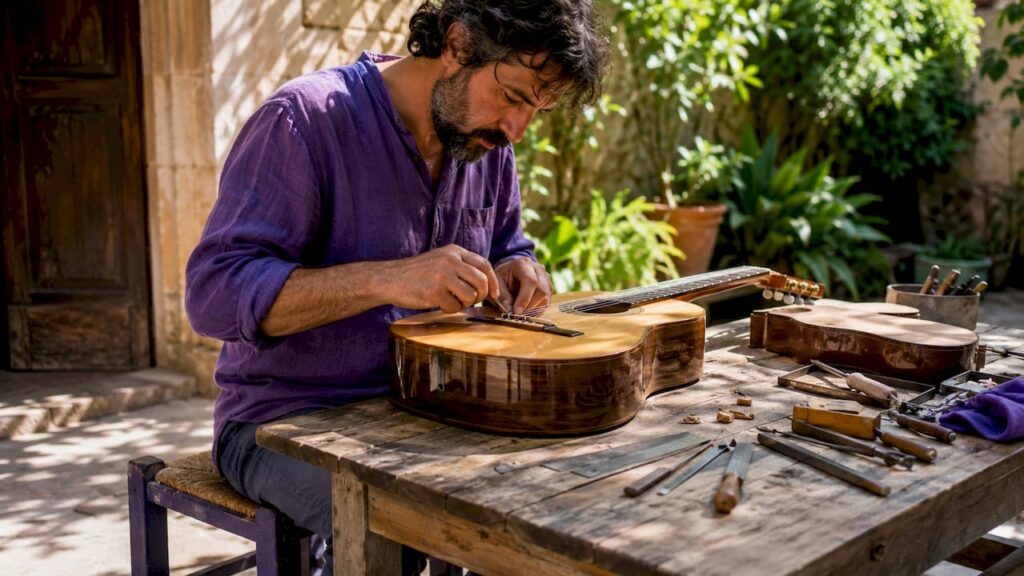
Flamenco guitar action setup is the process of adjusting string height and guitar components to maximize an instrument’s responsiveness and tone for flamenco playing. Get it wrong and you lose the pegada, that sharp, percussive attack that defines the art form. Get it right and techniques like rasgueo, picado, and alzapúa feel effortless. This guide walks you through every step, from measuring neck relief to filing nut slots, using the same systematic workflow professional luthiers follow. You will need a precision action gauge, a capo, a tuner, and patience.
What makes flamenco guitar action setup different?
Flamenco guitar action is more demanding than classical guitar action because flamenco techniques require precise, immediate string response. Too much height kills attack speed. Too little causes trasteo, the unwanted fret buzz that ruins a clean picado run.
The numbers tell the story clearly. Traditional flamenco guitars measure approximately 3.0mm on the bass side and 2.5mm on the treble side at the 12th fret. Classical guitars typically run higher, often 3.5mm to 4.0mm on the bass side. That half-millimeter difference is enormous when your right hand is driving aggressive rasgueo strokes.
Construction explains why flamenco guitars can sustain lower action. Flamenco instruments use lighter bracing and thinner tops, which produce faster vibration response and more natural resonance at lower string heights. Classical guitars, built for projection in concert halls, need higher action to avoid choking their sustain. You can read more about these flamenco vs. classical differences to understand how build affects setup before you touch a single component.
| Feature | Flamenco Guitar | Classical Guitar |
|---|---|---|
| Bass action at 12th fret | ~3.0mm | ~3.5–4.0mm |
| Treble action at 12th fret | ~2.5mm | ~3.0–3.5mm |
| Bracing weight | Light | Heavier |
| Top thickness | Thinner | Thicker |
| Buzz tolerance | Low | Moderate |
Which tools do you need before adjusting action?
Preparation determines accuracy. Walking into a setup without the right tools produces guesswork, not results.
Here is what you need on the bench before you start:
- Precision ruler or action gauge: Measures string height at the 12th fret and nut slots. A steel ruler marked in 64ths of an inch or tenths of a millimeter works well.
- Capo: Clamps the first fret to isolate neck relief measurement from nut height variables.
- Chromatic tuner: Strings must be at pitch before every measurement. Tension changes everything.
- Nut files or needle files: For carefully widening or deepening nut slots when needed.
- Sandpaper (220–400 grit): For incremental saddle height reduction.
- Radius gauge: Checks that string heights follow the fingerboard curve consistently across all six strings.
Workspace matters too. Use bright, direct lighting so you can see the gap between string and fret clearly. Place the guitar on a stable surface or guitar repair stand. Never measure action on a cold guitar that just came in from outside. Let it acclimate to room temperature for at least 30 minutes first.
Pro Tip: Use a feeler gauge set instead of a standard ruler for nut slot and neck relief measurements. Feeler gauges give you precise readings in thousandths of an inch, which matters when you are working with gaps as small as 0.3mm.
How to measure and set neck relief for flamenco action
Neck relief is the slight forward bow in the guitar neck, and it is the first thing you adjust in any systematic setup workflow. Skipping this step and going straight to the saddle is the most common mistake players make. You will chase symptoms forever if the neck is not right first.
Follow these steps in order:
- Tune the guitar to pitch. String tension directly affects neck bow. Every measurement must happen under full playing tension.
- Capo the first fret. This removes the nut from the equation and lets you read pure neck relief.
- Fret the lowest string at the body joint (around the 14th or 15th fret). Now the string acts as a straightedge between the capo and your fretting finger.
- Measure the gap at the 7th to 9th fret. Slide a feeler gauge or thin card under the string at the 7th fret. For flamenco guitars, the ideal gap is very slight, roughly 0.25mm to 0.35mm. This is thinner than a standard business card.
- Assess the result. Too much bow means the neck curves too far forward, pushing action up in the middle register. Too little bow, or a back bow, causes fret buzz across the middle frets.
Neck relief on a flamenco guitar is adjusted via the truss rod. This is where most players should stop and call a luthier. Truss rod adjustments require small, incremental turns (no more than a quarter turn at a time) and a waiting period of several hours between adjustments. Checking neck relief first before touching the saddle prevents the classic mistake of lowering the saddle to fix buzz that is actually caused by too much neck bow.
Pro Tip: After any truss rod adjustment, retune fully and wait at least four hours before measuring again. Wood moves slowly, and rushing the process leads to overcorrection.
How to adjust saddle height for optimal flamenco playability
With neck relief confirmed, saddle height is your primary action control. The standard starting point for saddle height is approximately 3.5/64ths to 4/64ths of an inch on the bass side and 2.5/64ths to 3/64ths on the treble side, measured at the 12th fret. Flamenco players typically work toward the lower end of those ranges.
Follow this process step by step:
- Measure current action at the 12th fret. Place your ruler between the top of the 12th fret and the bottom of the string. Record both bass and treble side readings.
- Compare to your target. For flamenco, aim for 3.0mm bass and 2.5mm treble. If you are above those numbers, the saddle needs to come down.
- Remove the saddle. On a classical or flamenco guitar, the saddle sits in a slot in the bridge and lifts out without tools once strings are loosened.
- Sand the saddle base incrementally. Place sandpaper on a flat surface and move the saddle base across it in even strokes. Remove material slowly. Every 0.5mm you remove from the saddle base lowers string height by approximately 0.25mm at the 12th fret.
- Reinstall, retune, and remeasure. Never skip the retuning step. String tension changes the reading.
- Repeat until you reach target height. Stop before you think you are done. You can always remove more material. You cannot add it back without shimming or replacing the saddle.
The impact on tone is real. Bridge and saddle modifications directly influence string dynamics and pegada. A saddle that sits too low kills the snap and projection that flamenco demands. A saddle too high makes fast picado runs feel like climbing stairs.
| String Side | Target Action at 12th Fret | Risk if Too Low | Risk if Too High |
|---|---|---|---|
| Bass (6th string) | ~3.0mm | Fret buzz on hard strokes | Slow, heavy feel |
| Treble (1st string) | ~2.5mm | Buzz on picado | Difficult fast runs |
Players with a heavier attack need slightly higher action than those with a lighter touch. This is especially true for flamenco players who drive aggressive right-hand techniques. Set your action to match how you actually play, not how you play when you are being careful.
How to adjust nut height and complete your setup
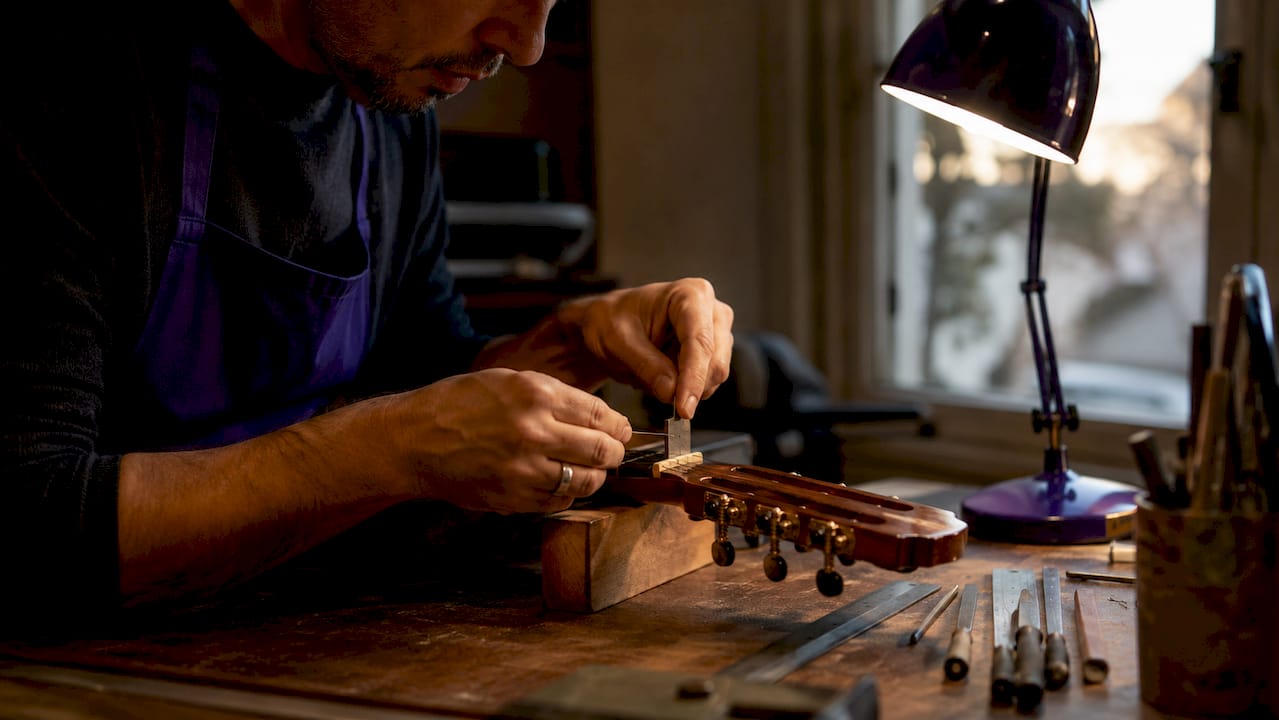
The nut controls action at the open strings and the first few frets. If fretting feels hard near the headstock but gets easier as you move up the neck, the nut is the problem. Nut and open-string action issues are distinct from relief and saddle problems, and treating them separately is the only way to diagnose accurately.
Here is how to check and correct nut height:
- Capo the second fret and measure string height at the first fret. The gap should be barely visible, around 0.3mm for treble strings and 0.5mm for bass strings. Any more than that and the nut slots are too high.
- File nut slots carefully. Use a nut file matched to the string gauge. File in the direction of the headstock at a slight downward angle. Remove material in tiny amounts and test frequently.
- Check for buzzing at open strings. If open strings buzz but fretted notes do not, the nut slot is too low. This requires a new nut or a shim under the existing one.
- Verify intonation after nut adjustment. Nut height affects how sharp or flat open strings sound relative to fretted notes. Tune up and compare the open string to the 12th fret harmonic.
Pro Tip: Before filing any nut slot, mark the current depth with a pencil. If you go too far, you have a reference point and can show a luthier exactly what happened.
Once nut height is set, perform your final verification using real flamenco technique. Testing with rasgueo, picado, and golpe at full performance volume is the only honest test of whether your setup works. Playing softly to check for buzz tells you nothing about how the guitar performs when you are actually playing. Run through a soleares falseta at full speed. Drive a hard rasgueo across all six strings. If the guitar holds clean and responds fast, your setup is done. Check the complete flamenco setup checklist to confirm you have covered every step before calling it finished.
Key takeaways
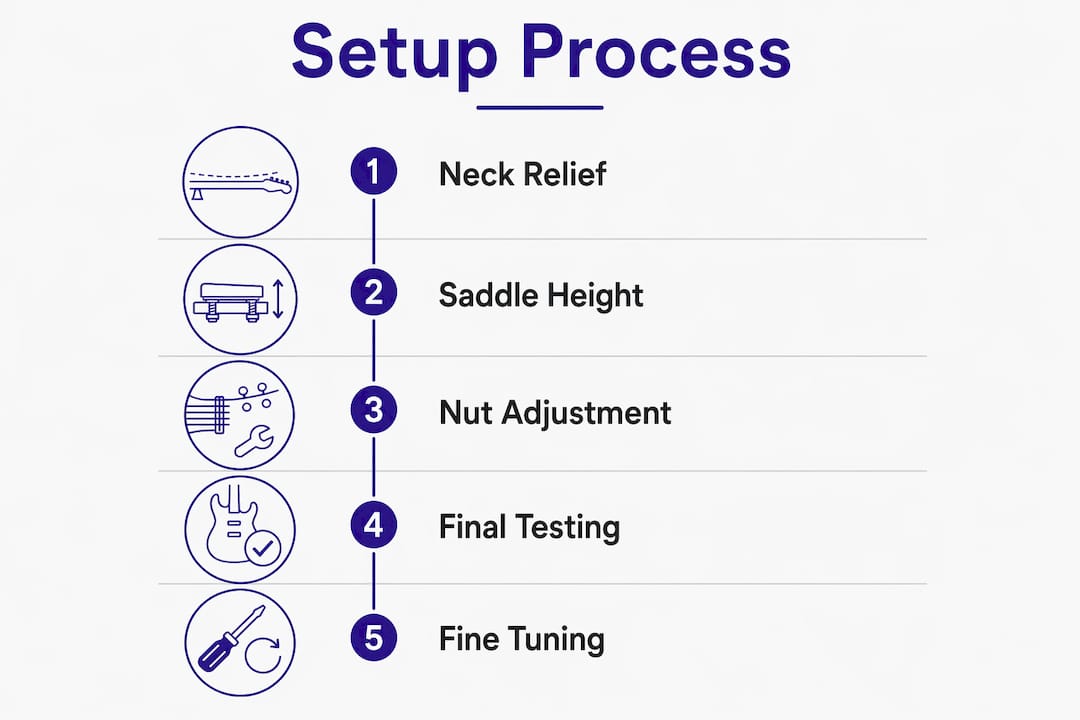
Correct flamenco guitar action setup requires neck relief, saddle height, and nut adjustment in that exact order, with full retuning between each step.
| Point | Details |
|---|---|
| Set neck relief first | Measure the gap at the 7th–9th fret before touching the saddle or nut. |
| Target flamenco-specific heights | Aim for 3.0mm bass and 2.5mm treble at the 12th fret for most flamenco players. |
| Adjust saddle incrementally | Sand the saddle base in small passes and remeasure after every adjustment. |
| Match action to your attack | Players with heavier right-hand technique need slightly higher action to avoid buzz. |
| Test under real conditions | Verify the setup with rasgueo and picado at performance volume, not light practice strokes. |
What i have learned setting up flamenco guitars
The most common mistake I see is players chasing the lowest possible action as if lower always means better. It does not. Flamenco is a percussive art form. The golpe, the thumb strokes in alzapúa, the full-force rasgueo in a bulería compás, these techniques generate serious string movement. A setup that feels perfect at low volume will buzz badly the moment you play with real intensity.
The setup order matters more than most players realize. I have seen players sand down a perfectly good saddle trying to fix buzz that was entirely caused by too much neck relief. They end up with a saddle that is too low and a neck that still needs adjustment. Now they have two problems instead of one.
My honest advice is this: do the neck relief check first, every single time, without exception. Then move to the saddle. Then the nut. Adjust one element, retune fully, and check all parameters before moving to the next. That discipline is what separates a stable, playable setup from one that drifts and frustrates you for months.
The other thing I will say is that your setup should reflect your playing, not a spec sheet. If you play with a light touch and favor delicate picado runs, you can push action lower than a player who drives hard compás strumming. The flamenco setup approach is always personal. Use the measurements as a starting point, not a final answer.
— Vintage
Find the right flamenco guitar to set up perfectly
A great setup starts with a great instrument. No amount of saddle filing will turn a poorly built guitar into a responsive flamenco machine. The wood, the bracing, and the craftsmanship of the instrument set the ceiling for what any setup can achieve.

At Vintage-guitar-world, we specialize in curated vintage and handcrafted guitars built to the standards that make proper action setup possible and rewarding. Our collection includes flamenco instruments with the lighter construction and tonal character that respond beautifully to the setup process described in this guide. Whether you are looking for a player-grade instrument or a collector-quality piece, explore our vintage guitar collection to find a guitar worth setting up right. You can also learn more about why handcrafted guitars deliver the tonal foundation that flamenco technique demands.
FAQ
What is the ideal action height for a flamenco guitar?
The standard target is approximately 3.0mm on the bass side and 2.5mm on the treble side, measured at the 12th fret. Players with a heavier right-hand attack may need slightly higher action to prevent buzz during rasgueo and golpe.
How is flamenco guitar action different from classical guitar action?
Flamenco guitars run lower action than classical guitars due to lighter bracing and thinner tops. Classical guitars typically measure 3.5mm to 4.0mm on the bass side, while flamenco instruments target around 3.0mm for faster string response.
Should i adjust neck relief before the saddle?
Yes. Neck relief must be set before saddle height. Adjusting the saddle first while neck relief is wrong causes you to compensate incorrectly, and the setup will be unstable.
Can i adjust flamenco guitar action myself?
Saddle sanding and basic nut filing are manageable for careful players with the right tools. Truss rod adjustments carry more risk and are best handled by a luthier if you are not experienced with the process.
Why does my flamenco guitar buzz only during hard playing?
Buzz that appears only at performance volume usually means action is set too low for your attack strength. Raise the saddle slightly and retest using full-force rasgueo strokes rather than light practice playing.