



Choosing a flamenco guitar comes down to five decisions: blanca or negra, the build (solid top, light bracing, golpeador), the action and neck, your budget, and how you test the instrument before you commit. Get those right and the guitar will feel like an extension of your right hand. Get them wrong and you will own a pretty classical guitar that buzzes in the wrong places. Below, we walk through each decision in the order you will actually face it, with the numbers a buyer in Germany needs.
TL;DR
- A flamenco guitar is built lighter than a classical one, with a thinner body and top and a lower action, for a dry, fast, percussive sound.
- Blanca (cypress) versus negra (rosewood) is a matter of taste more than a rule. Many professionals use one guitar for both accompaniment and solo playing.
- Check for a solid top, a golpeador (tap plate), a neck that fits your hand and an action you can live with. Always play several instruments and have a luthier look at anything you are unsure about.
- Beginners do not need a flamenco guitar to start, but if you buy one, expect roughly 500 to 700 € for a decent entry-level instrument and 2,000 € and up for professional level.
Table of Contents
- What actually makes a flamenco guitar different
- Do you need a flamenco guitar at all?
- Blanca or negra: choosing your wood
- The construction checklist
- How much should you spend?
- How to test a flamenco guitar properly
- Perspective: what we see in practice
- Buying with us
- FAQ
- Sources
What actually makes a flamenco guitar different
On paper, flamenco and classical guitars look like twins: six nylon strings, a similar shape, the same tuning. In your hands they behave very differently, and the reason is function.
Yamaha’s instrument guide explains that flamenco guitars use lighter, lower-density woods such as cypress for the back and sides, a thinner body and a lower string height, which gives the quick response that fast flamenco playing needs. Guitar World’s expert guide says the same about the build: shallower bodies, thinner tops and lighter bracing compared with a classical instrument.
The sound follows from that. Acoustic research documenting flamenco guitar sound describes the flamenco ideal as percussive, short in sustain, clear and dry with a strong bass, while a classical guitar aims for a melodic, sustained, full tone. The same paper points out a practical consequence: a flamenco guitar has to keep rapid rasgueado strokes distinct, where a classical guitar may smear them into one sound.
Three things to take away when you shop:
- Short sustain is not a flaw. It is what lets fast picado and rasgueado stay articulate.
- Low action is part of the design. Some buzz or growl can even be desirable in flamenco, though it is normally unwanted in classical playing, as one flamenco teacher’s buying guide notes.
- The golpeador is functional. It protects the top from golpe, the percussive tapping technique, which classical guitar does not normally use.
If you want a deeper tonal background, our article on the characteristics of Spanish guitars covers sound, construction and woods in one place.
Do you need a flamenco guitar at all?
Honest answer: not on day one. Beginners can learn flamenco technique on a classical guitar, and many teachers say so. A flamenco guitar becomes worth it when you play the style regularly, your teacher asks for it, or you are tired of fighting a high action while working on rasgueados and picado.
What changes when you switch is mostly feel. Expect lower action, less sustain and more attack. If you come from classical guitar, give yourself a few weeks: your touch will need to get lighter and your right hand more precise, because a flamenco guitar punishes sloppy attack and rewards clean technique.
That is also why buying decisions made on paper often go wrong. The guitar has to suit your hands, your repertoire and the way you play, which is why we always recommend trying before buying (more on that below).
Blanca or negra: choosing your wood
This is the question every buyer asks first, and it is less rigid than forum threads suggest.
Blanca (“white”) is the traditional flamenco build: a spruce top with cypress back and sides. Cypress is light and bright, and it gives the dry, snappy, immediate voice that dancers and singers have been accompanied by for generations. Negra (“black”) normally keeps the spruce top but uses denser woods such as rosewood for the back and sides, producing a richer sound with more sustain and a rounder bass.
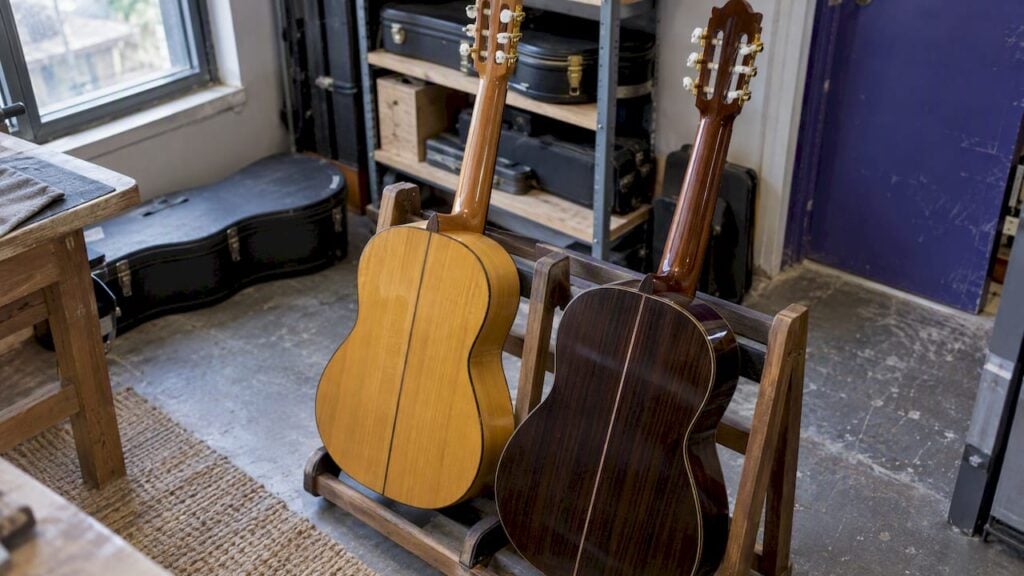
The academic interviews with makers and players report that cypress is traditional for accompanying singing or dance, while rosewood is considered beneficial for solo playing. The same study also notes that modern flamenco guitars increasingly approach classical guitars in sound.
In practice, a working flamenco teacher cautions that the blanca-for-accompaniment, negra-for-solo split is not absolute: many professionals use one guitar for both. So choose by the sound you prefer, not by the label.
| Blanca | Negra | |
|---|---|---|
| Back and sides | Cypress | Rosewood (or similar dense wood) |
| Typical character | Bright, dry, quick, percussive | Warmer, fuller, more sustain |
| Traditionally suited to | Accompanying dance and song | Solo playing, concert settings |
| Best for you if | You play compás-heavy, rhythmic music and want maximum attack | You want a rounder bass and a bit more sustain for solo falsetas |
We go further into this decision in Blanca vs. Negra: which one suits your playing style and in our piece on the role of wood in flamenco guitars.
Spruce or cedar top?
A buying guide for nylon-string guitars recommends a solid top over a laminated one whenever tone matters, and notes that spruce is common in flamenco and generally sounds clear and crisp, while cedar tends to sound warmer and darker. For a traditional flamenco voice, spruce is the safe choice. If you love a warmer tone, a cedar-topped instrument is worth trying, but play it next to a spruce one so you hear the difference rather than imagine it.
The construction checklist
When you hold a candidate guitar, walk through these points in order.
1. Solid top, light build
Look for a solid top, a shallow body and light bracing. A solid top responds more openly and improves with age, while a laminated top stays stiff and limited. Entry-level guitars often use laminated backs and sides with a solid top, which is a sensible compromise at lower budgets.
2. Golpeador (tap plate)
A flamenco guitar should have one. A buying checklist from a flamenco teacher lists a tap plate among the basics but adds that one can be added later, so its absence is not automatically disqualifying. If you own a good guitar without one, read about how a thin retrofit protects its value in our guide to retrofitting a golpeador.
3. Action
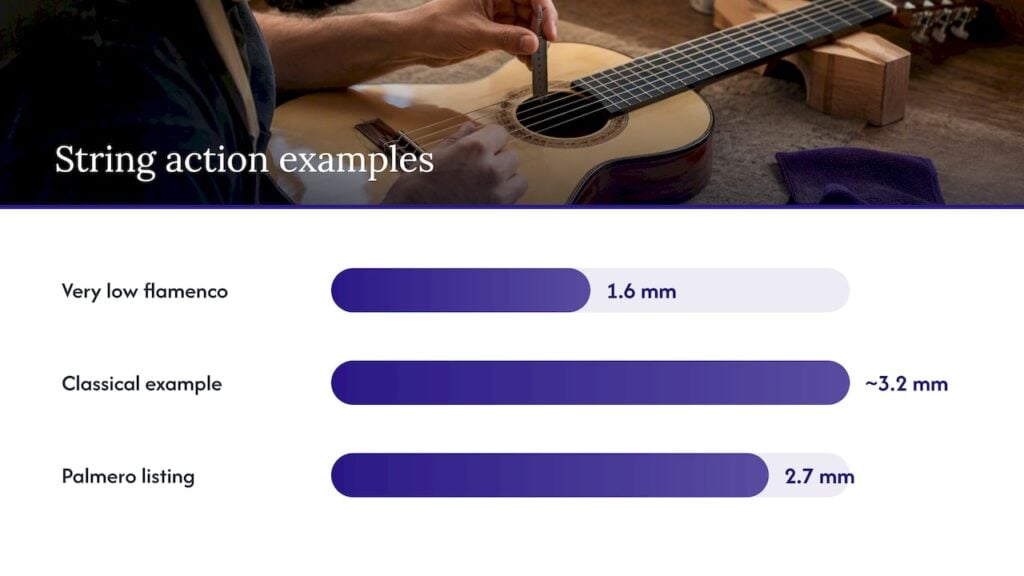
Action is the height of the strings above the frets. A personal-blog example gives about 1.6 mm on the wound E string at the 12th fret for a very low flamenco setup, against roughly 3.2 mm on a classical guitar. Treat these as an illustration, not a standard. The author’s point is the useful one: low action eases speed and left-hand comfort, but costs you some volume and adds buzz risk.
Our own listing of a José M. Palmero 2023 flamenco guitar describes a flamenco action of 2.7 mm on the low string, a good reminder that a playable flamenco setup is a range, not a single number.
Action can be adjusted. A luthier can change it at the saddle or nut, and higher action reduces unwanted buzz. Many flamenco guitars also have two saddles of different heights, so a quick swap can change the feel. So a slightly buzzy guitar you love is not a lost cause. A guitar whose sound you dislike is.
4. Neck, nut width and scale length
Neck profile should suit your hand. The same nylon-string guide gives 650 mm as the standard scale length, with instruments from 640 to 674 mm also on the market. A flamenco teacher’s checklist asks for a 650 to 665 mm scale and a 50 to 54 mm nut width. If you have small hands, lean toward 650 mm and a narrower nut. If you come from classical guitar and are used to a wide fingerboard, make sure the neck does not feel cramped.
5. Condition
With new guitars, condition is mostly about finish and setup. With used or vintage instruments, it matters much more: check for top cracks, bridge lift, neck relief, loose braces and repairs. Use a light, tap the top gently and listen for rattles inside the body. If anything looks doubtful, have a luthier assess it before you pay.
How much should you spend?
A fair warning first: prices vary with maker, wood, age and condition, and asking prices in the used market move constantly. As a rough orientation for buyers in Germany, a comparison of providers puts entry-level flamenco guitars at around 500 to 700 € and professional instruments from about 2,000 €. Treat those as signposts rather than quotes.
What each bracket typically gets you:
- Entry level. A solid top on a well-built guitar from a Spanish or comparable workshop, laminated or lightly finished back and sides, and a setup that gets you playing. Good enough for lessons and a few years of practice.
- Intermediate. Solid woods throughout, better bracing, a clearer and louder voice, and more consistent setup. This is where the blanca versus negra difference becomes obvious.
- Professional. Hand-built guitars with selected woods, strong projection and a response that changes how you play. Prices rise steeply, and the market for older instruments from known makers adds provenance on top.
One tip we repeat to every buyer: spend the money on the instrument and, if needed, a good setup, not on accessories. A proper setup by a luthier often transforms a mid-range guitar more than a jump to the next price tier does.
Why consider vintage or pre-owned at all? Because well-made flamenco guitars from established workshops often hold their value, and a restored older guitar can offer a lot of tone for the money. Our guide on how to choose a vintage flamenco guitar goes through what to check on older instruments in particular, and why craftsmanship shapes sound and value explains what you are paying for.
How to test a flamenco guitar properly
The single most reliable piece of advice in every buying guide is the same: try several instruments, let the sound and playability guide you, and have a luthier inspect any flaws or potential problems. Here is a simple test routine.
- Bring your own repertoire. Play a rasgueado pattern, a picado run, a few arpeggios and a short falseta you know by heart.
- Play the same passage on every guitar. Your memory of tone is short. Switch back and forth quickly.
- Listen for attack and decay. Does a rasgueado stay articulate? Does the note stop where you expect it to?
- Test the whole neck. Buzz at the first frets is common on low action. Buzz in the upper positions is often a setup problem.
- Have someone else play it while you stand a few meters away. Projection sounds different from the player’s seat.
- Tap the golpeador and feel the response of the top.
- Ask about the setup. What action does it have now, and can the saddle be changed?
If you cannot travel to a shop in person, ask for recordings, detailed photos of the top, bridge and heel, the exact action and scale length, and a clear return policy. Our 7 steps to the perfect flamenco guitar checklist and our guide to guitar testing appointments go into this in more detail.
Perspective: what we see in practice
We handle restored, rare and handcrafted instruments every day, and a few patterns keep repeating among people who ask us for help choosing a flamenco guitar.
First, buyers fixate on wood labels and under-weigh how the guitar actually responds. We have seen blanca guitars that sound warm and negras that bark, and the individual instrument matters more than the category. Second, a good guitar with a poor setup is usually a fixable problem, while a guitar with a structural flaw hides behind a tempting price. That is why we evaluate every instrument for condition before it is offered and describe it plainly, including action, scale length and any repairs. Third, the best purchases come from players who have tried at least three guitars back to back. Your ear and your hands will tell you more than any spec sheet.
If you are torn between two guitars, choose the one you want to keep playing at the end of an hour. Excitement fades, comfort stays.
— Vintage
Buying with us
If you want to compare real instruments rather than specifications, we offer exclusive testing appointments, where you can play selected guitars with our advice at your side. We also provide certificates and valuation reports, and we sell guitars on commission if you want to pass on an instrument. You can browse our current concert and nylon-string guitars or our vintage guitars, and if an older guitar needs work, our restoration service covers that too.

Tell us what you play, which hand position feels natural and what you want to spend, and we will point you toward instruments that fit. For a wider look at buying principles, see our flamenco guitar buying guide.
FAQ
Can a beginner buy a flamenco guitar?
Yes, but it is not required. Beginners can learn flamenco on a classical guitar, and a flamenco guitar mainly adds a lower action, quicker response and more attack. If you decide to buy one, choose a comfortable neck and a solid top, and set a realistic budget rather than buying the cheapest option.
Is a blanca or a negra better?
Neither is better. Blanca guitars with cypress are traditionally bright and percussive, while negras with rosewood sound fuller and richer. Because many professionals use one guitar for everything, pick the one whose sound you prefer after playing both.
Does a flamenco guitar need a golpeador?
It should have one if you plan to play golpe, since it protects the top from percussive tapping. If a guitar you like lacks one, a tap plate can be added later, so it does not need to rule out an otherwise excellent instrument.
What scale length and nut width should I look for?
Most nylon-string guitars use a 650 mm scale, and flamenco checklists suggest roughly 650 to 665 mm with a nut width of 50 to 54 mm. Smaller hands usually prefer 650 mm and a narrower nut, but your own playing test decides.
How much should a decent flamenco guitar cost in Germany?
Expect roughly 500 to 700 € for a decent entry-level guitar and about 2,000 € and up for professional instruments. Used and vintage instruments vary widely with maker and condition, so ask for the exact specification and have it checked.
Sources
- Yamaha: The Structure of the Classical Guitar, the flamenco guitar
- Guitar World: an introductory guide to nylon-string guitar
- Flamenco Guitar Sound: Documenting the Heritage (DAGA 2019)
- What Flamenco Guitar Should I Buy, Part 1
- What Flamenco Guitar Should I Buy, Part 2
- Flamenco Guitars, Samuel Moore
- Guide to Buying a Nylon String
- Flamenco guitar vs. classical guitar construction, Inside Guitar
- Difference Between Flamenco and Classical Guitars