













TL;DR:
- Rarity, artist connection, and craftsmanship are key factors determining a guitar’s collectible value.
- Limited runs with documented provenance and signatures appreciate faster and fetch higher prices.
- Iconic models like the SRV Stratocaster and Garcia Tiger exemplify the blend of artistry and investment appeal.
Choosing the most iconic custom guitar model is genuinely hard. Collectors and musicians face a market where rarity, artist connection, and craftsmanship all compete for attention, and the wrong call can cost serious money. Whether you’re eyeing a Fender Custom Shop tribute or a one-of-a-kind luthier build, the differences between a trophy piece and a smart investment aren’t always obvious. This guide walks you through the key criteria collectors use, spotlights the most legendary custom models ever built, and gives you a clear framework for comparing them side by side.
Table of Contents
- How collectors evaluate famous custom guitar models
- Stevie Ray Vaughan Stratocaster: Legacy, features, and collector appeal
- Jerry Garcia’s ‘Tiger’: Ornamental custom and modern replicas
- Other notable custom guitars: Cobain, Iommi, and rare luxury pieces
- Comparing famous custom guitar models: Features, rarity, and investment potential
- Why rarity and artist provenance matter more than hype
- Expand your collection: Find unique vintage guitars
- Frequently asked questions
Key Takeaways
| Point | Details |
|---|---|
| Collector criteria | Rarity, provenance, craftsmanship, and artist signature drive model value. |
| SRV Stratocaster | Relic’d versions with artist ties are especially desirable and fast-appreciating. |
| Modern replicas | Replicas—like ‘The Garcia’—if authenticated, can command high collector interest. |
| Comparison matters | Side-by-side model analysis clarifies which guitars are best fits for investment or artistic goals. |
| Beyond hype | Long-term value depends more on rarity and provenance than trending buzz. |
How collectors evaluate famous custom guitar models
Not every custom guitar earns legendary status. The ones that do share a specific set of qualities that serious collectors track obsessively. Understanding these criteria before you spend a dollar is the difference between building a meaningful collection and buying expensive wall art.
Here’s what experienced collectors consistently prioritize:
- Rarity and production numbers: The fewer units built, the higher the ceiling on value. Runs of 50 to 100 units are widely considered the sweet spot for collectibility.
- Artist connection and provenance: Instruments directly tied to a famous musician carry a story that no factory guitar can replicate. Documented ownership or use by a major artist multiplies value dramatically.
- Craftsmanship and materials: Special woods, hand-finishing techniques like PLEK (a computer-guided fret leveling process), and CITES-regulated tonewoods like Brazilian rosewood signal premium builds.
- Authenticity and resale potential: Original features, matching serial numbers, and unaltered hardware protect long-term value. Modifications, even tasteful ones, reduce collector appeal.
- Condition and documentation: Certificates of authenticity, original cases, and signed paperwork are not optional extras. They’re essential.
According to collector insights, vintage customs command millions, with benchmarks set by Gibson Custom Shop accuracy and Fender Master Builders, and investment value significantly higher for signed or limited-run pieces. Understanding the advantages of vintage guitars helps frame why these instruments outperform almost every other collectible category.
Pro Tip: Signed and numbered limited editions appreciate the fastest. A guitar with both an artist signature and a low production number is not just rare, it’s documented rare, which is what the secondary market actually rewards.
Knowing the key features for collectible guitars before you shop protects you from overpaying for instruments that look special but lack the provenance to back it up.
Stevie Ray Vaughan Stratocaster: Legacy, features, and collector appeal
Few signature models carry the emotional weight of the Stevie Ray Vaughan Stratocaster. It isn’t just a guitar with a famous name on the headstock. It’s a precise recreation of the instrument that defined one of the most influential blues sounds of the 20th century.
The model is built around SRV’s personal “Number One,” a heavily modified 1963 Strat that he played relentlessly throughout his career. The production model captures its core DNA faithfully.
Key features of the SRV Stratocaster include:
- Alder body with a vintage-correct contoured shape
- Thick oval maple neck that replicates the chunky feel SRV preferred for heavy string bending
- Texas Special pickups, designed to deliver the fat, mid-forward tone he was known for
- Left-handed tremolo system, just like his original, even on right-handed models
- Gold hardware throughout, giving it a visual distinction from standard Strats
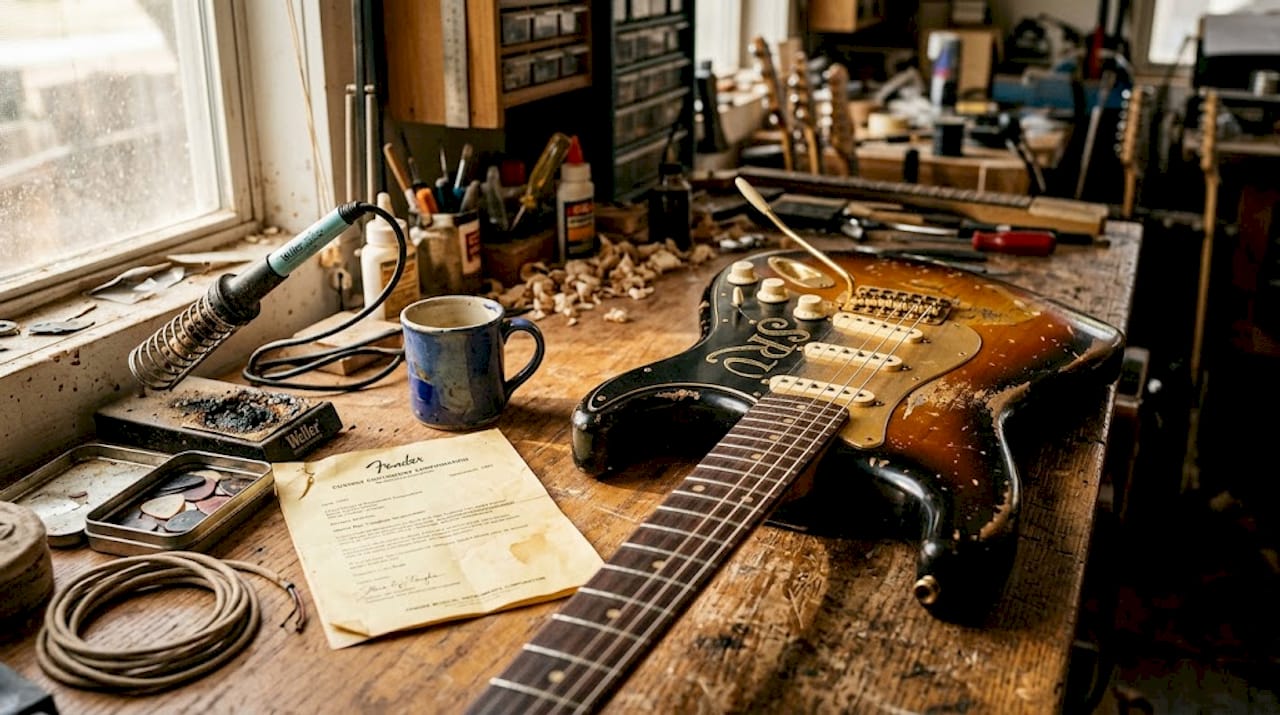
- Engraved “SRV” initials on the pickguard, a signature detail that makes authentication straightforward
The Fender Custom Shop produced only 100 relic’d tribute versions of this model, each aged to replicate the worn-in look of a genuinely played instrument. Those 100 units are what serious collectors target.
Pro Tip: When evaluating SRV Strat relic versions, look for authenticated aging documentation from Fender. Artificially aged guitars without paperwork are common, and they don’t command the same premium as certified Custom Shop pieces.
The SRV Strat checks every box: documented artist connection, limited production, distinctive features, and a story that resonates far beyond guitar circles. It’s a benchmark model for understanding what rare guitar models actually look like in practice. For anyone studying famous guitar makers, the Fender Custom Shop’s work on this model is essential reading.
Jerry Garcia’s ‘Tiger’: Ornamental custom and modern replicas
If the SRV Strat represents the pinnacle of production-based custom work, Jerry Garcia’s “Tiger” represents something entirely different: a one-of-a-kind instrument built by a master luthier for a specific artist’s vision.
Doug Irwin spent years building “Tiger” for Garcia, completing it in 1979. The guitar is immediately recognizable. Its ornamental inlays, elaborate body design, and unique tonal character made it as visually striking as it was sonically distinct. Garcia played it as his primary instrument from 1979 to 1990, making it one of the most documented artist guitars in rock history.
Key features of the Tiger include:
- Custom body design with elaborate carved details and a distinctive silhouette
- Ornamental inlays across the fretboard and body, hand-crafted by Irwin
- Unique electronics tailored specifically to Garcia’s tonal preferences
- One-of-a-kind construction, meaning no two Tigers exist in identical form
The original Tiger sold at auction as part of the Jim Irsay collection, and replica pricing for Tom Lieber’s “The Garcia” model runs from $4,300 to $32,000 depending on customization level. Lieber’s replicas are not mass-produced copies. They’re serious luthier builds with genuine customization options, which gives them their own collector appeal.
“Custom guitars reflect the artist’s vision and technical innovation in ways that production instruments simply cannot. The Tiger isn’t just a guitar. It’s a document of a creative relationship between a musician and a builder.”
For collectors considering a purchase in this category, buying vintage guitars requires understanding the difference between a documented replica and a speculative reproduction. The Garcia replicas by Lieber occupy a legitimate space because they come from a named luthier with a traceable build history.
Other notable custom guitars: Cobain, Iommi, and rare luxury pieces
Beyond the SRV Strat and Garcia Tiger, several other custom models have carved out permanent places in collector culture. Each one brings a different combination of artist legacy, design innovation, and scarcity.
| Model | Artist | Key Feature | Run Size |
|---|---|---|---|
| Jag-Stang | Kurt Cobain | Jaguar/Mustang hybrid, Sonic Blue | Limited |
| SG “Monkey” | Tony Iommi | 1964 replica, aged/signed | 50 units |
| SJ-200 Monarch #100 | Gibson luxury | Brazilian rosewood, diamond/abalone inlays | 1 unit |
Here’s what makes each one stand out:
- Kurt Cobain Jag-Stang: Cobain designed this himself by literally cutting up photos of a Jaguar and a Mustang and taping them together. The result is a Jaguar/Mustang hybrid with a Sonic Blue finish that became one of the most recognizable alternative rock instruments of the 1990s.
- Tony Iommi SG “Monkey”: The Gibson Custom Shop produced only 50 aged and signed replicas of Iommi’s 1964 SG, the guitar that defined heavy metal’s sonic identity. Each one is hand-aged and carries Iommi’s signature, making the 50-unit run extremely tight.
- Gibson SJ-200 Monarch #100: A single instrument built with Brazilian rosewood (now heavily restricted under CITES regulations) and luxury inlays featuring diamonds and abalone. There is exactly one of these. Full stop.
For collectors focused on rare acoustic guitars, the Monarch #100 represents a category of instrument where material rarity compounds artist and maker prestige into something genuinely irreplaceable. Exploring the broader guitar world helps contextualize how these pieces fit into the larger collector landscape.
Comparing famous custom guitar models: Features, rarity, and investment potential
With five major models on the table, a direct comparison helps clarify which instruments align with different collector goals.
| Model | Artist | Run Size | Primary Appeal | Investment Tier |
|---|---|---|---|---|
| SRV Stratocaster | Stevie Ray Vaughan | 100 (relic) | Artist legacy, playability | High |
| Garcia Tiger (replica) | Jerry Garcia | Custom order | Artisan build, uniqueness | High |
| Jag-Stang | Kurt Cobain | Limited | Cultural icon, design | Medium-High |
| Iommi SG “Monkey” | Tony Iommi | 50 | Signed, aged, genre-defining | Very High |
| SJ-200 Monarch #100 | Gibson luxury | 1 | Material rarity, luxury | Exceptional |
Several patterns emerge from this comparison:
- Smaller runs consistently outperform larger ones on the secondary market, especially when combined with artist signatures
- Material rarity adds a second layer of value that pure production scarcity alone cannot replicate
- Cultural impact matters, but it needs documentation to translate into investment returns
- Signed pieces with low serial numbers appreciate faster than unsigned equivalents, regardless of model
The investment benchmarks set by iconic vintage pieces like 1959 Les Paul Bursts, which have sold for millions, establish the ceiling for what documented rarity can achieve. Understanding the vintage vs. reissue guitars distinction is critical here, because reissues with strong artist connections can approach vintage-level values when runs are tight enough.
Choosing the right model ultimately comes down to aligning your personal connection to the artist or era with the instrument’s documented scarcity. Emotional resonance and investment logic don’t have to conflict.
Why rarity and artist provenance matter more than hype
Here’s something the guitar market teaches you quickly if you’re paying attention: hype fades, but documentation doesn’t. We’ve seen models spike in value based on a viral moment or a celebrity endorsement, only to plateau or drop within a few years. The instruments that hold and grow in value are almost always the ones with a clear, verifiable story.
A guitar signed by an artist who played it on a specific album, with photographs and receipts to prove it, is worth more than a guitar with a famous name on the headstock and nothing else. That gap widens every decade.
The signs of collectible guitars that serious buyers look for aren’t glamorous. They’re serial number records, original hang tags, handwritten notes from builders, and chain-of-custody documentation. Boring? Maybe. Valuable? Absolutely.
“Collectors who chase hype risk missing the true gems, those with a story, a signature, and documented scarcity.”
Don’t underestimate rarely seen artisan pieces with artist history. A luthier-built instrument with 10 years of documented use by a major artist will outperform a factory limited edition almost every time.
Expand your collection: Find unique vintage guitars
The models covered in this guide represent some of the most compelling intersections of artistry, history, and investment value in the guitar world. But they’re just the starting point.

At Vintage Guitar World, we specialize in curating instruments that carry exactly the kind of documented provenance and craftsmanship this guide describes. Whether you’re looking to understand the full range of types of vintage guitars available to collectors today, or you’re ready to browse and acquire, our platform connects you with unique vintage guitars backed by expert evaluation and certification. Every instrument in our catalog comes with the context you need to buy with confidence.
Frequently asked questions
Which famous custom guitar models are most valuable for collectors?
Signed or limited-run guitars with documented artist provenance, like the SRV Stratocaster, Iommi SG, and Garcia Tiger, are prized for value and investment, with vintage customs commanding millions at the top tier.
How do you authenticate a famous custom guitar model?
Collectors authenticate using original documentation, serial numbers, provenance records, and specialist verification of unique features like hardware, finish, and construction details.
What features distinguish the Stevie Ray Vaughan Stratocaster?
It features an alder body, thick oval maple neck, Texas Special pickups, gold hardware, left-handed tremolo, and an engraved “SRV” pickguard, with the Custom Shop producing only 100 relic’d tribute versions.
Are modern replicas of iconic customs worth collecting?
Yes, particularly luthier-built replicas with limited runs and strong artist connections. The Garcia replica range by Tom Lieber, priced from $4,300 to $32,000, demonstrates that serious replicas hold genuine collector value.
What makes the Tony Iommi ‘Monkey’ SG and Gibson SJ-200 Monarch attractive to collectors?
Extreme scarcity, artist signatures, unique materials, and luxury design elevate their desirability, with the Iommi SG limited to just 50 aged and signed units and the Monarch existing as a single instrument worldwide.