












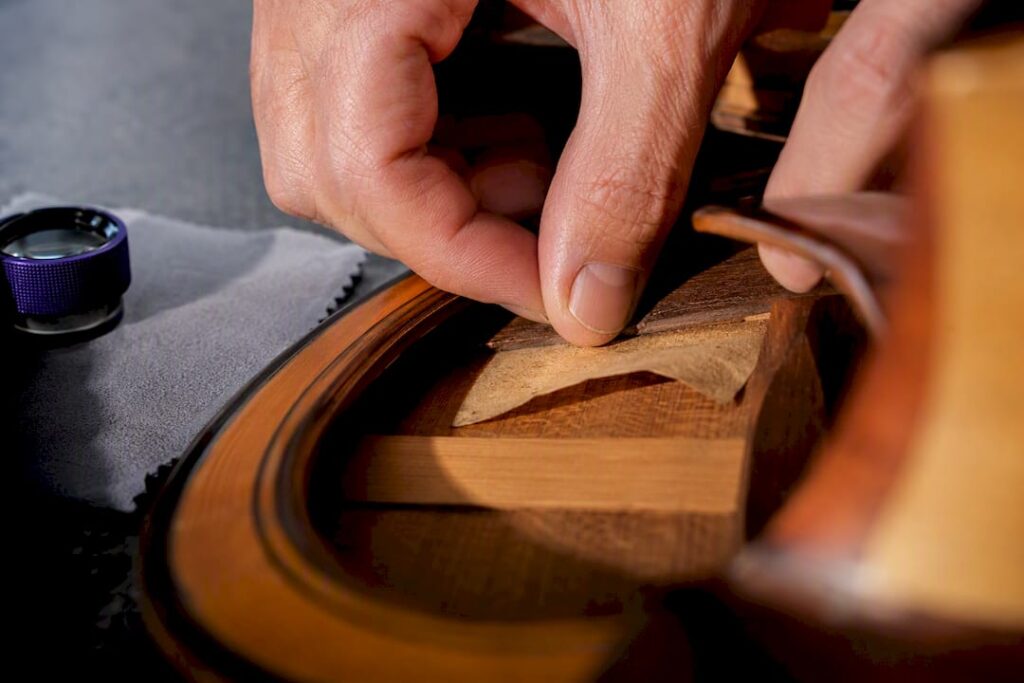

A likely-fake Ramírez usually reveals itself in three places at once: a blue or blue-and-white label on an instrument sold as handmade, no certificate matching the model and serial number, and a seller who won’t let you inspect it in person. If you spot any of that, stop the purchase and request documentation directly, or book an authentication before you pay a cent.
TL;DR:
- Authentic Ramírez guitars have genuine handmade labels made after 1967, with signatures and consistent formatting, especially if the guitar’s date is post-1967.
- Be cautious of blue or blue-and-white labels, which indicate factory-built, non-handmade models that lack official certificates matching the model and serial number.
- Inside the sound hole, solid wood should show natural grain continuity, and internal craftsmanship must be tidy, with no glue smears or uneven bracing, signaling genuine construction.
- Authentic documentation solely lists model, materials, year, and serial number; certificates claiming market value or matching non-official claims are likely fake.
- Seek expert verification when the asking price is high, paperwork conflicts with physical evidence, or the seller refuses in-person inspection or third-party evaluation.
Table of Contents
- Fake Ramirez Erkennen: The 5-Minute Checklist Before You Buy
- Ramírez Label Types and Why Serial Numbers Alone Aren’t Proof
- Checking the Wood and Build Quality Inside the Body
- What Real Documentation Looks Like, and What It Doesn’t Claim
- When to Stop Second-Guessing and Call in an Expert
- Why Careful Verification Protects More Than Your Wallet
- How Vintage Guitar World Helps You Verify Before You Buy
- Sources
Fake Ramirez Erkennen: The 5-Minute Checklist Before You Buy
Before you dig into labels, wood grain, or paperwork, run this quick pass. It won’t replace a full inspection, but it catches the majority of problem listings within minutes.
- Read the label color first. Guitarras Ramírez has stated plainly that blue or blue-and-white labels identify instruments not built in the workshop — these are factory-selected models, not handmade guitars, no matter what the seller’s description says.
- Ask for the certificate before you ask for a discount. A genuine certificate names the model, the materials, the construction year, and the serial number. If the seller can’t produce one, or produces something with a dollar figure printed on it, treat that as a warning sign rather than a bonus.
- Compare the wood inside and out. Peek through the sound hole with a flashlight. Genuine handmade Ramírez guitars use solid wood throughout, so the grain pattern inside the back and sides should mirror the grain on the outside. Laminate shows as a flat, repetitive pattern or a visible edge where thin veneer wraps around a core.
- Look at the workmanship inside the body. Bracing should be clean and evenly shaped, kerfing and cleats should sit tight with no glue smears, and binding should be neatly seated. Sloppy internal work on an instrument priced like a workshop guitar is a mismatch worth questioning.
- Check the heel block for initials. On higher-end models, the maker or luthier sometimes leaves initials inside the heel block as a personal mark, a detail confirmed on real instruments like the Ramirez 1A “Concert Professional”. Their presence supports authenticity; their absence isn’t automatically damning, but it’s one more data point.
- Watch how the seller behaves, not just what they say. A seller who refuses an in-person inspection, won’t let a third party examine the guitar, or insists their own “certificate” already proves market value is behaving like someone with something to hide.
Pro Tip: Photograph the label, the heel block, and the interior through the sound hole before you negotiate price. Send those three photos to a specialist first. It costs nothing and saves you from a bad deal in an afternoon.
Ramírez Label Types and Why Serial Numbers Alone Aren’t Proof
Labels tell a real story, but that story has a gap you need to know about. Guitarras Ramírez began consistent label control and regular signed labels starting in 1967, so dates before that are approximate and less reliable.
That gap is exactly where forgeries thrive. A convincing reprint of an old-style label, paired with a plausible date and a worn-looking guitar, can pass a casual glance. It won’t pass a comparison against the workshop’s own records.
A few things worth knowing about how labels actually work:
- Blue and blue-and-white labels identify selected or studio-line guitars sold through the Ramírez store; these are not handmade workshop instruments, and the workshop does not issue authenticity certificates for them.
- Genuine handmade labels carry signatures and specific formatting that changed over the decades, so a label style from one era on a guitar dated to another era is a red flag.
- Ramírez publishes a reference catalog of its own label designs and invites owners to email [email protected] when a label doesn’t match anything in that compilation.
Here’s the number that matters most in this section: 1967 is the hinge point. Everything labeled or dated before it deserves extra scrutiny, and everything after it should show the consistent signature practice the workshop adopted from that year forward. If a label looks right but the guitar predates 1967, don’t treat the label as the final word. Contact the workshop directly and let them cross-check it against their own label history.
Checking the Wood and Build Quality Inside the Body
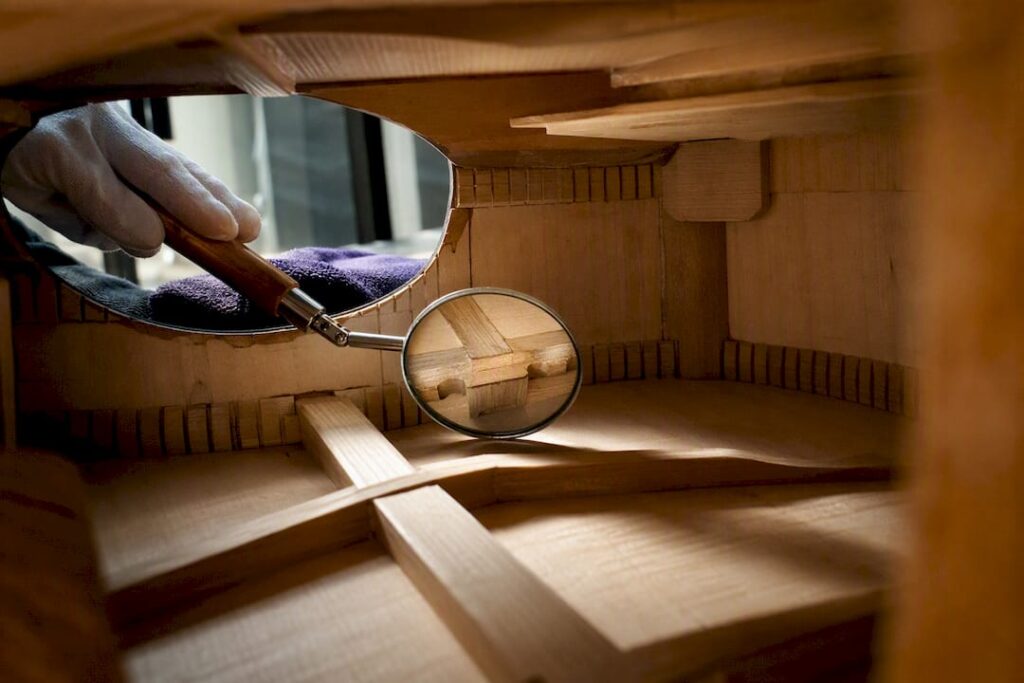
Materials tell you more than any label can, because wood is much harder to fake convincingly than a printed slip of paper. Handmade Ramírez guitars are built from solid woods, full stop. Studio and selected models may legitimately use laminated materials, so laminate itself isn’t proof of fraud. It’s only a problem when a laminated instrument is being sold to you as a handmade one.
Here’s what to look at:
- Grain continuity. Solid wood shows a natural, unbroken grain pattern from the outer surface through to the inside. Laminate often reveals a thin veneer layer at the edges of the sound hole or the guitar’s waist.
- Interior neatness. Genuine workshop craftsmanship shows in tidy bracing, well-fitted cleats over any repairs, and glue lines that look controlled rather than smeared.
- Heel block details. Check for stamped or handwritten initials inside the heel block, a marker documented on known high-end models.
- Hardware consistency. Tuners, bridge pins, and saddle materials should match what you’d expect for the guitar’s era and model tier, not obviously modern replacements dressed up to look vintage.
Pro Tip: If you can’t get your hand or a mirror inside the sound hole, a cheap dental inspection mirror and a phone flashlight do the job just as well as anything a shop would use.
What Real Documentation Looks Like, and What It Doesn’t Claim
Paperwork is where a lot of fake claims fall apart, mostly because forgers focus on the guitar and forget the paper trail needs to hold up too. Here’s what genuine documentation actually includes, and what it deliberately leaves out.
- Official certificates list four things only: the model name, the materials used, the year of construction, and the serial number. Guitarras Ramírez does not include market valuations on these certificates, so any “certificate” quoting a dollar amount didn’t come from the workshop.
- Third-party paperwork claiming to set value should raise questions. Valuation is a separate service from authentication, and a document that blends the two is mixing something the actual maker keeps deliberately apart.
- Strong provenance includes the boring stuff. An original dealer invoice, past service records, or old correspondence with the workshop all add weight that a certificate alone can’t.
- When in doubt, go to the source. Request digitized, signed pages, and if something feels off, contact the workshop yourself rather than taking a reseller’s word for it. Buying only through authorized channels also protects any warranty tied to the instrument.
When to Stop Second-Guessing and Call in an Expert
Some situations call for a professional look, not another round of photo comparisons. Get an expert involved when the asking price is high enough that a mistake would actually hurt, when the paperwork and the physical guitar tell conflicting stories, when the label predates 1967, or when a dealer themselves seems unsure.
An authentication check confirms origin, lists materials, and verifies the serial number against the model. It does not tell you what the guitar is worth. Before booking one:
- Gather every photo you have of the label, heel block, and interior.
- Collect any invoices, letters, or prior service paperwork.
- Write down the specific details that worry you, so the inspection has a clear starting point.
- Weigh shipping risk against an in-person appointment. Sending a fragile instrument through the mail for inspection carries its own risk, and a local, in-hand appointment often resolves doubts faster and more safely.
Why Careful Verification Protects More Than Your Wallet
Counterfeit and mislabeled Ramírez guitars follow the same pattern again and again in the secondary market: a plausible label, a vague story about provenance, and a seller who’s suddenly unavailable once you ask for a certificate. The pattern repeats because it works often enough on buyers who skip the paperwork step.
What actually holds up over time isn’t the guitar’s story. It’s the documentation trail behind it. A workshop certificate with a matching serial number protects the instrument’s sound reputation and its resale value at the same time, because both depend on the same underlying fact: that the guitar is what it claims to be. For anything approaching serious money, a professional check isn’t overcaution. It’s the cheapest insurance available against a very expensive mistake.
— Vintage
How Vintage Guitar World Helps You Verify Before You Buy
If you’re staring at a Ramírez listing and can’t shake the doubt, you don’t have to resolve it alone with a flashlight and a magnifying glass. Testing appointments are available where you can bring the instrument in for in-person checks including label style, wood construction, heel-block marks, and paperwork consistency, alongside valuation and certification services.

Book a testing appointment and bring whatever documentation you already have, even partial or suspicious paperwork helps narrow things down faster. Inconsistencies can be flagged, physical evidence confirmed, and certification issued where warranted. Certificates confirm findings based on inspection; no outside credentials are claimed. If you’re ready to stop guessing and get a straight answer, start with our guitar appraisal checklist or head to the shop to see instruments we’ve already vetted and stand behind.