














Guitar sustain is how long a note keeps ringing after you pluck or strike the string. That single quality shapes everything from a blues lead that hangs in the air to a clean chord that cuts off the moment you lift your fingers. Understanding what drives sustain, and what kills it, is the difference between chasing gear endlessly and actually knowing what to fix.
Table of Contents
- What is guitar sustain and why does it matter for your tone?
- How sustain differs across electric, acoustic, and artificially sustained guitars
- Key factors that determine how long your guitar sustains
- Practical techniques and gear choices to improve guitar sustain
- Why vintage guitars often sustain better than modern alternatives
- Key Takeaways
What is guitar sustain and why does it matter for your tone?
Sustain is the duration a string continues to vibrate at an audible level after it has been set in motion. No extra energy goes in; the string just keeps moving until friction, damping, and energy loss bring it to silence. The longer that process takes, the more sustain you have.
Why does it matter? Because sustain is the foundation of expressive playing. Vibrato only works if the note is still alive when your finger starts to move. Bends need a note that hangs long enough to reach its target pitch and sing there. Legato phrasing, where notes connect smoothly without re-picking, depends entirely on each note sustaining into the next. Without enough sustain, these techniques collapse into a series of dead thuds.
The key factors that shape sustain include:
- Wood type and density in the body and neck
- Neck joint construction (set, bolt-on, or neck-through)
- Hardware quality at the bridge, nut, and saddle
- String gauge and condition
- Pickup type and magnet strength
- Guitar setup, including action, intonation, and neck relief
- Playing technique, including finger pressure and vibrato
One thing worth knowing early: more sustain isn’t always better. A Telecaster with short, snappy notes fits a country picker perfectly. A Les Paul with long, singing sustain suits a rock soloist. Musical style determines the ideal sustain length, not some universal standard.
How sustain differs across electric, acoustic, and artificially sustained guitars
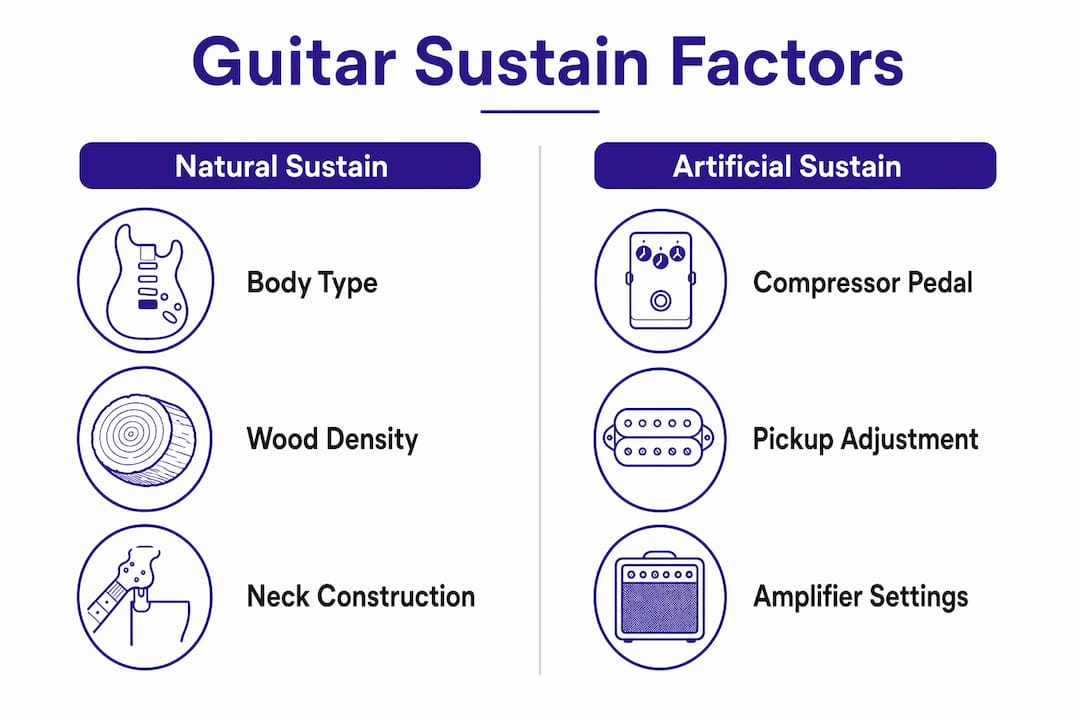
The guitar’s body type is the single biggest variable in how sustain behaves, and the differences between electric, acoustic, and electronically assisted instruments are dramatic.
Electric guitars
Solid-body electrics generally sustain longer than acoustics because their dense, rigid construction minimizes energy loss. When a string vibrates on a solid body, that energy stays in the string rather than radiating into the air through a resonating top. Solid-body guitars preserve string energy, letting notes bloom and ring out. Semi-hollow designs split the difference, adding some acoustic warmth while retaining a solid center block that keeps sustain respectable.

Acoustic guitars
Acoustic guitars are built for projection, not sustain. Their hollow bodies transfer string energy quickly into the soundboard, which pushes air and creates volume. That energy transfer is exactly what makes an acoustic loud and resonant in a room, but it also means the string loses its energy faster. Notes on an acoustic guitar tend to decay more quickly than on a comparable solid-body electric, even when the acoustic sounds louder.
- Hollow-body acoustics excel at volume and projection
- Sustain is shorter because energy moves from string to air rapidly
- Tonewoods still matter: denser woods like mahogany tend to retain more string energy than lighter alternatives
Artificial sustain
When the guitar’s natural sustain isn’t enough, players turn to electronics. A compressor pedal levels out the signal, making quieter notes louder and extending the perceived duration of a sound. A low-gain overdrive adds harmonic content that keeps a note feeling alive longer. Devices like the Sustainiac use an electromagnetic coil to feed energy back into the strings continuously, allowing a note to sustain indefinitely.
Pro Tip: A compressor pedal doesn’t increase physical sustain. It increases perceived sustain by boosting the signal as the note fades. For true sustain improvement, start with the guitar itself before reaching for pedals.
Key factors that determine how long your guitar sustains
Sustain is the result of a complex system, not a single variable. Natural sustain is mostly determined by the guitar’s construction and wood quality before amplification or effects come into play. A guitar that doesn’t resonate acoustically will have limited sustain regardless of what gear you plug into.
Wood type and density
Two schools of thought exist among luthiers on this. One camp argues that lighter, softer woods resonate more freely, creating a feedback loop where body vibration puts energy back into the string. The other holds that denser, harder woods prevent the body from absorbing string energy, keeping vibration in the string longer. Expert luthiers debate this balance, and both arguments have real-world support. Mahogany is warm and dense with excellent sustain. Ash is brighter with moderate sustain. Rosewood offers deep bass and long note decay.
Environmental factors matter too. Wood that has been aged, dried, or even submerged for decades can develop density and mineral content that changes how it vibrates, sometimes dramatically improving resonance and sustain.
Neck construction
How the neck attaches to the body affects how freely vibration travels through the instrument.
| Neck Joint Type | Sustain Characteristic | Common Examples |
|---|---|---|
| Neck-through | Best vibrational continuity; string energy travels uninterrupted | Many bass guitars, some electrics |
| Set neck (glued) | Strong energy transfer; tight joint reduces loss | Classic single-cutaway electrics |
| Bolt-on | Some energy loss at joint; easier to replace | Many American-made electrics |
Hide glue in neck joints creates tighter connections than synthetic adhesives because it shrinks as it dries, pulling pieces together. That tighter bond reduces vibration loss at the joint.
Hardware: bridge, nut, and saddle
The nut and saddle are contact points where the string’s vibration either transfers cleanly or gets absorbed. A well-cut nut with proper break angle minimizes contact area, acting almost like a knife edge so the string vibrates freely on both sides of the contact point. A poorly cut nut with too much contact area damps the string and kills sustain before it even starts.
Bridge design matters similarly. Bridges with more contact against the body transfer vibrations more effectively. Floating tremolo systems, by contrast, have less body contact and can reduce sustain.
Pickups and magnet strength
This is where things get counterintuitive. High-output pickups can both increase and decrease sustain depending on their magnetic strength. A powerful magnet pulls on the string, acting like an invisible mute that slows vibration. Lower-output pickups with weaker magnets let the string move more freely, which can actually produce longer, sweeter sustain even though the signal is quieter. Pickup height plays into this directly: raising a pickup too close to the strings increases magnetic pull and can choke sustain.
String gauge and condition
Heavier strings don’t always guarantee more sustain because the interaction with pickup magnets complicates the picture. More string mass means more momentum, but stronger magnetic pull from heavier strings can offset that advantage. Old, corroded strings lose their ability to vibrate cleanly, which shortens sustain noticeably. Fresh strings with consistent winding and high-purity metal tend to sustain better and more evenly across the fretboard.
Guitar setup
Action that is too low causes strings to rattle against frets, which absorbs energy and cuts sustain short. Action that is too high creates intonation problems and makes the guitar harder to play. Proper neck relief, correct intonation, and well-dressed frets all contribute to a guitar that sustains cleanly across every position. Worn or uneven frets create dead spots where notes die faster than they should.
Practical techniques and gear choices to improve guitar sustain
The guitar’s construction sets the ceiling for sustain, but your hands and gear choices determine how close you get to it. Vibrato and connected phrasing techniques keep strings vibrating longer, extending sustain beyond passive string decay.
Playing technique
- Firm fretting pressure: Press strings cleanly behind the fret. Insufficient pressure creates a partial mute that kills sustain immediately.
- Vibrato: Moving the string in a controlled oscillation keeps it vibrating actively rather than decaying passively. This is why a note with vibrato always sounds longer than the same note held static.
- Avoid premature damping: Lifting fingers too early or resting the picking hand on strings cuts notes short. Using finger overlap and avoiding picking release maintains note energy and smooths the perception of sustain.
- Picking angle and attack: A pick that strikes the string cleanly and exits quickly transfers more energy than one that drags or muffles on contact.
- Slides: Sliding into a note keeps the string vibrating continuously rather than re-exciting it from silence.
Equipment choices
A compressor pedal is the most direct way to extend perceived sustain electronically. It raises the volume of a decaying note, making it audible longer without changing the physical vibration of the string. A low-gain overdrive adds harmonic saturation that makes notes feel fuller and longer. Neither replaces good construction, but both are legitimate tools for specific sounds.

Pickup height adjustment is free and often overlooked. Lowering pickups slightly reduces magnetic pull on the strings, which can noticeably improve sustain on guitars with high-output humbuckers.
Pro Tip: The nut is one of the most overlooked sustain killers on any guitar. A nut slot that is too wide, too deep, or cut at the wrong angle damps the string at the contact point. A luthier can re-cut or replace a nut for a modest cost, and the sustain improvement on a well-built guitar can be immediate and obvious.
Maintenance habits that protect sustain
- Change strings regularly. Corroded windings vibrate unevenly and lose sustain faster than fresh strings.
- Have frets dressed or leveled when you notice dead spots. Uneven frets create inconsistent sustain across the neck.
- Check and adjust action seasonally. Wood moves with humidity changes, and action that was perfect in summer may be too low in winter.
- Keep the nut slots clean. Debris in a nut slot changes the break angle and contact area, both of which affect sustain.
Understanding how tonewoods shape vintage guitar sound gives you a clearer picture of why certain instruments sustain the way they do, and why well-aged wood on a vintage instrument often produces sustain that newer guitars struggle to match. The acoustic versus electric sustain comparison is especially relevant when you’re choosing an instrument for a specific style or sound.
Why vintage guitars often sustain better than modern alternatives
Vintage instruments frequently outperform newer guitars in sustain, and the reasons are grounded in physics rather than nostalgia. Well-seasoned tonewoods that have dried and stabilized over decades vibrate more freely than freshly cut lumber. Hide glue construction, common in older American and European instruments, creates tighter neck joints than most modern synthetic adhesives. Hardware on vintage guitars was often heavier and more precisely fitted, reducing energy loss at the bridge and nut.
At Vintage-guitar-world, every instrument in the collection is evaluated for resonance and sustain as part of the expert assessment process. A guitar that doesn’t sing acoustically doesn’t make the cut. If you’re looking for an instrument with genuine, built-in sustain rather than one that depends on effects to compensate, exploring vintage guitar options is worth your time. The craftsmanship and materials in a well-chosen vintage guitar deliver sustain that modern production instruments rarely replicate.

Key Takeaways
Guitar sustain comes from the instrument’s construction first, playing technique second, and electronics third; no pedal compensates for a poorly built or badly set up guitar.
| Point | Details |
|---|---|
| Sustain defined | How long a string vibrates audibly after being struck, shaped by wood, hardware, and setup. |
| Body type matters most | Solid-body electrics sustain longer than acoustics because less string energy transfers to the air. |
| Pickups can hurt sustain | Excessively strong pickup magnets pull on strings and act as an invisible mute, reducing sustain. |
| Technique extends sustain | Vibrato, firm fretting, and avoiding premature damping keep strings vibrating actively and longer. |
| Nut and saddle are critical | A well-cut nut with the correct break angle minimizes damping and preserves string vibration at the contact point. |