














TL;DR:
- Proper cleaning with guitar-specific products and microfiber cloths preserves guitar finish and tone.
- Maintaining stable humidity between 45% and 55% RH prevents cracks and structural damage.
- Regularly checking and adjusting string action enhances playability and prevents fret buzz.
Your acoustic guitar is a living instrument. It breathes with the seasons, responds to every environment, and gradually reveals the effects of how well you treated it. Even well-built guitars from respected makers will lose playability, tone, and value without consistent, informed care. This guide gives you practical, proven maintenance steps to protect your instrument whether you’re a weekend hobbyist or a serious collector. Small habits repeated over time make a dramatic difference, and knowing what not to do is just as important as knowing what to do.
Table of Contents
- 1. Cleaning and polishing: What to use and avoid
- 2. Setting and maintaining string action
- 3. Protecting your guitar from humidity swings
- 4. Special tips for vintage and laminated acoustic guitars
- What decades of guitar care taught us
- Restore, value, or collect: Next steps for your acoustic
- Frequently asked questions
Key Takeaways
| Point | Details |
|---|---|
| Use safe cleaners only | Guitar-specific polishes prevent finish damage and keep your guitar looking new. |
| Set correct string action | Regularly check and adjust action to enhance playability and prevent fret issues. |
| Control humidity levels | Maintaining 45-55% relative humidity keeps your guitar safe from cracks or swelling. |
| Special care for vintage | Vintage and laminated guitars each need tailored care to preserve tone and value. |
| Prevention saves repairs | Consistent maintenance and storage habits save money and protect your investment. |
1. Cleaning and polishing: What to use and avoid
Most guitar damage from cleaning comes from one source: the wrong product. This is not an exaggeration. Many players have permanently damaged high-gloss nitrocellulose (nitro) or polyester finishes by reaching for whatever was under the kitchen sink. The right products are inexpensive and widely available. The wrong ones are irreversible.
Here is what you should always avoid:
- Furniture polish (like Pledge): Contains silicone and wax, which build up on surfaces and interfere with the guitar’s natural resonance over time.
- Alcohol and acetone: These solvents can dissolve or cloud nitro finishes instantly, especially on vintage instruments.
- Silicone-based sprays: Silicone penetrates wood grain and is nearly impossible to remove once applied.
- Abrasive household cleaners: Scratch the finish and dull the surface.
Stick to guitar-specific cleaners from trusted brands like Dunlop, Martin, or Gibson. These are pH-balanced and safe for most finish types. For removing sticky residue, old stickers, or stubborn grime that a polish won’t lift, naphtha (lighter fluid) works well when applied sparingly with a cotton cloth. It evaporates quickly and does not damage most finishes, but use it with caution and test a small hidden area first.
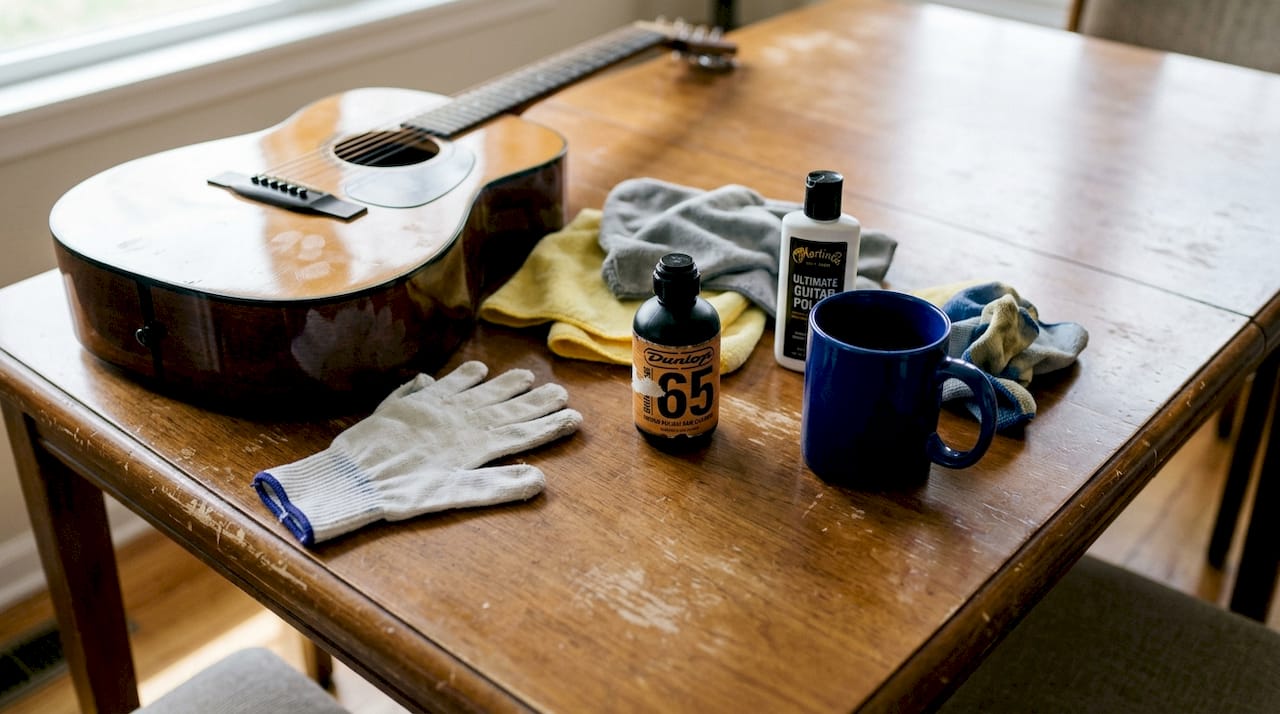
When it comes to polishing, less is more. Applying guitar polish once a month is usually enough. Overwaxing creates product buildup that can actually trap moisture against the wood and harm older finishes. This is a particularly common mistake with vintage instruments.
Pro Tip: Microfiber cloths are your best tool. They pick up dust, oils, and fingerprints without scratching. Keep one in your case at all times and wipe your guitar down after every session. Pay special attention to the fretboard, the back of the neck, and the area around the soundhole where sweat and skin oils accumulate most.
If you’re working with a vintage instrument or considering acoustic guitar restoration, choosing the right cleaning products is the starting point of a much larger care process. Getting this step right protects every subsequent repair or restoration effort.
Once you know which cleaning products are safe, it’s time to focus on the central component of your guitar’s playability: action and setup.
2. Setting and maintaining string action
String action refers to the height of the strings above the fretboard. It directly affects how easy the guitar is to play and how clearly notes ring out. Too high, and your hand fatigues quickly. Too low, and strings buzz against the frets. Finding and maintaining the right balance is one of the most impactful things you can do for your instrument.
How to measure action:
- Capo the first fret to eliminate nut slot depth from the measurement.
- Place a string action gauge or ruler at the 12th fret.
- Measure the gap between the bottom of the string and the top of the 12th fret.
- Compare to the standard ranges below.
- Decide whether the saddle or nut needs adjustment.
- Make changes gradually and recheck after each step.
Standard action reference:
| String | Ideal range | Acceptable upper limit |
|---|---|---|
| Low E (6th) | 2.0 to 2.4mm | 2.8mm |
| High E (1st) | 1.5 to 1.8mm | 2.0mm |
These action guidelines are widely used by luthiers and represent a solid starting point for most steel-string acoustic players. Classical guitars use slightly higher action by design, so adjust your expectations accordingly.
To lower action, most adjustments happen at the saddle, the white or bone piece at the bridge. Sand the bottom of the saddle, not the top. Sanding the top changes the contact point and can cause string buzz or dead spots. When sanding, remove approximately twice the amount you want to lower the action. So if you want to drop the action by 0.5mm at the 12th fret, sand 1mm off the saddle bottom. Sand evenly and check often using a flat surface or sandpaper on a tile.
The nut slots, located at the headstock end of the neck, also affect action, especially in the first few frets. Slots that are too shallow cause excessive pressure on your fretting hand. Slots that are too deep cause buzzing on open strings. Nut adjustments are more delicate and often worth leaving to a professional if you’re unsure.
Understanding bridge mechanics and adjustability can also inform how you approach setup, since bridge construction varies significantly across guitar types. For vintage instruments especially, checking your vintage guitar action care requirements before making any adjustments prevents unnecessary wear on irreplaceable parts.
Proper action is only part of the equation. Environmental factors like humidity play a critical role in overall guitar health.
3. Protecting your guitar from humidity swings
If there is one single factor that causes more acoustic guitar damage than anything else, it is uncontrolled humidity. Wood expands and contracts with moisture changes, and acoustic guitars are made of thinly carved, highly responsive tonewoods. Even small shifts in relative humidity (RH) over days or weeks can cause serious structural damage.
Here is what happens at each extreme:
Low humidity (below 40% RH): The wood shrinks. Cracks appear on the top, back, or sides. Fret ends protrude as the fretboard shrinks inward. Glue joints loosen. This damage is often permanent and expensive to repair. Winter heating seasons are the most dangerous period for most players in temperate climates.
High humidity (above 60% RH): The wood swells. Glue joints soften and can separate. The top bellies up around the bridge, raising action significantly. While high humidity risks are generally considered less catastrophic than low humidity damage, they are still serious and should not be ignored.
Key humidity facts to know:
- The safe zone is 45% to 55% RH for most acoustic guitars.
- Cracks caused by low humidity often appear suddenly rather than gradually.
- A dropped guitar in dry conditions can crack more easily than in stable humidity.
- Finish checking (a pattern of small cracks in the lacquer) is an early sign of dryness.
Humidity management tools compared:
| Method | Best for | Pros | Cons |
|---|---|---|---|
| Room humidifier | Multiple guitars | Stable environment | Requires monitoring |
| Soundhole humidifier (sponge) | Single guitar | Inexpensive, simple | Needs frequent refilling |
| Humidipak (two-way) | Case storage | Set and forget | More expensive |
| Silica gel packs | High humidity areas | Absorbs excess moisture | Replace regularly |
Many players find that managing humidity effectively comes down to a personal balance: a room humidifier running during winter months for guitars displayed on a wall, and Humidipaks inside closed cases for instruments in storage. A digital hygrometer placed inside or near the case gives you accurate RH readings and removes the guesswork.
For more on safe storage conditions and long-term instrument protection, the guitar storage tips available from our team cover both climate and physical storage decisions in depth.
Environmental control matters for all acoustics, but certain guitar types need special attention, especially vintage and laminated models.
4. Special tips for vintage and laminated acoustic guitars
Not all acoustic guitars respond the same way to humidity or cleaning. Understanding your specific guitar’s construction helps you tailor your care approach.
Laminated acoustics (guitars made with layers of wood pressed together rather than solid wood tops, backs, or sides) are more resistant to humidity swings than solid-wood instruments. Brands like Yamaha and many entry-level Martins use laminated or HPL (high-pressure laminate) construction for this reason. However, do not assume laminated guitars are maintenance-free. The internal braces, glue joints, and bindings are still vulnerable to moisture and temperature changes. A laminated guitar stored in an extreme environment will still suffer glue failures, buzzing braces, and warped necks over time.
Vintage acoustic guitars require extra care for several reasons:
- Older nitrocellulose finishes are thinner and more reactive to cleaning products.
- Original glue joints (often hide glue) are period-correct and irreplaceable.
- Worn frets and aged hardware are part of the instrument’s identity and value.
- Any overcleaning or abrasive product application can reduce the collector value significantly.
Here are specific care tips for vintage and laminate instruments:
- Never use abrasive polish on vintage finishes. Use only a dry or very lightly dampened microfiber cloth for routine cleaning.
- Avoid rapid temperature changes. Bringing a cold guitar in from the car and immediately opening the case is a common cause of condensation and potential cracking.
- Store vintage instruments in hard cases with a reliable humidity system, never on open wall hangers unless the room is climate controlled year-round.
- Inspect glue joints seasonally. Run your fingernail gently along the seam where the top meets the sides. Any lifting or clicking sound signals early glue separation.
Pro Tip: When working with a vintage instrument, less intervention is almost always better. If you’re unsure whether a product or technique is safe, hold off and consult a specialist. A single misstep with the wrong product can reduce a guitar’s collector value by hundreds or thousands of dollars. Visit our authentic preservation tips guide for a deeper look at period-correct care methods.
For those interested in pursuing vintage guitar restoration, the distinctions between different construction eras and finish types matter enormously when deciding what products and techniques are appropriate.
What decades of guitar care taught us
Here is something the guitar care community rarely says out loud: most acoustic guitar damage is caused by the owner, not by time or bad luck. Over many years working with rare, restored, and collectible instruments, one pattern appears again and again. The players who tinker constantly, polish weekly, swap strings every month, and constantly tweak their action often end up with instruments in worse shape than those who simply store their guitar properly and leave it mostly alone.
The biggest maintenance mistake is not neglect. It is overthinking.
A stable environment does more for your guitar’s long-term health than any product on the market. A guitar kept at 50% RH and 65 to 70 degrees Fahrenheit, played regularly and wiped down after sessions, will outlast a guitar that gets obsessive weekly polishing in a room that swings between 30% and 70% humidity with the seasons.
There is also a common belief that professional setups are something only experienced players need. We’d push back on that. Even beginners benefit from understanding their action and knowing how to recognize when something is off. And with the knowledge in this guide, you can handle basic saddle sanding and humidity monitoring yourself, saving money and building a real connection with your instrument. More complex work like fret leveling, nut replacement, or truss rod adjustment still belongs with a skilled luthier, but day-to-day care is absolutely within your reach.
One more thing worth saying: the value of a vintage acoustic is tied directly to its condition, originality, and history of care. Proper maintenance is not just about tone. It is an investment decision.
Restore, value, or collect: Next steps for your acoustic
These tips cover the foundations of acoustic guitar care, but there is always more to learn when you’re protecting an instrument you love or growing a collection.

Whether you’re ready to restore your acoustic guitar after years of use, or you’re wondering whether your instrument has collectible value, Vintage Guitar World gives you the expert guidance to take the right next step. Our detailed guides, valuation resources, and curated catalog are built for players and collectors who take their instruments seriously. If you’re curious about what makes certain instruments worth preserving and acquiring, our resource on identifying collectible guitars is a strong starting point. We’re here to support every stage of your guitar journey.
Frequently asked questions
How often should I clean my acoustic guitar?
Wipe it down with a microfiber cloth after every playing session, and use guitar-specific polish every two to three months to prevent finish buildup and grime accumulation.
What is the ideal humidity level for acoustic guitars?
Aim for 45% to 55% relative humidity. Monitor and maintain RH consistently to prevent both cracking from dryness and glue failures from excess moisture.
Can I use household cleaners on my guitar?
No. Avoid solvents and furniture polish entirely. Even products that seem mild can cloud or dissolve guitar finishes, especially on vintage instruments with nitro lacquer.
How do I know if my guitar needs a setup?
If strings buzz, feel unusually stiff to press, or notes sound dead in certain positions, check your 12th-fret action measurement against the standard ranges and inspect the nut slots for depth issues.
What’s the safest way to store my acoustic guitar?
Store it in a hard case with a reliable humidity system, kept in a room with stable temperature and humidity above 40% RH. Avoid attics, basements, and car trunks where conditions fluctuate widely.