












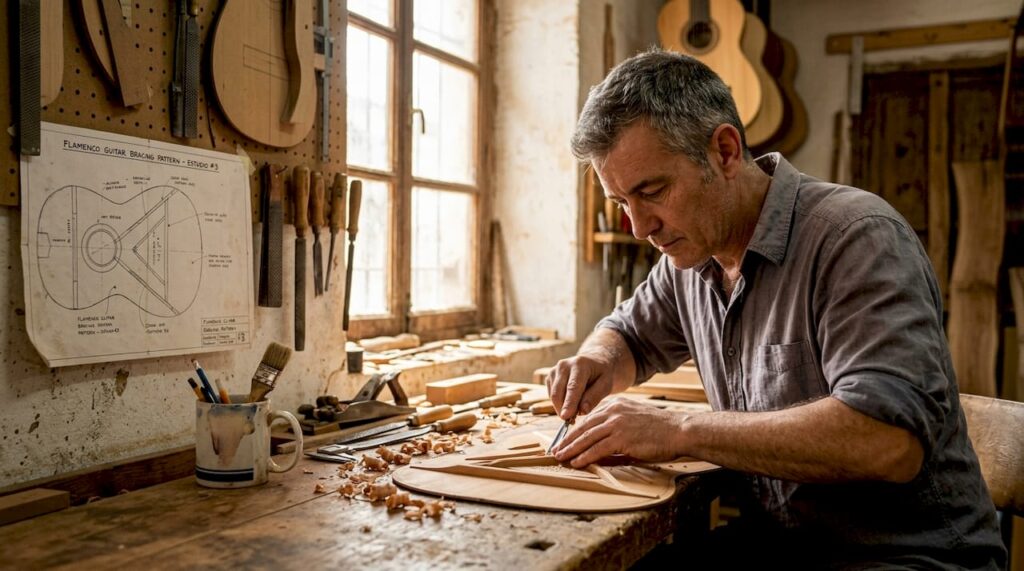

Flamenco guitars are not classical guitars with a Spanish paint job. That misconception costs collectors real money and leaves players chasing the wrong instrument. The truth is that a handcrafted flamenco guitar is a purpose-built machine, engineered by skilled luthiers to deliver explosive percussive attack, razor-fast response, and a tonal brightness that no classical guitar can replicate. Understanding how craftsmanship drives those qualities, and how it shapes long-term value, is what separates a smart buyer from someone who simply got lucky.
Table of Contents
- Why craftsmanship matters in flamenco guitars
- Key materials and construction differences
- Sound, playability, and the luthier’s role
- Collecting and investing in handcrafted flamenco guitars
- Find your handcrafted flamenco guitar
- Frequently asked questions
Key Takeaways
| Point | Details |
|---|---|
| Craftsmanship drives tone | Skilled luthiers use materials and build techniques to create the stunning sound and playability of flamenco guitars. |
| Materials matter most | Cypress and lighter bracing define flamenco guitars, offering a bright, percussive response distinct from classical models. |
| Collector value depends on provenance | Reputation, originality, and history of the guitar and builder significantly influence investment appeal and market price. |
| Practical buying insights | Use maker, condition, and craftsmanship as your main criteria when evaluating flamenco guitars for purchase or collection. |
Why craftsmanship matters in flamenco guitars
The flamenco guitar’s identity lives in the hands of the luthier who builds it. Every decision, from the thickness of the top to the angle of the neck joint, shapes how the instrument responds under a player’s fingers. This is not mass production. It is a tradition of intentional, skilled construction that has evolved over centuries.
Historically, flamenco and classical guitars share the same Torres-era blueprint, the same dimensional framework and bracing geometry developed by Antonio de Torres in the 19th century. But the differences in woods and lighter build are where the two instruments diverge completely. Modern luthiers push that divergence further, experimenting with hybrid bracing patterns that blend flamenco attack with extended sustain.
“The flamenco guitar is not a simplified classical guitar. It is a different instrument built for a different purpose, and the luthier’s choices make that purpose audible.”
For collectors, craftsmanship is not just about tone. It is about provenance and reputation. A guitar built by a recognized master carries a story, a lineage, and a market value that a factory instrument simply cannot match. When you explore handmade guitars for flamenco, you quickly realize that the builder’s name is as important as the wood species on the label.
Here is what skilled luthier work delivers in a flamenco guitar:
- Precise top thickness calibrated for fast vibration and bright attack
- Intentional bracing that controls resonance without killing projection
- Neck geometry set for low action without fret buzz
- Wood selection matched to the player’s tonal goals
- Hand-fitted joints that eliminate dead spots and energy loss
Understanding the full picture of flamenco vs classical guitars helps you appreciate why these construction choices are not cosmetic. They are functional. And when you look at top makers of flamenco guitars, you see how reputation compounds over decades into serious collector value.
Key materials and construction differences
Material selection is where a flamenco guitar’s character is born. The choice of wood for the back and sides is the single biggest factor in determining whether a guitar sounds like a flamenco instrument or a classical one.
Cypress is the traditional choice for flamenco backs and sides. It produces a bright percussive sound with low action that cuts through the rhythmic complexity of flamenco music. Classical guitars typically use rosewood, which adds warmth and sustain but sacrifices the snap and immediacy that flamenco demands. The top is also thinner on a flamenco guitar, which lowers the resonant threshold and lets the instrument respond to lighter touches.
| Feature | Flamenco guitar | Classical guitar |
|---|---|---|
| Back and sides | Cypress (traditional) | Rosewood or mahogany |
| Top thickness | Thinner for fast response | Thicker for sustain |
| Bracing | Fewer struts, lighter | More struts, heavier |
| String action | Very low | Higher |
| Golpeador (tap plate) | Yes | No |
| Tonal character | Bright, percussive, fast | Warm, sustained, full |
The golpeador deserves special mention. This thin protective plate, usually clear or white, sits on the soundboard to protect it from the rhythmic tapping and strumming that defines flamenco technique. It is a functional element, not decorative, and its presence on a guitar tells you immediately that the builder understood what the instrument was for.
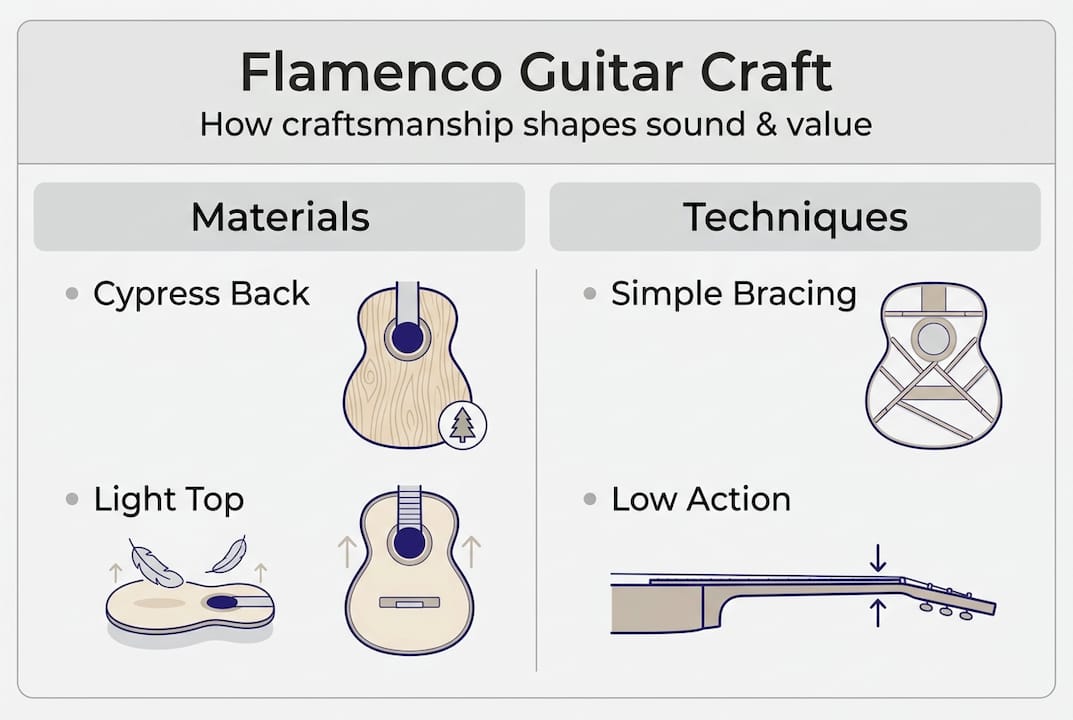
Pro Tip: When evaluating a flamenco guitar, press lightly on the top near the soundhole. A well-built flamenco top will feel noticeably more flexible than a classical guitar top. That flexibility is what gives the instrument its fast attack.
Bracing patterns also differ in meaningful ways. Flamenco guitars use simpler, lighter bracing with fewer struts, which allows the top to vibrate more freely. This is a deliberate trade-off: less sustain in exchange for more immediacy. Understanding the difference between classical and Spanish guitars clarifies why these trade-offs exist and why they matter for both performance and collecting.
If you want to see how these construction choices play out in real instruments, studying well-known flamenco guitar models gives you a practical reference point. And if you are learning the technique to match the instrument, flamenco guitar lessons can help you develop the touch that these guitars are built to reward.
Sound, playability, and the luthier’s role
A master luthier does not just build a guitar. They tune it. Every element of the construction process is a variable that the builder adjusts to achieve a specific sonic result. The top graduation, the brace height, the bridge mass, the nut slot depth: all of these interact to create the instrument’s voice.
For players, the most immediate quality is response. A well-built flamenco guitar reacts to the slightest change in right-hand technique. Picado (single-note runs), rasgueado (strumming), and golpe (percussive tapping) all demand different things from the instrument, and a skilled luthier builds a guitar that handles all three without compromise.

For collectors, the calculus shifts toward provenance and originality. As documented in flamenco guitar history, luthiers like Marcelo Barbero and the Conde family built instruments whose reputations have only grown with time. Cypress produces a brighter, faster attack while rosewood delivers warmth and sustain, and preferences among serious players often blur the line between flamenco and classical repertoire.
Here is how to evaluate a luthier’s impact on an instrument:
- Research the maker’s history and where they trained. Apprenticeship lineage matters enormously in the flamenco world.
- Examine the interior work through the soundhole. Clean, precise bracing and neat kerfing indicate a careful builder.
- Check the neck joint for gaps, cracks, or signs of poor fitting. A tight joint preserves energy transfer.
- Play every fret on every string. Buzzing or dead notes reveal setup problems that a master builder would never leave unresolved.
- Look for original parts. Replaced tuners, bridges, or nuts reduce collector value significantly.
| Luthier | Era | Known for | Collector value |
|---|---|---|---|
| Marcelo Barbero | 1940s to 1950s | Explosive attack, thin tops | Very high |
| Hermanos Conde | 1960s to present | Consistency, tonal balance | High |
| Antonio de Torres | 1850s to 1890s | Foundational design | Museum-level |
| Santos Hernandez | 1910s to 1940s | Rich tone, elegant build | Very high |
“The luthier’s reputation is not just a marketing label. It is a documented record of consistent quality that the market has verified over decades.”
If you are ready to make a purchase decision, the flamenco guitar buying guide walks you through the process with practical criteria. And if you are focused on the collector side, rare flamenco guitars represent the upper tier of what the market offers.
Collecting and investing in handcrafted flamenco guitars
Buying a handcrafted flamenco guitar as a collector is a different discipline than buying one as a player. Both require knowledge, but the collector’s checklist adds layers of documentation, condition assessment, and market awareness that go beyond how the instrument sounds.
Provenance is the foundation of collector value. A guitar with a clear ownership history, original case, and documented luthier attribution commands a premium that an identical guitar without that paper trail simply cannot match. As confirmed by luthier reputation research, makers like Barbero and Conde consistently hold and grow their value because the market trusts their quality record.
Here is what to look for when evaluating a handcrafted flamenco guitar for collecting:
- Original finish integrity: Refinished guitars lose significant value. Look for even aging and original pore-fill.
- Structural soundness: Check the top for cracks, especially around the bridge and soundhole. Small cracks, if properly repaired, are acceptable. Unrepaired cracks are not.
- Label authenticity: Interior labels can be forged. Cross-reference the construction style, wood choices, and hardware with known examples from the claimed maker.
- Action and setup: Original setups preserved by careful owners indicate respectful stewardship.
- Case and accessories: Original cases, certificates, and correspondence add measurable value.
Pro Tip: Before buying a vintage flamenco guitar, request a high-resolution photo of the interior through the soundhole. The quality of the bracing work and the cleanliness of the interior finish tell you more about the builder’s standards than the exterior ever will.
Understanding flamenco guitar prices across different makers and eras gives you a realistic baseline for negotiation. And if you are targeting the upper end of the market, studying rare flamenco guitar collecting helps you understand what separates a good investment from a great one.
The investment case for handcrafted flamenco guitars is strong when you buy correctly. Instruments by recognized masters in original condition have appreciated steadily, driven by a global collector base and a finite supply of authentic vintage examples. The key is patience and knowledge. Rushed purchases based on surface appeal rarely perform well over time.
Find your handcrafted flamenco guitar
If this article has sharpened your eye for what makes a flamenco guitar genuinely exceptional, the next step is seeing that knowledge applied to real instruments. At Vintage Guitar World, we curate a selection of handcrafted and vintage flamenco guitars evaluated by experts who understand exactly what you have been reading about.

Our handcrafted guitar craftsmanship guide goes deeper into what separates a master-built instrument from a production guitar. If you are ready to buy, the unique handmade guitar guide walks you through the process step by step. And if you are specifically focused on flamenco, our resource on handmade guitars for flamenco artists connects you directly to instruments and insights built for your needs. Every guitar we list comes with detailed provenance notes, condition assessments, and expert context so you can buy with confidence.
Frequently asked questions
How does craftsmanship affect flamenco guitar sound?
Craftsmanship, especially material selection and bracing, shapes the guitar’s percussive brightness and attack, giving it its signature flamenco sound. A thinner top and lighter bracing allow faster vibration and more immediate response than a classical guitar delivers.
What woods are most commonly used in flamenco guitars?
Cypress is traditional for flamenco backs and sides, prized for its bright tone and rapid attack. Classical guitars typically use rosewood, and the difference in woods is the primary reason the two instruments sound so distinct.
Which makers are most sought after for handcrafted flamenco guitars?
Renowned luthiers like Barbero and Conde are highly prized for their craftsmanship and tonal quality. Their luthier reputation is backed by decades of consistent market performance and collector demand.
What makes a vintage flamenco guitar a good investment?
A vintage flamenco guitar’s value is driven by its maker, originality, condition, and documented provenance. Instruments with clear ownership history and original condition consistently outperform those with gaps in their documentation or signs of heavy restoration.