












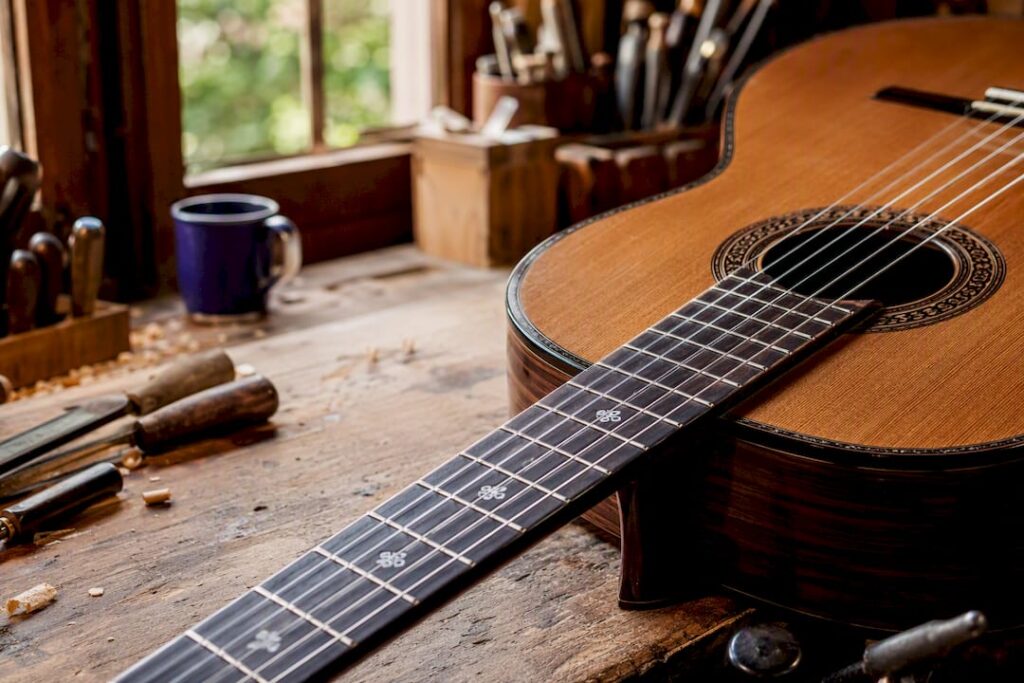

Most finished guitars containing palisander (Dalbergia spp.) do not need CITES paperwork to be owned, sold, or carried across borders in the EU. The exception is Rio palisander, Dalbergia nigra, which stays tightly restricted. If your guitar’s rosewood is unidentified or you suspect Rio palisander, carry proof of acquisition and a Declaration of materials and contact the Bundesamt für Naturschutz (BfN) about a Musikinstrumentenbescheinigung before you travel or sell.
TL;DR:
- Guitars made with Dalbergia species other than Rio palisander usually do not require CITES permits when owned, sold, or transported within the EU.
- A Musikinstrumentenbescheinigung issued by the German authorities is necessary only for traveling outside the EU with instruments containing Rio palisander or other Annex A materials.
- Documentation proving the wood species, origin, and lawful acquisition—such as invoices, declarations, or expert appraisals—is crucial to avoid seizures or fines.
- Identifying the specific Dalbergia species is essential, especially distinguishing Rio palisander, which remains fully regulated under CITES Appendix I and EU law.
- Pre-1992 vintage guitars with unclear wood provenance may require expert verification and detailed paperwork to prove legality before sale or export.
Table of Contents
- What changed in 2019, and why cites gitarre palisander questions still matter
- How do you travel with a palisander guitar from Germany?
- Do you need a permit to buy or sell a palisander guitar in Germany?
- Rio palisander vs. other rosewoods: what’s the real risk?
- What documents should you carry or request?
- How Vintage Guitar World handles documentation and provenance
- Get expert help with your palisander guitar’s paperwork
- Where to find official CITES and BfN resources
- Sources
What changed in 2019, and why cites gitarre palisander questions still matter
The confusion around cites gitarre palisander rules traces back to one regulatory shift. In 2019, CITES contracting parties adopted an annotation, implemented in the EU under Regulation (EC) No 338/97, that exempted finished musical instruments, parts, and accessories made from most Dalbergia species from permit requirements. That change took effect in late 2019 and freed up the vast majority of guitars built with East Indian, Madagascar, or Honduran rosewood.
One species was deliberately left out.
- Dalbergia nigra, known as Rio palisander or Brazilian rosewood, remains listed in CITES Appendix I and EU Annex A.
- Instruments containing it are not covered by the finished instrument exemption, regardless of how old or well documented they are.
- The BfN acts as Germany’s competent CITES management authority, translating the EU regulation into enforcement at borders, shops, and shipping counters.
Industry groups like NAMM note the 2019 changes were meant to reduce paperwork burden on musicians specifically because finished instruments represent a tiny fraction of global timber trade compared to industrial logging. That context matters: the rule isn’t designed to trap guitarists, it’s designed to leave the highest risk species under scrutiny while freeing everything else.
How do you travel with a palisander guitar from Germany?
The Musikinstrumentenbescheinigung is the document most touring musicians will eventually need. Issued by the BfN, it’s valid for three years, covers multiple border crossings, and is tied to a specific instrument, not a person or a batch of gear. It applies to non-commercial professional uses: performances, recordings, teaching, and similar activities. It does not authorize commercial sale or export.
You need one if your guitar contains Rio palisander or another Annex A material and you’re traveling outside the EU. Purely intra-EU travel with a finished instrument made from an exempted Dalbergia species usually needs no certificate at all.
- Check the wood species against your invoice, builder’s specification sheet, or an expert appraisal.
- Gather any existing documentation: purchase invoice, maker statement, prior CITES paperwork.
- If records are thin, ask a qualified luthier for a written material declaration.
- Contact the BfN directly to request the Musikinstrumentenbescheinigung if your instrument qualifies.
- Carry originals, not photocopies, when you cross a border.
Pro Tip: Prepare your Declaration of materials in English, French, and Spanish. Customs officers at busy transit hubs move faster when the language barrier isn’t part of the inspection, according to guidance from Touring Artists.
Do you need a permit to buy or sell a palisander guitar in Germany?
Private possession of a guitar with exempted Dalbergia wood needs no ongoing paperwork once you own it. Selling it privately, once, to another individual in Germany, is generally straightforward if the instrument isn’t Rio palisander. Commercial trade is a different matter entirely.
- Dealers importing or exporting instruments as part of a business need to check whether an EU marketing certificate or CITES export/import permit applies, particularly for Rio palisander stock.
- Evidence of lawful acquisition, meaning invoices, supplier declarations, or prior certificates, is often required to demonstrate a piece entered trade legally.
- Selling or transporting an undocumented Rio palisander instrument commercially can result in seizure at customs and fines, according to municipal guidance from Leipzig.
- Dealers should retain supplier declarations and wood-source records indefinitely, not just at the point of sale, since manufacturers are still required to log the wood types they use even under the exemption.
Buyers transferring ownership should ask the seller to hand over any material declarations along with the instrument itself, and sellers should keep a copy for their own records.
Rio palisander vs. other rosewoods: what’s the real risk?
The single biggest point of confusion in cites bescheinigung gitarre paperwork is species identification. General Dalbergia species sit under CITES Appendix II and are largely exempt when finished. Dalbergia nigra sits under Appendix I, the strictest tier, with no instrument exemption at all.
- If your guitar’s back and sides are labeled simply “rosewood” with no species named, treat it as unresolved until you get an expert opinion.
- Vintage instruments built before the 1990s often predate detailed species labeling entirely, which makes provenance work essential rather than optional.
- A luthier’s written declaration or a formal appraisal can substitute for missing factory paperwork in many cases.
Proving lawful pre 1992 origin for Rio palisander is genuinely difficult in practice. A practitioner handbook from FIM and Pearle notes that incontrovertible provenance evidence is often the only reliable route to lawful export, and many vintage Rio palisander guitars simply can’t clear that bar without significant documentation work. When in doubt, treat the instrument as high risk and get an expert declaration before you plan any sale or trip.
What documents should you carry or request?
Assembling paperwork before you need it saves weeks of scrambling later. A compact travel folder, kept both digitally and printed, is what BfN and industry sources consistently recommend for musicians crossing borders regularly.
- Original purchase invoice or receipt naming the wood species where possible.
- A builder or manufacturer statement identifying the tonewood used.
- A Declaration of materials, ideally multilingual, prepared by a luthier or dealer.
- Serial numbers and clear photographs of the instrument, headstock, and label.
- Any prior CITES certificates or the Musikinstrumentenbescheinigung itself, if issued.
Request an EU marketing certificate when buying from a dealer engaged in commercial trade, and a Musikinstrumentenbescheinigung specifically when you know Rio palisander or another Annex A material is present. Keep originals in a dedicated folder and store scanned backups separately, since customs officers generally want to see the physical document, not a phone screenshot.
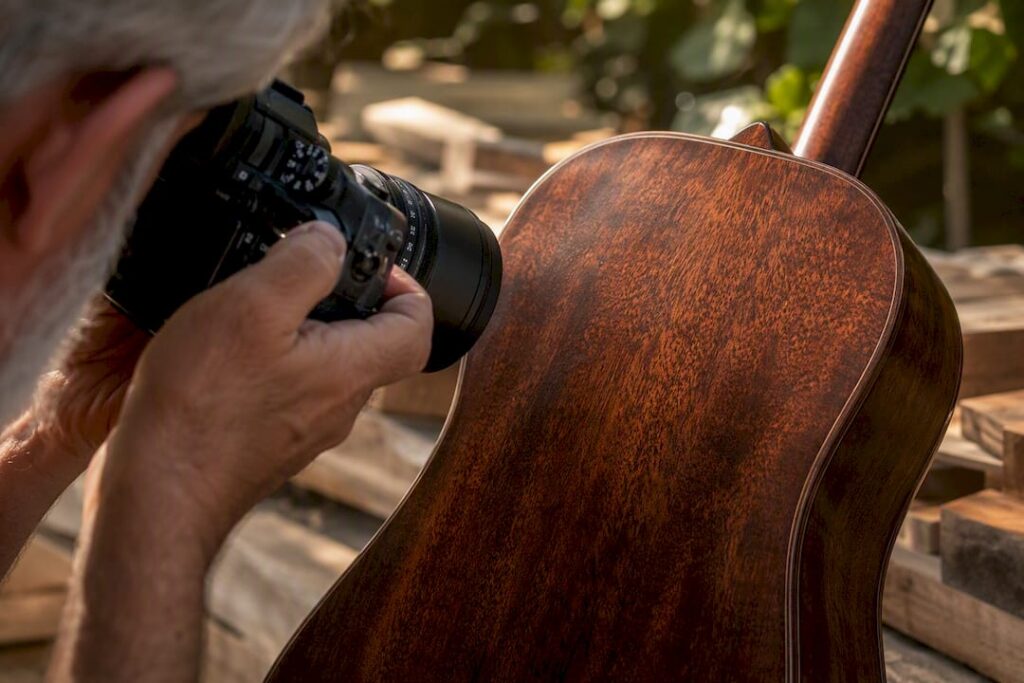
Pro Tip: Photograph the wood grain up close before any trip or sale. It won’t replace expert verification, but it gives an appraiser something concrete to work from if a dispute comes up later.
How Vintage Guitar World handles documentation and provenance
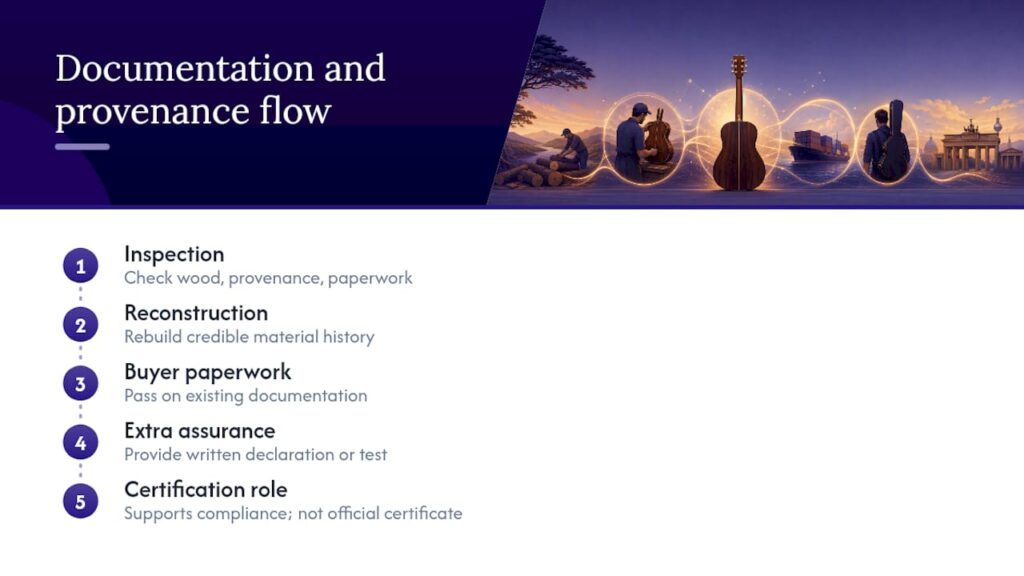
Every instrument that passes through Vintage-guitar-world gets inspected for wood species, provenance, and existing paperwork before it’s listed. When records are incomplete, our team works to reconstruct a credible material history rather than guessing, and buyers receive whatever documentation the instrument came with.
If you’re planning to travel with a purchase or need extra confidence before a sale, ask us for a written material declaration or a dedicated testing appointment. Our certification work supports compliance. It doesn’t replace an official Musikinstrumentenbescheinigung when one is legally required.
— Vintage
Get expert help with your palisander guitar’s paperwork
Chasing down a Musikinstrumentenbescheinigung or piecing together provenance for a decades-old Rio palisander instrument takes real expertise, not guesswork with old invoices. Vintage-guitar-world offers hands-on appraisal and certification services built specifically for owners and dealers who need documented, defensible answers about what their guitar is actually made of.
Our guitar appraisal service covers expert wood inspection, material declaration drafting, and full valuation reports, the same groundwork you’d need before applying to the BfN or listing an instrument for sale. Turnaround depends on the instrument’s complexity and how much existing documentation you bring in, and our fees are quoted per appraisal rather than as a flat rate. These services strengthen your paperwork trail; they don’t substitute for a Musikinstrumentenbescheinigung or CITES permit where the law requires one. If you own or are considering a palisander instrument with uncertain history, book a testing appointment with our team and get a clear answer on what you’re actually holding.
Where to find official CITES and BfN resources
For forms and direct contact details, start with the BfN’s musical instrument guidance, the Leipzig certificate leaflet as a procedural example, and the European Commission’s list of national CITES authorities for contacts outside Germany. For species annotation text, consult the CITES COP18 documentation directly.
Sources
- Bundesamt für Naturschutz (BfN) — Musikinstrumente
- Meinl — CITES guidance for musical instruments
- CITES COP18 information (annotation details)