



If you own a rare, authenticated vintage instrument with strong provenance and want the highest possible price, auction often delivers. If you want predictability, professional authentication and less hassle, a dealer or consignment sale is usually the better fit, and this is where working with an expert dealer pays off. One caveat applies to every seller in Germany: how often and how commercially you sell can change your tax and registration obligations.
TL;DR:
- Auction sales can reach significantly higher prices for rare or celebrity-owned guitars due to competitive bidding, but they involve higher seller effort and risk.
- Dealer or consignment sales offer more predictable pricing, immediate payout, and less hassle, especially for guitars needing certification or documentation.
- Overseas bidding in auctions requires careful logistics, export paperwork, and insurance, with provenance being a key factor in attracting top bids.
- Reputable dealers provide clear contracts on commissions, insurance, and payout terms, reducing disputes and ensuring professional handling.
- Germany’s tax rules depend on sale frequency and presentation, so maintaining sales as occasional and well-documented can limit tax obligations.
Table of Contents
- Auction vs Dealer Sale: A Quick Reference Comparison
- How Guitar Auctions Work: Formats, Fees and Buyer Profile
- How Dealer and Consignment Sales Work: Valuation, Contracts and Timeline
- A Decision Checklist: Match Your Goal and Guitar to the Right Route
- Costs, Taxes and Risks: What to Plan For
- When Vintage Guitar World Is the Right Option for Sellers
- Why We Still Sometimes Recommend a Private Sale
- Ready to Sell? Start With a Valuation
- FAQ
- Sources
Auction vs Dealer Sale: A Quick Reference Comparison
Before choosing a route, it helps to see how auctions and dealer or consignment sales stack up across the factors that actually decide your outcome: money in hand, time spent, risk carried, and who sees your guitar.
- Expected net price: Auctions can produce higher peaks for rare or famous instruments, since competitive bidding pushes prices up; dealers offer steadier, more predictable numbers.
- Seller effort: Auctions require you to handle photography, shipping logistics, and often your own marketing copy; a dealer or consignment partner typically takes on these tasks.
- Payout speed: Auction proceeds arrive after the sale closes and funds clear, often weeks later; dealer purchases can pay out immediately, while consignment sales pay once a buyer is found.
- Risk: Auctions carry payment and shipping risk spread across many unknown bidders; reputable dealers concentrate that risk in one accountable party with established procedures.
- Buyer reach: A well-marketed auction can reach international collectors instantly; a dealer’s reach depends on their existing client network and reputation.
- Suitability by guitar type: Rare and historically significant instruments tend to reward auction exposure, while vintage guitars needing certification or carrying complex ownership history often do better through a dealer who can document and vouch for them.
A simple rule of thumb: use auction for instruments with built-in hype, documented rarity, or celebrity history. Use a dealer when your guitar needs expert condition reporting, restoration, or certification before a buyer will trust the price. If your instrument falls into that second category, collectors and estates often find that a specialist like Vintage Guitar World is a direct fit, since valuation and certification are built into the process rather than bolted on afterward.
How Guitar Auctions Work: Formats, Fees and Buyer Profile
Auctions sell guitars through two broad formats. Timed online auctions run over days and let a global pool of bidders compete asynchronously, while live auctions (in person or livestreamed) compress bidding into a single high-energy event that can push prices further when multiple bidders want the same lot.
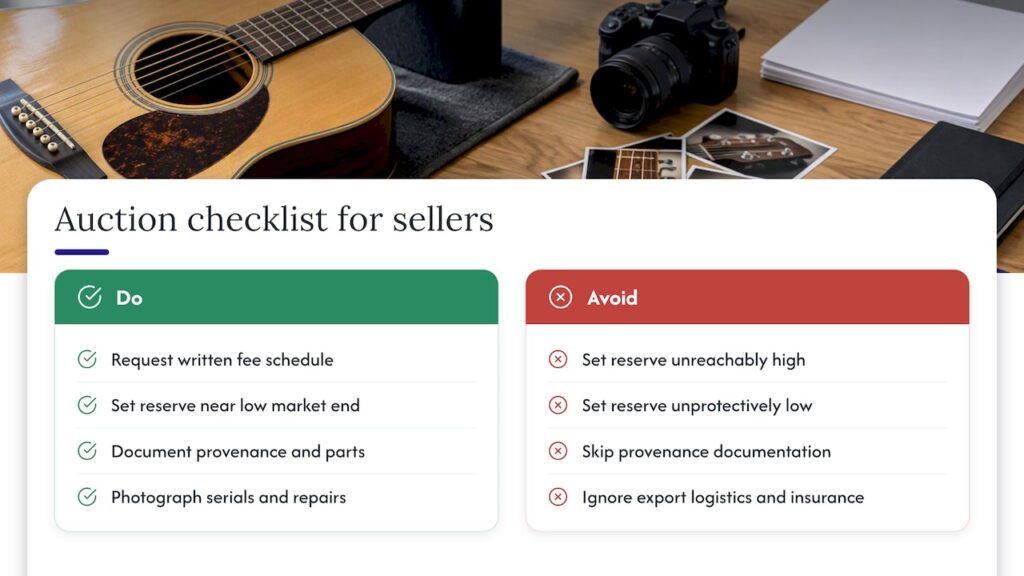
Fees vary by auction house, but sellers typically encounter an insertion or listing fee, a seller’s commission taken from the hammer price, and a buyer’s premium added on top for the purchaser. Because these amounts vary house to house, always ask for a written fee schedule before consigning a guitar, so you can estimate your net proceeds rather than guess at them.
Reserve pricing is the seller’s main lever. Setting a reserve too high can scare away bidders and leave your guitar unsold; setting it too low risks an unexpectedly cheap sale if interest fizzles. Auction houses generally recommend a reserve close to the low end of realistic market value, which keeps bidding active while still protecting you from a disaster price.
Provenance drives outcomes more than almost anything else, similar to how condition and history are key value drivers in collectibles as explained in The Hidden Value of Vintage Jewellery – blackwellonline. The record-setting David Gilmour guitar collection sold for $21.5 million, a result that shows how strong documentation, celebrity history, and focused marketing can pull in bidders willing to pay far above typical market value. Few instruments carry that kind of story, but the principle scales down: clear history, original parts, and verifiable rarity all lift bids.
Cross-border bidding adds logistics to plan for. International buyers mean export paperwork, customs considerations, and shipping insurance sized to the instrument’s value, not just its weight.
Pro Tip: Photograph every serial number, repair, and original part before you ship a guitar to auction, so you have your own record if a dispute arises later.
How Dealer and Consignment Sales Work: Valuation, Contracts and Timeline
Selling through a dealer splits into two distinct paths. An outright purchase means the dealer buys your guitar directly, pays you immediately, and takes on all resale risk themselves, usually at a lower price than consignment because they are compensating for that risk. Consignment means the dealer lists and markets your guitar on your behalf, pays you only after it sells, and typically nets you more since you are not discounting for the dealer’s risk.
Whichever path you choose, a written consignment agreement should spell out several terms before you hand over an instrument:
- Commission rate and whether it is flat or scaled to final sale price.
- Listing duration and what happens if the guitar has not sold by the end of it.
- Insurance coverage while the instrument is in the dealer’s possession.
- Reserve price and who controls adjustments to it.
- Payout timing once a sale is confirmed.
Reputable consignment terms exist precisely to prevent disputes over these points, and insisting on a clear agreement protects both your instrument and your payout.
Once a buyer is interested, most dealers build in an inspection or approval period before finalizing payment. During that window:
- The buyer inspects or plays the instrument in person or receives it on approval.
- The dealer confirms condition matches the listing description.
- Funds clear and the seller receives payout according to the agreed schedule.
This approval period protects buyers and, indirectly, sellers, since a dealer who stands behind the sale has an incentive to describe the guitar accurately in the first place. Dealers also add value through professional photography, minor restoration work, and authentication, all of which can raise a guitar’s final sale price enough to offset commission costs. For sellers who want a structured version of this process, our step-by-step consignment guide walks through what to expect, cost estimate included.
A Decision Checklist: Match Your Goal and Guitar to the Right Route
Matching your sale route to your actual goal, rather than habit or convenience, is the single biggest factor in a good outcome. Start by being honest about what you want most.
- If your top priority is the highest possible price and your guitar has documented rarity, celebrity provenance, or strong collector demand, lean toward auction.
- If your top priority is speed and certainty, an outright dealer purchase gets cash in hand fastest, even if the number is lower.
- If your top priority is low hassle with strong authentication, consignment through a specialist dealer handles photography, marketing, and buyer vetting for you.
- If your guitar is mass-market (a common production-line electric or acoustic with no unusual history), a dealer’s established buyer network often outperforms an auction, where it may get lost among rarer lots.
- If your guitar is high-end modern or custom, either route can work, but a dealer’s certification adds trust that modern buyers increasingly expect.
Before committing, look for concrete signals that favor one route over the other: strong existing demand and recent comparable sales favor auction, while incomplete provenance, replaced parts, or an unclear ownership history favor a dealer who can document and explain those gaps to a buyer.
When vetting an auction house, ask directly: What is your marketing reach for instruments like mine? What is the buyer’s premium, and is it disclosed upfront? How is the reserve price set and can I adjust it? Do you have access to international bidders for guitars in my category?
When vetting a dealer, ask: What commission do you charge, and is it negotiable for higher-value instruments? Is my guitar insured while in your possession? What are your appraisal credentials? What is the approval or return window for a buyer, and what happens if a sale falls through?
Pro Tip: Treat a vague answer on commission or insurance as a red flag; a professional dealer or auction house will have these terms in writing without hesitation.
Costs, Taxes and Risks: What to Plan For
The sale price you see advertised is never the number you actually keep. Several costs chip away at proceeds on both routes, and in Germany, your tax treatment depends partly on how you sell.
Occasional private sales of personal instruments in Germany are generally not taxable, but selling regularly, presenting goods professionally, or showing clear profit motive can shift you into Gewerbe territory, where registration and tax reporting may apply. The Finanzamt weighs turnover and regularity among other factors, and courts have found that a sustained pattern of sales activity, even through platforms rather than a shop, can be judged as commercial in the eyes of tax authorities. Keeping careful records and selling intermittently rather than as a side business generally keeps you in the private-seller bracket.
Beyond tax, budget for the practical costs that reduce net proceeds on either route:
- Professional photography, which materially affects buyer trust and final price.
- Pre-sale restoration or setup work to present the instrument at its best.
- Shipping and insurance sized to the instrument’s actual value, not just its retail replacement cost.
- Auction commission or dealer commission, which vary by house and should be confirmed in writing.
Used electric guitar prices sat about 10% below their pandemic-era highs in early 2025, according to market observation and seller guidance, underscoring why model, origin, original parts, and condition now matter more than ever in setting realistic price expectations.
To reduce risk on either route, insist on a documented condition report before listing, use insured shipping for anything of real value, confirm payment methods before releasing an instrument, and get every term in a signed contract rather than a verbal agreement.
When Vintage Guitar World Is the Right Option for Sellers
If your instrument is a vintage, rare, or collectible guitar and you want certification alongside the sale, our services at Vintage Guitar World are built for exactly that situation. We offer exclusive test appointments (Exklusive Anspieltermine), commission-based consignment sales (Verkauf in Kommission), certificates and valuations (Zertifikate und Wertgutachten), and restoration services, each designed to reduce the friction a buyer feels when considering a high-value instrument.
This approach fits collectors, estates handling an inherited instrument, and owners who need an independent valuation before deciding how to sell at all. The typical path starts with a valuation request, continues with a test appointment or consignment intake once terms are agreed, and moves toward sale once the guitar is documented, priced, and listed to the right buyer pool.
Why We Still Sometimes Recommend a Private Sale
Not every guitar belongs on the auction block or in a dealer’s showroom. High-demand modern models with an active resale market often sell quickly and fairly through a private sale or marketplace listing, and sellers who want cash fast sometimes accept a slightly lower price for that speed. Experienced sellers who go this route still insist on documentation and insured shipping, since a private sale offers no safety net if something goes wrong.
— Vintage
Ready to Sell? Start With a Valuation
If you are weighing whether your guitar belongs at auction or with a dealer, the simplest next step is getting an informed opinion before you decide anything else. We offer valuation and certification services that tell you what your instrument is actually worth and what documentation would strengthen a sale, along with consignment terms that spell out commission, insurance, and payout timing upfront.

- Request a valuation or certificate through our main services page to understand your guitar’s market position.
- Review our consignment commission and process page to see contract terms before committing.
- Browse our restoration services if your instrument needs work before it goes to market.
Once we have assessed your guitar, you will know whether consignment, an outright purchase, or a referral toward auction makes the most sense for your specific instrument.
FAQ
Who owns the most expensive guitar in the world?
Ownership of record-setting guitars typically traces to private collectors or the estates of the original musicians, and these instruments rarely stay in one set of hands for long since record prices tend to attract further collector interest. The David Gilmour collection sold for $21.5 million at auction, illustrating how provenance and celebrity history drive record-breaking sales.
What are Custom Shop guitars?
Custom Shop guitars are instruments built by a manufacturer’s specialized in-house division using premium materials, hands-on craftsmanship, and often custom specifications requested by the buyer. They typically carry a higher price than standard production models because of the extra labor and materials involved, and well-documented examples can perform strongly in both dealer and auction markets.
What should I check before buying a guitar?
Confirm the guitar’s condition, originality of parts, and serial number against the maker’s records, since replaced parts or inconsistent serial numbers affect both playability and resale value. If buying online in Germany, remember that distance selling law gives you a 14-day right of withdrawal when purchasing from a trader, which protects you if the instrument does not match its description.
How much was Jimi Hendrix’s guitar worth?
Individual instruments tied to Jimi Hendrix have sold for substantial sums at auction over the years, with final prices depending heavily on documentation and which specific guitar is being sold. Rather than a single fixed figure, pricing for Hendrix-owned instruments reflects the same provenance-driven dynamics seen in other major guitar auctions, where authenticated history pushes bidding well above typical market value.
Should I sell my vintage guitar through a dealer or at auction?
Choose auction if your guitar has strong documented rarity or a compelling ownership story that will attract competitive bidding. Choose a dealer or consignment partner if you want professional certification, steadier pricing, and less hands-on effort throughout the sale.
Sources
- Gitarre verkaufen: Preise, Tipps & Wege 2026
- Do You Pay Tax Selling Online in Germany? (2026)
- Gebrauchte Gitarren online: Das Fernabsatzrecht für Käufer und Verkäufer
- Consignment terms and conditions (example)
- The David Gilmour Guitar Collection sells for $21.5 million | Christie’s