


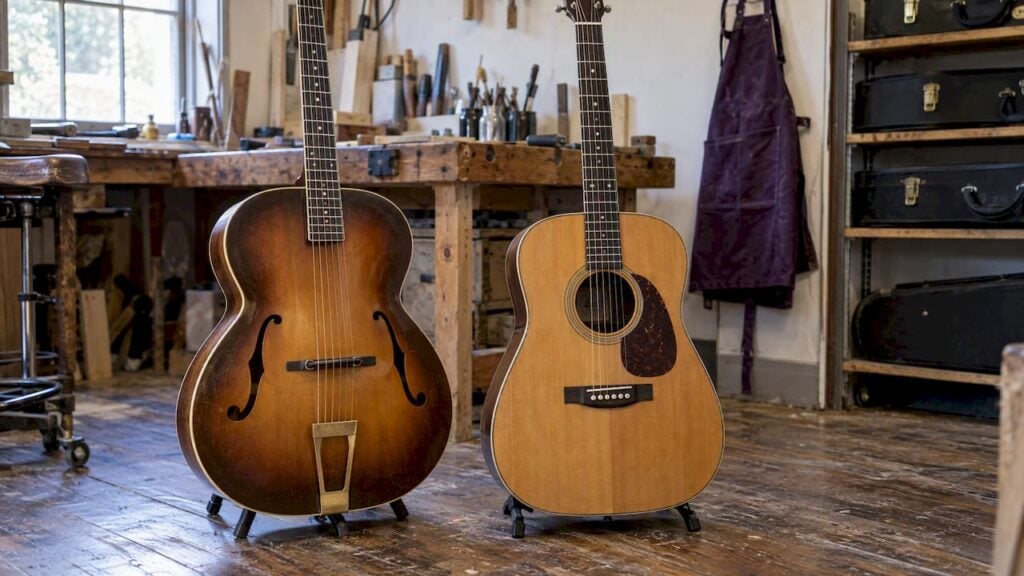

An archtop acoustic gives you focused midrange, quick note decay, and the single-string clarity that cuts through a band, while a flattop gives you fuller bass, longer sustain, and the chordal warmth most singer-songwriters want. If you strum open chords or fingerpick solo, a flattop usually suits you better. If you play single-note lines or need your guitar to sit cleanly inside an ensemble, an archtop is worth serious consideration, especially as modern builders design them for far more than jazz.
TL;DR:
- Modern archtops now incorporate thinner tops and flatter backs to enhance bass response and fingerstyle versatility, blurring traditional genre boundaries.
- Flattops provide deeper bass, longer sustain, and fuller overtones due to their flat soundboard and x-bracing, making them ideal for rhythm and chordal playing.
- The construction process influences tone significantly: archtops use thicker, arched, compression-top plates with f-holes, while flattops employ lightweight, flat soundboards with glued bridges.
- Playability differences include archtops often having higher actions and floating bridges that require adjustments, whereas flattops generally offer lower action for easier chord changes.
- For amplified settings, archtops typically resist feedback better with floating pickups, but careful EQ and positioning are essential for both styles in stage and studio environments.
Table of Contents
- Tonal Differences: What Players Hear and Why
- Construction and Bracing: How Each Top Is Built
- Playability, Setup, and Feel: What Changes Under Your Hands
- Amplification and Feedback: Practical Guidance for Stage and Studio
- Use Cases and Genres: Where Each Guitar Fits
- How to Choose Between an Archtop and a Flattop: A Shop Checklist
- Why Trust Vintage Guitar World on Archtops and Flattops
- Both Instruments Deserve a Place in a Serious Collection
- Try Before You Decide: Testing, Certification, and Restoration
- FAQ
- Sources
Tonal Differences: What Players Hear and Why
Pick up a flattop and strum an open G chord, and you get a wash of overtones that fills a room: deep bass, ringing trebles, and a note that keeps blooming after you’ve moved your hand away. That sustain and bass response come from a thin, flat soundboard braced to flex more freely, usually with X-bracing, letting the top move in broad, sustained waves.
An archtop responds differently to the same chord. The attack arrives fast and clean, but the note decays quicker, and the overall voice leans toward the midrange. Play a single-note melodic line instead, and the difference becomes the point: each note arrives with a percussive, immediate clarity that doesn’t blur into the next one, which is exactly why jazz players favored archtops for comping and improvised lines inside a horn section.
The physical explanation comes down to tension versus compression. A flattop’s soundboard is held flat and under string tension, so the whole plate can flex as a single unit. An archtop’s top is arched and sits under compression, more like a violin or mandolin top, which stiffens the plate and shifts how it vibrates. According to a breakdown of the tonal and structural contrast between the two designs, flattops typically offer a wider frequency range with shimmering highs and deep bass, while archtops emphasize midrange clarity and faster decay.
Bracing and plate thickness reinforce this split. A thin, lightly braced flattop resonates broadly across its surface, which is part of why fingerstyle players prize the resonance for alternating bass lines. A carved or pressed archtop plate is thicker and shaped to specific tap-tuned frequencies, trading some of that broad resonance for punch and separation.
If you want to hear the difference yourself, try these quick comparisons on any two guitars you can get your hands on:
- Play a single melodic line on the low strings and listen for how fast the note fades.
- Strum a full open chord and listen for how long the overtones ring before dying out.
- Pick percussively near the bridge and compare how much “pop” versus “bloom” you hear.
The arching itself matters as much as the wood. Because an archtop’s top sits under compression rather than tension, the plate behaves structurally more like a violin top than a typical acoustic soundboard, which is the root cause of its faster decay and midrange focus.
Construction and Bracing: How Each Top Is Built
The tonal personality of each guitar starts on the workbench, long before any strings go on.
An archtop’s top and back are arched, either carved from solid wood blocks or heat-pressed into shape, and the top is noticeably thicker than a flattop’s. A floating bridge rests under string tension but isn’t glued down, and f-holes (borrowed from violin family instruments) let the arched plates vibrate without a round soundhole interrupting the arch. These are the defining features of the archtop design, developed in the United States by drawing on centuries of violin-family construction.
A flattop, by contrast, uses a thin, flat soundboard glued directly to the body, with the bridge also glued in place rather than floating. Internal bracing, most commonly an X-pattern, supports the top while still letting it flex. A round soundhole sits in the open space below the bridge. Spruce and cedar tops paired with rosewood or mahogany bodies are typical, and the resonance comes from the whole system working as a single flexing unit.
Bracing choice inside an archtop still matters a great deal. According to luthier Bob Benedetto’s notes on archtop bracing, parallel bracing tends to produce a louder, punchier voice, while X-bracing on an archtop leans warmer and more balanced. Both patterns remain common, and the choice is less about one being objectively superior than about how an experienced builder voices the top.
Thickness and bracing geometry change more than loudness. They shift the plate’s resonant frequency, its stiffness, and how long a note sustains before dying out, which is part of why two guitars built from similar wood can sound distinctly different depending on how the top was carved, braced, and tap-tuned.
Practical trade-offs follow from these choices:
- Archtops are more labor-intensive to build well, since carved or pressed plates must be shaped to precise target frequencies.
- Flattops are generally simpler and less costly to produce at a comparable quality level.
- A glued bridge on a flattop is more sensitive to humidity swings, while a floating bridge gives an archtop a bit more forgiveness in that department.
- Repairing a cracked carved top is a more specialized job than most flattop soundboard repairs.
Readers who want a deeper look at how body shape and top construction interact across styles can see our guide to acoustic body shapes for more context.
Playability, Setup, and Feel: What Changes Under Your Hands
The construction differences above translate directly into how each guitar feels to play.
- A floating bridge on an archtop isn’t glued down, so action and intonation are adjusted by shifting the bridge itself, which gives you flexibility but also means the bridge can shift if bumped.
- A glued bridge on a flattop locks intonation in more permanently, trading adjustability for stability.
- Archtops are often set up with slightly higher action to keep the floating bridge under enough tension to stay seated, which can take some getting used to for chord-heavy playing.
- Flattops typically allow lower action more easily, which favors fast chord changes and aggressive strumming.
- Neck joint and body depth also affect reach: a full-depth archtop body can feel bulkier against your strumming arm than a dreadnought or parlor-sized flattop.
When you’re trying guitars in a shop, pay attention to how quickly a single low note dies out, how much resonance you feel through the body on an open chord, and how straightforward the setup looks if you ever need adjustments made.
Pro Tip: If you’re testing an archtop, bring a pick you’d normally use for single-note lines, not just a strumming pick, since that’s where the instrument’s voice really shows up.

Amplification and Feedback: Practical Guidance for Stage and Studio
Getting either guitar loud enough for a stage brings its own set of trade-offs.
Archtops are traditionally amplified with a floating pickup mounted above the top, which avoids drilling into the carved plate and sidesteps some of the feedback problems that come with a hollow, arched body on a loud stage. Flattops more commonly use an under-saddle pickup or a soundhole pickup, both of which interact directly with the glued bridge and braced top.
Feedback behavior differs meaningfully between the two. An archtop’s arched, compression-loaded top tends to resist uncontrolled feedback a bit better at stage volume than a thin flattop soundboard, which is part of why archtops became a practical choice for amplified jazz combos long before solid-body electrics took over. That said, flattops with a well-placed soundhole pickup and sensible EQ can perform fine in most small to mid-size venues.
A few practical tips help regardless of which body type you’re using:
- Roll off some low-midrange frequencies around 200 to 400 hertz to reduce boominess before it turns into feedback.
- Keep the guitar’s face pointed away from monitor wedges rather than directly in front of them.
- Use a soundhole cover on a flattop in high-volume settings if feedback becomes a persistent issue.
Pro Tip: For studio recording, a quality microphone captures the natural tonal differences between archtop and flattop far more faithfully than most pickups, so save the pickup for live shows and mic the guitar whenever you’re tracking. For more on when it makes sense to add electronics to an acoustic instrument, our comparison of acoustic and electric vintage guitars covers the trade-offs in more depth.
Use Cases and Genres: Where Each Guitar Fits
Genre history maps closely onto the tonal differences above, though the lines are blurrier today than they once were.
- Jazz comping and single-note soloing remain the classic home for archtops, where midrange clarity helps the guitar sit inside a horn-driven arrangement.
- Blues players who favor punchy, articulate single lines over a band often lean toward archtops for the same reason.
- Folk, singer-songwriter, and fingerstyle playing generally favor flattops, where sustain and bass depth carry a solo performance.
- Bluegrass flatpicking relies heavily on a flattop’s projection and note separation across fast runs.
Modern builders are actively narrowing the gap. According to a profile of luthier Tim Frick’s archtop work, the old assumption that archtops belong only to jazz is outdated, and builders are now using thinner tops or flat backs on archtop bodies specifically to add bass response and fingerstyle friendliness, creating genuine hybrids that borrow strengths from both designs.
How to Choose Between an Archtop and a Flattop: A Shop Checklist
Deciding between the two comes down to a short list of honest questions about how you actually play.
- Identify your primary use: chordal accompaniment and solo fingerstyle point toward a flattop, while single-note lines and ensemble work point toward an archtop.
- Decide how you plan to amplify the instrument, since that affects pickup choice and feedback tolerance on stage.
- Set a budget bracket, since carved archtops are generally more labor-intensive to produce than comparable flattops.
- Consider your tolerance for maintenance, as a floating bridge needs periodic repositioning and a glued bridge needs less frequent attention.
- Ask the seller specific construction questions: is the top carved or pressed, what bracing pattern was used, and has the bridge or neck been modified from original spec.
- Inspect any used instrument for top cracks near the bridge, bridge feet that have shifted out of position, and neck joints that show signs of past repair.
Pro Tip: Ask to play the same musical phrase on two or three different guitars back to back rather than judging each one in isolation, since relative comparison reveals tonal differences far faster than playing them on separate days.
Why Trust Vintage Guitar World on Archtops and Flattops
Choosing between a carved archtop and a braced flattop often comes down to details that are hard to judge from photos alone: top thickness, bridge condition, bracing pattern, and how a particular instrument has aged.
We offer a few services built specifically for this kind of decision:
- Exclusive testing appointments let you play archtops and flattops side by side before committing to either.
- Certification and valuation services provide documented assessments of an instrument’s construction and condition.
- Restoration work addresses issues such as cracked tops, shifted bridges, or bracing problems on older instruments.
For more detail on what separates a well-built archtop from the rest, our guide to archtop construction and sound characteristics covers the features worth checking before you buy.
Both Instruments Deserve a Place in a Serious Collection
The old divide—archtops for jazz and flattops for everything else—no longer holds up the way it once did. Builders are using arched tops with flatter backs and thinner plates to bring bass response and fingerstyle warmth into instruments that used to be built for one job. That reappraisal is worth taking seriously if you’ve dismissed archtops as a one-genre instrument.
The only real way to know which body type suits your hands and your ear is to play both back to back, ideally on the same day, with the same pick and the same phrase. Testing appointments can help remove the guesswork that comes from judging guitars by specs alone.
— Vintage
Try Before You Decide: Testing, Certification, and Restoration
We make that side-by-side comparison easy. Testing appointments allow you to play archtop and flattop instruments in person before committing, and certification and valuation services provide documented assessments of a guitar’s authenticity and condition before purchase.

Our curated inventory spans vintage and handcrafted acoustic instruments selected for playability as much as provenance.
- Book a testing appointment to compare archtop and flattop models in person.
- Request a valuation or certificate on an instrument you already own.
- Browse our acoustic guitar category for current listings.
Start by visiting Vintage Guitar World to see what’s available and arrange a time to play.
FAQ
What are the key differences between archtop and flattop guitars?
Archtops have a carved or pressed arched top, a floating bridge, and f-holes, which produce a focused midrange with quick note decay. Flattops use a thin, flat, braced soundboard with a glued bridge and a round soundhole, giving them deeper bass and longer sustain, as detailed in the archtop guitar overview.
Are archtop guitars harder to play?
Archtops are not inherently harder to play, but their floating bridge setup often means slightly higher action, which can feel different if you’re used to a flattop’s lower, more chord-friendly setup. The learning curve is more about adjusting technique than genuine difficulty.
What are archtop guitars good for?
Archtops excel at single-note clarity and midrange punch, which made them a historic choice for jazz comping and soloing within a band. Modern builders are also designing archtops with thinner tops and flatter backs specifically to make them more versatile for fingerstyle and other genres, according to luthier Tim Frick’s recent work.
What is the best acoustic archtop guitar?
There is no single best archtop, since the right one depends on your playing style, budget, and whether you want a vintage or handcrafted build. High-end builders like John Monteleone are known for voicing archtops with careful bracing so they handle both aggressive picking and lyrical touch, and our vintage guitar category includes curated archtop options worth testing in person.
Sources
- A visit with archtop luthier Tim Frick
- Acoustic archtop guitar bracing — Bob Benedetto
- Archtop guitar (Wikipedia)