














TL;DR:
- Proper documentation and scientific authentication significantly increase a vintage guitar’s market value.
- Scientific tools detect hidden refinishes and repairs that can reduce value by up to 80%.
- A disciplined, process-driven workflow distinguishes elite collectors and preserves collection legacy.
A single overlooked receipt, a missing luthier record, or an undisclosed refinish can swing a vintage guitar’s value by tens of thousands of dollars. For serious collectors, this isn’t a hypothetical. It’s a real risk that plays out at auction houses, private sales, and insurance appraisals every year. Whether you’re evaluating a 1959 Les Paul, a hand-built flamenco by a Spanish master, or a rare one-of-a-kind acoustic, the difference between an accurate appraisal and a costly mistake almost always comes down to process. This guide walks you through every step of a proven valuation workflow, from documentation gathering to scientific authentication, so you can protect your collection and its legacy.
Table of Contents
- What you need before starting your guitar valuation
- Step-by-step workflow for valuing vintage and unique guitars
- Modern scientific authentication: The new standard
- Consulting experts and cross-referencing valuations
- Why mastering valuation workflow sets elite collectors apart
- Get expert help for your next valuation
- Frequently asked questions
Key Takeaways
| Point | Details |
|---|---|
| Gather thorough documentation | Complete paperwork and provenance can add up to 50% to your guitar’s value. |
| Follow a proven workflow | A step-by-step valuation process reduces risk and increases appraisal accuracy. |
| Use scientific authentication | Scientific tests can prevent value drops from missed refins or undiscovered modifications. |
| Consult multiple experts | Getting several opinions and cross-referencing guides boosts reliability. |
What you need before starting your guitar valuation
Now that you see the impact of a well-executed valuation, let’s start with the foundational materials you need on hand. Skipping this stage is the single most common mistake collectors make, and it often costs far more than the time saved.
Think of your documentation package as the guitar’s biography. Without it, appraisers are working blind, and buyers have no reason to trust the asking price. Solid documentation can add 20-50% to market value, and that’s not a small margin when you’re dealing with instruments worth $10,000 or more.
Here’s what every collector should gather before any valuation begins:
- Model and year of manufacture confirmed against factory records or a trusted reference
- Serial number verified through builder databases or a resource like Gruhn’s Guide
- Original purchase receipt or bill of sale whenever available
- Luthier and repair records listing every modification, setup, or restoration
- Provenance documentation, including previous ownership history and any celebrity or historical association
- Photographs taken under controlled lighting showing headstock, body, finish, and hardware
- Certification or appraisal letters from prior evaluations
For handcrafted and one-of-a-kind instruments, guitar provenance carries extra weight. A hand-built instrument without builder records is nearly impossible to authenticate objectively, which pushes buyers toward discounting the price significantly as a risk buffer.
Pro Tip: Store your guitar in an environment maintained at 45-55% relative humidity. Condition is inseparable from value, and a guitar that shows cracking or warping due to poor storage will lose points on any appraisal, even if the documentation is perfect.
Here’s a quick reference for how documentation types typically affect final value:
| Documentation type | Value impact |
|---|---|
| Serial number verified | Low to moderate uplift |
| Original receipt or bill of sale | Moderate uplift |
| Luthier and repair records | Moderate to high uplift |
| Full provenance with ownership chain | High uplift (up to 50%) |
| Celebrity or historical association | Very high uplift |
| Prior certified appraisal | Moderate uplift |
If you’re still building your understanding of why provenance matters in the collectibles market, investing that time now will pay dividends every time you buy, sell, or insure an instrument.
Step-by-step workflow for valuing vintage and unique guitars
With all documentation gathered, it’s time to move methodically through the proven valuation workflow. Rushing any single step undermines the integrity of the entire appraisal.
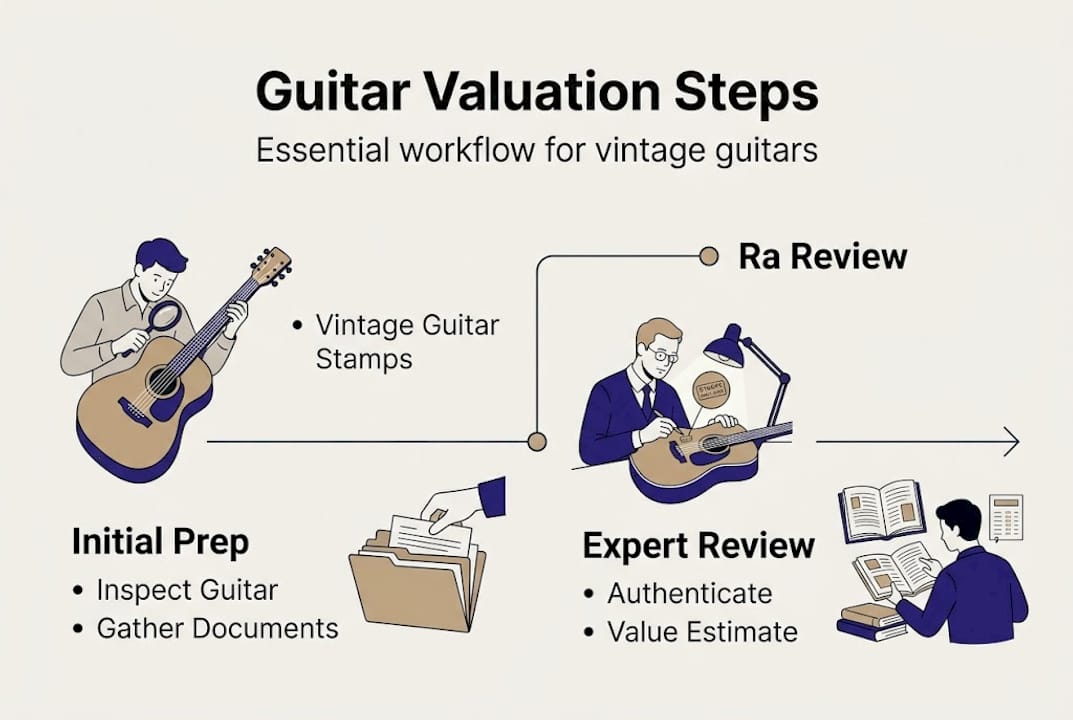
The standard appraisal workflow follows a logical sequence that builds a case for value rather than guessing at it. Here’s how to work through it:
- Gather and organize documentation. Compile every document from the checklist above. Cross-reference the serial number against manufacturer records to confirm the production year and factory origin.
- Research market comparables. Search recent auction results, dealer listings, and private sales for instruments of the same model, year, and condition. Avoid comparing across condition grades. A near-mint 1962 Stratocaster is not comparable to a well-played example, even if the model is identical.
- Assess physical condition. Examine finish originality, hardware integrity, fret wear, neck set, and any structural repairs. Condition is one of the two most decisive factors in guitar pricing, and a single non-original part can shift the category.
- Evaluate originality and provenance. Cross-reference the instrument’s components against factory specifications. A guitar with all original hardware and finish commands a premium. Replacements, even period-correct ones, reduce that premium.
- Consult qualified experts. Submit the instrument and documentation for review by at least one specialist. For rare or high-value pieces, two independent opinions are better than one.
Pro Tip: When researching market pricing for guitars, always filter for sold listings, not asking prices. What sellers want and what buyers actually pay are often very different numbers.
Here’s how traditional and modern valuation approaches compare:
| Approach | Strengths | Weaknesses |
|---|---|---|
| Traditional (visual/experience) | Fast, cost-effective | Misses hidden refinishes, repairs |
| Scientific (spectrometry, chemical analysis) | Objective, highly accurate | Requires specialist access, higher cost |
| Combined approach | Most reliable overall | Time-intensive but worth it for high-value pieces |
Provenance and originality land their biggest impact at steps three and four. A guitar that appears original but carries hidden alterations can be worth a fraction of what visual inspection suggests, which is exactly where scientific authentication changes everything.
Modern scientific authentication: The new standard
Beyond visual inspection, today’s experts deploy powerful new tools for authentication that leave very little room for error.
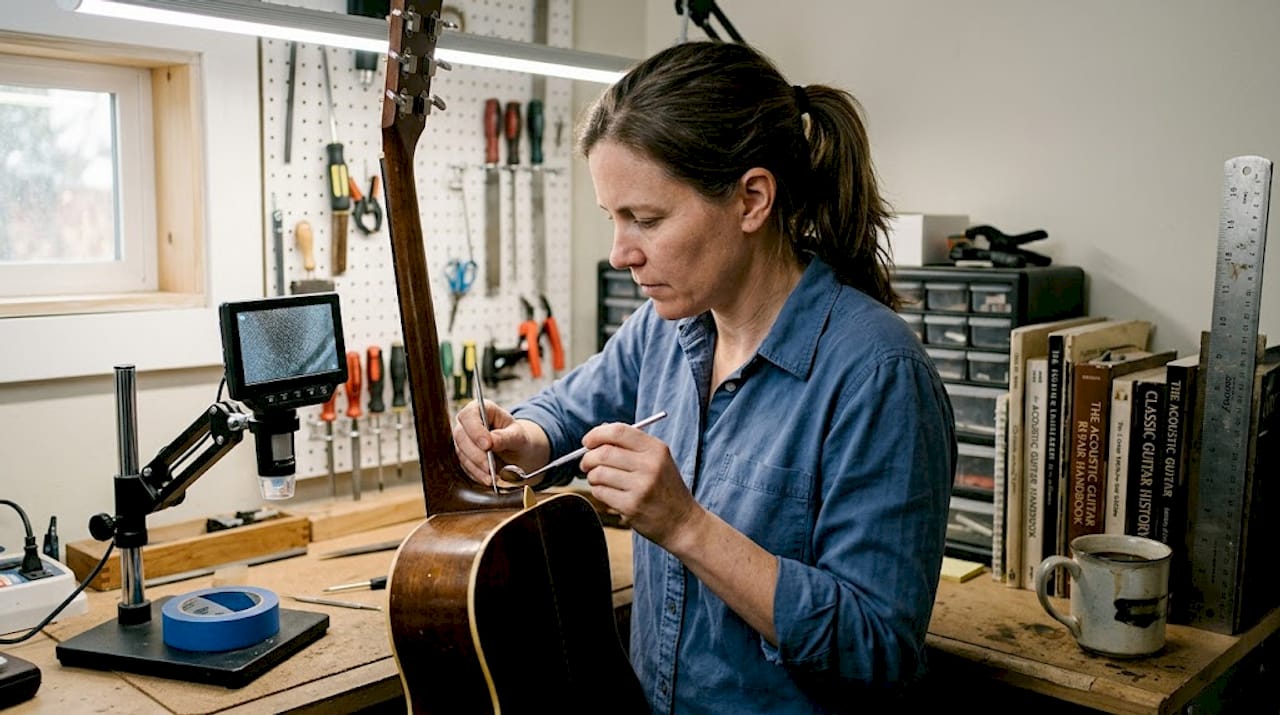
Spectrometry and chemical analysis have transformed what’s possible in vintage guitar authentication. These tools examine the chemical composition of finishes, woods, and hardware at a molecular level, confirming whether components match the production era of the instrument. The technology is especially critical for detecting refinishes, which are the most common form of value-altering alteration in the vintage guitar market.
“Modern authentication tools can detect refinish work that’s completely invisible to the naked eye, and a confirmed refinish on a collectible guitar can reduce its market value by as much as 80%.”
Scientific authentication uses spectrometers and chemical analysis to detect refinishes that can decrease value by up to 80%. To put that in concrete terms: a refinished vintage Stratocaster that might be worth $100,000 in original finish condition could realistically be valued at $20,000 once a refinish is confirmed. That’s an $80,000 difference hinging on one test.
Here are the situations where scientific verification is not optional for serious collectors:
- Instruments priced above $25,000
- Any guitar with suspected or disclosed repairs to the finish
- Instruments lacking full provenance documentation
- Pieces purchased at estate sales, auctions, or through private parties without verifiable history
- Any guitar being submitted for insurance appraisal or sale certification
The move toward scientific tools is also reshaping what buyers expect. Collectors authenticating vintage guitars with laboratory-grade methods are commanding higher prices and faster sales because buyers trust the process, not just the seller’s word. In a market where reputation and documentation carry real financial weight, scientific authentication is quickly becoming the baseline, not the exception.
Consulting experts and cross-referencing valuations
Even with scientific methods, the final value often hinges on expert judgment and consensus. No single tool or test tells the whole story on its own.
Knowing when to call in a specialist is as important as the consultation itself. For instruments above $10,000 in estimated value, or any guitar with unusual history or modifications, appraisal best practices call for at least two independent expert opinions. Conflicting valuations are more common than most collectors expect, and they almost always signal that more information is needed before a final number can be trusted.
Gruhn’s Guide remains the gold standard reference for verifying factory specifications and serial number dating on American-made vintage instruments. For European or handcrafted guitars, luthier networks and builder archives are often more useful.
When you sit down with an appraiser, come prepared with specific questions:
- Is every component consistent with the stated year of manufacture?
- Are there signs of repair, refinishing, or replacement parts?
- How does the condition compare to instruments currently selling at auction?
- What documentation would increase the valuation if added?
- Are there comparable sales from the past 12 months to support the estimate?
Pro Tip: If two experts offer significantly different valuations, don’t automatically accept the higher one. Instead, ask each expert to explain the specific factors driving their number. Disagreements are often rooted in how condition or originality is being weighted, and resolving that disagreement is where the real value clarity comes from.
For deeper context on navigating conflicting appraisals, expert valuation guidance tailored to collectors in 2026 outlines when a third opinion is warranted and how to weigh specialist credentials.
Why mastering valuation workflow sets elite collectors apart
There’s a persistent myth in collecting circles that the best buyers operate on instinct. The story goes that experienced collectors can walk into a room, pick up a guitar, and know its worth within minutes based on feel and experience alone. That story sells well, but it doesn’t survive contact with reality.
What actually separates elite collectors isn’t sharper intuition. It’s process discipline. The collectors who consistently protect and grow the value of their holdings are the ones who treat every acquisition and every appraisal as a structured exercise, not a gut check. They document obsessively, use scientific tools without hesitation, and never let the excitement of a great find override the need for verification.
Scientific authentication is reshaping what experienced collectors trust, and that’s a good thing. It removes the subjectivity that dealers and sellers have historically exploited. It makes the market more transparent and ultimately more valuable for everyone who participates in it honestly.
Mastering the workflow is also about legacy. A collection with meticulous guitar provenance value documentation, authenticated instruments, and organized records doesn’t just sell for more. It tells a story that future collectors, museums, and heirs can carry forward. That’s what transforms a collection from an investment into something genuinely significant.
Get expert help for your next valuation
A rigorous valuation workflow is worth every hour you invest in it, but you don’t have to build it alone. At Vintage Guitar World, we work directly with collectors who want professional guidance at every stage of the appraisal process.

Whether you’re exploring types of vintage guitars to understand what factors drive different market segments, or you need a detailed walkthrough from our expert guitar appraisal guide, we have the resources to support you. If you’re ready to see what we currently have available for serious collectors, browse our curated selection in the Vintage Guitar World shop and find instruments with the documentation and authentication standards you expect.
Frequently asked questions
How do I know if my guitar needs scientific authentication?
If your instrument is high value or shows any signs of finish changes or suspicious repairs, scientific authentication is essential. Finish analysis detects refinishes that can dramatically reduce market value and that are completely invisible during visual inspection.
What documents have the biggest impact on guitar value?
Original receipts, luthier records, and a documented ownership chain carry the most weight. Strong documentation adds 20-50% to a vintage guitar’s market value compared to instruments without supporting paperwork.
What’s the risk of using only visual inspection for valuation?
Visual inspection alone can miss refinishes, replacement parts, and structural repairs that cut value by up to 80%. Spectrometry and finish analysis catch what the eye cannot, making them essential for accurate, high-stakes appraisals.
How should handcrafted guitars be valued differently?
For hand-built instruments, builder records and provenance are the foundation of any credible appraisal. Provenance and luthier records are critical for accurate valuation, and condition should always be assessed in a humidity-controlled environment for best results.