














TL;DR:
- Check for solid tonewoods, hand-carved bracing, and original craftsmanship features to verify quality.
- Use proper tools and environment conditions for inspection, focusing on cracks, bracing, and structural integrity.
- Condition, originality, and provenance outweigh age, making well-preserved modern guitars valuable collectibles.
Buying a handcrafted guitar without a proper inspection plan is one of the most expensive mistakes a collector can make. The market is full of instruments that look stunning in photographs but hide lifted bridges, non-original parts, or structural repairs that quietly destroy long-term value. At the same time, the right guitar, bought with knowledge and care, can be a musical and financial asset that appreciates for decades. This guide walks you through every stage of that process: reading materials, using the right tools, running a structured inspection, and verifying historical value before you commit to any purchase.
Table of Contents
- Understand tonewoods and construction methods
- Essential tools and environmental requirements for inspection
- Step-by-step inspection: structure, playability, and sound
- Evaluating provenance, rarity, and historical value
- Why condition, not just age, should drive your collecting decisions
- Find, value, or restore your perfect handcrafted guitar
- Frequently asked questions
Key Takeaways
| Point | Details |
|---|---|
| Tonewood and build matter | Superior materials and skilled construction define collectible handcrafted guitars. |
| Inspect with the right tools | A straightedge, feeler gauge, and controlled environment reveal details amateurs often miss. |
| Historical value affects price | Rarity and provenance determine investment value as much as playability. |
| Condition tops age | Well-kept, newer handcrafted guitars can outshine old ones with wear or repairs. |
| Professional input is vital | For expensive pieces, expert consultation ensures authenticity and investment security. |
Understand tonewoods and construction methods
True craftsmanship starts with the wood. A handcrafted guitar built from solid tonewoods behaves, resonates, and ages completely differently from one built with laminated sheets. Laminates, which are thin veneers pressed together, look similar on the surface but never develop the tonal depth that solid woods produce over time. Learning to tell them apart is your first real skill as a collector.
Premium species carry a reputation for good reason. Adirondack spruce, once the standard top wood for pre-war American guitars, produces a stiff, responsive soundboard with exceptional dynamic range. Brazilian rosewood, now heavily regulated under CITES (the Convention on International Trade in Endangered Species), offers a density and harmonic richness that Indian rosewood simply cannot match. When you see either species on an older instrument, you are already looking at something rare.
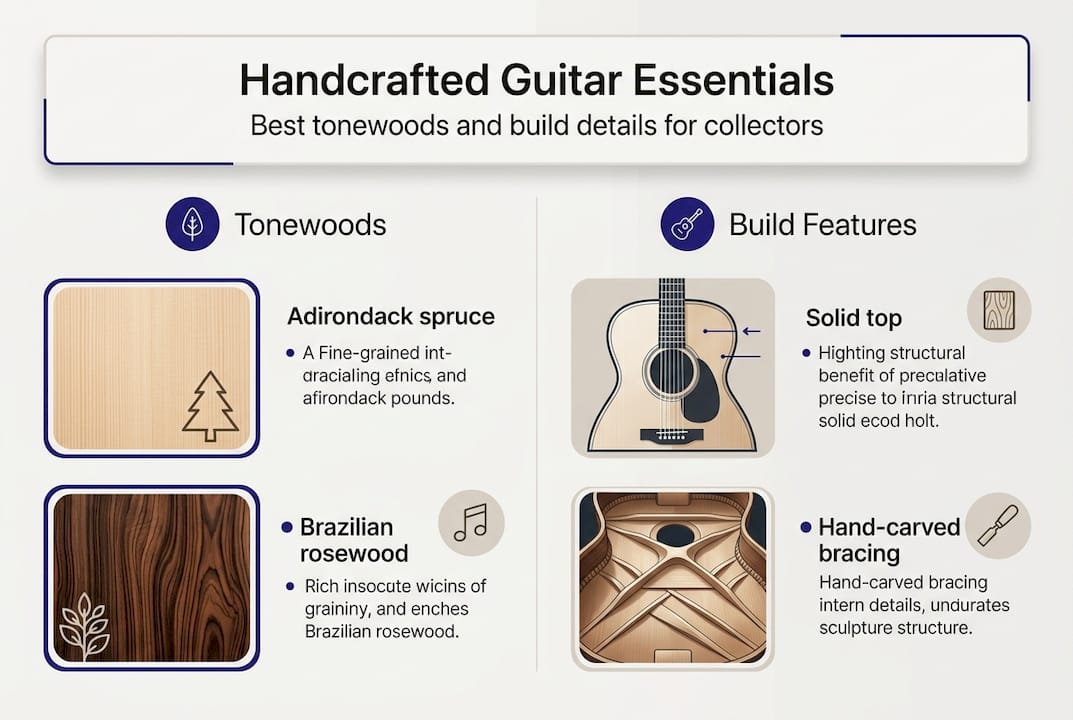
Visual cues matter enormously. On a quality spruce top, tight grain lines should run at 5 to 8 per inch, evenly spaced and consistent from edge to edge. Quarter-sawn rosewood, where the wood is cut perpendicular to the growth rings, shows tight, straight grain on the back and sides rather than the wavy figure of flat-sawn cuts. Clean joinery at the seams, a center seam that practically disappears, and a finish that follows the wood rather than masking it are all signs of a builder who knew what they were doing.
Bracing is where construction philosophy becomes audible. Hand-carved scalloped bracing, where a luthier (guitar maker) removes material from each brace to reduce mass while preserving stiffness, produces a top that vibrates more freely. Factory guitars use uniform, machine-cut braces. The difference is subtle to the eye but dramatic to the ear. Traditional hide glue, made from animal collagen, is another marker: it is reversible under heat and moisture, which is why skilled restorers prefer it, and it transmits vibration differently than modern synthetic adhesives.
Finishes also tell a story. French polish, a shellac-based finish applied by hand in dozens of thin layers, is the traditional choice for classical and flamenco guitars. Nitrocellulose lacquer, used widely through the mid-20th century on American acoustics and electrics, ages beautifully and allows the wood to breathe. Both are signs of craftsmanship in guitars that modern polyester finishes simply do not replicate.
Key visual markers to check:
- Grain density: 5 to 8 lines per inch on spruce tops
- Wood orientation: Quarter-sawn back and sides show straight, tight grain
- Bracing: Hand-carved scalloping visible through the soundhole
- Glue: Hide glue joints appear slightly amber at close inspection
- Finish: French polish or nitrocellulose, never thick plastic-like polyester
Pro Tip: Shine a flashlight through the soundhole and look for luthier signatures, date stamps, or handwritten notes on the inside of the top. Many master builders signed their work internally, and finding that signature is one of the most exciting moments in collecting. You can discover craftsmanship details that most buyers overlook simply by spending two extra minutes with a light source.
| Feature | Handcrafted (solid) | Factory (laminate) |
|---|---|---|
| Top material | Solid spruce or cedar | Laminated veneer |
| Bracing | Hand-carved, scalloped | Machine-cut, uniform |
| Finish | French polish or nitro | Thick polyester |
| Glue | Hide glue | Synthetic PVA |
| Aging | Improves tonally | Stays flat |
Essential tools and environmental requirements for inspection
Knowing what to look for is only half the equation. You also need the right tools and the right conditions to see what is actually there. A guitar inspected in poor lighting, at the wrong humidity, or without measurement tools will give you incomplete information at best.
For testing acoustic guitars at a professional level, assemble this kit before any serious evaluation:
- Straightedge: A 24-inch aluminum straightedge reveals neck relief and body geometry
- Feeler gauge: Measures fret height and neck relief in thousandths of an inch
- Clip-on tuner: Essential for intonation testing at multiple frets
- LED flashlight: Narrow beam for inspecting inside the body and under the finish
- Hygrometer: Measures relative humidity in the room
Environment matters more than most buyers realize. Proper inspection conditions require 45 to 55 percent relative humidity and a room temperature of 70 to 75 degrees Fahrenheit. Outside those ranges, wood expands or contracts enough to change neck relief readings, affect fret seating, and even open or close hairline cracks that would otherwise be visible.
Lighting angle is critical for crack detection. Hold the guitar at roughly 45 degrees to a single light source and rotate it slowly. Cracks and old repairs catch the light differently from surrounding wood. A repaired crack often shows a slight ridge or a color variation in the finish. Viewing straight on under overhead lights will hide almost everything.
Pro Tip: Before traveling to inspect a guitar, place your hygrometer in the inspection room for 30 minutes. If humidity is below 40 percent, the guitar’s neck may read stiffer than it actually is, and small cracks may be closed. Ask the seller to store the instrument at stable humidity for 48 hours before your visit. This one step has saved experienced collectors from both false positives and missed problems.
| Tool | Purpose | Acceptable range |
|---|---|---|
| Hygrometer | Humidity monitoring | 45 to 55% RH |
| Thermometer | Temperature control | 70 to 75°F |
| Straightedge | Neck and top geometry | No visible gap at 12th fret |
| Feeler gauge | Relief and fret measurement | 0.010 to 0.012 inch relief |
| Tuner | Intonation accuracy | Within ±3 cents |
Step-by-step inspection: structure, playability, and sound
With your tools ready and your environment controlled, work through the guitar in a fixed sequence. Skipping steps or jumping around creates gaps that sellers, even honest ones, cannot fill for you.
Structural inspection sequence:
- Top and back: Look for cracks longer than 1/4 inch, especially near the bridge plate and along the center seam
- Bridge: Press firmly at all four corners. Any flex or lifting is a serious red flag
- Neck angle: Sight down the neck toward the body. The fretboard plane should meet the bridge, not the top
- Neck relief: Press the first and 14th frets simultaneously and use a feeler gauge at the 7th fret. Acceptable relief is 0.010 to 0.012 inch
- Frets: Check for uneven wear, loose ends, and height consistency using your straightedge
- Originality: Confirm tuning machines, nut, saddle, and pickguard match the instrument’s era
For playability, action and intonation measurements are your benchmarks. Action at the 12th fret should measure approximately 3.2mm on the bass side and 2.8mm on the treble side for most acoustic collectibles. Check intonation by comparing the fretted note at the 12th fret to the natural harmonic at the same position. A difference of more than ±3 cents signals a saddle or neck angle problem.
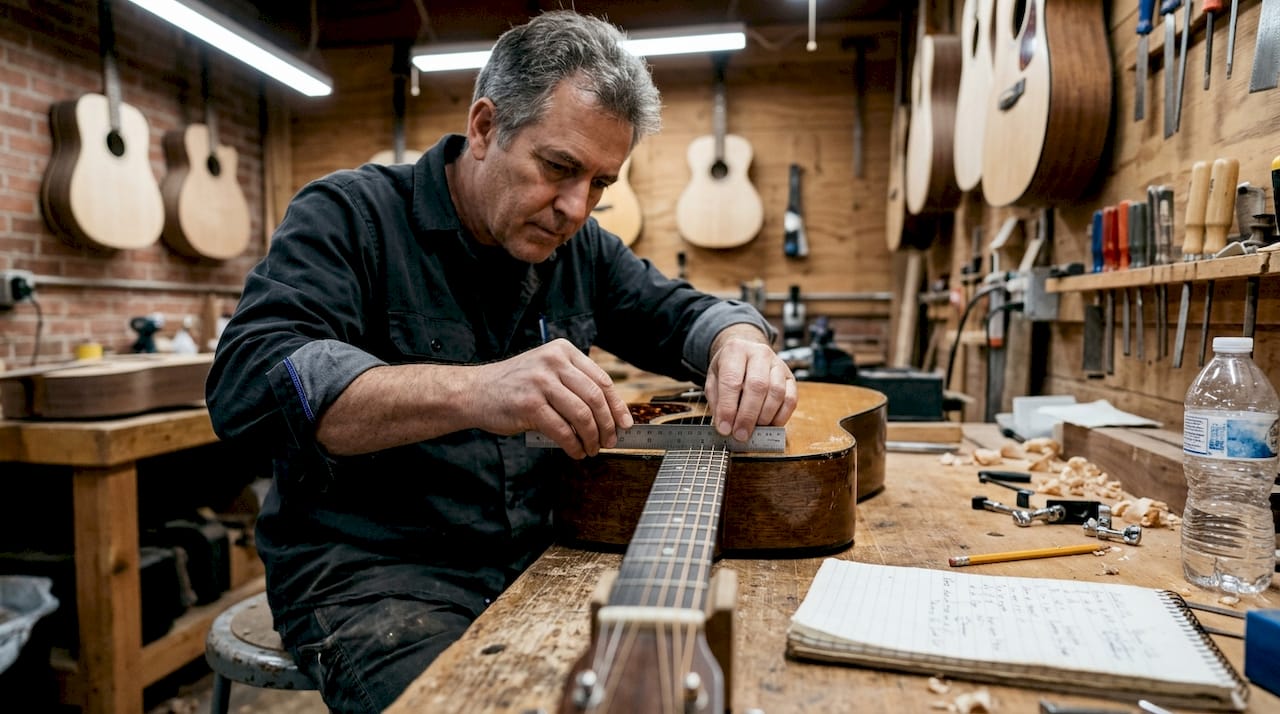
The business card neck test is a quick field check: slide a standard business card under the strings at the first fret with the guitar in playing position. Light contact is ideal. No gap means a back-bowed neck; a wide gap suggests excessive relief.
For sound, tap the top lightly with your knuckle near the bridge. A dry, focused tap tone with clear sustain indicates a healthy, well-braced top. A thuddy or dead response can mean bracing failure or moisture damage. Play harmonics at the 5th, 7th, and 12th frets and listen for clarity. A great handcrafted guitar rings out cleanly at every position.
“Condition checks including crack assessment, bracing integrity, neck angle, fret wear, and originality of hardware are non-negotiable steps before any purchase.”
For checking guitar authenticity, compare hardware details, headstock shape, and internal markings against documented examples from the same production period.
Evaluating provenance, rarity, and historical value
Once the instrument passes structural and playability review, its story becomes the final piece of the valuation puzzle. Provenance, meaning documented ownership and origin history, can add or subtract thousands of dollars from a guitar’s market value.
Serial numbers are your starting point. Gibson, Martin, and Fender all maintained production records, and databases now exist to cross-reference serial numbers with production years, factory locations, and original specifications. Discrepancies between a serial number and the guitar’s physical features, wrong tuner style for the year, incorrect inlay pattern, are immediate authenticity concerns.
Historical significance drives collector value in ways that pure condition cannot. Pre-war instruments, built before 1942, used Adirondack spruce and Brazilian rosewood before wartime material shortages changed American lutherie forever. A pre-war Martin D-28 in excellent condition commands $15,000 to $35,000 precisely because the materials and construction methods cannot be replicated today. The 1959 Gibson Les Paul Standard is perhaps the most extreme example: fewer than 1,700 were produced, and prices for original examples now exceed $300,000.
Key collecting periods and approximate market ranges:
- Pre-war Martin acoustics (1930 to 1941): $8,000 to $35,000+
- 1950s Gibson archtops and Les Pauls: $15,000 to $300,000+
- 1960s Fender Stratocasters and Telecasters: $10,000 to $60,000+
- Spanish classical guitars by Torres or Hauser: $20,000 to $150,000+
For any purchase above $10,000, consulting a certified appraiser is not optional. Use resources for identifying rare guitars and learn to recognize handmade guitars by their construction signatures before you sit down with a seller.
| Value trigger | Historic handcrafted | Modern handcrafted |
|---|---|---|
| Materials | Brazilian rosewood, Adirondack spruce | Indian rosewood, Sitka spruce |
| Rarity | Limited production, pre-war | Master luthier, numbered series |
| Provenance | Documented ownership chain | Builder certificate |
| Appreciation | Strong, market-driven | Growing, reputation-driven |
Why condition, not just age, should drive your collecting decisions
Here is something that took many collectors years to learn the hard way: a 1940s guitar with a replaced top, a refretted neck, and a refinished body is not a 1940s guitar in any meaningful sense. It is a collection of old parts wearing a prestigious date stamp. We have seen instruments like this sell for multiples of their actual value simply because buyers fixated on the year.
The collector consensus is clear: a well-preserved modern handcrafted guitar from a respected luthier can outperform a heavily restored vintage piece in both tone and long-term value growth. A 2018 guitar by a master builder with documented provenance, original finish, and excellent playability is a stronger investment than a 1950s guitar that has been through three neck resets, a bridge replacement, and a body refinish.
Documentation and professional setup add more real value than a famous year. A guitar that comes with original case, receipts, photographs, and a recent professional setup is easier to sell, easier to insure, and more enjoyable to own. Explore the full picture of handcrafted guitar appeal before letting nostalgia drive a five-figure decision.
Find, value, or restore your perfect handcrafted guitar
Applying these principles takes practice, and having expert support makes every step more reliable.

At Vintage Guitar World, we provide detailed guitar appraisal guidance so you understand exactly what you are buying before you commit. Our team evaluates instruments for structural integrity, originality, and tonal quality using the same criteria covered in this guide. If you are still learning what separates a collectible from a commodity, our resource on signs of collectible guitars is the right next read. When you are ready to browse, our curated selection of unique vintage guitars includes instruments with full documentation and expert evaluation already completed.
Frequently asked questions
What are the most important features to check in a handcrafted guitar?
Focus on solid premium tonewoods, hand-carved bracing, original hardware, and clean playability. Materials and playability are the two foundational pillars of any serious evaluation.
How do I verify a guitar’s provenance and authenticity?
Start with the serial number and cross-reference it against manufacturer records, then compare hardware and construction details to documented examples from the same period. For purchases above $10,000, consult a certified appraiser before finalizing anything.
How should I store a handcrafted or collectible guitar?
Maintain 45 to 55 percent relative humidity and a stable temperature of 70 to 75 degrees Fahrenheit, keep the guitar slightly detuned, and store it in a hard case to protect the finish and structure.
Does age always increase a guitar’s collectible value?
No. Condition, originality, and provenance consistently matter more than age alone, and a well-built modern handcrafted guitar in excellent condition often outperforms a heavily restored vintage piece.
Is it safe to buy handcrafted guitars online?
For high-value instruments, avoid purchasing without inspection. Arrange an in-person visit or request a professional appraisal with detailed photographs and condition reports before committing.