Johann Georg Stauffer: A Pioneer of Guitar Craftsmanship
Johann Georg Stauffer, born on January 26, 1778, in Vienna, is remembered as one of the most significant figures in the world of guitar making, particularly known for his impact on the Viennese guitar style. His journey from humble beginnings to becoming a renowned luthier is a testament to his innovation and dedication to the craft.
Johann Georg Stauffer’s Early Life and Career

Stauffer’s life began in the Viennese suburb of Weißgerber, the son of Mathias Stauffer, a laborer from Weyregg am Attersee. He initially learned the art of violin making under the tutelage of Franz Geissenhof. In 1800, after taking the Viennese citizenship oath, and marrying Josepha Fischer in 1802, Stauffer took over the workshop of Ignaz Christian Bartl. Initially, he followed the designs of Italian guitar makers like Giovanni Battista Fabricatore and Gaetano Vinaccia. However, he soon began to develop his own style, refining and perfecting the models to create what became known as the quintessential Viennese guitar.
Professional Challenges and Innovations
In 1813/14, Johann Georg Stauffer applied for the prestigious position of court violin maker but was ultimately passed over in favor of Martin Stoß. Despite this setback, he continued to innovate and, from 1830 to 1836, even ventured into music publishing. His focus on invention may have contributed to financial difficulties, leading to a request for a 1,000-guilder advance in 1829 and subsequent financial troubles, including imprisonment for debt and the seizure of his assets.
During this turbulent period, Stauffer briefly worked in his son Johann Anton’s workshop and spent some time in Kaschau (now Košice, Slovakia). Despite these challenges, he remained committed to his craft, spending his later years in the St. Marx civic almshouse in Vienna. Here, he continued to develop new guitar concepts, including oval-bodied guitars and double-bottom designs, all bearing his signature label.
Family and Legacy
Stauffer had three sons, though only two survived childhood. His son Franz Seraph Georg Stauffer was a pianist and child prodigy, while Johann Anton Stauffer followed in his father’s footsteps, taking over the workshop in 1833 and establishing his own name in the industry by 1836.
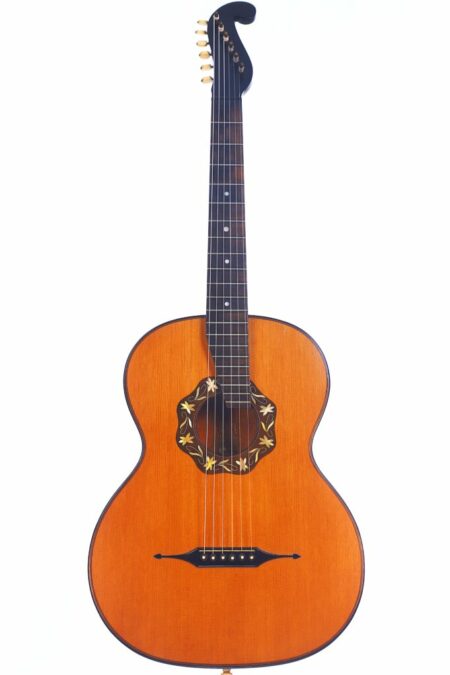
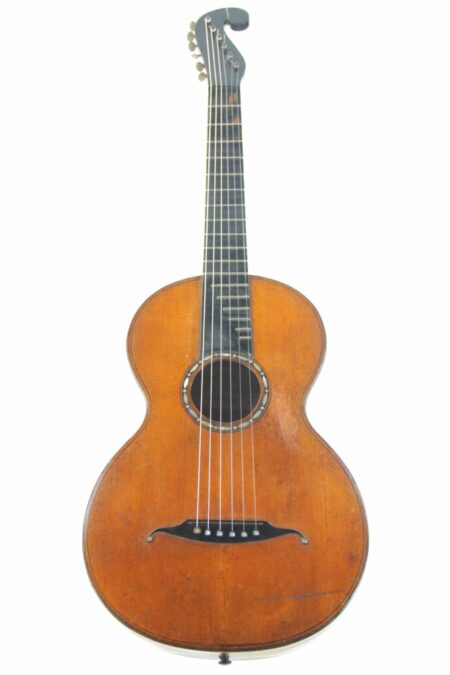
 Stauffer’s contributions to guitar design were profound. He developed the Viennese guitar model characterized by a longitudinally arched back, a narrower waist, and a plug bridge. In 1822, he received an imperial privilege with Johann Ertl for innovations that included elevating the fingerboard, separating it from the soundboard, and creating new tuning mechanisms featuring metal frets.
Instrumental Innovations
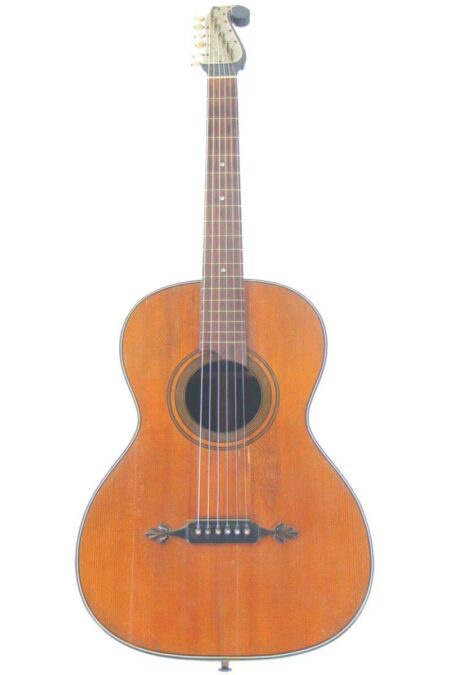
Stauffer’s instruments often featured the iconic 8-shaped headstock until 1825 when he invented the Stauffer tuning mechanism. This mechanism included a metal peg plate with an asymmetrical volute head, screw gears, and side pegs with knobs, arranged in a single row on the right side of the peg plate. This design remains influential, with companies like Rodgers and Rubner still producing Stauffer-style tuners today.
In 1823, Johann Georg Stauffer crafted his Arpeggione, a bowed instrument blending features of the guitar and cello. This unique creation inspired Franz Schubert to compose his Sonata for Arpeggione and Piano in A minor (D 821), though the instrument itself did not achieve widespread popularity.
Stauffer also experimented with new violin forms and contraguitars, leading to disputes over originality with fellow luthier Peter Teufelsdorfer. His instruments bore either his initials or the name “Johann Georg Staufer.”
At Vintage Guitar World, we are proud to always offer instruments from Johann Georg Stauffer and Stauffer-style guitars: