

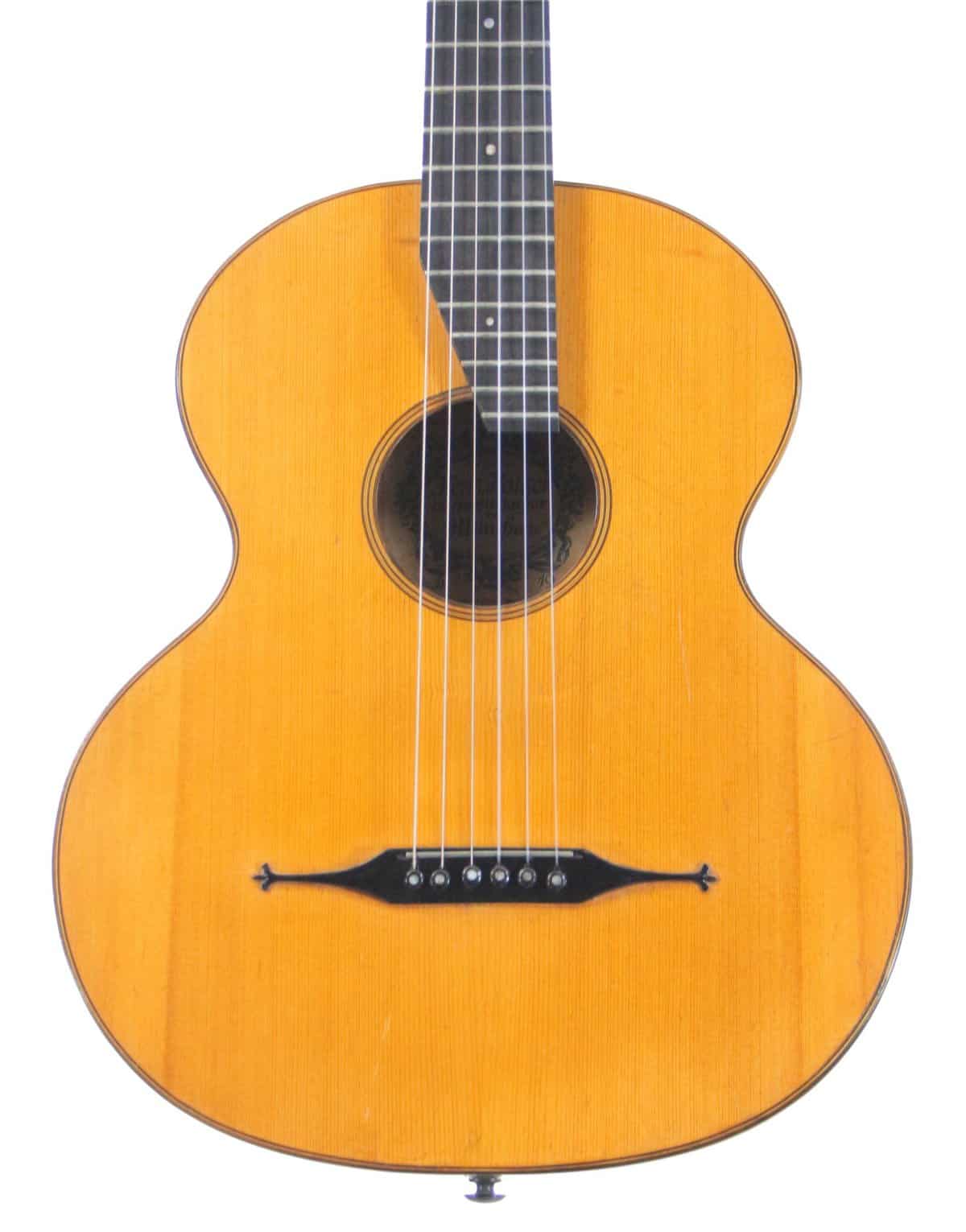








Hermann Hauser sr. Viennese model classical guitar from 1928 in excellent condition. The sound of this instrument is impressive. The guitar has a top made of German spruce, back and sides made of flamed maple and a fingerboard made of dark ebony. The scale length is 630 mm, the width at the nut is 48 mm. The original French polish is in excellent condition with few signs of use. The guitar is fitted with its original Landstorfer tuners, which are considered very exquisite and work and look very well on this guitar.
It has 2 small repaired cracks which have been very professionally repaired and are barely visible. The pencil notation of the year is unfortunately so badly faded that it is no longer recognizable. However, the guitar can be dated to 1928.
Background: The German violin maker Hermann Hauser I (or Sr.) (1882-1952) is best known for the remarkable instruments he made after 1924 in the Spanish tradition. In that year, both Andres Segovia and Miguel Llobet visited Hauser in Munich, and Segovia encouraged Hauser to copy his 1912 Manuel Ramirez guitar (an instrument generally believed to have been built by Santos Hernandez while he was a luthier in Ramirez's store). He examined this instrument and took measurements on it. Since Llobet owned an Antonio de Torres from 1859, Hauser also had the opportunity to examine this instrument. Although Hauser began building in the Spanish tradition in 1925, he had been building guitars, lutes and other related stringed instruments in the German tradition since 1900. While it is generally believed that Hauser built perhaps 250 guitars in the Spanish tradition between 1925-1952, he built no more than about 250 in the Viennese tradition. He continued to make Viennese models, whose tonal quality was in demand, even after 1935. This guitar was made a year after Hauser and Segovia met and is probably considered a rare gem.
Hauser built the Viennese model, the Munich model, the Terz bass, the Prim bass and the Quint bass, among others. Hauser introduced many innovations in top and body construction, and his guitars are prized today for their clear, loud and rich sound and great sustain. Andres Segovia and many other great maestros have played guitars by Herman Hauser 1. Hauser's son, Hermann Hauser II (1911-1988) and his grandson, Hermann Hauser III (born 1958) have continued the tradition of the master guitar maker.

By loading the video, you accept YouTube's privacy policy.
Learn more
 German German
  English
 Spanish
 French
 Portuguese
 Italian
 Chinese
 Japanese
 Korean
 Russian
 Dutch
Dutch
 Arabic