












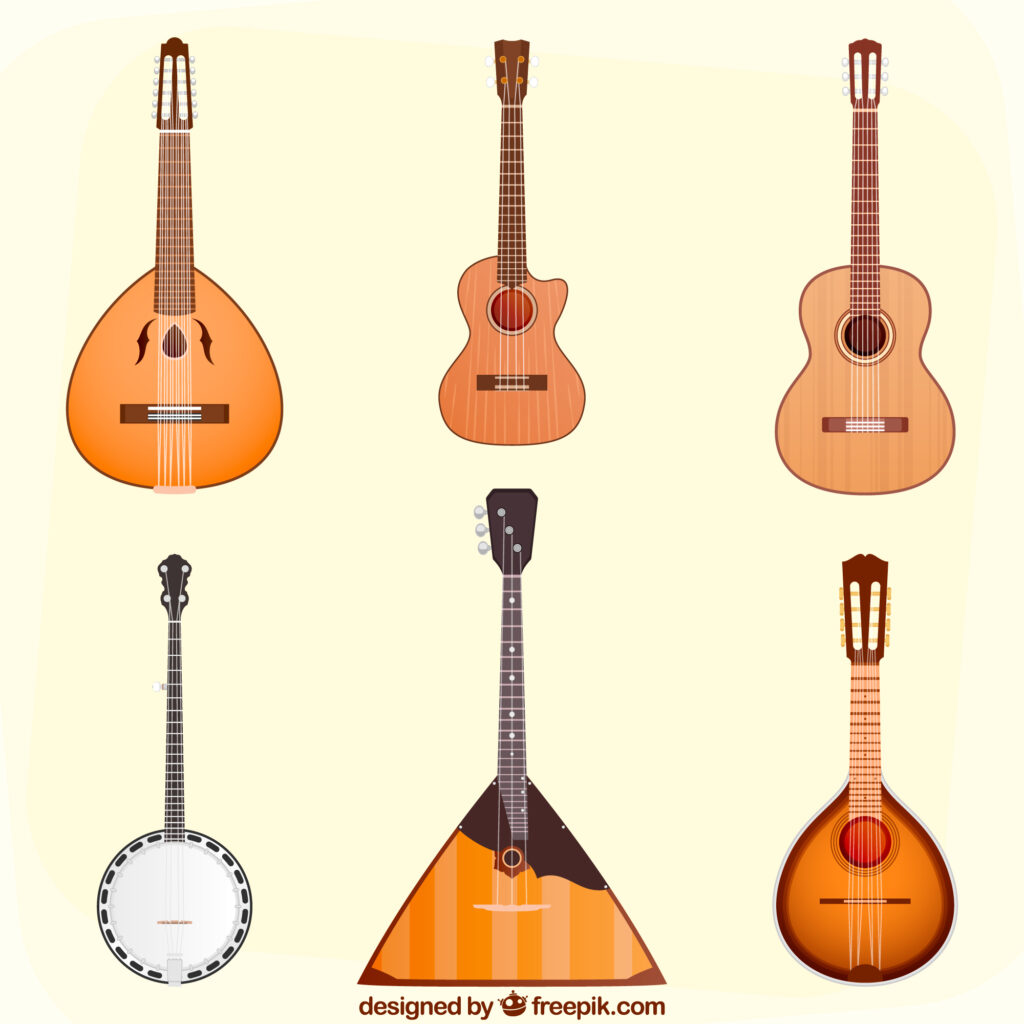

Discover the fascinating development of the guitar, from its ancient origins in the Middle East to the many modern models we know today, in our brief overview of the history of the guitar. Learn how this popular instrument has shaped music across cultures and centuries and inspired countless musicians worldwide.
Origins of the guitar
The guitar has a long and mysterious history whose roots go back to ancient stringed instruments. The term „guitar“ probably comes from the Greek word „kithara“. According to mythology, Hermes created the first kithara from a tortoise shell. The early instruments had a wooden top and a resonator, and the strings were played with a plectrum.
Early influences: The oud and the lute
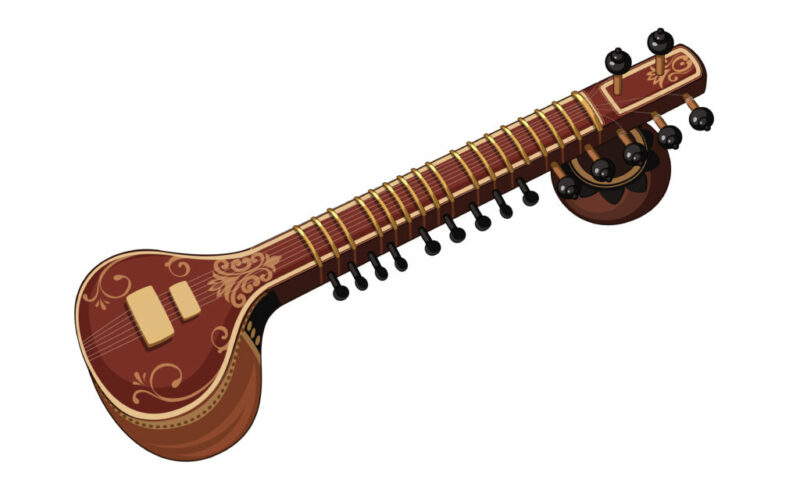 The shape and design of the guitar have evolved from instruments such as the oud and the lute. The oud, which was brought to southern Spain by the Moors in 711 AD, is said to have been inspired by Lamech, a biblical figure. The lute, which had a curved back and various shapes, became popular in Europe and passed through cultures from the Egyptians to the Romans.
Development in the course of time
The popularity of the lute declined during the Renaissance, when the Baroque guitar which had a more guitar-like shape and five courses of gut strings. The vihuela with its hourglass shape also gained importance in Spain and influenced the development of the guitar.
 In the 1790s, the modern guitar began to take shape thanks to Antonio de Torres Jurado, who introduced innovations such as a wider body and fan bracing that improved the sound of the instrument. His designs led to the establishment of the classical guitar as a concert instrument, which was advocated above all by the influential guitarist Andrés Segovia.
Modern guitar innovations
When European immigrants brought the Spanish guitar to America, new shapes emerged, including the flattop and archtop guitars. The flat top, developed by Christian Frederick Martin, used X-bracing to accommodate steel strings, which significantly changed playing styles and musical genres.
Popularized by Orville Gibson, the archtop guitar featured f-holes and a curved body that improved its sound and volume, making it a favorite among jazz and country musicians. The electric guitar also emerged at the beginning of the 20th century, when George Beauchamp and Adolph Rickenbacker patented the first model in 1931. Innovations by Les Paul and Leo Fender continued to shape the electric guitar and led to the solid body designs that dominate today.
Conclusion
The evolution of the guitar from ancient stringed instruments to the diverse forms we see today reflects its enduring importance in music. With each innovation, the guitar continues to adapt, inspire musicians and shape genres for generations.
Visit our store to discover fantastic guitars from different centuries
Why the guitar is the best instrument
The Guitar applies as one of the most versatile and popular instruments in the world, and there are several compelling reasons that underpin its popularity.
- Versatility across genres:
The guitar blends effortlessly into a variety of musical styles, from rock, blues and jazz to classical and folk. This adaptability allows musicians to express themselves in a variety of ways, making it a staple in virtually every musical genre.
- Transportability:
Unlike many other instruments, the guitar is relatively light and easy to transport. Whether you're jamming around a campfire with friends or performing on stage, the guitar's portability makes it the first choice for musicians who are on the road a lot.
- Accessibility for beginners:
With a wealth of resources available, including online tutorials and instructional books, the guitar is an excellent choice for beginners. Simple chords and basic strumming patterns allow newcomers to start playing songs quickly, promoting a sense of achievement.
- Rich sound and expression:
The guitar produces a warm, resonant sound that can evoke a wide range of emotions. From gentle fingerpicking to powerful strumming, the instrument enables various playing techniques that enhance musical expression.
- Community and cooperation:
The guitar is often a social instrument that encourages collaboration between musicians. Whether in bands, duets or informal gatherings, the guitar promotes a sense of community and shared musical experiences.
To summarize, the guitar's versatility, portability, accessibility, rich sound and ability to bring people together make it arguably the best instrument for musicians of all skill levels.