













Spotting a true pre-war guitar is like unlocking history through wood and wire. Collectors and musicians understand that each detail—from hand-carved bracing to original hardware—signals genuine pre-war authenticity. As interest grows in American, European, and Spanish instruments built before modern mass production, the real challenge lies in separating rare treasures from clever imitations. This guide will help you recognize what sets these iconic guitars apart, ensuring your next addition reflects both legacy and sound excellence.
Table of Contents
- What Defines A Pre-War Guitar Today
- Major Pre-War Guitar Types And Brands Explained
- Key Features And Construction Methods Detailed
- Factors Influencing Pre-War Guitar Value
- Authenticity Challenges And Common Pitfalls
Key Takeaways
| Point | Details |
|---|---|
| Definition of Pre-War Guitars | Pre-war guitars are defined as those made before 1949, reflecting unique craftsmanship and materials not found in post-war instruments. |
| Importance of Authenticity | Genuine pre-war instruments must have original hardware and construction methods to maintain their value and collectibility. |
| Value Factors | The market value of pre-war guitars is influenced by their condition, rarity, maker reputation, tonal quality, and provenance. |
| Common Authentication Pitfalls | Collectors should be cautious of hardware replacements, refinishes, and serial number discrepancies that can affect authenticity claims. |
What Defines a Pre-War Guitar Today
A pre-war guitar typically refers to an acoustic or electric instrument manufactured before 1949. The exact cutoff varies by source and collector preference, but the post-World War II era marks a clear shift in manufacturing practices, materials, and design philosophies.
The definition centers on several key factors that distinguish these instruments from later production:
- Manufacturing era: Built during the 1800s through 1940s, capturing a distinct period of craftsmanship
- Materials and construction: Hand-selected tonewoods, non-uniform bracing, and individual quirks in each instrument
- Historical context: Created before mass-production standardization became the industry norm
- Design authenticity: Original hardware, finishes, and construction methods unchanged by modern restoration trends
- Rarity and collectibility: Limited production numbers compared to post-war instruments
Understanding how to identify vintage guitars helps collectors recognize authentic pre-war examples. Many instruments from this period show signature characteristics: hand-carved braces, aged wood with specific color variations, and finishes that developed naturally over decades.
The sound quality becomes a defining marker as well. Pre-war instruments often possess a brightness and resonance that collectors describe as unmatched by modern guitars. This tonal character results from wood maturation, specific construction techniques, and the absence of modern finishing sealants that dampen vibration.
Pre-war guitars represent a specific moment in musical instrument history when craftsmanship prioritized individual quality over production efficiency.
Authenticity matters tremendously when defining pre-war status. Original hardware, unmodified electronics on electric models, and factory-original finishes distinguish genuine pre-war instruments from later reproductions or heavily modified examples. A guitar might be old, but modifications made decades after manufacture can diminish its pre-war classification value.
The geographic origin also influences definition. American-made pre-war guitars carry different significance than European instruments from the same period. Documentation and serial number verification become critical tools for establishing true pre-war status.
Price and market value directly reflect how the guitar world defines pre-war instruments. Authentic examples command premium prices because collectors and professional musicians recognize their unique properties. A 1930s acoustic guitar with original hardware and finish can value significantly higher than a 1960s model, despite the age difference being only decades.
Pro tip: Request documentation of any service history when evaluating pre-war guitars, as original condition matters more than playability adjustments made after manufacture.
Major Pre-War Guitar Types and Brands Explained
Pre-war guitars came in distinct types, each serving different musical purposes and reflecting the craftsmanship standards of their era. Understanding these categories helps collectors identify authentic instruments and appreciate their historical significance.
The primary pre-war guitar categories include:
- Steel-string acoustics: Featured robust construction with X-bracing, designed for volume and projection in live settings
- Classical guitars: Built with nylon strings and traditional Spanish design, prioritizing tonal warmth and finger technique
- Archtop acoustics: Featured carved, violin-like tops and backs, producing a sophisticated jazz and orchestral sound
- Early electrics: Among the first amplified instruments, representing the birth of modern guitar design
- Parlor guitars: Smaller body instruments popular in homes and intimate venues before amplification became standard
Classical guitars from the pre-war period represent some of the most sought-after instruments today. Spanish makers like Manuel Ramírez and Enrique Fleta created instruments that defined the classical guitar sound for generations. Their hand-carved bracing patterns and aged European spruce tops remain unmatched in tonal quality.
Archtop acoustics became the foundation for jazz guitar. Brands like Gibson, Epiphone, and D’Angelico dominated this category, creating instruments with distinctive f-holes and curved wooden tops. These guitars became essential to the American jazz explosion of the 1920s and 1930s.
The earliest electric guitars emerged during the pre-war era, representing a revolutionary shift from purely acoustic traditions to amplified innovation.
Steel-string acoustics from pre-war periods showcase different construction than modern versions. Instruments from makers like Martin and Gibson featured thinner bracing, lighter wood selections, and finishes that aged dramatically. These guitars sound distinctly warm compared to contemporary models.
Exploring rare guitar models collectors should know about reveals lesser-known pre-war brands that commanded respect among musicians. Smaller manufacturers like Stromberg, Gretsch, and Vega produced exceptional instruments despite limited production runs.
Geographic origin shaped brand identity. American makers dominated the steel-string acoustic and electric markets, while European makers excelled in classical and concert guitar production. German manufacturers contributed innovative designs during the 1920s and 1930s before wartime disruptions halted production.

Serial numbers and manufacturing dates vary significantly by brand. Gibson guitars from 1902-1949 carry different serial numbering than Martin instruments from the same period. Documentation of these marking systems becomes crucial for authentication.
Here’s a side-by-side comparison of the most notable pre-war guitar types and their musical impact:
| Guitar Type | Iconic Makers | Typical Sound | Impact on Music |
|---|---|---|---|
| Steel-String Acoustic | Martin, Gibson | Bright, clear, warm | Folk, country, blues |
| Classical | Ramirez, Fleta | Rich, mellow, rounded | Classical, flamenco |
| Archtop Acoustic | Gibson, D’Angelico | Jazzy, deep, resonant | Jazz, orchestral |
| Early Electric | Gibson, Rickenbacker | Warm, experimental | Rock, pop innovation |
| Parlor | Vega, Gretsch | Intimate, soft | Home, solo playing |
Pro tip: Research the specific brand’s manufacturing timeline and serial number system before purchasing; this verification step prevents costly mistakes when identifying authentic pre-war examples versus later reproductions.
Key Features and Construction Methods Detailed
Pre-war guitars display distinctive construction methods that modern instruments simply cannot replicate. These techniques shaped the instruments’ legendary tonal characteristics and durability.
The most recognizable construction differences include:
- Hand-carved bracing: Each brace shaped individually to optimize wood resonance patterns
- Solid tonewoods: Spruce, mahogany, and rosewood selected for age and quality rather than availability
- Hide glue construction: Natural animal-based adhesives that age and cure differently than modern synthetic glues
- Shallow body depths: Earlier designs featured thinner bodies with less internal bracing
- Non-uniform thicknesses: Wood carved to varying thicknesses based on acoustic principles rather than production efficiency
- Hand-wound frets: Individually installed and crowned, creating subtle variations in feel
The hide glue used in pre-war guitars becomes more flexible and responsive over decades. This characteristic allows wood vibration in ways modern polyurethane finishes restrict. Collectors notice this tonal difference immediately when playing original instruments versus modern reproductions.
Wood selection separated pre-war makers from modern manufacturers. Pre-war craftsmen waited for aged lumber stocks, sometimes seasoning wood for years before construction began. This patience produced instruments with superior acoustic properties and remarkable stability.
Bracing patterns varied dramatically between makers. German lattice bracing differed from American X-bracing, which contrasted sharply with Spanish radial patterns. Understanding vintage guitar identification methods helps collectors recognize these signature construction approaches.
Hand-crafted construction methods created instruments with natural variations that enhanced rather than hindered their musical character.
Finish application reveals construction philosophy. Pre-war instruments featured thin, hand-applied lacquer that aged to amber or golden hues. Modern thick polyurethane finishes protect better but suppress the wood’s natural vibration characteristics.
Electric guitar construction introduced innovations during the pre-war period. Solid bodies with hand-wired electronics became experimental designs that defined the electric guitar’s future. Early pickup designs used simple magnets and hand-wound coils, creating warm, responsive tones.
Hardware variations indicate authenticity. Original tuning machines featured different materials and mechanisms than modern versions. Bridge designs evolved significantly, with some pre-war examples using wooden components that modern instruments abandoned.
The neck construction method distinguishes pre-war examples. One-piece neck construction opposed three-piece designs that emerged later. Headstock angles and scroll designs reflected individual maker preferences rather than standardized templates.
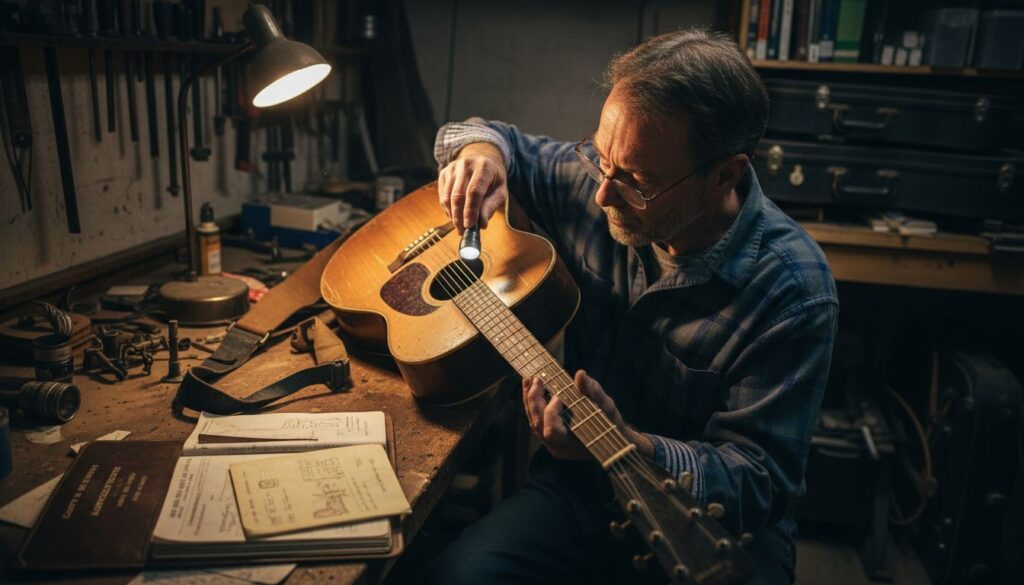
Pro tip: Examine the interior bracing pattern through the f-holes or soundhole with a flashlight; distinctive hand-carved variations confirm authentic pre-war construction versus modern replicas.
The following table summarizes key construction attributes that distinguish authentic pre-war guitars from later models:
| Attribute | Pre-War Guitars | Post-War Guitars | Value Impact |
|---|---|---|---|
| Bracing | Hand-carved, variable | Machine-cut, uniform | Enhances originality |
| Glue Type | Animal hide glue | Synthetic glue | Superior resonance |
| Finish | Thin lacquer, natural | Thick polyurethane, uniform | Boosts tonal quality |
| Neck Construction | Single-piece, unique | Multi-piece, standardized | Collectibility factor |
Factors Influencing Pre-War Guitar Value
Pre-war guitar values fluctuate based on multiple interconnected factors. Understanding these elements helps collectors make informed purchasing decisions and accurately assess instrument worth in today’s market.
The primary value determinants include:
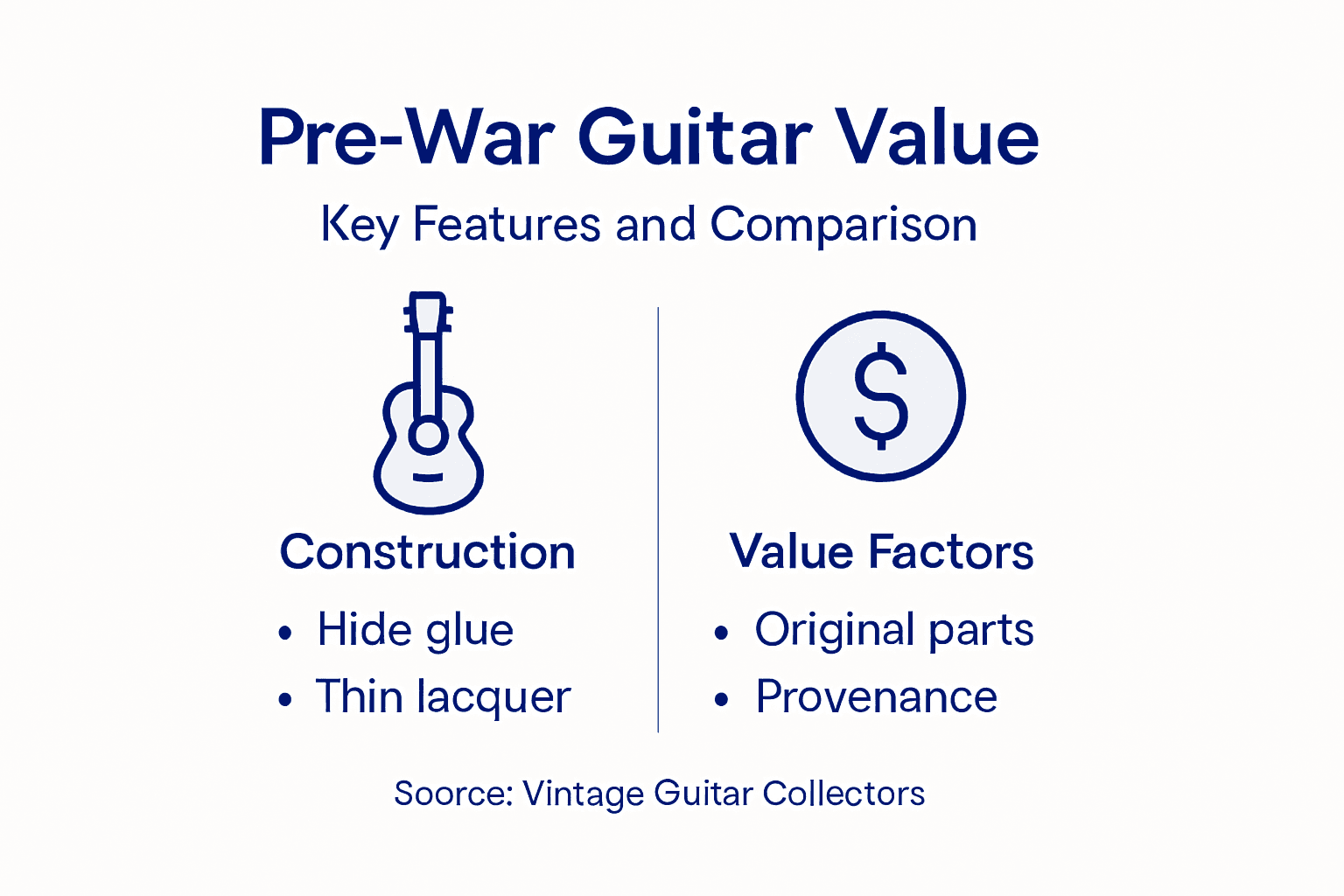
- Condition and originality: Unmodified instruments with factory finishes command premium prices
- Rarity and production numbers: Limited-run models appreciate faster than mass-produced examples
- Maker reputation: Instruments from acclaimed craftsmen hold value better than lesser-known brands
- Tonal quality: Playability and acoustic performance significantly impact desirability
- Provenance and documentation: Verified ownership history strengthens market value
- Historical significance: Instruments used by notable musicians become investment-grade pieces
Condition represents the most visible value factor. A pre-war guitar with its original finish, uncracked wood, and functional hardware commands 40-60% higher prices than a restored example. Even minor repairs reduce collector appeal substantially.
Originality extends beyond cosmetics. Factory-original hardware, unmodified electronics on electric models, and period-correct components preserve authenticity. Collectors reward instruments that remain unchanged since manufacture with significant premiums.
Rarity drives competition among serious collectors. A model produced in limited quantities during a single year becomes more desirable than a instrument manufactured across multiple decades. Production numbers directly correlate with market scarcity.
Maker reputation influences value dramatically. An instrument bearing the signature of a legendary craftsman commands vastly higher prices than an identical guitar from an unknown maker. Established makers like Martin, Gibson, and Fender established market hierarchies that persist today.
Understanding how collectible guitars are valued in the market requires evaluating tonal characteristics objectively. Professional musicians and serious collectors test instruments personally, as exceptional sound quality justifies premium pricing.
Originality and condition consistently outweigh age alone when determining pre-war guitar market value.
Provenance documentation transforms value significantly. A pre-war guitar with documented ownership history, original sales receipts, or historical photos commands 20-35% premium versus undocumented equivalents. Museum-quality documentation elevates status further.
Historical associations create dramatic value increases. A pre-war instrument photographed with a famous musician, mentioned in period publications, or used during significant recordings becomes an investment-grade piece beyond standard market pricing.
Market demand fluctuates by type and era. Classical guitars from Spanish makers command consistently higher prices than steel-string acoustics from the same period. Electric guitars from the 1930s-40s appreciate faster than acoustic models.
Geographic origin influences collector preferences. American-made pre-war instruments typically outvalue European examples, though Spanish classical guitars remain an exception to this pattern.
Pro tip: Obtain a professional appraisal from a certified guitar expert before buying or selling; market values shift quarterly, and expert evaluation prevents costly miscalculations based on outdated pricing information.
Authenticity Challenges and Common Pitfalls
Authenticating pre-war guitars presents genuine challenges even for experienced collectors. Counterfeiters have become increasingly sophisticated, while legitimate restoration work blurs authenticity lines significantly.
The most common authentication mistakes include:
- Overlooking hardware replacements: Tuning machines and bridges swapped for modern versions diminish authenticity status
- Misinterpreting refinishes: Resprayed finishes appear original to untrained eyes, concealing major modifications
- Ignoring serial number inconsistencies: Mismatched or fabricated serial numbers indicate fakes or heavily modified instruments
- Trusting visual inspection alone: Missing interior bracing variations that reveal construction methods
- Assuming age equals authenticity: Old instruments aren’t necessarily pre-war or genuinely original
- Overlooking electronics tampering: Original wiring and pickup configurations altered beyond recognition
Hardware replacement represents the most common authenticity issue. Original Kluson tuning machines differ significantly from modern reproductions, yet many collectors overlook this critical detail when evaluating instruments. Bridge materials, nut composition, and tailpiece designs evolved considerably across pre-war decades.
Finish work deceives frequently. A professionally refinished pre-war guitar appears nearly indistinguishable from an original example to casual observers. Under ultraviolet light or close microscopic inspection, refinishes reveal themselves through color inconsistencies and application patterns.
Serial numbers require careful verification. Pre-war manufacturers used inconsistent numbering systems across different years and production runs. Understanding vintage guitar authentication methods helps collectors identify legitimate instruments from fakes using period-correct serial number formats.
Sophisticated counterfeiters replicate external features convincingly, but interior construction details remain the most reliable authenticity markers.
Interior bracing patterns offer definitive authentication evidence. Examining the internal structure through soundholes reveals hand-carved irregularities that machine-produced replicas cannot duplicate authentically. Professional examination with appropriate lighting exposes these signature construction variations.
Electric guitar authentication involves verifying original wiring and pickup specifications. Many pre-war electrics underwent electronics modifications that diminish collectibility substantially. Original hand-wound coils, cloth-covered wiring, and period-correct pots prove authenticity through their specific characteristics.
Documentation gaps create red flags. Instruments with no ownership history, missing labels, or absent identifying marks warrant skeptical evaluation. Pre-war guitars typically include maker’s marks, paper labels, or internal stamps identifying manufacturer and approximate production date.
Comparative research prevents costly mistakes. Studying authentic examples from established collections helps collectors recognize subtle differences in construction quality, aging patterns, and material selection.
Reputable dealers and certification services provide invaluable protection. Professional evaluation costs less than potential financial losses from purchasing counterfeit instruments.
Pro tip: Request a detailed professional inspection report before purchasing; reputable sellers welcome expert examination and provide documentation proving authenticity through verifiable construction details and period-correct specifications.
Discover Authentic Pre-War Guitars with Confidence
Navigating the complex world of pre-war guitars means understanding their unique craftsmanship, original hardware, and rare tonal qualities. Many collectors and musicians face the challenge of verifying authenticity and finding instruments that retain their original charm without costly modifications. At Vintage Guitar World, we specialize in offering carefully vetted, high-quality vintage guitars that preserve the rich history and legacy described in the article. Our collection includes rare pre-war steel-string acoustics, classical guitars, and early electrics, each evaluated for condition, originality, and provenance.

Immerse yourself in the legacy of handcrafted instruments and make an informed investment today. Visit our Vintage Guitar World Shop to explore our curated selection. Benefit from our expert appraisals and detailed product descriptions that guide you through key features such as hand-carved bracing and authentic hardware. Don’t miss the opportunity to own a piece of guitar history with confidence. Start your journey by browsing our collection now at Vintage Guitar World and take the first step toward acquiring your perfect pre-war guitar.
Frequently Asked Questions
What are the characteristics that define a pre-war guitar?
Pre-war guitars are defined by their manufacturing era (before 1949), unique construction methods, hand-selected materials, and historical context. They often exhibit original designs and hardware, making them rare and collectible.
How can I determine the value of a pre-war guitar?
The value of a pre-war guitar is influenced by factors including condition and originality, rarity, maker reputation, tonal quality, and provenance. Instruments that retain their original finishes and have documented histories command higher prices.
What types of guitars are classified as pre-war instruments?
Pre-war guitars include steel-string acoustics, classical guitars, archtop acoustics, early electrics, and parlor guitars, each serving different musical styles and reflecting the craftsmanship of their time.
What are the common pitfalls when authenticating pre-war guitars?
Common pitfalls include overlooking hardware replacements, misinterpreting refinishes, ignoring serial number inconsistencies, and relying solely on visual inspections. Authenticity should be verified through construction details and documentation.