








Description
Lucien Gélas (1 January 1873 – 5 June 1944) was a luthier, classical guitarist, and teacher.
Gélas is well known for inventing and patenting a guitar design which uses a double top: It is often called a Gélas guitar, or a double-top guitar (or double-resonance-guitar) and was common in the first half of the 20th century.
Gélas was awarded a Gold Medal at the Bordeaux Exhibition in 1907 and a Gold Medal at the Brussels Exhibition in 1910 for his double-top instruments.
The two tops of the instruments have a resonating space between them. The inner top is not parallel to the outer one, such that the guitar can be observed to have a particular tilt. Also, the strings run through the bridge (which is on the inner top) and are attached at the bottom, in such a way that the plucked part of the string before the bridge is at an angle to the part of the string after the bridge. This is achieved by having the plucked part of the string slightly angled to the inner top (in conventional guitar it would be parallel), resulting in a raised tension in the inner top.
The patent was first filed in Paris in 1905.
His guitars were played by numerous important artists, particularly in the first half of the 20th century. Heinrich Albert (1870–1950) obtained a Gélas guitar (from Gaudet in Paris) and ascribes his concert successes in a large part to the guitar, praising its carrying sound, ease of responsiveness, and tone-colour. Other players of Gélas guitars included Luise Walker (1910–1998) and Bruno Henze (1900–1978).
His guitars are thought after nowadays!
Gélas produced the instruments with the help of different guitar-makers (following his patent).
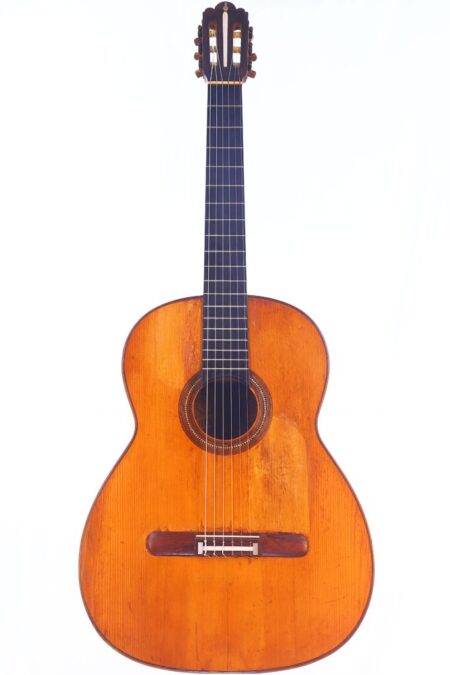
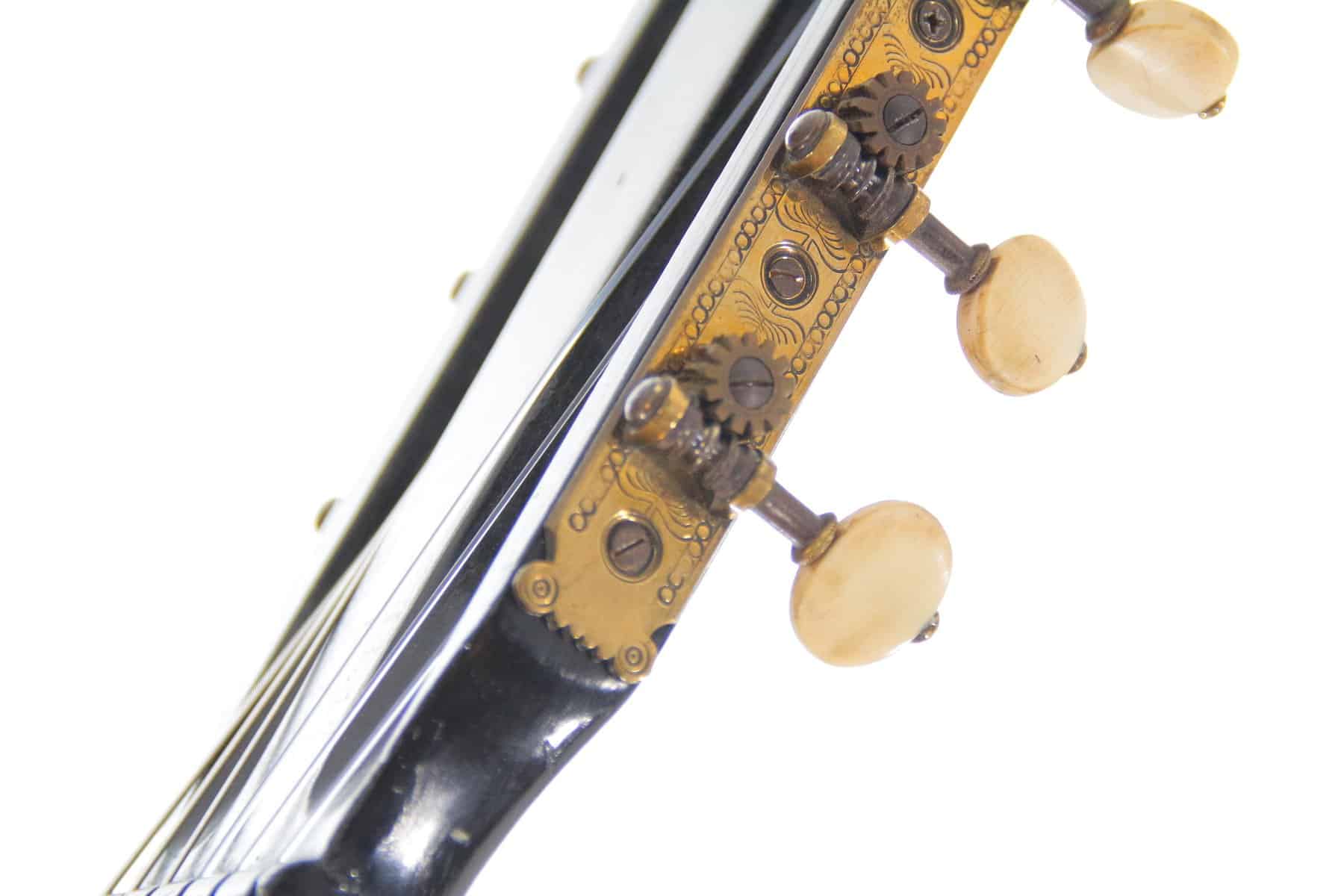
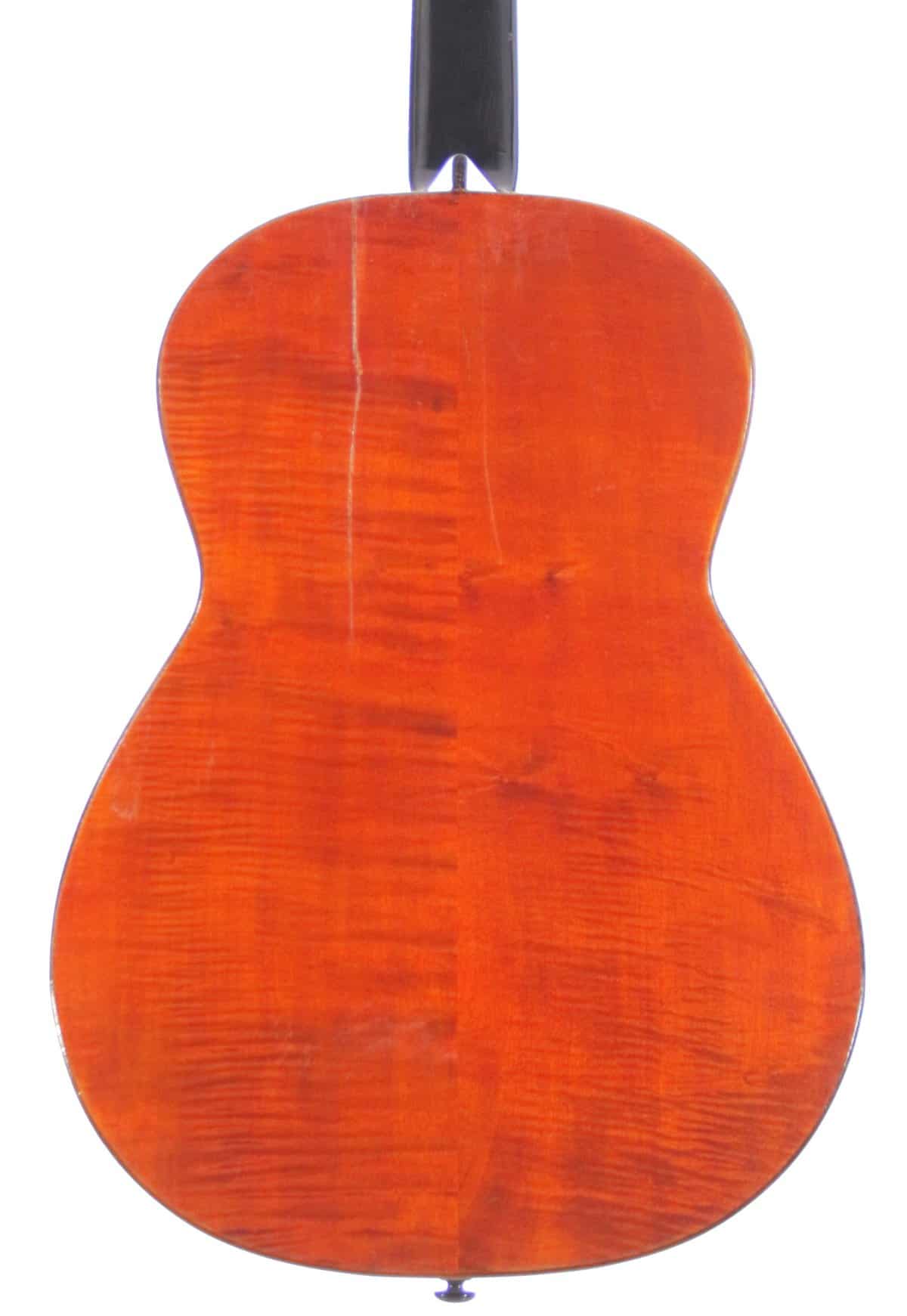
This guitar is a very nice example of a Gelas guitar. 640 mm scale length and 50 mm nut width. It has a spruce top and maple back and sides. It is in restored condition, with some repairs performed over the years. It can be dated to around 1920.
The sound is absolutely astounding. We compared this guitar in the same room with some modern guitars. We were so much surprise when this one was played, it was every bit the equal in volume and projection as any of these modern guitars and far more interesting to listen to in terms of color and nuance.
The guitar has a great richness and harmonious quality. The notes blend together beautifully and yet maintain their clarity and separation. The sensation of playing the guitar is as it vibrates against the players body in a very deep way.
It has an incredibly powerful and dynamic sound.