


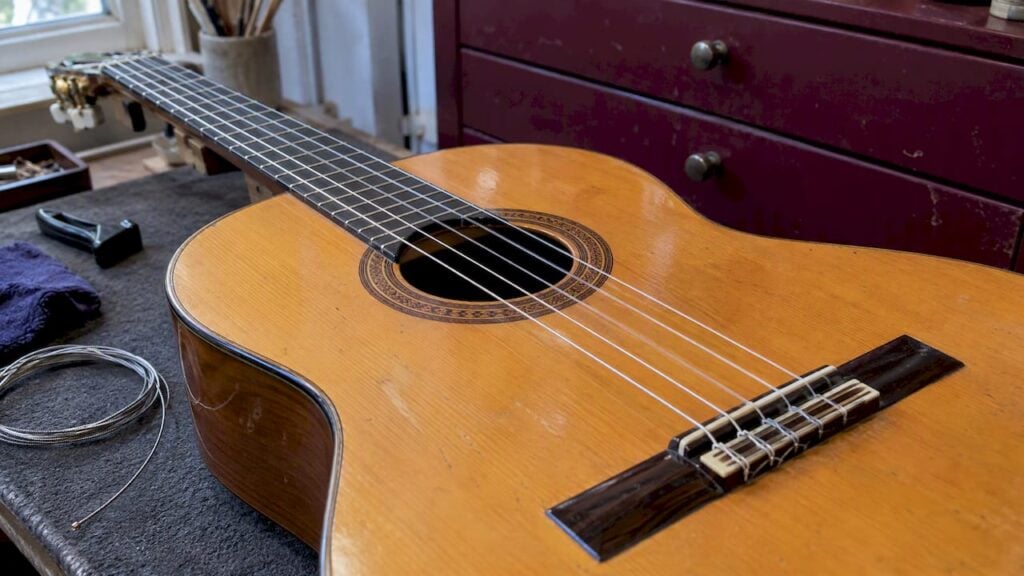

Yes, you can put flamenco strings on a classical guitar. Both instruments use nylon strings and the same tuning, so a set sold for flamenco fits a classical guitar without any change to the bridge, nut or neck. What changes is the sound and the feel under your fingers: flamenco sets are built to be brighter and snappier, and often a little stiffer. Whether that suits your guitar depends on three things: tension, the material of the treble strings and the construction of the basses.
TL;DR
- Flamenco and classical sets share the same nylon construction and tuning, so swapping is safe. Sit Strings describes its sets as suited to classical, flamenco and other nylon-string guitars.
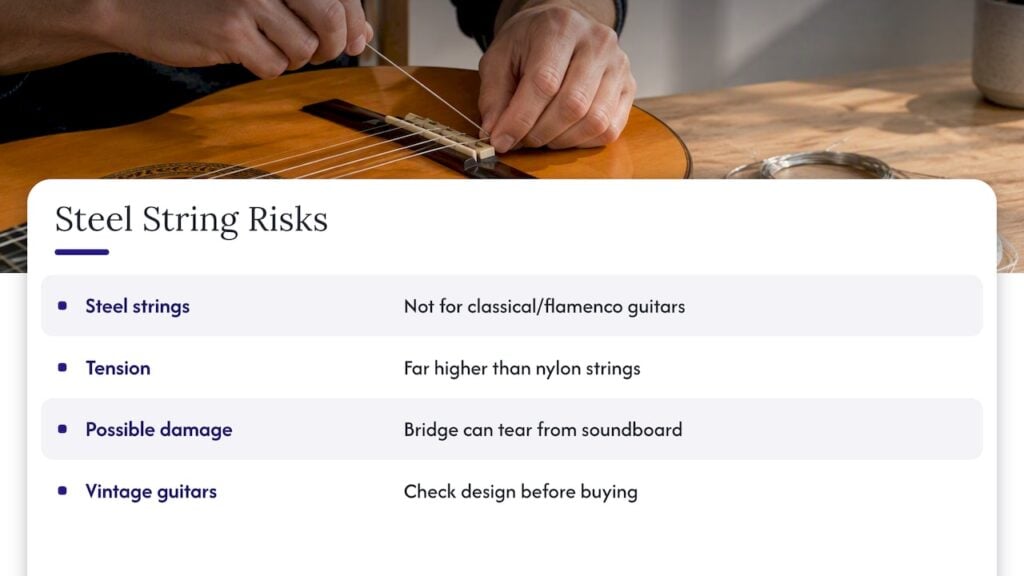
- Never fit steel strings on a classical guitar. Their tension can damage the instrument, up to tearing the bridge off the top.
- Tension is your main control. Higher tension generally means more volume and firmer response, but sometimes fewer bright overtones.
- Treble material (nylon or fluorocarbon) and the bass winding shape brightness and attack.
- Expect a week of frequent retuning with any new set, and change strings when they sound dull or look worn.
Table of Contents
- Are flamenco strings different from classical strings?
- The one hard rule: no steel strings
- Tension: the setting that changes the most
- Treble strings: nylon or fluorocarbon
- Bass strings: core and winding
- Match the strings to the guitar and your playing
- How to compare string sets fairly
- Fitting a new set on a classical guitar
- How long new strings take to settle
- Our perspective
- Try the guitar before you commit to a string
- A simple starting plan
- FAQ
- Sources
Are flamenco strings different from classical strings?
Less than the marketing suggests. Plenty of players point out that there is no strict wall between the two categories: the same set can be strung on a classical guitar or a flamenco guitar, depending on taste. What a “flamenco” label usually tells you is the intended character of the set.
The typical differences are:
- Brighter, more percussive voice. Flamenco sets are designed for crisp attack and a sharp, dry sound. Hannabach, for example, describes the treble strings of its Flamenco Classic series as orange nylon developed for flamenco, with a brilliant sound, paired with silver-plated basses coated against corrosion.
- Slightly different gauges or tension. Some sets are thinner than standard classical sets to get more brightness. Others are built with higher tension. Aquila reports that Paco de Lucía wanted higher tension for flamenco than for classical, with the same tactile feel.
- Color. Many flamenco sets have red, orange or black trebles. That is a look, not a different instrument requirement.
The guitars differ too. Flamenco guitars usually have a lower, more responsive build and sit closer to the fretboard, which is why a classical guitar with high action may feel different with a flamenco set. If you want the full picture of the instrument itself, our flamenco guitar guide explains the differences to the classical guitar, and the overview of classical, Spanish and nylon-string guitars clears up the terminology.
The one hard rule: no steel strings
Everything above concerns nylon. Steel strings, the kind made for western or electric guitars, do not belong on a classical or flamenco guitar. Their tension is far higher than a nylon-string guitar is built to carry, and it can cause severe structural damage, including the bridge tearing away from the soundboard. This matters most on older instruments with aged glue joints. If you own a vintage guitar, check what it was designed for before you buy any set. Our guide to strings for vintage classical guitars covers tension on older instruments.
Tension: the setting that changes the most
Tension is the force a string needs to reach pitch. It shapes how the guitar feels in both hands and how it responds.
In general terms, as players and string writers describe it:
- Higher tension tends to give more volume and a firmer, more controlled response. It can reduce the bright overtones some players want.
- Lower tension feels softer and is easier on the left hand, but can buzz or feel loose when you hit the strings hard.
- Perception is relative. A thinner string at a given tension may feel stiffer on the fingertip than a thicker one at the same tension, because of the contact area.
Flamenco players hit the strings hard, with rasgueados, golpes and fast picado runs, so many prefer a firmer feel. A common reason given for high-tension basses is that they keep fret noise from smearing the notes.
Even tension versus the classical pattern
Standard classical sets often put more tension in the trebles to support singing melodies. Some flamenco sets aim for a more even distribution across all six strings so that fast lines feel the same in bass and treble. Advanced players sometimes mix tensions within a set, for instance a medium first string with a high-tension second, to get a consistent feel for quick string crossings. Treat these as ideas to test rather than rules.
How to pick your tension
- Start with the tension you already play. Note what you like and what bothers you.
- If the guitar sounds soft or buzzes under strong right-hand attack, try the next tension up.
- If your left hand tires during long sessions or the tone turns hard, go down.
- Change one variable at a time, so you know what caused the difference.
The most important test is practical: can you play your repertoire comfortably for an hour? A string that is perfect on paper but fights your hands is the wrong string.
Treble strings: nylon or fluorocarbon
The top three strings decide most of the brightness.
| Treble material | Typical character | Good for |
|---|---|---|
| Clear or colored nylon | Warm, rounded, familiar | Players who want a softer attack and traditional flamenco color |
| Fluorocarbon (carbon) | Denser, often brighter, clear and projecting | Players who want clarity and sustain, or a boost on a dull string |
Fluorocarbon is denser than nylon and can sound brighter. Many players mix materials: a frequently described trick is replacing only the third string with a fluorocarbon one, because the third string often sounds duller than the first and second. Tomatito is named as a famous user of this approach. Our article on nylon versus carbon strings goes deeper into the trade-offs.
Bass strings: core and winding
The three wound strings have a core of nylon (mono- or multifilament) or carbon, wrapped in metal. Denser materials mean higher tension. Silver-plated winding is the common choice for flamenco sets, and some makers add a coating that protects against corrosion and wear. The winding affects how bright the bass is and how quickly it dulls under sweat and heat.
If your bass notes sound muddy on a flamenco guitar, a wound string with a firmer feel can tighten the response. If they sound harsh, a softer-feeling core usually helps.
Match the strings to the guitar and your playing
No set is right for every instrument. Three things interact:
- The guitar. A lightly built top with a lively response may sound better with medium tension, because very high tension can choke it. A heavier, darker guitar often gains from a brighter, higher-tension set.
- The action. Low action combined with a hard attack and low-tension strings gives buzz. Raising tension or adjusting the saddle can help. See our flamenco guitar action setup guide.
- Your hands. Flamenco educators stress comfort first: the best sonic choice is useless if it does not feel right for both your right and left hand.
The good news is that classical guitars need no truss rod or intonation adjustment when you change strings, so you can switch between types without a setup. Experimenting costs you a set of strings and an afternoon, not a trip to the workshop.
How to compare string sets fairly
A sloppy comparison makes every new set sound better or worse than it is. Use this routine:
- Change only one thing at a time: tension, treble material or bass winding.
- Wait until the set has settled before judging (see below).
- Play the same passages each time: a rasgueado pattern, a picado run, a slow melody.
- Record yourself at the same distance from the guitar in the same room.
- Take notes on feel and tone separately.
One warning: fresh strings always sound brightest. If you compare a new set against old strings, the new set wins every time, whatever its tension.
Fitting a new set on a classical guitar
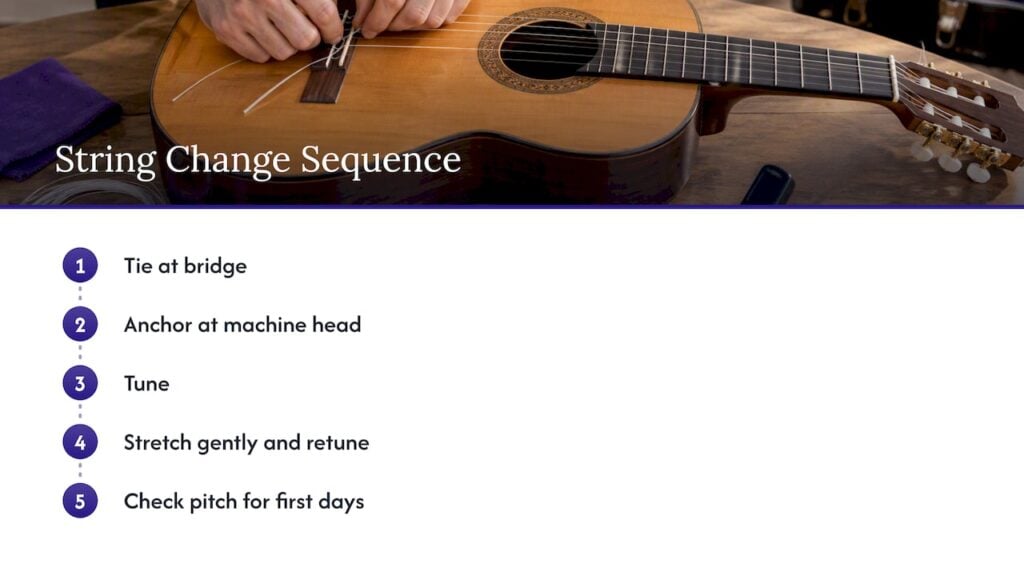
The process is the same as for any classical guitar. Tie each string at the bridge, anchor it at the machine head and tune. Many players start with the low E string, because the bass string ends differ from the trebles. For a step-by-step walkthrough, use our string change instructions for classical guitar. Our tuning guide for flamenco players helps once the strings are on.
Two practical habits help. Stretch each string gently by pulling it away from the fretboard a few times and retune. Then keep checking pitch for the first days.
How long new strings take to settle
New nylon strings stretch. Expect to retune often during the first week, and more so in the first days. After that, the pitch holds.
For lifespan, bass strings generally wear out sooner than trebles; the trebles can last up to three times longer. How long a set lasts depends on how often you play, how clean your hands are, sweat, heat and humidity. Replace the set when the strings look worn or rusty, or when they sound dull and lifeless. Many flamenco players change basses more often than trebles for exactly that reason.
Our perspective
We handle many nylon-string guitars, from vintage concert instruments to modern flamenco guitars, and we hear the same thing from players: the strings change the character of a guitar more cheaply and more reversibly than almost anything else.
That is why we recommend treating the strings as part of the voice of the instrument. A guitar that is carefully built and well maintained will show you what it can do when the set matches your hands. A vintage instrument deserves extra care: choose a tension it was designed for, and never anything near steel-string loads.
When you try guitars with us, you can bring the strings you play and compare. Our expert evaluation looks at how the top responds, how the action sits and which tension will let the guitar speak. That is how we match instruments to players, whether they play flamenco, classical or both.
Vintage
Try the guitar before you commit to a string
Strings can only do so much. If your guitar feels wrong for flamenco, the better move may be a different instrument. At Vintage Guitar World, we offer exclusive guitar testing appointments, so you can play an instrument with the strings you prefer and judge the response in person. Browse our concert guitars (nylon), look at flamenco instruments such as the Sergio Sanchez 2024 flamenco guitar, or ask us for personal advice through our main page.
If your own guitar needs work before new strings can do their job, our restoration service covers that. For players who want to improve technique alongside their gear, read about learning flamenco guitar with professional help. And to hear what the great players wanted from their strings, see our profile of Paco de Lucía.
A simple starting plan
If you want one recommendation to begin with:
- Buy a flamenco-labeled set in the tension that matches what you already play.
- Fit it and give it a full week to settle.
- If the sound is too soft, move up in tension. If it is too harsh, move down.
- Only then try a fluorocarbon third string or a mixed-tension set.
Keep the old set’s packaging, so you remember what you tried. Small notes beat memory after three or four sets.
FAQ
Can I put flamenco strings on any classical guitar?
Yes, as long as it is a nylon-string guitar. The construction and tuning are the same, and you need no setup change. On valuable vintage instruments, choose a tension in line with what the guitar was built for.
Will flamenco strings make my classical guitar sound like a flamenco guitar?
Partly. They will usually make it brighter and more percussive, but the body, top wood, bracing and action shape the sound just as much. A classical guitar with strings for flamenco gets closer to the flamenco sound, but it stays a classical guitar.
Are high-tension strings better for flamenco?
Not automatically. Higher tension tends to give more volume and a firmer response, which many flamenco players like. It can also reduce bright overtones and feel harder on the left hand, so the right choice depends on your guitar and your hands.
How often should I change flamenco strings?
Change them when they look worn or rusty, or when they sound dull and lifeless. Basses usually go first, while trebles can last up to three times longer. Playing time, sweat and humidity all shorten or extend the life of a set.
Sources
- Can I use classical guitar strings on a flamenco guitar? (Sit Strings)
- Hannabach 827 Flamenco Classic
- Flamenco Guitar (Aquila Corde Armoniche)
- Saitenwechsel: Klassische Gitarre (Der Gitarrenblog)