




In a shop you can pick the instrument up, play it and walk out with it. Online you usually get a wider choice and a statutory right to withdraw from the purchase. In Germany, that right applies to distance contracts and not to purchases made over the counter. Neither route is better in general. The better one depends on what you are buying, how much it costs and how well you can judge the instrument from a distance.
This guide compares the two routes on the points that decide the outcome: playability, choice, price, legal protection, shipping and fraud risk. It also covers the case where the choice is hardest, a vintage or handmade guitar.
TL;DR
- A shop lets you test neck feel, weight and balance. Online gives you more choice, plus a 14-day withdrawal right for most distance contracts.
- In a German shop there is no statutory withdrawal right. Returns and exchanges are goodwill from the dealer.
- For online orders, the seller carries the transport risk. Photograph the packaging on arrival and report damage immediately.
- For vintage and handmade guitars, the seller’s expertise and documentation matter more than the sales channel.
- The best hybrid is to play before you decide, then buy from a seller who stands behind condition, setup and papers.
Table of Contents
- What a shop does better
- What buying online does better
- Side by side
- Your legal position in Germany
- Shipping: who bears the risk
- How to judge playability and build quality
- Budget: what to spend and where
- Vintage and handmade guitars: a different decision
- Our view: the best of both routes
- Try a guitar with us before you buy
- A five-step way to decide
- FAQ
- Sources
What a shop does better
The strongest argument for a physical shop is touch. Holding a guitar shows you things that photos and spec sheets hide: neck thickness, weight and how the instrument balances on your knee or strap. A guitar magazine’s buying guide makes this point for buyers at every level, and most players will recognize it. Two guitars with identical specs can feel very different in the hand.
A shop also lets you compare several guitars of one model back to back. Differences in tone and feel between individual instruments are often larger than differences between models. That is especially true for acoustic and classical guitars, where the wood, bracing and age of each instrument shape the sound.
The drawbacks are practical. A local shop carries a limited stock, and the guitar you want may not be on the wall. Prices can be higher than online, and the staff are not always specialists in the type of guitar you are after. A busy shop floor is also a poor place to judge an acoustic guitar’s tone, or to hear an amplified instrument at realistic volume.
What buying online does better
Online buying gives you range. You can compare many makers, models and individual instruments in one evening, read detailed descriptions and look at close-up photos. For rare instruments the choice matters most, because the exact guitar you want may only exist in a few places in Germany or Europe.
Prices are easier to compare too. Dealers who ship nationwide often price sharply, and you can see the going rate for a model before you commit. Delivery to your door also saves travel if the nearest well-stocked shop is a long drive away.
The weak point is that you cannot play the guitar. You rely on the seller’s description, the photos and the seller’s honesty. That makes the quality of the listing, and of the seller, the real variable. A listing with sharp photos of the neck, fretboard, headstock and back, and with honest notes on flaws, tells you a lot. A listing with a few staged photos and a vague description tells you just as much.
Side by side
| Criterion | Shop | Online |
|---|---|---|
| Playing and feel | Direct: neck, weight, balance, tone | Only after delivery, or by appointment |
| Selection | Limited to stock on the wall | Wide, including rare and used pieces |
| Advice | Immediate, but varies with the staff | Written or by phone, varies with the seller |
| Statutory withdrawal right | None in Germany | 14 days for most distance contracts |
| Return after purchase | Goodwill of the dealer | Legal right, plus any longer shop policy |
| Transport risk | None, you carry it home | Rests with the seller until handover |
| Fraud risk | Low | Higher with unknown sellers |
Your legal position in Germany
This is where the two routes differ most. For most online purchases, consumers can withdraw from the contract within 14 days without giving a reason, as one guitar buying guide also notes. A law firm’s overview confirms that qualifying distance contracts carry a 14-day withdrawal period, while in-store purchases have none.
The Verbraucherzentrale says the same about physical shops: no statutory withdrawal right exists, and a return or exchange is a voluntary courtesy of the dealer. So if you buy over the counter and the guitar simply does not suit you, the shop does not have to take it back. Ask about the exchange policy before you pay, and get it in writing on the receipt.
A few details matter in practice:
- Refunds. The seller generally has to refund the original shipping costs after a withdrawal, except extra costs you chose, such as express delivery, according to the same legal overview.
- Return shipping. Who pays depends on what the shop states in its terms and withdrawal notice, and the Verbraucherzentrale advises that you document the condition in which you pack the item, especially for expensive goods.
- Defects. The withdrawal right is separate from warranty claims for defects. Read the shop’s terms to see how each works for used items.
For a guitar, treat the withdrawal period as a real test window. Play it daily, check the neck and electronics, and decide within the first days. Do not modify the instrument, and keep all packaging.
Shipping: who bears the risk
A guitar is fragile and bulky, so transport damage is the most common worry. The Verbraucherzentrale explains that in a dispute over non-delivery or transport damage on an online order, the seller bears the risk and must prove the item arrived. That is stronger protection than most third-party buyer schemes.
What you can do on your side:
- Check the outer box before you sign. Note visible damage with the courier.
- Photograph the box and the opening of the package, then the guitar.
- Tune the guitar only after it has adjusted to room temperature, especially in winter.
- Report any damage to the seller at once, in writing, with the photos.
Ask the seller how the guitar is packed and whether it ships insured. A serious seller can describe the packaging method without hesitation.
How to judge playability and build quality
The same checks apply in a shop and in your living room after delivery. Use them in both places.
- Neck. It should be straight. A guide for beginners says a slight bow is acceptable, but a twisted neck is not.
- Action. String height at the twelfth fret of about two to three millimeters is a common reference for comfortable playing, per the same guide.
- Fret ends. Look and feel along the fingerboard edge for sharp fret ends sticking out. One buying guide notes that dry wood causes this and makes playing uncomfortable.
- Electronics. For electric guitars, plug into an amp and listen for crackling from the pots and switches, as the School of Rock guide advises.
These are quick checks, and most problems they reveal are fixable with a setup. Still, you should know about them before you pay, not after.
Budget: what to spend and where
Set a budget before you browse. Good guitars exist at every price level, and a guitar newsletter notes that brand reputation can influence resale value. For beginners, a guitar magazine recommends choosing on value for money, build quality and comfortable playability rather than on brand name.
A simple rule helps. The more the guitar costs, the less sense it makes to buy it unseen from a seller you cannot verify. The same newsletter quoted above is not needed to see that; a forum thread on a fake shop shows how it goes wrong. For expensive guitars, buy from a known dealer or shop, and be wary of unknown platforms with prices far below the market.
Vintage and handmade guitars: a different decision
With a new factory guitar, any copy of the model plays about the same. With a vintage or handmade instrument, each guitar is unique, and authenticity, originality and condition drive both sound and value. That changes what you need from a seller.
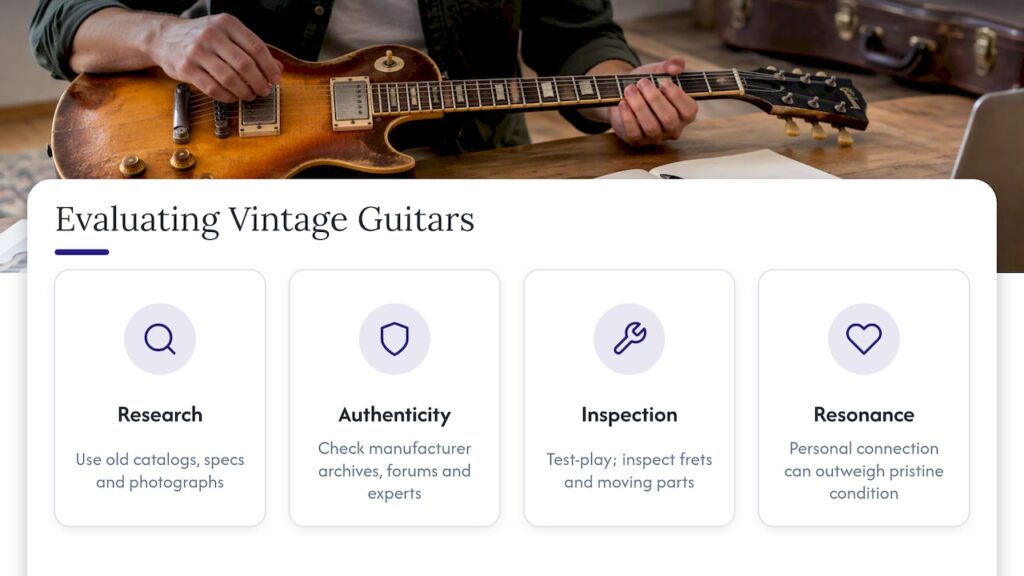
A guide to vintage guitars suggests researching old catalogs and specifications, comparing photographs, asking for detailed photos of parts and consulting other enthusiasts, and it also says to test-play the guitar and inspect setup, frets and moving parts. Another source recommends using manufacturer archives, forums and experts to verify authenticity.
We cover the details in separate guides: how to evaluate a used guitar, how to check authenticity, serial number verification and how to document provenance. If you are worried about fraud, read our guide on avoiding scams when buying a guitar.
One reassurance from the same vintage guide: it cites a dealer’s view that resonance and personal connection matter most, because most mechanical problems can be repaired. A worn guitar that speaks to you is often a better buy than a pristine one that does not. Repairs still cost money, so see what restoration involves before you count on them.
Our view: the best of both routes
We sell vintage, rare, restored and handcrafted guitars, and we see the same pattern with buyers. The question is rarely online or shop. It is whether you can know enough about a specific instrument before you pay for it.
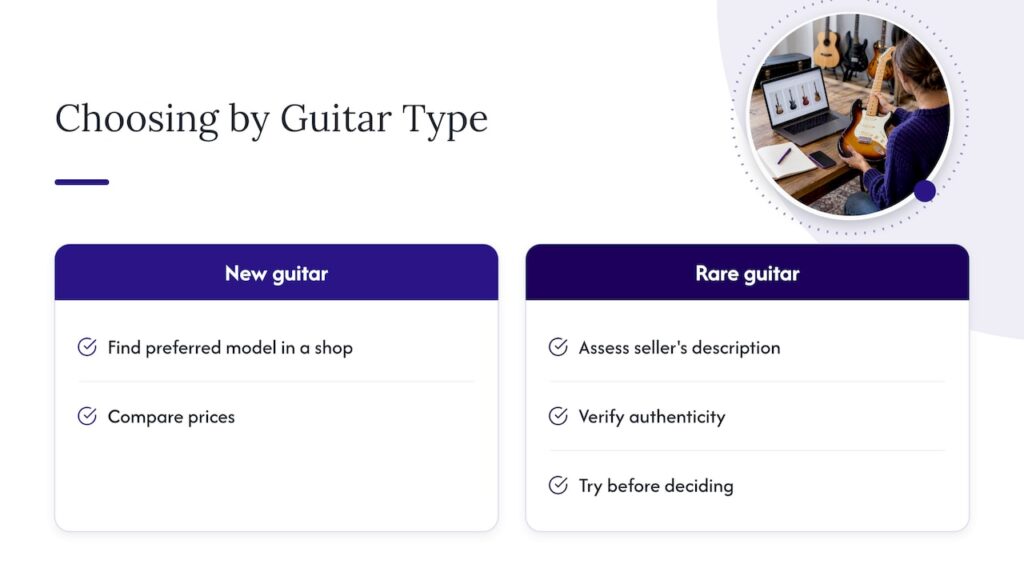
For an ordinary new guitar, a shop visit to find the model you like, followed by a price check, is sensible. For a rare instrument there may be no shop that has it, and the decision rests on three things: how well the seller describes the guitar, whether the guitar can be verified, and whether you can try it. Photos can show condition. They cannot show how a neck feels or how a top responds. That is why we think a rare guitar should never depend on photos alone.
This is how we work around it. We evaluate each instrument ourselves and describe it in detail with its history. We offer exclusive testing appointments, so you can play a guitar before deciding. We also provide certificates and valuation reports, and sell on commission for owners who want to part with an instrument. Authenticity and honest description come first, because with collectible guitars they are what the price rests on.
— Vintage
Try a guitar with us before you buy
If you are considering a vintage, acoustic, classical, flamenco or electric guitar, you do not have to choose between a screen and a shop floor. Browse our vintage guitars, acoustic guitars, classical guitars or electric guitars, then book a testing appointment for the instrument you like.

See how our testing appointments work, or contact us through the Vintage Guitar World home page for valuation, certification or commission sales.
A five-step way to decide
- Define the guitar. Type, budget and the sound you want. A narrow brief makes every later step easier.
- Play first. Try similar models in a shop or at a testing appointment, so you know what feels right.
- Vet the seller. Look for a full imprint, clear terms, a described withdrawal policy and detailed, honest listings. Be wary of prices far below the market.
- Check the paperwork. For used and vintage guitars, ask about serial numbers, provenance and any restoration work. Our guide on testing vintage guitars for quality and value shows what to look for.
- Inspect on arrival. Photograph the packaging, run through the playability checks above and decide while the withdrawal period is open.
We also have a more general guide to where to buy your guitar.
FAQ
Is it cheaper to buy a guitar online?
Often, but not always. Online sellers make price comparison easy, and that pushes prices down for standard models. For used and vintage guitars, the price depends on condition and originality, so the cheapest listing can be the most expensive mistake.
Can I return a guitar I bought in a shop in Germany?
Not by law. The Verbraucherzentrale states that no statutory withdrawal right exists for purchases in a physical shop, so a return or exchange is the dealer’s goodwill. Ask about the policy before paying.
How long do I have to return a guitar bought online?
For most distance contracts, 14 days without giving a reason, per the legal overview cited above. Check the seller’s withdrawal notice for the exact terms, including who pays return shipping.
Who is liable if the guitar is damaged in transit?
On an online order, the seller bears the risk and must prove that the item arrived, according to the Verbraucherzentrale. Document the damage with photos and report it to the seller straight away.
Should I buy a vintage guitar without playing it?
We advise against it. Each vintage guitar is different, and feel and tone cannot be judged from photos. Arrange a test appointment, or buy from a seller who documents the instrument thoroughly and offers a clear route to verify it.
Sources
- Gitarre kaufen für Anfänger und Profis, GITARRE & BASS
- Gitarre kaufen: worauf du als Anfänger achten musst, Online Musikakademie
- Das Widerrufsrecht beim Internetkauf, Anwaltskanzlei Hofauer
- Tipps für den erfolgreichen Widerruf, Verbraucherzentrale
- Retoure angeblich unvollständig?, Verbraucherzentrale
- Wann Käuferschutz einspringt, Verbraucherzentrale
- Gitarre kaufen: Dein genialer 5-Schritte-Plan
- Guide to Buying Your First Guitar, School of Rock
- VIP-Guitar Newsletter WO.23/2024
- Wie viel kostet eine gute E-Gitarre?, Guitar Player
- Was ist beim Kauf einer Vintage-Gitarre zu beachten?, Guitarriego
- Vintage Gitarren: was ist beim Kauf zu beachten?