




A classical master guitar (in Germany, a Meistergitarre) is a handmade instrument built by one maker or workshop, with solid woods and a sound meant to last decades. To choose one well, decide first what you play and how you play it. Then check scale length and neck width against your hands, compare a spruce top with a cedar top, and inspect the setup and construction. If the guitar is vintage, verify its origin before you talk about price. The sections below follow that order.
TL;DR
- Start with your repertoire, your level and your hands, not with a maker’s name. A fine guitar that does not fit you will not be played.
- Scale length (about 650 mm is standard) and nut width (about 52 mm) decide comfort. Short-scale models start at about 597 mm.
- Spruce tops tend to be louder and sustain longer; cedar tops tend to sound rounder and more even. Play both, ideally on the same model.
- A good setup can be corrected. Cracks, a warped neck and a laminated top cannot be corrected cheaply.
- On a vintage instrument, authenticity and originality come before everything else. Ask for documentation.
Table of Contents
- Start with how you play, not with the label
- Size, scale length and neck width
- Tonewoods: spruce, cedar and what is under the top
- Judge setup, action and build quality
- Choosing a vintage or older master guitar
- How much should a classical master guitar cost?
- Our perspective
- Try it with us
- A short checklist to take along
- FAQ
- Sources
Start with how you play, not with the label
People who search for a master guitar usually already play. They may be a conservatory student moving up from a factory instrument, a teacher who wants a guitar for concerts, or a collector who also plays. The best choice differs for each.
Ask yourself four questions before you look at any guitar:
- What do you play most? Romantic and early repertoire (Sor, Tárrega) often suits a warm, rounded voice. Contemporary and concert hall music often rewards projection and clear separation between voices.
- Where do you play? A guitar for small rooms and teaching can be more intimate. A guitar for halls needs reserve in volume.
- How long do you play at a stretch? Long sessions make neck width, string tension and body size matter far more than a spec sheet suggests.
- Is it a classical or a flamenco guitar you really need? Flamenco guitars are typically built with a lower action and a drier, more percussive voice. Many players in Germany are drawn to both and own one of each. We keep both types in the shop, so you can compare them side by side.
Write down your answers. They are your filter, and they keep you from buying the first beautiful guitar you hold.
Size, scale length and neck width
Comfort comes first because it determines how much you will practice. Two numbers do most of the work.
Standard concert guitars have a scale length of about 650 mm and a nut width of 52 mm, while short-scale models start at about 597 mm, according to a German guitar magazine’s tutorial on scale length, nut width and neck profile. Some makers also build longer scales, for example 664 mm, and the difference is felt in the stretch between frets and in string tension.
| Feature | What it changes | Who tends to benefit |
|---|---|---|
| Shorter scale (about 640 mm and below) | Lower string tension, shorter stretches | Smaller hands, players with wrist or finger strain |
| Standard 650 mm | Balanced tension and projection, the reference for most repertoire | Most players |
| Longer scale (such as 664 mm) | Higher tension, more definition in the bass | Players with large hands who want a tighter response |
| Wider nut (52 mm and up) | More room between strings for fingerstyle | Players who play fast scale passages and polyphony |
| Narrower nut | Easier chord reach | Smaller hands, players coming from steel-string guitars |
Short scales are not a compromise in tone. One luthier’s technical note argues that a shorter scale of around 640 mm lowers string tension, which may let the top move more freely and give a warmer, more pliable tone without losing volume. Treat that as one maker’s view, and test it with your own hands.
If you cannot decide, read our guide to choosing the right scale length for a classical guitar or try a direct comparison with 650 mm versus 664 mm scale length on classical and flamenco guitars. Nothing replaces holding both for an hour.
Tonewoods: spruce, cedar and what is under the top
The top (soundboard) shapes most of what you hear. The two classic choices are spruce and cedar, and the differences are real but not absolute.
Spruce versus cedar
A 2015 study of materials used in guitar tops found that German spruce soundboards generally gave higher volume and longer sound duration, while Canadian cedar soundboards tended to give a more homogeneous sound. The same study linked those results to wood density, stiffness and related properties.
In practice that means:
- Spruce: clear, bright, strong projection, good note separation. Often chosen for concert playing.
- Cedar: warm, quick to respond, and generally easier to bring to life with a lighter touch. Many players find it forgiving.
Individual pieces of wood vary a great deal. Researchers who model guitar making describe wood variability as a significant source of uncertainty and see wood selection as a critical step. So a cedar guitar by one maker may sound brighter than a spruce guitar by another. Judge the instrument, not the category.
Bracing, back and sides
The way the top is braced (traditional fan bracing, lattice or other designs) shapes response and balance. Fan-braced guitars tend to sound the way many players expect a classical guitar to sound. Lattice and double-top designs can add volume and clarity, with a different character. You do not need to be an expert on every pattern. You do need to hear two or three side by side.
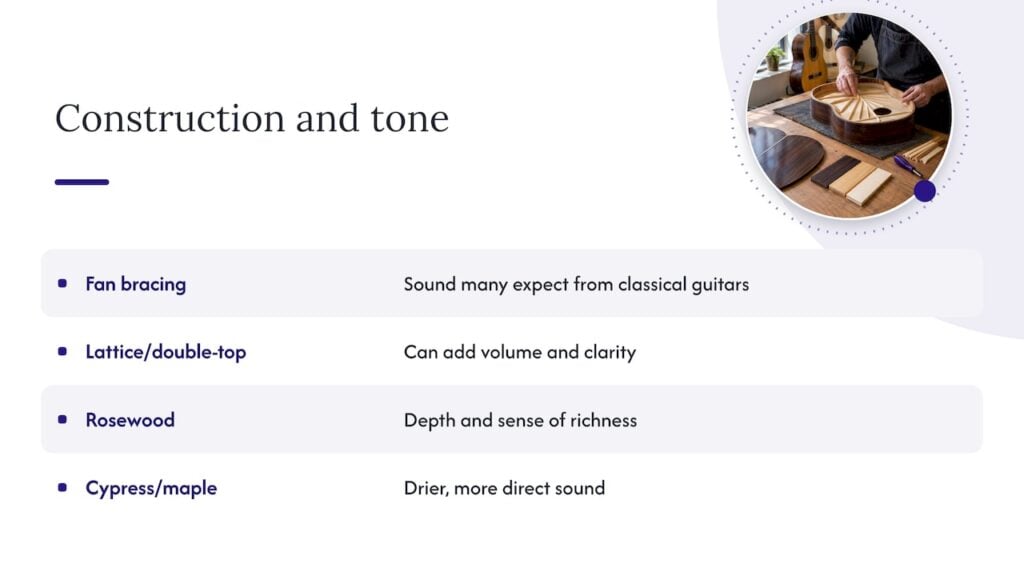
Back and sides also color the sound. Rosewood types often add depth and a sense of richness. Cypress and maple tend to be drier and more direct, which is why cypress is traditional on flamenco guitars.
Confirm the top is solid
A master guitar has a solid top. One practical check is to look at the edge of the soundhole: if the grain lines run continuously through the thickness of the wood, the top is solid rather than a laminated “sandwich”. Ask the seller directly and ask for it in writing.
Judge setup, action and build quality
A setup can make a great guitar feel dull, and a poor guitar feel acceptable for five minutes. Separate the two before you decide.
What you can check in 15 minutes
- Action at the 12th fret. Measure from the top of the fret to the underside of the string. On classical guitars the bass side is normally set a little higher than the treble side. If the action feels high but the neck is straight, the saddle may simply need lowering. If it is far too low, you will hear buzzing, and a saddle cannot easily be rebuilt to fix it.
- Buzz up the neck. Play every string at every position. A buzz on a single fret points to a fret problem. Buzz everywhere points to neck relief or action.
- Intonation. Tune the open strings and then check the 12th fret harmonic against the fretted note on each string. Large differences point to a misplaced bridge or saddle, or to old strings. Fresh strings give the fairest test.
- Balance. Do bass and treble sound equally strong? Do notes above the 7th fret still sing, or do they die quickly?
- Neck. Sight along the neck from the headstock. A twisted or bowed neck is a serious issue. A slight, even relief is normal.
What to look for in the construction
Look at the joints between top, sides and back, the binding, the rosette, the bridge and the inside of the body with a small mirror and a flashlight. Clean, even work and tidy bracing are signs of a maker who cares. Check for cracks in the top and for lifted bridges or braces. A hairline crack that has been properly repaired is not always a deal breaker, but you should know about it and the price should reflect it.
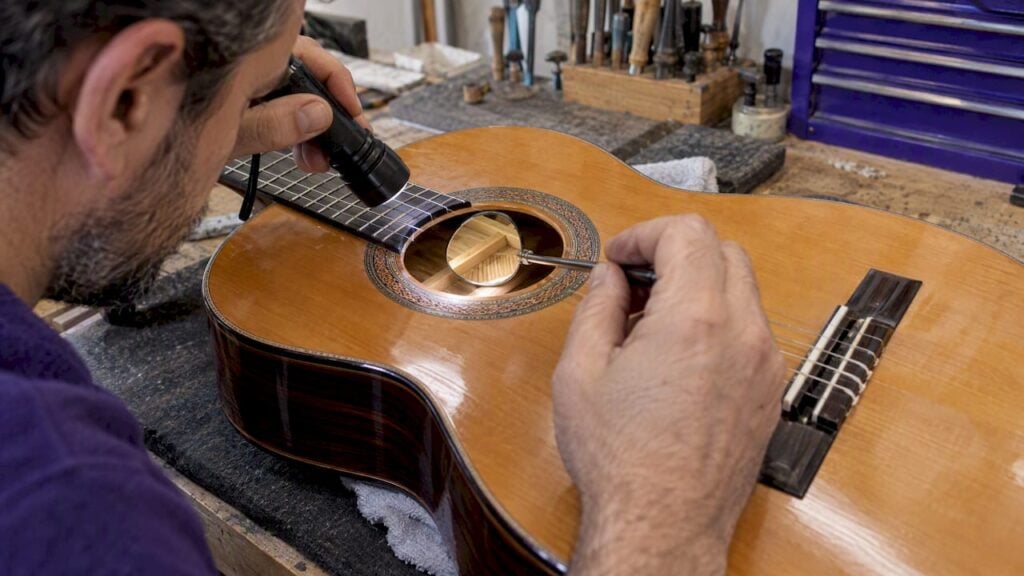
Setup you can change, and damage you cannot
Saddle height, string choice and tension, and minor fret dressing are normal, affordable adjustments. A warped neck, a collapsing top or extensive structural repairs are not. If a guitar needs work, our restoration service can assess what is realistic before you commit.
Choosing a vintage or older master guitar
Do older guitars always sound better? No. Older instruments can sound warmer, fuller and more complex as the wood ages and settles, and many players prefer them. But a tired top, an old repair or a poorly done neck reset can leave a vintage guitar sounding worse than a new one. Age is a possibility, not a guarantee.
What matters more on a vintage instrument is whether it is what the seller says it is. A German buying guide on vintage guitars says authenticity, serial numbers, original parts and wood types decide whether you get a genuine instrument or a composite of mismatched parts, and it lists cracks, neck warping and fret wear as the physical points to inspect.
When you inspect, check these in order:
- Label and signature. Is it consistent with the maker’s known work? Labels can be replaced or forged.
- Serial or workshop numbers. Do they match the period and the maker’s records, where those exist?
- Originality. Original tuners, bridge, saddle and finish are worth more than replacements. A refinished top changes both sound and value.
- Repairs. Ask for every repair to be listed: cracks, bridge reglue, neck reset, refrets.
- Documentation. Invoices, earlier appraisals and certificates are part of the guitar’s history.
For the verification step itself, our guide to checking the authenticity of a vintage guitar and our checklist of ways to spot a fake guitar go through the evidence step by step. If you want a view on how formal checks work for other kinds of collectibles, what an authenticity guarantee checks shows the general logic: materials, markings and provenance. For guitars, see also how certification works in guitar collecting.
Be cautious with private sales where you cannot play the guitar first. Our article on avoiding scams when buying a guitar covers the red flags.
How much should a classical master guitar cost?
Prices vary widely, and this is where most buyers get confused. Four things explain almost all of the difference.
- Who built it. A named maker with a waiting list charges for reputation and consistency. A small workshop may offer similar craftsmanship at a lower price.
- Materials. Solid woods, quality of the cut, aging of the wood, and rare species raise the cost.
- Labor. A fully handmade guitar takes weeks. A workshop guitar built in a small series takes less time and costs less.
- Condition and provenance (for vintage). Originality, documented history and a clean structure matter more than the date alone.
For your own budget, work backwards. Decide what you can spend including a possible setup, a case and a few new sets of strings. Then compare guitars that sit in the same bracket, rather than stretching for a famous name that leaves nothing for adjustments. We publish no fixed prices for vintage and master guitars because each one is a single instrument, so each is priced individually on the product page.
Do not expect a bargain from an unusually cheap “master” guitar. If the price is far below comparable instruments, look for a laminated top, a hidden repair or a doubtful label.
Our perspective
We handle classical, flamenco, acoustic and electric guitars every day, and the same pattern repeats. Buyers arrive with a list of specifications and leave with the guitar that felt right in their hands. Specifications narrow the field. They do not make the decision.
We believe three things about choosing a master guitar:
- Play it before you decide. A guitar must be heard in a room, with your own hands, over more than a few minutes. This is why we offer exclusive testing appointments.
- Provenance deserves as much attention as sound. A guitar whose history you can follow is easier to trust, easier to insure and easier to sell again later.
- Restoration is not a flaw. A well-done repair that respects the original instrument is better than an untouched guitar with a hidden problem. What matters is that it is disclosed.
We select every instrument we list, evaluate it, and describe its condition and history in the product description. If you would like a second opinion on a guitar you already own or are considering, ask us.
— Vintage
Try it with us
If you are comparing several guitars, the most useful step is to play them in one session. We offer exclusive testing appointments in our shop, and you can browse the current classical guitars (nylon) online first. We also provide certificates and valuation reports, and we sell guitars on commission for owners. See all services on our main page.

Tell us what you play and what you are looking for, and we will tell you honestly which instruments fit and which do not.
A short checklist to take along
- Your repertoire, budget and the room you play in, written down.
- A tuner and a small ruler (in millimeters) for the action at the 12th fret.
- A flashlight and a small mirror for the inside of the body.
- Your own strings, or fresh ones from the seller, for a fair comparison.
- A list of questions about repairs, originality and documentation.
- Time. Play at least three guitars in the same room, and come back to the first one.
For a broader buying routine, see our 7-point checklist for buying vintage guitars and our guide on how to evaluate a used guitar.
FAQ
Is a spruce or a cedar top better for a classical master guitar?
Neither is better in general. Research on guitar top materials found that German spruce tended to give more volume and longer sound duration, and Canadian cedar a more even sound. Which one you prefer depends on your touch, your repertoire and the specific guitar, so play both.
What scale length should I choose?
Start with 650 mm, which is the standard for classical guitars. Choose a shorter scale if you have small hands or feel strain, and try 664 mm only if you want higher tension and have the reach for it. Hold each version for at least half an hour before you decide.
Do old guitars sound better than new ones?
Not automatically. Aged wood can sound warmer and more complex, but condition, repairs and originality have a large effect. A new master guitar in excellent condition can easily outperform a vintage guitar with structural problems.
How can I tell whether a classical guitar is genuinely handmade with a solid top?
Look at the edge of the soundhole. If the grain lines run continuously through the thickness of the top, it is solid wood, not a laminate. Then ask for the maker, the label, the serial number and any documentation, and have anything unclear checked by a specialist before you pay.
Sources
- Mensur, Sattelbreite, Halsprofil: ihr Einfluss auf die Bespielbarkeit
- Guitar Scale Length: Definition, Impact, and Choosing the Right One
- Acoustic and mechanic characterization of materials used in guitar soundboards (2015)
- Model-predicted geometry variations to compensate material variability in classical guitar making (2023)
- Buying a Guitar: new or used, handmade or factory
- Vintage Gitarren: was ist beim Kauf zu beachten?
- Authenticity guarantee: what it checks