


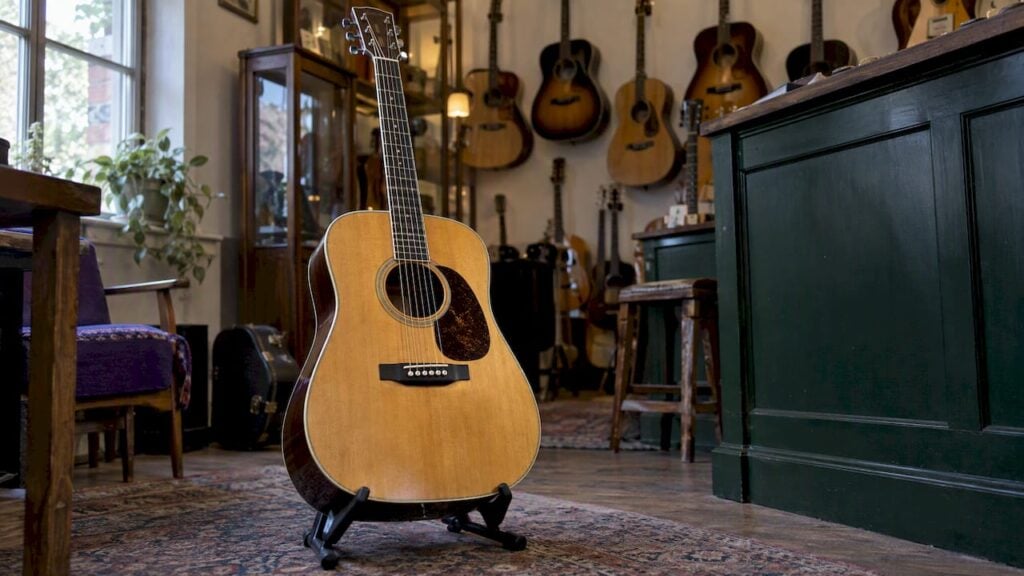

The Martin D-28 is a dreadnought acoustic guitar that C. F. Martin & Company of Nazareth, Pennsylvania, introduced in 1931. It combines a large, square-shouldered body with a rosewood back and sides, and it became the benchmark that other steel-string guitars are measured against. This article walks through how it got there, which years collectors care about and why, and what the history means if you plan to buy, sell or play a vintage example in Germany.
TL;DR
- The D-28 arrived in 1931. Its rosewood back and sides and big dreadnought body made it the reference point for the professional steel-string guitar.
- Pre-war examples with herringbone trim are the most prized. Martin discontinued the herringbone top border in 1946.
- Martin moved from Brazilian to East Indian rosewood in late 1969. That date splits the vintage market in two.
- Brazilian rosewood has been under CITES Appendix I since 1992, so paperwork matters when a guitar crosses a border or changes owner.
- Condition, originality and documentation drive value as much as the year on the label.
Table of Contents
- Where the dreadnought came from
- Why the D-28 became the standard
- The pre-war years and the herringbone
- The rosewood turning point of 1969
- Era by era: what changes and what to look for
- The neck question: are Martins harder to play?
- Buying a vintage D-28: five practical checks
- Where to see the history in person
- Our perspective: why the D-28 still matters
- Looking for a guitar, a valuation or a second opinion?
- FAQ
- Sources
Where the dreadnought came from
The word dreadnought is a naval term. The shape took its name from the big battleships of the early twentieth century, and the name stuck because the body really was larger than anything else on the market. The Martin D-28 overview describes the design this way and credits the model with booming projection and a high-quality tone.
Martin did not build the D-28 out of nowhere. According to the same source, the first batch went entirely to a Chicago wholesaler, although that exclusive arrangement did not last long. Before the Second World War, only three dreadnoughts appeared in the Martin catalog: the D-18, the D-28 and the D-45. The two with rosewood back and sides, the 28 and the 45, were both inducted into the Vintage Guitar magazine Hall of Fame.
That catalog logic is useful when you read old listings. The number 28 refers to Martin’s style system, which tells you about trim and appointments. The D tells you the body size. A D-28 is a plain-spoken, well-finished professional instrument, while the D-45 sits at the ornate top of the range.
Why the D-28 became the standard
A guitar does not stay in production for almost a century because of marketing alone. Guitar World notes that the D-18 and D-28 have been best-selling standards since the mid-1930s, and that the Martin dreadnought body is quite possibly the most copied design in guitar history.
In practical terms, the D-28 offers three things:
- Power. The large body moves a lot of air, which suits flatpicking, strumming and playing with a band.
- Balance. Rosewood back and sides add depth and a complex, layered color to the bass and a clear top end, so the guitar sits well in a recording.
- Predictability. A professional knows roughly what a D-28 will do in a room or a studio. That reliability is why it keeps turning up on records.
Those qualities are also why the model carries a lot of cultural weight. Players, collectors and builders use it as a yardstick, even when they prefer something else.
The pre-war years and the herringbone
Ask a collector about the golden era and the answer is usually the pre-war D-28. The word herringbone is enough to signal an instrument that, in the words of one vintage guitar reference, carries the richest tone and most powerful sound of any flat-top guitar.
The herringbone is a decorative pattern lining the top edge of the body. It is more than cosmetics, because it works as a dating clue. According to the Martin D-28 overview, the pattern was discontinued in 1946 because the German-made material used for it was no longer available after the war. If you see a guitar described as pre-war, herringbone trim is one of the first things to check, along with the serial number and the neck block stamp.
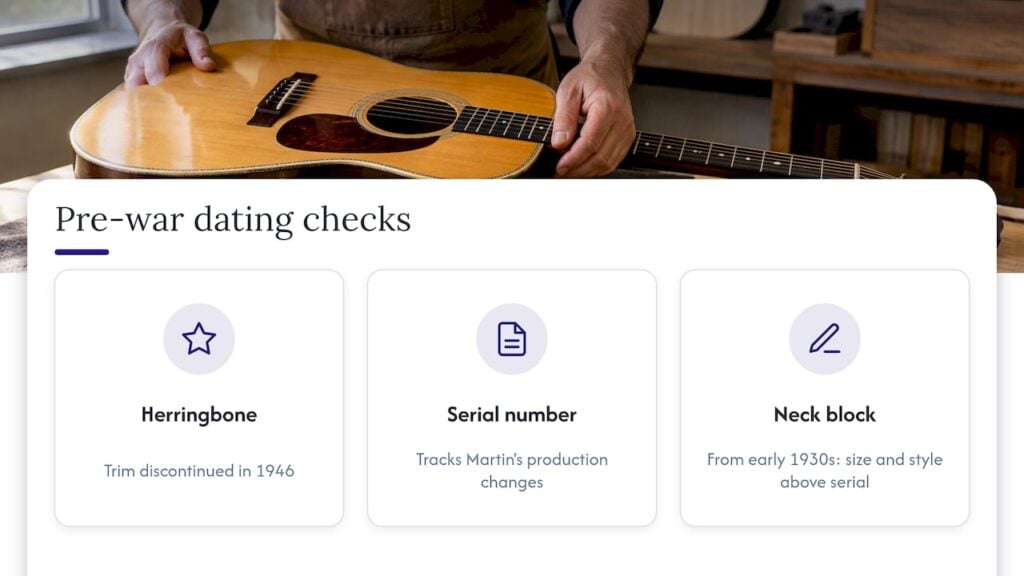
Martin’s own production changes can be traced through serial numbers. A French-language serial number milestone list records, for example, that from the early 1930s both body size and style number were stamped on the neck block above the serial number. Details like these help a specialist confirm that the parts of a guitar belong together.
The rosewood turning point of 1969
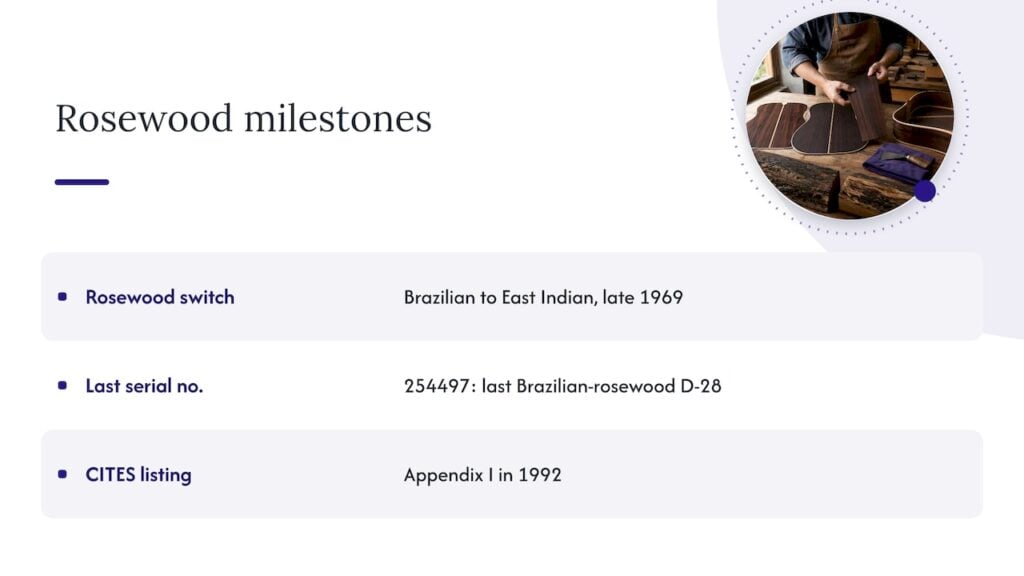
The most important date for modern buyers is not 1931 but 1969. Martin changed the D-28 from Brazilian rosewood to East Indian rosewood in late 1969. The same serial number reference gives serial number 254497 as the last D-28 made with Brazilian rosewood.
Why does the wood matter so much? Part of the mystique, as Guitar Player explains, comes from the fact that Brazilian rosewood was widely used in many of the best vintage acoustic and electric guitars until the late 1960s. Plenty of players hear a difference. Others simply value the historical consistency of an instrument built from the original material. Either way, the market prices the two woods differently.
The legal side changed everything afterwards. Brazilian rosewood was placed in CITES Appendix I in 1992, according to the same French-language reference. NPR reported on how new regulations on the international movement of rosewood hit parts of the music industry that had long relied on it as a tonewood, in guitars as well as cellos and clarinets.
What this means for a D-28 in Germany
If the guitar has Brazilian rosewood, the question is no longer only about sound. It is also about whether you can document the instrument and move it legally. German municipal authorities describe the permit duty broadly: it covers live and dead animals and plants as well as parts or products made from them, as one city administration page on protected species puts it. For your specific case, ask the competent species protection authority, because the rules depend on whether you stay inside the EU or cross its border.
We have written separate guides on this topic. If you are unsure whether your instrument qualifies, start with CITES guitar regulations in Germany, then read what you will really need in a CITES certificate. If you are selling, our page on how to identify Rio rosewood explains what to verify first.
Era by era: what changes and what to look for
The table summarizes the milestones that are supported by the sources above. It is a starting point for a conversation, not a replacement for a hands-on inspection.
| Period | What defines it | What to check |
|---|---|---|
| 1931 to 1946 | Introduction of the D-28, herringbone top trim | Herringbone, neck block stamp, serial number, originality of the top and bracing |
| After 1946 | Herringbone discontinued | Trim style, any later modifications |
| Up to late 1969 | Brazilian rosewood back and sides, last serial 254497 | Wood identification, paperwork, repairs |
| From late 1969 | East Indian rosewood | Condition, neck angle, finish wear |
| From 1992 | Brazilian rosewood under CITES Appendix I | Documentation for sale or transport |
The neck question: are Martins harder to play?
Readers often ask whether a Martin is harder to play than other makes. The honest answer is that it depends heavily on the era and the neck. As Vintage Guitar magazine describes, older Martins can have different neck dimensions and reinforcement than the adjustable truss-rod necks on contemporary instruments. Any difficulty usually comes from neck profile and setup, not from the design of the guitar itself. A good luthier can adjust action and often make a vintage D-28 comfortable without touching its originality.
This is also why we encourage anyone serious about a vintage purchase to play the guitar before deciding. A photo cannot tell you how a neck feels in your hand.
Buying a vintage D-28: five practical checks
The history is interesting, but it also gives you a checklist. These are the points we would go through with a customer.
- Confirm the era. Match the serial number to the features. Herringbone, neck block stamps and the rosewood type should all fit the claimed year.
- Identify the wood. After the 1969 changeover, Brazilian and East Indian rosewood are both found on Martin guitars of different periods. Do not rely on a seller’s word alone.
- Ask about repairs. Cracks, neck resets, refinishes and replaced bridges change value. Honest documentation is a sign of a trustworthy seller.
- Get the paperwork. For Brazilian rosewood, discuss the CITES situation before you pay, not after.
- Play it. Compare tone, neck feel and action in person, ideally on more than one example.
If you are weighing an original against a modern copy, our guide to vintage versus reissue guitars goes through the trade-offs. For more context on Martin’s role in the broader story, see our article on Martin guitars and the modern acoustic guitar and our overview of rare guitar woods.
Where to see the history in person
The Martin Guitar Museum sits inside the same building as the Martin factory in Nazareth, Pennsylvania. A report on the museum’s D-28 exhibit describes it as an immersive experience that tells the company’s history through a large collection of prized instruments. For most readers in Germany it is a long trip, which is one reason many collectors prefer to study individual instruments up close through a specialist dealer.
Our perspective: why the D-28 still matters
At Vintage Guitar World we think of the D-28 as a teaching instrument for collectors. It shows how a model can be simple, well made and widely used, and still become historically important because of small details: a trim pattern, a wood species, a date on a neck block.
When we evaluate a guitar, we care less about the legend than about the evidence in front of us. Is it original? Has it been restored with care? Can the owner prove what it is made of? Those questions are where a good purchase is decided, and they are the reason we offer expert evaluation, certification and personal testing appointments alongside the guitars themselves.
We also believe a vintage guitar should be played. The best D-28 is not always the oldest one. It is the one that is honest about its history, fits your hands and sounds right for the music you make.
— Vintage
Looking for a guitar, a valuation or a second opinion?
We sell vintage, restored and handcrafted guitars, and our services include testing appointments, commission sales and certificates and valuations. If you are searching for an acoustic with real history, browse our acoustic guitars or our vintage guitars. If you own a Martin and want it assessed, certified or sold on commission, you can reach us through our main page. For repair work, see our page on restoration.
FAQ
Why is the Martin D-28 so popular?
It combines a powerful dreadnought body with rosewood back and sides that give a balanced, complex tone. Guitar World points out that the D-28 has been a best-seller since the mid-1930s. Musicians treat it as the reference for a professional steel-string acoustic.
Why did Martin stop using Brazilian rosewood?
Martin changed the D-28 to East Indian rosewood in late 1969. The formal trade ban followed later: Brazilian rosewood was listed in CITES Appendix I in 1992. If you own or want to buy an earlier guitar, ask for documentation of the wood and its history.
When did the D-28 lose its herringbone trim?
The herringbone pattern was discontinued in 1946, according to the Martin D-28 overview, because the German-made material was no longer available after the war. This is why pre-war guitars with herringbone are so sought after.
Is a vintage Martin harder to play than a modern guitar?
Not by design. Older instruments can have different neck dimensions and reinforcement, as Vintage Guitar magazine explains. A proper setup by an experienced repairer usually makes a big difference.
Do I need a certificate to sell a Brazilian rosewood D-28 in Germany?
Often you need documentation that proves the instrument’s origin and age, and sometimes a formal permit, depending on whether it stays in the EU. Read our guide to CITES rules for guitars in Germany and contact the responsible species protection authority for your situation.
Sources
- Martin D-28, Wikipedia
- Martin D-28 and D-45, Vintage Guitar magazine
- How the Martin D-18 and D-28 became the definitive acoustics, Guitar World
- Martin D-28, VintageGuitarEncyclopedia.com
- Modifications chez Martin en fonction des numéros de série
- Why Brazilian rosewood is a big deal, Guitar Player
- The Tree That Rocked The Music Industry, NPR
- Ein- und Ausfuhr geschützter Pflanzen- und Tierarten, Stadt Göppingen
- Martin Celebrates Its Flagship D-28 With a New Exhibit, Acoustic Guitar