


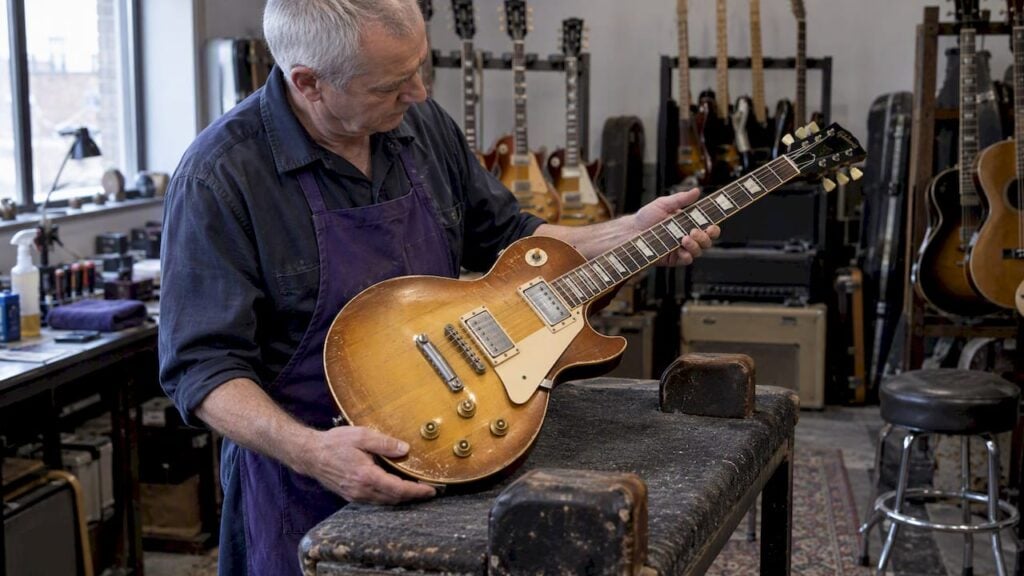

A Norlin-era Les Paul is a Gibson built while the company belonged to Norlin, which means roughly 1969 to the mid-1980s. You identify one by combining physical clues: a volute behind the headstock, a layered “pancake” body, a three-piece maple neck, the neck tenon length, potentiometer date codes and a heavy weight. Serial numbers alone will not settle it, especially from 1970 to 1975.
This guide shows the order we work through when a Les Paul lands on our bench, what each clue really proves, and where a single feature can fool you.
TL;DR
- Norlin took control of Gibson on December 19, 1969. Les Pauls from the following years carry a recognizable set of construction changes.
- Serial numbers from 1970 to 1975 are erratic. Check the pot codes (format 137YYWW), the volute, the body layers and the neck wood instead.
- Remove the neck pickup to look at the tenon. Long tenon means 1974 or earlier, short tenon became standard in 1975, with overlap in 1975 and 1976.
- Weight is a hint, not proof. Many Norlin Les Pauls are very heavy, but a heavy guitar is not automatically a Norlin.
- Refinishing or swapped parts can cost you a large share of the value, so confirm originality before you buy.
Table of Contents
- What “Norlin era” means
- Why the serial number is not enough
- The nine checks, in the order we do them
- A quick decision table
- Our perspective: how we judge these guitars
- Getting a second opinion
- Common mistakes when dating a Norlin Les Paul
- A short checklist for your next viewing
- FAQ
- Sources
What “Norlin era” means
On December 19, 1969, Ecuadorian Company Ltd bought controlling interest in Chicago Musical Instruments, which owned Gibson. The new parent was named Norlin, and Gibson ended up as the last musical company asset it sold off. In practice, collectors use “Norlin era” for Gibsons made from 1969 until the sale in the mid-1980s.
The label is controversial. Many players criticize the period for heavy guitars and cost-driven construction. Yet these instruments have seen growing appreciation as underdog vintage pieces, while the 1958 to 1964 golden-era guitars remain the collectors’ priority. Knowing exactly what you hold decides whether the price is fair.
Why the serial number is not enough
If you come from German-language forums, your first instinct is to look up the serial number. For the Norlin years that is the weakest tool you have.
According to the Gibson information collected in the Les Paul Forum FAQ, from 1970 to 1975 the serialization became even more random. Numbers were pressed into the wood, six digits were assigned in no particular order, and some instruments carry a lower number than their build date would suggest. Practitioners therefore lean on secondary indicators instead.
Serial decoding becomes far more reliable later: serials since 1977 encode the exact production day, with exceptions in the 2010s. The same source warns that Gibson has used more than a dozen serial systems and reused numbers, so an honest answer is often two to four candidate years. Treat the serial as one witness among several, never as the verdict.
The nine checks, in the order we do them
1. Look at the headstock angle: the volute
Norlin-era Les Pauls typically show a volute, a thickened ridge of wood where the neck meets the headstock. It was added as reinforcement against headstock breaks. Combined with the other features below, a volute points strongly to the Norlin years. The Les Paul Forum FAQ lists it, together with the pancake body and the neck wood type, among the structural features used to establish a timeline.
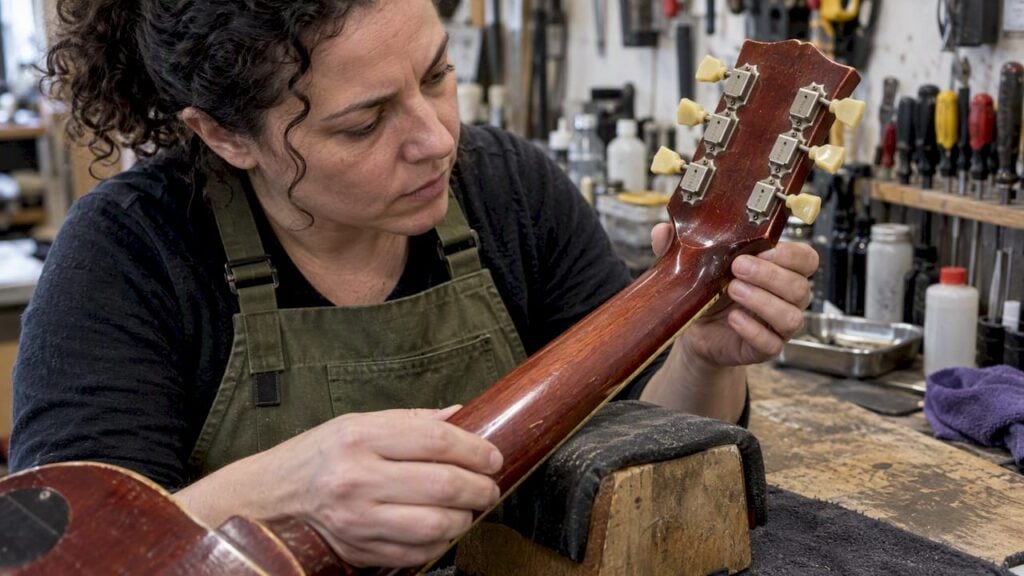
Caution: a volute alone does not date a guitar, because a neck can be replaced or a later instrument can carry similar features. Treat it as one box ticked.
2. Check the body edge for the pancake layers
The “pancake” body is a mahogany body built from layers with a thin maple layer sandwiched in the middle, under the usual maple cap. Seen from the side, you can often spot a stripe along the edge. Look at the body from the underside and along the rim of the cutaway, where a refinish may not fully hide it.
A solid one-piece mahogany back is not a sign of a Norlin. If you see a stripe in a guitar that is sold as a 1950s original, something is wrong.
3. Examine the neck wood
Many early Norlin-era Les Pauls have a three-piece maple neck rather than a one-piece mahogany neck. Look at the back of the neck and the headstock edges for glue lines. A single-piece neck on a guitar claimed to be from 1970 to 1975 deserves questions: it may be a replacement, a later model or something else.
Maple necks are also one reason many players like these guitars. The feel is slim and wide, and some owners describe the low, wide frets as a plus.
4. Remove the neck pickup and measure the tenon
This is the check beginners skip and experts value. The neck tenon is the part of the neck that is glued into the body. According to the Les Paul Forum FAQ, models through 1974 generally have the long “trans” tenon, and the shorter tenon became standard in 1975, though transitional instruments from 1975 and 1976 can still have the longer joint. Removing the neck pickup is the standard way to see it.
What this tells you:
| Tenon | Typical period | What to conclude |
|---|---|---|
| Long | up to 1974 | Early Norlin years, consistent with volute and pancake body |
| Short | from 1975 | Later Norlin build |
| Long, with 1975 or 1976 features | transition | Possible, check other details |
Only open the cavity if you own the guitar or have the seller’s permission. At our shop visits, we do this ourselves so that nothing gets scratched.
5. Read the potentiometer codes
Pot codes are the most useful date tool of the early 1970s. The format is 137YYWW: the code starts with 137, then two digits for the year, then two digits for the week. The FAQ describes this format, and it is how practitioners confirm a timeline when the serial fails.
A worked example: a code reading 1377415 means year 74, week 15, so the pot was made in April 1974. The guitar cannot be older than that. It can be newer, because the factory used up stock and an owner may have swapped the pots. So:
- Pot date earlier than the serial’s suggested year: impossible for an original guitar.
- Pot date a few months before the build year: normal.
- Pots from clearly different years on the same guitar: parts were replaced.
Take photos with good light. You will need a lamp and a mirror, and often you must lift the control cavity cover.
6. Check the stamp and headstock details
From the Norlin years onward, details on the back of the headstock and the serial stamp changed. Compare the font and the placement of the stamped numbers with documented originals. We do not give a rigid rule here, because the earlier lists vary by model. Instead, compare against several verified examples and be suspicious if the stamp looks like it was added later.
7. Weigh the guitar
Norlin Les Pauls are famous for their weight. Many examples are called “boat anchors”, with weights upward of 4.5 to 5 kg (10 to 12+ lbs), and the same source ties this to heavier wood blanks rather than to a deliberate sustain upgrade. Gear Talk also notes that many changes were made to the way the Les Paul was built in this period.
How to use it: weigh the guitar on a kitchen scale or ask the seller for the figure. 4.5 kg or more fits a Norlin. A lighter guitar with a pancake edge may have been weight-relieved, so it is no automatic red flag. A heavy guitar without any of the other features is not a Norlin by weight alone.
8. Inspect the finish for originality
The market is sensitive to originality. According to the analysis in the research we reviewed, refinished or significantly modified instruments can lose 40 to 60% of their collector value. That figure comes from a general market commentary, so treat it as a rough indicator, not a guarantee.
Look for overspray in the control cavity, in the pickup routes and at the binding, for filled holes from missing hardware, and for a new nitrocellulose smell. If the finish has been redone, ask for a documented reason.
9. Verify hardware and electronics
Tuners, bridges and pickups are often replaced. Tuner swaps are especially common in this era. A replaced part does not make a guitar worse to play, but it does change the value. Write down every non-original part and discuss it in the price.
A quick decision table
| Clue | Points to Norlin | Warning sign |
|---|---|---|
| Volute | Present | Absent on a claimed 1970s guitar |
| Body edge | Maple stripe | Single-piece mahogany claimed as Norlin |
| Neck | Three-piece maple | One-piece neck with fresh glue marks |
| Tenon | Long until 1974 | Short tenon on a claimed 1971 guitar |
| Pot code | 137 plus plausible year and week | Date later than the claimed build, or mixed years |
| Weight | Around 4.5 kg and up | Very light with no explanation |
No single line proves it. Three or four consistent clues together make a convincing case, and one hard contradiction is enough to stop and investigate.
Our perspective: how we judge these guitars
We treat the Norlin years as neither a bargain bin nor a myth. Some of these Les Pauls are heavy and some play beautifully, and the only way to know is to see the guitar, open the cavities and play it. That is why we describe instruments in detail, with historical context, and why we offer testing appointments for guitars we sell.
What we look for first is consistency. A guitar whose pots, tenon, neck wood and body construction tell the same story is a guitar we can describe honestly. When the story does not fit, we say so and adjust the description. Because originality drives value so strongly, we would rather lose a quick sale than present a refinished or heavily modified guitar as untouched.
For buyers, the advice is simple: ask for photos of the control cavity and the neck pocket before you travel or pay, and do not accept “it’s all original” without them.
— Vintage
Getting a second opinion
If you are about to spend serious money, or you inherited a Les Paul and want to know what you have, an independent assessment is worth it. Appraisal of a vintage guitar is not an exact science but a mix of model, year, condition and proven originality, and the market is complicated by fakes and by the gap between street prices and book values.
We offer certificates and valuation reports, as well as exclusive testing appointments, and you can find them on our main page. If you want to browse what we currently have, see our vintage guitars and electric guitars. If a guitar needs work, our restoration page explains how we approach it. We do not publish prices for these services, so please ask us for details.
For wider background, these guides on our site go deeper:
- Checking the authenticity of a vintage guitar
- How to spot a fake guitar
- How to evaluate a used guitar
Common mistakes when dating a Norlin Les Paul
Trusting the serial number. As shown above, early 1970s serials are unreliable. Use them last.
Mistaking a reissue or a custom build for a vintage guitar. Later Les Pauls may borrow looks from earlier eras. If you are unsure whether you want a true vintage piece or a modern reproduction, our vintage versus reissue guide lays out the trade-offs.
Ignoring the tenon because it requires effort. It is the clue that most often separates a 1974 guitar from a 1976 guitar.
Paying golden-era money for a Norlin. The two groups are priced differently. Golden-era Standards from 1958 to 1960 are quoted in the hundreds of thousands of euros depending on provenance, and a Norlin-era guitar sits in a very different bracket. A seller who describes a 1970s guitar with 1950s language is a reason to walk away.
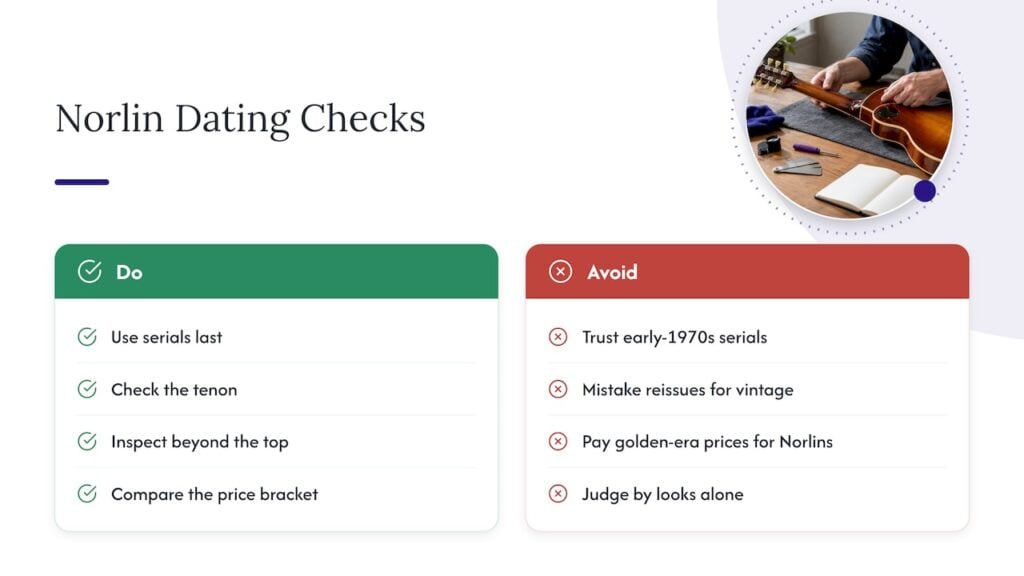
Judging only by looks. A Les Paul with a perfect top can hide a neck repair, a refinished back or replaced electronics.
A short checklist for your next viewing
- Ask for the serial number, and photos of the headstock and the back of the neck before you meet.
- Weigh the guitar.
- Look at the body edge for the maple stripe and at the neck for the volute.
- Inspect the neck wood and glue lines.
- Remove the neck pickup with permission and check the tenon length.
- Read all pot codes and compare them with the claimed year.
- Look for overspray, filled holes and mixed hardware.
- Play the guitar unplugged and amplified.
- Write down every discrepancy and discuss it in the price.
This takes about 30 minutes, and it protects you from the most expensive mistakes.
FAQ
How can I tell quickly whether a Les Paul is from the Norlin era?
Look for a volute behind the headstock, a stripe along the body edge from the layered pancake construction, and a three-piece maple neck. Then check the pot codes and the weight. If several of these agree, the guitar is very likely from the Norlin years, which begin with the 1969 takeover.
Can I identify a Norlin Les Paul by its serial number?
Not reliably. From 1970 to 1975 serial numbers were assigned in no particular order, so a number may not match the build year. Use the pot code, the tenon and the construction details together, and treat the serial as supporting evidence.
Are Norlin-era Les Pauls bad guitars?
No. They are often heavy and sometimes inconsistent, but many play and sound excellent, and the maple necks are popular with some players. The market has slowly given them more recognition as underdog vintage instruments, so play the individual guitar rather than judging by the label.
How heavy is a Norlin Les Paul?
Many weigh upward of 4.5 to 5 kg (10 to 12+ lbs), according to Gear Talk. Weight varies by guitar, so use it as a hint that must be confirmed by other features.
Do I need a certificate for a Norlin Les Paul?
If you plan to resell, insure or invest, yes, a documented assessment is useful, because originality drives value. For a player’s guitar you will keep, a careful self-check plus a testing appointment may be enough.
Sources
- FAQ: Norlin identification 1970-1975, Les Paul Forum
- FAQ: Norlin History, Les Paul Forum
- How Much Does a Gibson Les Paul Weigh? Gear Talk
- Antique Musical Instruments Worth Buying
- Rendite mit Rock ‘n’ Roll: Sammler-Gitarren, FOCUS online
- Gibson Serial Numbers: Decoder and Dating Charts