


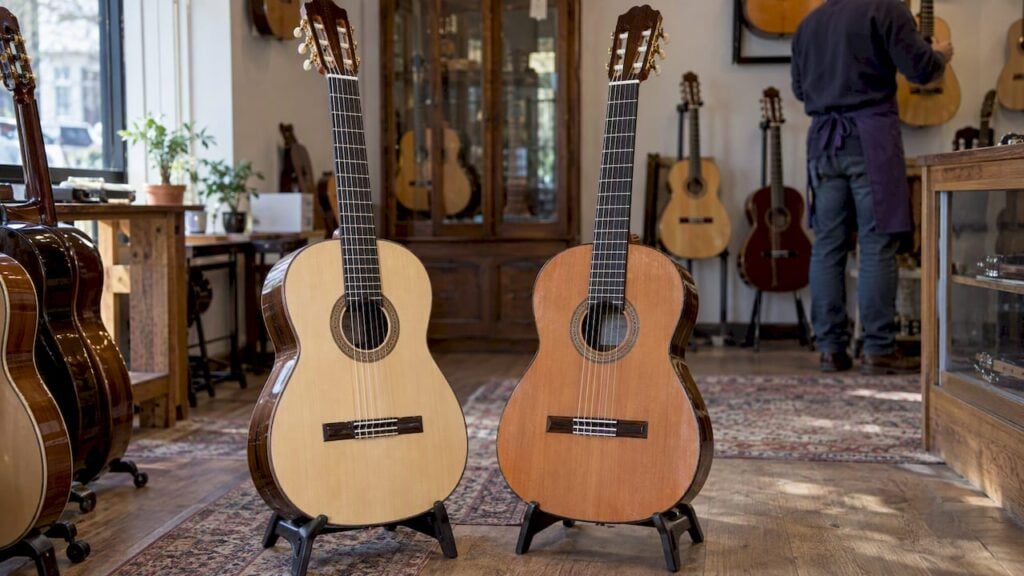

There is no single best tonewood for a classical guitar. There are best choices for a particular sound. Spruce and cedar are the two classic soundboard woods, and the back and sides then color that sound: rosewood for depth and separation, mahogany for warmth, maple for clarity, cypress for a bright, dry flamenco bite. Below we explain what each wood does, what the research supports, and how to choose, whether you buy new, vintage or restored.
TL;DR
- The top (soundboard) matters most: spruce tends toward a direct, clear voice, cedar toward a warmer, quicker response.
- Back and sides shape color and projection. Rosewood, mahogany, maple and walnut are the common classical choices.
- Wood quality (stiffness, density, grain, seasoning) often matters more than the species name on the spec sheet.
- Rosewood is legally regulated. Rio rosewood in particular needs CITES paperwork for cross-border trade, so check documents before buying an older instrument.
- Age can improve a guitar, but good voicing and construction decide how it sounds today. Always play it before you decide.
Table of Contents
- Why “best” depends on how you play
- The soundboard: spruce or cedar
- Back and sides: where the color comes from
- Neck, fingerboard and bridge
- Quality of the piece matters more than the species
- Does old wood sound better?
- Rosewood and the law: what to check before you buy
- Our perspective: how we look at tonewoods
- How to choose: a short decision path
- Looking for a classical guitar? Start with us
- FAQ
- Sources
Why “best” depends on how you play
A classical guitar is played with the fingertips and nails, so it has little energy to work with. A Japanese acoustics study on aging and classical guitar sound quality makes the point that building a guitar that produces volume efficiently is central to the craft, and that the instrument is often called a small orchestra because of the range of colors a player can pull from it. That is why wood choice is not cosmetic. It decides how much of your touch becomes sound.
The woods are only one part of the system. Bracing pattern, plate thickness, string length, the bridge and the maker’s voicing all interact with the material. A 2025 paper in the Journal of the Acoustical Society of America notes that designing soundboards on an acoustical and structural basis is hard precisely because wood is a variable natural material. Two tops of the same species can behave quite differently.
So read every wood description as a tendency, not a promise. If you want the fuller background on how the parts interact, our guide to the role of materials in classical guitars goes deeper.
The soundboard: spruce or cedar
The top is the engine of the guitar. It is thin, light and braced to move air. Two woods dominate classical guitar tops.
Spruce
Spruce has been the favored soundboard wood for flat-top guitars for well over a century. GITARRE & BASS describes it as light, hard and inelastic, which are the properties a well-vibrating body needs. On classical guitars, European (often called German) spruce and Engelmann spruce are the usual choices.
In practice, spruce tops tend to sound focused and clear, with good note separation. That suits players of polyphonic repertoire, such as Bach transcriptions or contrapuntal contemporary pieces, and anyone who wants a guitar that carries in a hall. Spruce can need more playing time to open up, which is one reason a well-aged spruce-top instrument is attractive.
The research behind spruce is practical rather than romantic. A 2023 abstract from the Acoustical Society of America builds on earlier work from the same group showing that a spruce top’s longitudinal Young’s modulus (stiffness along the grain) is an important material property for tonal quality. In plain terms, makers select spruce by measuring and tapping it, not just by looking at the grain.
Cedar
Cedar, usually Western red cedar, is lighter and generally less stiff than spruce. Guitars with cedar tops often sound warm and round, and respond quickly even to a light touch. Many players find them comfortable straight from the case, which is why cedar is popular for concert instruments that need to sound mature early.
The trade-off is that cedar can sound a little less defined in fast, dense passages, and its soft surface marks more easily. Neither point is a flaw. It is a matter of taste and repertoire.
A study of materials used for the soundboard of the Spanish guitar relates the commonly used top woods to timbre, volume and sustain, which is exactly the set of criteria worth testing yourself when you compare two guitars.
Quick comparison of tops
| Top wood | Typical character | Often favored by | Watch for |
|---|---|---|---|
| European spruce | Direct, clear, well separated | Players of polyphonic music, concert halls | May need time to open up |
| Engelmann spruce | Slightly warmer, quick response | Players who want clarity with some bloom | Quality varies by cut and seasoning |
| Western red cedar | Warm, round, immediate | Romantic repertoire, soft and medium touch | Less defined in busy passages, softer surface |
These are tendencies we see in practice and commonly described by makers, not measured guarantees.
Back and sides: where the color comes from
The back and sides do two jobs. They form the cavity that shapes the sound, and they reflect and filter the vibration from the top. Their effect is subtler than the top’s, but it is audible, especially in sustain, projection and the balance of bass and treble. For more on this, see our article on the role of back and sides in vintage guitar tone.
Rosewood
Indian rosewood is the benchmark for concert classical guitars: deep bass, clear trebles and a lot of complexity. A paper characterizing tropical woods used in classical guitars notes that hardwoods such as ebony and rosewood are common because of their high stiffness and dimensional stability, as well as their appearance. Because rosewood is dense and reflective, it returns more energy to the top, which many players hear as projection and shimmer.
Older guitars with Brazilian (Rio) rosewood are a special case. They are prized, and also legally sensitive. More on that below.
Mahogany
Mahogany gives a warmer, more compact sound with a strong fundamental and less overtone shimmer. It is lighter than rosewood and often found on student and mid-range instruments, but fine mahogany-back guitars exist and can sound beautifully intimate. The neck of most classical guitars is also made of mahogany or Spanish cedar, because the wood is stable and easy to work.
Maple
Maple is bright, transparent and articulate. Flamed maple backs are also visually striking. A maple guitar can sound very clean and analytical, which is great for recording and for players who want to hear every detail. Some find it less sweet in the bass than rosewood.
Walnut, sapele, ovangkol and other alternatives
Walnut sits between mahogany and rosewood: reasonably warm, with a good measure of clarity. Sapele and ovangkol are frequently chosen as sustainable alternatives to rosewood. A July 2026 article in the search results on sustainable tonewood alternatives is not one we draw on here, so treat these species as options to audition rather than as automatic substitutes.
The scale of the issue is real: a review of the global acoustic guitar market found 62 different woods in current use, about 70% of them tropical hardwoods. That variety means many makers are experimenting, and good instruments exist outside the rosewood canon.
Cypress and flamenco woods
Flamenco guitars traditionally use cypress for back and sides, with a spruce top. The result is a lighter, drier, faster sound with a percussive attack and less sustain, which fits the rhythmic demands of the music. If you are choosing between a classical and a flamenco instrument, read our guide to the role of wood in flamenco guitars and our overview of Spanish guitar sound, construction and woods.
Comparison of back and side woods
| Wood | Sound tendency | Weight | Typical use |
|---|---|---|---|
| Indian rosewood | Deep bass, shimmering trebles, complex | Heavy | Concert guitars |
| Brazilian rosewood | Very rich, highly responsive | Heavy | Historic and collector instruments |
| Mahogany | Warm, focused, compact | Medium | Mid-range guitars, necks |
| Maple | Clear, bright, transparent | Medium to heavy | Recording and detail-oriented players |
| Walnut | Balanced, warm with clarity | Medium | Alternative to rosewood |
| Cypress | Dry, fast, percussive | Light | Flamenco guitars |
Neck, fingerboard and bridge
The neck is typically mahogany or Spanish cedar, and the fingerboard ebony or rosewood. Ebony is hard and wears slowly, which is why it appears on most serious instruments. These parts matter more for feel and durability than for tone, though a heavy neck can change how the guitar balances in your lap and how the headstock end vibrates.
If you want a full list with notes on every species, our overview of wood types used for classical guitars covers them.
Quality of the piece matters more than the species
Two tops of the same species can differ widely. What a maker looks for:
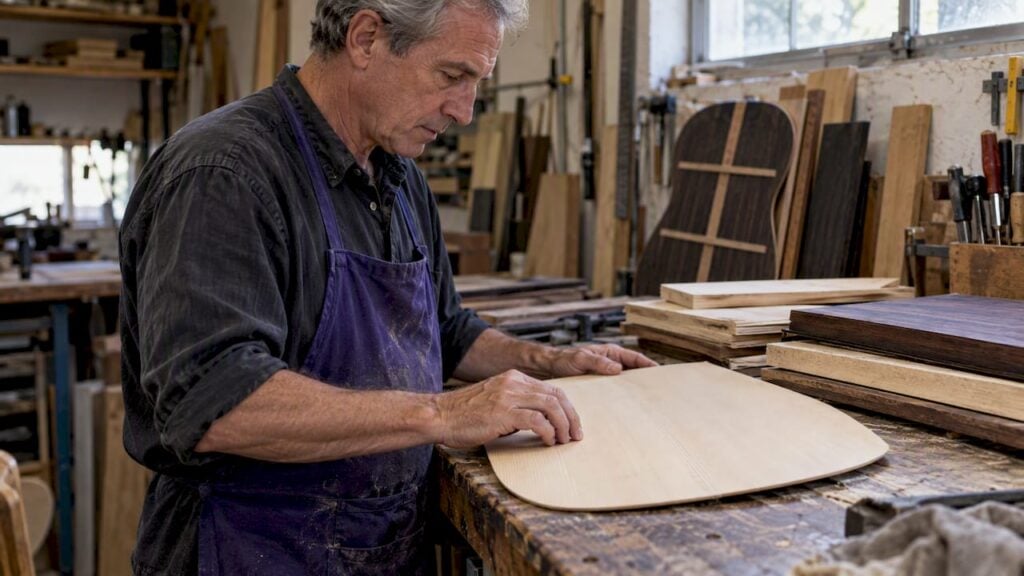
- Straight, even grain, quartersawn so the plate is stable and stiff across the width.
- Stiffness and density appropriate to the design, checked by flexing and tapping.
- Seasoning. Well-dried wood is more stable and more resonant. Many makers prefer lumber that has rested for years.
- Consistency. Symmetry between the two halves of the top gives balanced response.
That is why a guitar with a modest species on paper can outplay a more famous one. Always judge the instrument, not the spec list.
Does old wood sound better?
This is the most common question we hear from collectors, and the evidence is mixed in an interesting way.
A review in the Journal of Cultural Heritage on natural and artificial aging of wood in instruments says that musicians and artisans see aging not as degradation but as a treatment that improves acoustic quality and stability. That matches what many players report from experience.
But the picture on “playing in” is more cautious. A paper in the Savart Journal on vibration treatment and guitar tone points out that the belief that instruments improve with age and playing rests mostly on anecdotal and qualitative evidence. And a report from the GITEC forum on playing in describes blind tests in which experienced players compared old and new violins with similar, not clearly one-sided, results.
Our reading: seasoned wood is a real advantage, and a guitar that has been played for decades has had its structure settled. But age alone does not make a guitar good. A poorly built old guitar remains poorly built. What an old guitar offers is a proven track record. If it still sounds wonderful after fifty years, the construction has already passed the test.
For a deeper look at how species affect both sound and collectible value, read how wood types shape vintage guitar sound and value.
Rosewood and the law: what to check before you buy
If you buy or sell a guitar with rosewood in Germany or the EU, regulation is part of the decision. Brazilian rosewood (Dalbergia nigra) is strictly protected. The environmental office of the city of Nuremberg explains that taking instruments with Rio rosewood in or out of the EU requires a CITES permit, issued by the Federal Agency for Nature Conservation (BfN) in Bonn, and it provides the application for an EU certificate for instruments with specially protected woods.
Practical rules of thumb:
- Ask the seller whether the guitar contains Brazilian rosewood or other protected species.
- Ask for existing documentation. For cross-border shipping, do not assume it is unnecessary.
- If you plan to travel with the instrument, for example to concerts outside the EU, check the rules with the BfN before departure.
- Do not rely on a forum post. Rules change, so confirm with the authority.
We cannot give legal advice, and what applies to your specific guitar depends on its species, age and route. The authority to ask is the BfN.
Our perspective: how we look at tonewoods
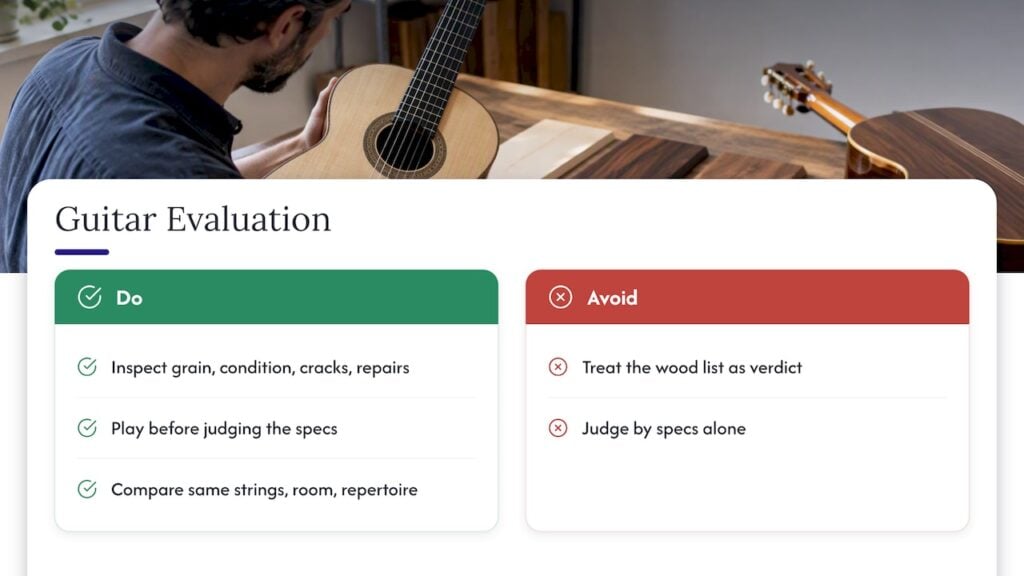
We handle vintage, restored and handcrafted guitars every day, and our view is simple: the wood list is a starting point and never the verdict.
When we evaluate a classical guitar, we look at the top first: grain, condition, any cracks or past repairs, and whether the bracing is original. Then we play it, because a guitar that looks right on paper can still feel closed, and one with a plain spec can open up beautifully under the fingers. We pay attention to how the bass answers, how clearly the trebles separate, and how the instrument responds when you change touch.
For older guitars, we also care about what has been done to them. A careful restoration can bring a tired instrument back, while a heavy-handed one can take away what made it special. This is why our service includes expert evaluation, and why we offer certificates and valuations for instruments whose provenance and condition matter.
If you cannot decide between cedar and spruce, or rosewood and mahogany, our advice is to compare guitars with the same strings, in the same room, with the same repertoire. Your own ear will tell you more than any chart.
— Vintage
How to choose: a short decision path
- Start with your repertoire. Polyphonic and contemporary music often benefits from a spruce top. Romantic, lyrical pieces often suit cedar.
- Think about your touch. A light touch gets a lot out of cedar. A strong touch can bring out spruce’s power.
- Choose the back and sides for color. Rosewood for depth, mahogany for warmth, maple for clarity.
- Check the condition and documentation. Particularly for vintage instruments, ask about repairs, originality and protected woods.
- Play before you commit. A recording tells you about the microphone and the room. Only playing tells you about the guitar.
Looking for a classical guitar? Start with us
We offer carefully selected classical guitars with detailed descriptions and historical context in our classical guitar (nylon) collection. If you want to hear a guitar before you buy, you can arrange an exclusive testing appointment through our main page, where you will also find our commission sales and our certificate and valuation services. Older instruments that need work can go through our restoration service.
FAQ
What is the best wood for a classical guitar top?
Spruce and cedar are the two established choices. Spruce usually sounds clearer and more focused, cedar warmer and more immediate. Neither is better in general, so choose by repertoire and touch.
Which wood is best for the back and sides?
Indian rosewood is the usual benchmark for concert guitars because of its depth and projection. Mahogany, maple and walnut are excellent alternatives with different colors. The best choice is the one that sounds right to you on a specific instrument.
Do old guitars really sound better?
Sometimes. Well-seasoned wood and a settled structure are real advantages, and craftspeople regard aging as beneficial. But published research describes the improvement from age and playing as largely anecdotal, so judge each guitar by how it sounds now.
Is a laminated or solid-wood classical guitar better?
A solid top is the most important feature for tone, because it vibrates more freely and develops over time. Solid back and sides add further richness. Laminated bodies are more stable and affordable, which can make sense for a first guitar.
Can I buy a guitar with Brazilian rosewood?
Instruments with Brazilian rosewood are traded, but the species is strictly protected, and cross-border movement requires CITES documents. Ask the seller for documentation and check with the German Federal Agency for Nature Conservation (BfN) if you plan to export or travel with it.
Sources
- The study of the aging effect for classical guitar sound quality
- Survey and evaluation of classical guitar soundboard design methods with finite element analysis (JASA)
- Tonhölzer bei Akustikgitarren (GITARRE & BASS)
- Wood for guitars II (JASA)
- Acoustic and mechanic characterization of materials used in the soundboard of the Spanish guitar
- Characterization of acoustic and mechanical properties of common tropical woods used in classical guitars
- Use and sustainability of wood in acoustic guitars (PMC)
- Effects of natural and artificial ageing on wood in musical instruments
- Effect of Vibration Treatment on Guitar Tone (Savart Journal)
- Sound Enhancement of Musical Instruments by Playing them in (GITEC)
- Musikinstrumente mit Rio-Palisander (City of Nuremberg)