



The best way to find a top flamenco guitar builder is to judge the instrument itself, not the name on the label: check the wood, the bracing, the setup, and the response under your own hands, then confirm provenance before you commit. Working with a specialist who can arrange a test appointment, verify a maker’s history, and advise on restoration gives you a lower-risk path to a serious instrument. This guide covers the criteria that matter, the maker lineage behind them, and the practical steps for buying, commissioning, or authenticating a flamenco guitar.
TL;DR:
- The builder’s craft, wood selection, and setup are more critical than the label when choosing a flamenco guitar, with a focus on light construction and low action.
- Provenance, workshop lineage, and documented history greatly influence the guitar’s value and predictability of its tonal and structural behavior.
- A hands-on inspection and structured play test are essential to assess response, attack, and build quality before making a purchase or commission decision.
- Custom builds offer personalized voicing but require longer timelines and higher costs, while vintage guitars need verified provenance and condition reports to ensure value.
- Prioritizing actual testing and expert setup over brand reputation maximizes the chance of acquiring a guitar that suits your playing style.
Table of Contents
- What makes a flamenco guitar unique: blanca vs negra, construction, and setup
- Historical maker lineage that shaped flamenco guitars and why provenance matters
- Practical criteria to evaluate a flamenco guitar builder: inspection checklist and play-test steps
- How to buy, commission, or authenticate a flamenco guitar: routes, timeline, and costs
- How Vintage Guitar World helps: expert evaluation, test appointments, certification, and restorations
- Profiles of contemporary top flamenco guitar makers with reputation and signature styles
- Comparison of price ranges and budget considerations for various builders
- Geographic regions known for flamenco guitar craftsmanship and how location affects style and availability
- Publisher perspective: why player-match and setup trump brand-only decisions
- Book an appointment or request valuation: Vintage Guitar World services and next steps
- Sources
- FAQ
What makes a flamenco guitar unique: blanca vs negra, construction, and setup
A flamenco guitar is built to answer a different question than a classical guitar. Classical instruments chase sustain and tonal color across a concert hall; flamenco guitars chase immediacy, so a player’s rasgueado and golpe cut through a room the moment the string or the tapboard is struck. That single design goal shapes almost every choice a builder makes, from the wood on the back and sides to the height of the strings above the fretboard.
The clearest split among flamenco instruments is between blanca and negra models. A flamenco blanca is traditionally built with cypress back and sides, and that wood favors a dry, percussive attack with fast decay, which suits traditional accompaniment and dance work. A negra swaps in rosewood or another dense hardwood, adding warmth and longer sustain closer to a classical guitar’s voice, which appeals to concert soloists who need more tonal color without losing flamenco’s snap. Neither wood choice tells the whole story on its own: top stiffness, bracing, and the builder’s final setup do as much to determine how an instrument actually responds as the species written on the back.
Construction signals separate a serious flamenco build from a converted classical model dressed up with a tap plate. Builders typically favor a thin, light finish—traditional French polish or a thin modern equivalent—because a thicker film damps the top and slows its response, and flamenco depends on the top moving freely the instant it is struck. Lighter tops, narrower bracing, and lower bridge mass all push in the same direction: quicker attack, less sustain, more immediacy under the fingers.
Setup finishes the job that materials start. A flamenco guitar generally runs lower action and lighter string tension than a classical guitar, which lets a player execute fast picado runs and aggressive rasgueado without fighting the strings. Many models also carry a golpeador, the tap plate below the soundhole that protects the top from rhythmic finger strikes during golpe technique.
When you’re comparing builders, look for:
- Wood pairing: cypress or another light wood for a blanca voice, rosewood or similar dense wood for a negra voice.
- Top thickness and bracing: thinner, lighter tops with simpler bracing patterns generally support faster response.
- Finish: a thin French polish or comparable light finish rather than a thick lacquer coat.
- Action and tension: low, even action with string tension suited to fast right-hand technique.
- Golpeador presence and placement: correctly positioned to protect the top without muting it.
Historical maker lineage that shaped flamenco guitars and why provenance matters
Modern flamenco and classical Spanish guitar design traces back to one workshop more than any other. Antonio de Torres Jurado is widely regarded as the most important Spanish guitar maker of the 19th century, and his innovations, particularly fan bracing and thinner, arched soundboards, increased projection and set the template that Spanish builders have refined ever since. Before Torres, guitars were smaller and quieter; after him, the instrument had the volume and sustain that both classical and flamenco playing would eventually demand in different directions.
Out of that Spanish tradition grew distinct workshop lineages, and the Esteso and Conde families are the clearest example in flamenco circles. Builders trained inside these workshops absorbed not just techniques but a specific approach to voicing an instrument for the player in front of them. Felipe Conde, continuing that family tradition, has spoken about how a close, ongoing relationship between luthier and musician shapes the final instrument more than any single spec sheet could, and that iterative give and take between builder and player is exactly what workshop continuity preserves across generations.
That lineage matters for buyers for a practical reason: apprenticeship history, a builder’s client roster, and workshop continuity often predict how an instrument will behave better than a single listed detail like “rosewood back.” A guitar built by someone trained for a decade inside a family workshop carries decisions in the bracing and voicing that a spec sheet cannot capture.
This is also where provenance starts to affect resale value and buyer confidence, not just tone:
- Serial numbers and workshop records tie an instrument to a specific builder, period, and sometimes a specific commission.
- Documented repairs or modifications affect both playability and value, so a clean paper trail matters as much as a clean top.
- Certificates of authenticity from a qualified appraiser reduce the risk of paying vintage prices for an instrument with an unclear history.
Our historical overview of Antonio de Torres covers how his fan-bracing innovation continues to influence builders today, and our piece on the role of luthiers in flamenco craftsmanship goes deeper into how workshop traditions show up in a finished instrument.
Practical criteria to evaluate a flamenco guitar builder: inspection checklist and play-test steps
A single hands-on appointment, done properly, tells you more about a builder’s work than any amount of reading. The goal is to combine a physical inspection with a structured play test, then ask the questions that a spec sheet never answers.
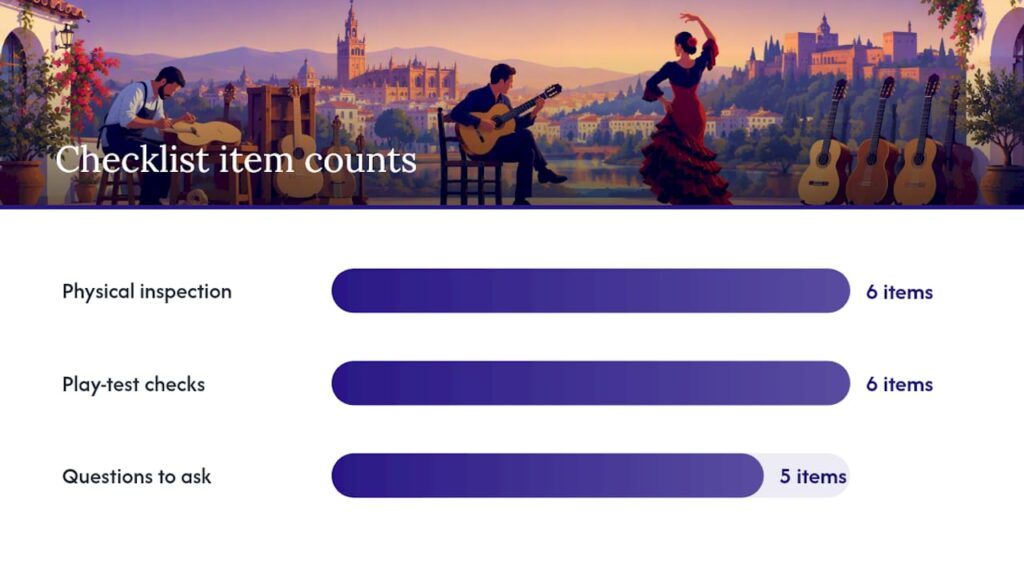
Start with what you can see and feel before you play a note:
- Check top thickness and flex. Press gently on the soundboard near the bridge; a flamenco top should feel notably thinner and more responsive than a classical guitar’s.
- Look inside the soundhole at the bracing. Simpler, lighter bracing patterns generally support the faster attack flamenco technique demands.
- Confirm the wood species on back and sides. Cypress points to a blanca voicing, while rosewood or another dense hardwood points to a negra build.
- Inspect the finish. A thin French polish or comparable light finish should show minimal build-up, especially around the edges and heel.
- Weigh the instrument in your hands. A genuinely light build often correlates with the fast, dry response flamenco players want.
- Examine bridge and nut materials. Bone or comparable dense material at the saddle and nut affects both tone transfer and durability.
Once the physical checks are done, move to a structured play test. Testing golpe, rasgueado clarity, and picado speed during a hands-on session is one of the most reliable ways to judge whether a guitar actually supports flamenco technique, rather than just looking the part.
- Golpe response: tap the golpeador and listen for a clean, percussive sound that does not bleed into or muddy the strings’ tone.
- Rasgueado clarity: run through a rasgueado pattern and listen for individual string separation rather than a blurred wash of sound.
- Picado speed: play a fast scale passage and check whether the action and string tension let your right hand keep up without extra effort.
- Sustain versus attack: strike a single note and time how quickly it decays. A blanca should decay faster than a negra by design.
- Low action handling: fret notes up the neck and check for buzzing, which signals either a setup problem or a structural issue.
- String tension feel: compare the tension under your left hand to what you’re used to. Flamenco setups typically favor lighter tension than classical setups.
Pro Tip: Bring a short piece you know well to every test appointment. A familiar passage exposes a guitar’s real behavior far faster than random noodling.
Finish the appointment with direct questions for the builder or seller. Ask about the build method (fully handmade versus assisted with machine work), where the tonewoods were sourced and how long they were aged before construction, what setup options are available if the factory action doesn’t suit you, whether a warranty covers structural issues, and what provenance documentation comes with the instrument. A builder or seller who answers these clearly, with specifics rather than generalities, is telling you as much about their reliability as the guitar itself.
How to buy, commission, or authenticate a flamenco guitar: routes, timeline, and costs
There are four realistic routes to owning a serious flamenco guitar, and each suits a different kind of buyer.
A custom commission puts you in direct contact with a builder who voices the instrument to your playing style, string preference, and tonal goals. This route takes the longest and costs the most, since commission timelines and costs vary widely depending on wood availability, the builder’s backlog, and how bespoke the voicing request is. Expect a wait measured in months rather than weeks, and expect rare tonewoods or a heavily customized specification to push the price well above a standard build.
Buying from a specialist retailer trades some of that customization for speed and reduced risk. A curated seller has already screened instruments for build quality and, ideally, verified provenance, so you’re choosing among guitars that have passed a first filter rather than starting from zero.
A vetted vintage purchase brings history and often a proven tonal character into the picture, but it raises the stakes on authentication. An older instrument needs its story checked: who built it, when, and what has happened to it since.
Restoration is the fourth route, either as a standalone purchase of a guitar that needs work or as a step after buying a vintage instrument with structural issues. Cracked tops, loose bracing, and worn frets are common on older flamenco guitars and are usually repairable, but the cost depends heavily on the extent of the damage and the rarity of the materials needed to match the original build.
Whichever route you choose, authentication deserves the same attention as tone. Before paying vintage or commission-level prices, insist on:
- Provenance documents: any paperwork tying the guitar to a specific builder, workshop, or prior owner.
- A condition report: a written account of the instrument’s structural state, ideally from an independent appraiser.
- A valuation or certificate of authenticity: a formal assessment that supports both insurance and resale, since certification and provenance are core trust signals for high-value guitar purchases.
- A restoration report, if applicable: a clear record of what work was done, when, and by whom, so you know exactly what you’re buying.
Our guide on choosing a vintage flamenco guitar walks through provenance and valuation checks in more depth if you’re leaning toward the vintage route.
How Vintage Guitar World helps: expert evaluation, test appointments, certification, and restorations
Specialist retailers often offer curated selections of flamenco guitars that have been screened for build quality and history, so buyers don’t start from an unfiltered pile of listings.
For buyers who want to play before they buy, exclusive test appointments may be available to run golpe, rasgueado, and picado checks under expert guidance. Commission sale services may help owners sell instruments without listing them directly.
When provenance or condition is in question, services providing certificates and valuation reports can offer paper trails that protect insurance claims and facilitate resale. Restoration services may provide estimates for costs and scope before work begins.
These types of services help close gaps in the buying process by supporting testing before commitment, verifying authenticity before premium payment, and restoring with clear cost estimates. Such assistance can offer practical value compared to navigating commissioning, vintage listings, or restoration independently.
Profiles of contemporary top flamenco guitar makers with reputation and signature styles
Contemporary flamenco building still runs largely through Spanish family workshops, where reputation is built over decades rather than marketing cycles. The Conde workshop lineage remains one of the most cited names among working flamenco players, with a documented emphasis on close collaboration between builder and musician that shapes each instrument’s final voicing rather than producing a fixed, repeatable spec.
Beyond named workshops, the flamenco world also includes independent luthiers trained in the Spanish tradition who have built individual reputations through their client rosters and word of mouth among professional players. What distinguishes a respected contemporary builder is rarely a single signature feature. It’s usually a consistent voicing character across their output: a recognizable balance of attack and warmth, a particular approach to bracing, or a setup style that suits a specific strand of flamenco technique, whether that’s traditional accompaniment or more concert-oriented solo playing.
For buyers, the practical takeaway is that a builder’s reputation is best judged through the combination of workshop lineage, documented client history, and hands-on testing, not through a single feature or wood choice. Our overview of luthiers in flamenco craftsmanship goes further into what separates a workshop’s signature style from a generic build.
Comparison of price ranges and budget considerations for various builders
Flamenco guitar prices track a handful of clear cost drivers rather than brand prestige alone. Entry-level factory-made or workshop-assisted flamenco guitars sit at the lower end of the market and suit players who want an authentic blanca or negra voicing without commissioning custom work. Mid-range instruments, often built by independent luthiers with a documented apprenticeship history, cost more because of the labor involved in individual voicing and finishing rather than any single premium material.
At the top end, custom commissions from established workshops or highly regarded independent builders command the highest prices, driven by wood rarity, builder reputation, and the time required for bespoke voicing. As noted in the buying-routes section, commission costs and timelines vary widely based on wood availability and how customized the specification is, and rare tonewoods or an unusually long backlog at a sought-after workshop both push the final price up.
Vintage instruments add another variable: age and documented provenance can push a well-preserved guitar from a respected historical workshop well above the price of a comparable new build, purely on the strength of its verified history. Budgeting for a flamenco guitar means separating what you’re paying for wood and labor from what you’re paying for a name, a documented lineage, or a builder’s current backlog, since all three show up in the final price differently.
Geographic regions known for flamenco guitar craftsmanship and how location affects style and availability
Spain remains the center of flamenco guitar craftsmanship, and within Spain, certain regions carry particular weight. Andalusia, as flamenco’s birthplace, hosts a concentration of builders working in the traditional style, while workshops based in and around Madrid, including the Conde lineage, have built international reputations that draw commissions from players well beyond Spain’s borders.
Location affects style in subtle but real ways. Builders working close to flamenco’s performance culture tend to voice instruments with traditional accompaniment and dance work in mind, favoring the dry, percussive character associated with blanca guitars. Builders with a broader concert clientele, wherever they’re based, more often lean toward negra designs with added sustain and tonal color for solo repertoire.
Availability follows a similar pattern. Instruments from well-known Spanish workshops often carry long waiting lists precisely because demand extends far past their home region, while lesser-known regional builders may offer shorter turnaround times at a lower price point without necessarily sacrificing quality. For buyers outside Spain, working with a specialist retailer that already maintains relationships with vetted builders and sellers can shorten the distance between wanting a specific regional style and actually testing an instrument that delivers it.
Publisher perspective: why player-match and setup trump brand-only decisions
A guitar with a respected name on the label can still be the wrong instrument for a specific player, and a guitar from a lesser-known builder can outperform it once the action, tension, and voicing actually fit how someone plays. We’ve seen instruments transformed by a setup adjustment alone: lowering the action a fraction of a millimeter, or adjusting saddle height, can turn a guitar that felt stiff and unresponsive into a genuine flamenco partner.
That’s the case for testing over trusting a name. Brand reputation tells you a builder has produced excellent instruments in general; it says nothing about whether this specific guitar, with its specific setup, suits your hands and your technique. Prioritize hands-on testing and expert setup over reputation alone, especially at the price point where a mismatch becomes expensive. For a purchase this significant, use a specialist service that lets you test before you commit rather than relying on a builder’s name to do the deciding for you.
— Vintage
Book an appointment or request valuation: Vintage Guitar World services and next steps
Finding the right flamenco guitar comes down to testing before you buy and verifying before you pay a premium, and that’s exactly what Vintage Guitar World is built to support. Rather than piecing together provenance checks and play tests on your own, you can book an exclusive test appointment, request a valuation on an instrument you’re considering, or browse our curated flamenco selection with the confidence that each piece has already passed a first round of expert screening.
If you already own a flamenco guitar and want to know what it’s worth, our certification and valuation service gives you a documented answer rather than a guess. And if restoration is on the table, we provide a clear cost estimate before any work begins. Visit Vintage-guitar-world to book a test appointment, request a valuation, or start browsing.
Sources
- Antonio de Torres Jurado — Wikipedia
- Felipe Conde — Flamenco Madrid
- Flamenco blanca versus negra — Scharpach custom-built master guitars
FAQ
What are the best flamenco guitars for serious players?
The best flamenco guitars for serious players come from builders with documented workshop lineage and a consistent voicing character, tested hands-on for golpe response, rasgueado clarity, and picado speed rather than chosen on reputation alone. Blanca models suit traditional dry, percussive playing, while negra models suit players who want more sustain and tonal color.
Who are the most respected Spanish guitar builders?
Spanish guitar building traces its modern foundation to Antonio de Torres Jurado, whose fan bracing and thinner soundboards shaped the instrument’s design going forward. Contemporary respect tends to follow family workshop lineages, such as the Conde tradition, where apprenticeship history and client relationships carry as much weight as any individual instrument’s specifications.
Is there a single best guitar builder in the world?
Definitions vary and no single builder holds a universally agreed title, since flamenco and classical guitar building both reward different strengths depending on the style a player needs. A more useful question is which builder’s voicing and setup match your own playing, which is why hands-on testing matters more than chasing a single name.
How do I choose between a blanca and a negra flamenco guitar?
Choose a blanca (cypress) if you want a dry, percussive attack suited to traditional accompaniment and dance work, and a negra (rosewood or a similarly dense wood) if you want added warmth and sustain for solo or concert playing. Top stiffness and the builder’s setup also shape the final response, so testing both styles in person is the most reliable way to decide.
What should I check before buying a vintage flamenco guitar?
Before buying a vintage flamenco guitar, check provenance documents, a written condition report, and, where possible, a certificate of authenticity, since these reduce the risk of overpaying for an instrument with an unclear history. Vintage Guitar World offers valuation and certification services, along with restoration estimates, for readers who want these checks handled by a specialist.