












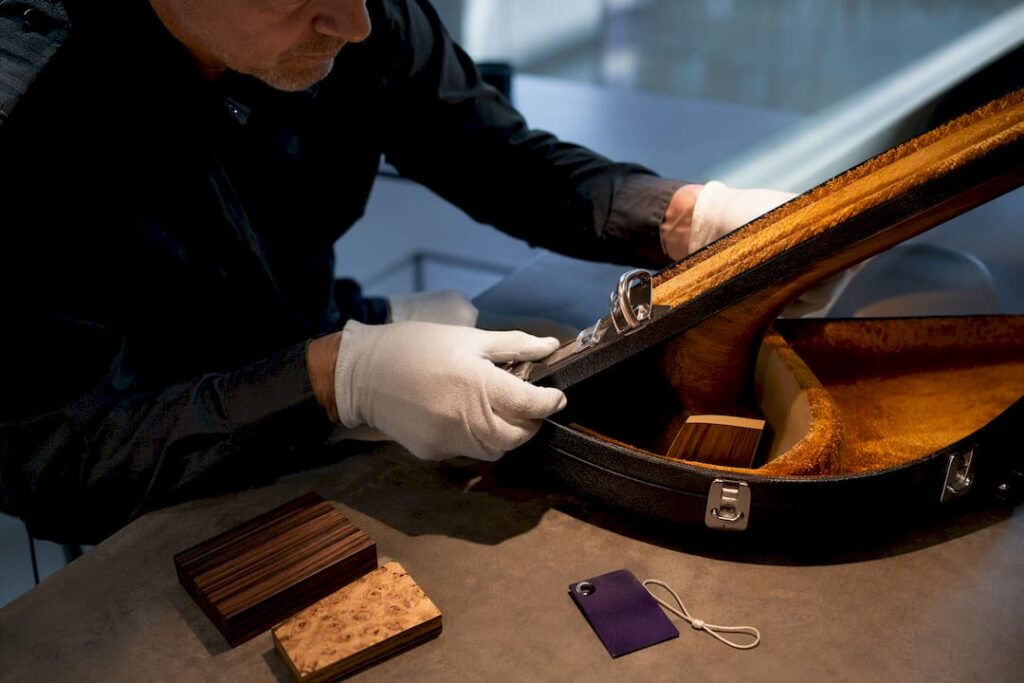

Yes, you can export a guitar from Germany to a country outside the EU, but three things determine whether it goes smoothly: the materials in the instrument, whether the move is temporary or permanent, and your paperwork. Check for CITES-listed woods first, since those need a BfN permit or instrument certificate. Decide if you need a Carnet ATA for a temporary trip or a full export process for a sale. Then line up your invoice, Declaration of Materials, correct HS code, and insurance before the guitar leaves your hands.
TL;DR:
- Protected materials like Brazilian rosewood, ebony, ivory, or tortoiseshell require CITES paperwork regardless of the guitar’s age or value to avoid border seizures.
- Using a Carnet ATA is suitable for temporary trips into non-EU countries, but a full export process with proper documentation is necessary for permanent sales.
- Accurate, detailed invoices, Declaration of Materials, and expert certificates are essential to match the physical instrument and prevent customs delays.
- Export and import duties depend on verified transaction records, with specific customs classifications and legal requirements varying by destination country.
- Starting permit and appraisal processes months in advance is crucial, as delays or missing documents can significantly hinder international guitar shipments.
Table of Contents
- When Do CITES Rules or Cultural-Goods Permits Apply?
- Which HS Code Applies, and Who Pays the Duties?
- Carnet ATA or Full Export: Which Route Fits Your Trip?
- Getting the Paperwork Right: Materials, Provenance, and Invoices
- Shipping Methods, Insurance, and What It Actually Costs
- Step-by-Step: Exporting a Guitar From Germany
- How Vintage Guitar World Supports the Export Process
- Exporting to the US, UK, or China: What Changes by Destination
- Rosewood, Ebony, and Other Restricted Materials: The CITES Permit Process
- Packaging and Labeling a Guitar for International Shipment
- What Happens at the Border: Customs Clearance and Common Snags
- Exporting a Second-Hand Guitar vs. a New Instrument
- VAT Exemptions and Refunds When Exporting Outside the EU
- Why the Real Bottleneck Isn’t Customs, It’s Timing
- Sources
When Do CITES Rules or Cultural-Goods Permits Apply?
The material inside the guitar decides everything. Rio palisander (Brazilian rosewood), certain ebony species, ivory inlays, and tortoiseshell pickguards all fall under CITES protection, and exporting a guitar built with them requires documentation regardless of the instrument’s age or value. Guitars containing these materials need specific CITES paperwork for both export and import, and missing documents can lead to seizure at the border, according to Touring Artists. That risk is real, not theoretical: customs officers do not make exceptions for a beloved instrument with sentimental value.
The Bundesamt für Naturschutz (BfN) runs the German side of this process. Here’s the typical sequence:
- Prepare a Declaration of Materials identifying every protected component.
- Request a Vorlagebescheinigung (presentation certificate) from your state nature conservation authority.
- Apply for a CITES instrument certificate, valid for three years once issued.
- Submit the application roughly three months before your planned export or trip.
Separately, the EU’s cultural-goods regulation (EU 2019/880) can apply to older or high-value instruments independent of CITES, based on age and declared value thresholds. A 1930s classical guitar with real cultural or historical significance may trigger this even if its wood is unprotected.
Which HS Code Applies, and Who Pays the Duties?
Guitars generally fall under HS code 9202, the tariff category covering string instruments played with a bow or by hand. That’s your starting point, not your final answer. You still need to verify the exact TARIC subheading for export and confirm the matching import code in the destination country, since TARIC and EBTI lookups show classifications vary by wood, electronics, and construction details.
Customs value is calculated from the invoice price plus transport and insurance costs. German customs treats undervaluation as evasion, not a clever discount, so keep verifiable transaction records ready.
Practical points to nail down before shipping:
- Confirm whether an export declaration is required for the shipment value and destination.
- Decide who handles customs: you directly, a freight forwarder, or a licensed customs broker.
- Get written agreement with the buyer on who covers import duties and VAT on arrival.
- Keep the invoice, insurance certificate, and Declaration of Materials together as one package.
Import duties and taxes on the receiving end are the buyer’s country’s business, not yours, but disputes over who pays them kill deals fast if you don’t settle it in writing beforehand.
Carnet ATA or Full Export: Which Route Fits Your Trip?
A Carnet ATA and a permanent export serve different purposes. Choosing the wrong one can lead to extra costs and delays. The Carnet lets you move an instrument temporarily into many non-EU countries without paying duties at entry, issued through your local IHK. It works for tours, recording sessions, and exhibitions where the guitar comes back to Germany.
- Confirm the destination country accepts Carnet ATA for temporary instrument entry.
- Apply through your regional IHK, providing an itemized list with serial numbers and values.
- Pay for a security deposit or bank guarantee, since Carnets require one.
- Coordinate with your carrier or airline early, as Carnet processing can take participating carriers by surprise if arranged last minute.
A Carnet is the wrong tool for a permanent sale. If ownership changes hands, you need standard export documentation and the buyer needs proper import clearance, not a temporary admission document that assumes the guitar returns.
Getting the Paperwork Right: Materials, Provenance, and Invoices
Customs officers and BfN reviewers want the same thing: proof that matches the physical instrument. A vague description invites delays.
The Declaration of Materials should detail all woods, exotic materials, and hardware components, ideally prepared by a knowledgeable luthier or appraiser who can identify specific types such as Rio palisander or ebony. Vintage Guitar World’s guitar evaluation checklist walks through what a proper material assessment covers.
For older instruments, provenance carries real weight. Bills of sale, prior export permits from the country of origin, and expert certificates all support a claim that materials were harvested or imported before current restrictions took effect. Sinfonima’s guidance recommends assembling expert certificates and Declaration of Materials well before travel, not after a customs officer asks for them.
Round out the package with:
- Commercial invoice showing agreed price and currency.
- Purchase contract or bill of sale with serial numbers.
- Any prior CITES certificates tied to the instrument’s history.
Pro Tip: Carry originals, not photocopies, and keep a second set of copies separately from the guitar case. Border agents want to see the real document, and losing your only copy mid-trip turns a routine check into a delay.
Shipping Methods, Insurance, and What It Actually Costs
Hand-carrying works for one guitar on a personal trip, but it puts you at the mercy of airline cabin policy and gate staff discretion. Insured courier services, including specialized music instrument shippers, handle high-value guitars with better packing standards than general freight, though costs run higher. Full freight makes sense for multiple instruments or a dealer-scale shipment.
Standard household insurance rarely covers an instrument once it leaves your home, which is why agreed-value or all-risk instrument policies matter for anything genuinely valuable. Confirm the international coverage limit before shipping, not after something goes wrong in transit.
Budget for these cost lines separately:
- Carrier or courier fees, which scale with declared value and speed.
- Customs handling charges on both ends of the shipment.
- Carnet ATA security deposit or export permit fees, where applicable.
- Import duties and VAT the buyer owes at destination.
Realistic timelines run longer than most sellers expect. A CITES instrument certificate application typically requires several weeks to months of lead time for first-time applicants; rushing the process may result in refusal. Vintage Guitar World’s shipping workflow guide breaks down carrier coordination in more detail if you’re planning a specific shipment.
Step-by-Step: Exporting a Guitar From Germany
Work through this in order, and don’t skip ahead on the permit steps just because the shipping feels more urgent.
- Decide whether this is a temporary trip (Carnet ATA via IHK) or a permanent sale (formal export process, possibly involving BfN).
- If CITES materials are present, start the Declaration of Materials and BfN application immediately given the multi-month lead time.
- Get an appraisal if the instrument’s age or materials are uncertain, since a documented valuation speeds every subsequent step.
- Collect invoices, prior ownership records, and serial numbers into one file.
- Apply for the Carnet or export permit based on your decision in step one.
- Arrange insurance with confirmed international coverage limits.
- Book your carrier and complete customs paperwork, confirming the buyer or importer is ready to receive and clear the shipment.
- Keep original documents with you or with the shipment, and track delivery until confirmed receipt.
How Vintage Guitar World Supports the Export Process
Some specialty services include appraisals, documentation preparation, and pre-shipment checks for owners navigating an export. This may involve assembling the Declaration of Materials, coordinating with shippers on packing standards for high-value instruments, and advising on insurance coverage before shipment.
What Vintage Guitar World does not do is issue government permits. BfN certificates and IHK Carnets come from those specific authorities, not from any private business. What a specialist adds is reducing the paperwork errors that cause delays or seizures, particularly on CITES-sensitive instruments where a vague material description or missing invoice detail is enough to stop a shipment cold.
Exporting to the US, UK, or China: What Changes by Destination
Each destination country layers its own import rules on top of German export requirements, and treating them as interchangeable is a common mistake.
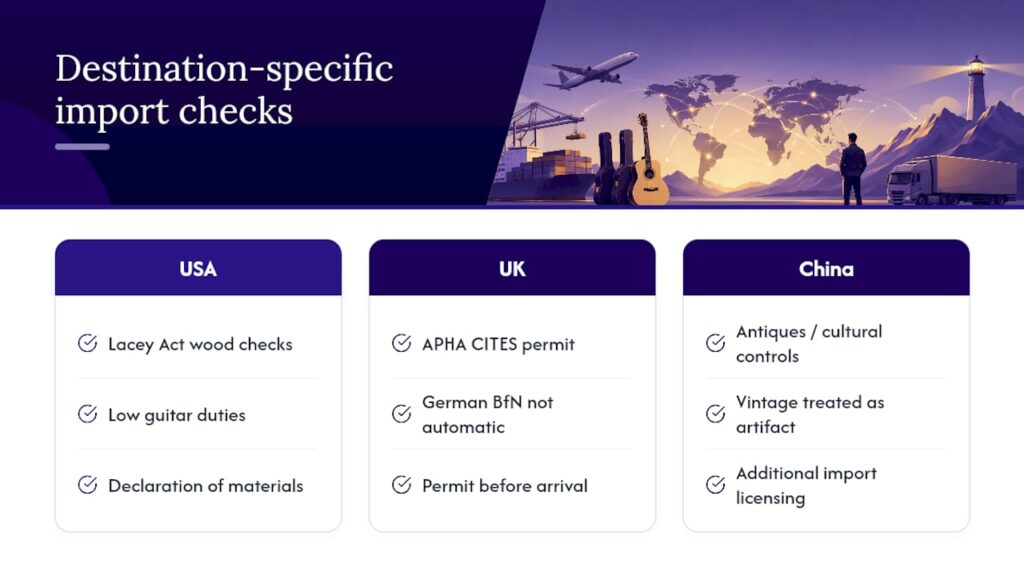
The United States applies its own Lacey Act enforcement on wood products, separate from CITES, meaning US Customs and Border Protection can scrutinize a guitar’s wood content independently of whatever certificate Germany issued. US import duties on guitars are typically low, but a missing or inconsistent Declaration of Materials draws more attention than the tariff itself.
The United Kingdom, since leaving the EU, runs its own CITES permitting system through its Animal and Plant Health Agency, and a German BfN certificate does not automatically satisfy UK import requirements. You need the UK-side import permit lined up before the instrument arrives, not after.
China enforces strict controls on antique and cultural items, and customs there can treat a vintage guitar as a cultural artifact requiring additional import licensing, particularly for instruments framed as collectible or historic pieces rather than working instruments for sale.
The common thread: confirm the destination country’s own import permit requirements before shipping, because a clean German export does not guarantee a clean foreign import. Contacting the buyer’s local customs broker early saves far more time than assuming reciprocity between systems.
Rosewood, Ebony, and Other Restricted Materials: The CITES Permit Process
Rio palisander (Brazilian rosewood, Dalbergia nigra) is the material that trips up the most sellers, since it appears in fretboards, bridges, and back-and-sides construction on decades of guitars without anyone tracking it at the time of manufacture.
Some CITES listings include narrow exceptions for finished instruments or specific Dalbergia species under certain conditions, so a blanket assumption of “banned” is often wrong. What actually decides the outcome is documented provenance: expert certificates, prior legal import records, or evidence the wood predates the relevant convention listing.
The application process runs through the BfN. You submit the Declaration of Materials, request the Vorlagebescheinigung from your state authority, and then apply for the CITES instrument certificate itself, which stays valid for three years. Applying weeks or months in advance prevents last-minute refusals, and getting a professional appraisal first speeds the valuation and declaration steps considerably. Vintage Guitar World’s article on identifying Rio palisander covers how to spot the wood and start assembling documentation before you’re under deadline pressure.
Packaging and Labeling a Guitar for International Shipment
A guitar surviving customs paperwork only to arrive cracked defeats the purpose of doing the paperwork correctly.
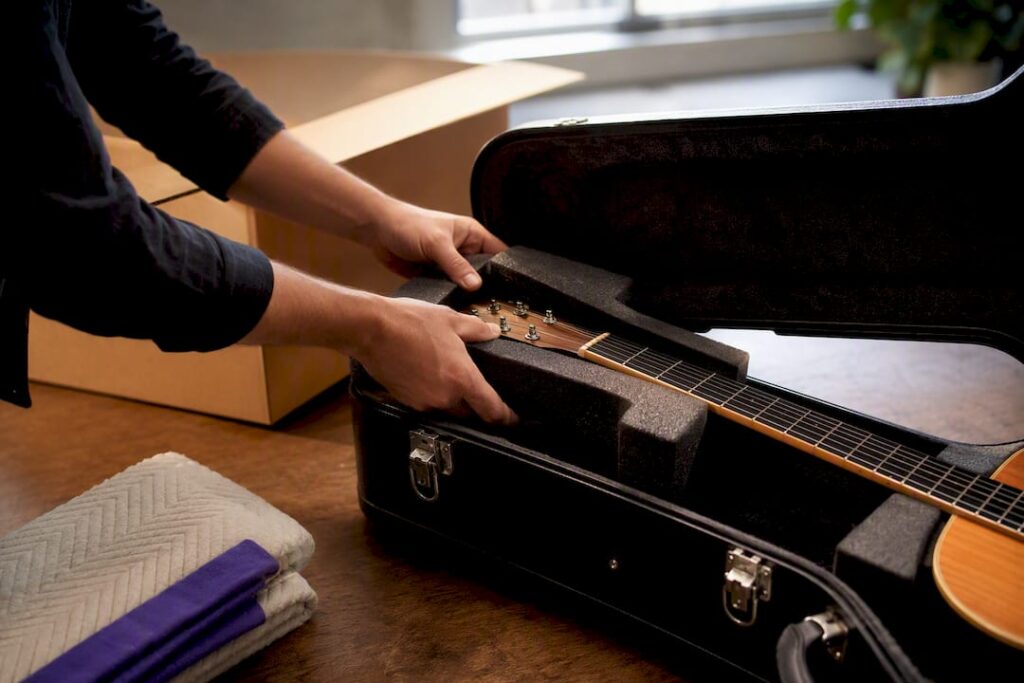
Loosen the strings slightly before packing to reduce tension-related stress on the neck during temperature and humidity swings in transit. Use a hard case inside a shipping-rated outer box with at least two inches of cushioning material on all sides, not just top and bottom. Foam padding around the headstock and body corners prevents the most common transit damage points.
Label the exterior with a fragile-item designation and orientation arrows, but don’t write “vintage” or “rare” prominently on the outside, since that can attract unwanted handling attention or theft risk at transfer points. Attach a packing list inside the box that mirrors your invoice and Declaration of Materials exactly, so customs inspectors opening the package see consistent information rather than a discrepancy that triggers further questions.
For hand-carry situations, Vintage Guitar World’s guide on flying with a guitar covers airline-specific cabin rules and what documentation to have accessible at the gate, separate from what’s packed in the case.
What Happens at the Border: Customs Clearance and Common Snags
Customs clearance for a guitar leaving Germany typically involves an export declaration, verification of the HS code and declared value, and a check against any restricted-materials flags tied to the Declaration of Materials. On the receiving end, the process mirrors this in reverse, and that’s usually where problems surface.
The most common snag is a mismatch between the invoice value and the customs valuation. If your invoice undervalues the guitar to reduce fees, expect the shipment held for review rather than waved through. A second frequent issue is incomplete CITES documentation. Officers treat missing paperwork on protected wood as grounds for seizure, not a minor formality to sort out later.
A third issue shows up specifically with older instruments: customs staff unfamiliar with vintage guitar construction sometimes flag ordinary aged wood as a protected species by mistake. Having an expert certificate or appraisal on hand resolves this faster than arguing the point verbally at the counter. Keep the appraisal, invoice, and Declaration of Materials as one coherent bundle, and present all three together if questioned.
Exporting a Second-Hand Guitar vs. a New Instrument
Reselling a vintage or used guitar internationally follows the same customs and CITES framework as a new instrument, but provenance carries more weight and value assessment gets trickier.
A new instrument from a manufacturer typically comes with clean paperwork: a fresh invoice, known materials, and a manufacturer’s declaration if CITES woods are involved. A second-hand guitar, especially one that has changed hands multiple times over decades, often lacks that paper trail entirely. This is exactly where a documented appraisal matters most, since it establishes both the material composition and a defensible valuation for customs purposes.
Resale also raises the pre-convention question more often. A guitar built in the 1960s with Brazilian rosewood may qualify for treatment as pre-convention material, but only with supporting evidence: a dated bill of sale, an old import permit, or credible expert documentation of the instrument’s age. Without that evidence, customs and BfN reviewers have no reason to assume the wood predates any restriction.
Vintage Guitar World’s guide on guitar appraisal for collectors covers how a proper valuation supports both the sale price and the export documentation for second-hand instruments specifically.
VAT Exemptions and Refunds When Exporting Outside the EU
Sales genuinely exported outside the EU are generally exempt from German VAT, but the exemption depends entirely on proof of export, not on the buyer’s location alone. You need documented evidence the guitar physically left the EU, typically an export declaration or shipping confirmation showing the destination outside the customs union.
If VAT was charged at the point of sale and the export is confirmed afterward, a refund process applies, but the paperwork burden falls on the seller to demonstrate the goods left EU territory within the required timeframe. Keep the export declaration, shipping documents, and proof of delivery together, since a VAT refund claim without solid export evidence gets rejected more often than approved.
This differs from the tourist VAT refund scheme, which applies to a private buyer physically carrying goods out of the EU themselves, not to a business-to-business export sale. If you’re a dealer or small exporter, confirm with your tax advisor which VAT treatment applies to your specific transaction structure before assuming standard export exemption automatically covers it.
Why the Real Bottleneck Isn’t Customs, It’s Timing
The conventional advice treats export paperwork like a checklist you complete the week before shipping. That’s backwards, and it’s the single biggest reason sellers get stuck. A CITES instrument certificate needs roughly three months of lead time for a first application, and a Carnet ATA needs security arrangements and IHK coordination that don’t happen overnight either. Sellers who start the process after agreeing a sale price are already behind.
The bigger blind spot is assuming a guitar’s age protects it. Plenty of owners believe a decades-old instrument is automatically exempt from restrictions, when what actually matters is documented provenance, not the calendar. A guitar without a paper trail faces the same scrutiny as one built last year, sometimes worse, because there’s more ambiguity for a customs officer to question.
If there’s one thing worth prioritizing above all else, it’s getting a professional appraisal before you commit to a sale or shipping date. It speeds the Declaration of Materials, strengthens any pre-convention claim, and gives you a defensible customs valuation instead of a guess.
— Vintage
Sources
- Bundesamt für Naturschutz (BfN) — Ein- und Ausfuhr von Musikinstrumenten
- Touring Artists — Protected species material and cultural assets
- IHK — Carnet A.T.A.
- Zoll — Protection of cultural goods from third countries (EU 2019/880)
- Sinfonima recommendations: travelling with instruments (2021)