












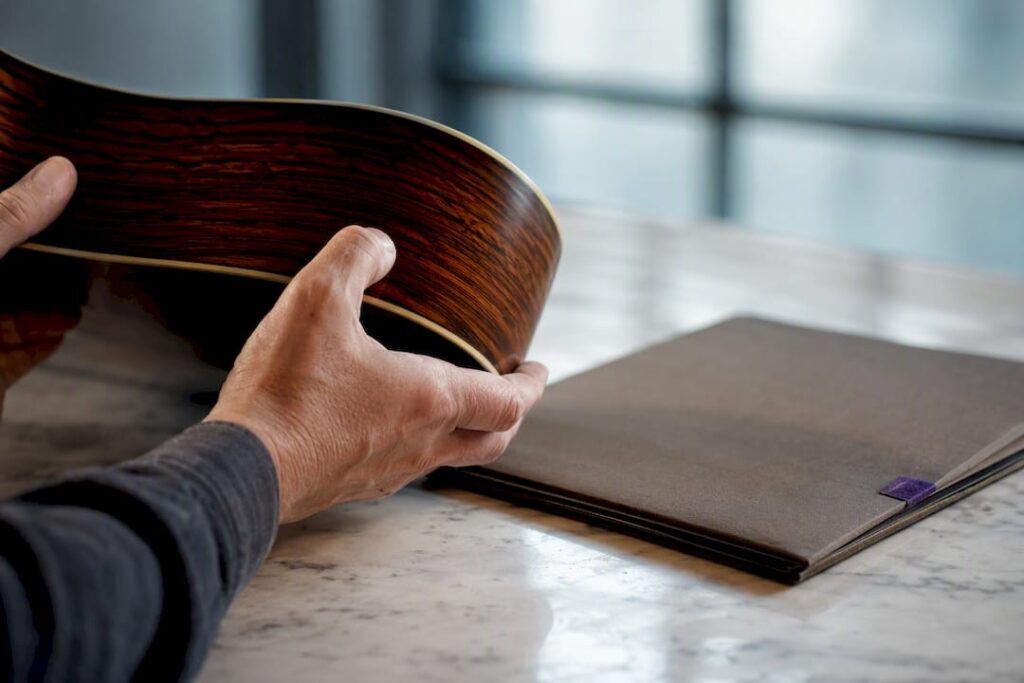

Visual and tactile checks can point toward Rio Palisander, but they cannot confirm it. Color, grain, and pore pattern are useful clues, not proof, and a confident answer usually requires expert appraisal or lab testing. Even then, identifying the wood is only half the problem: paperwork covering pre-1992 import or CITES compliance determines whether the instrument can legally be sold at all. Photograph everything and gather any receipts or documentation before you do anything else.
TL;DR:
- Visual identification of Rio Palisander relies on distinctive color, grain, and large pore structure, but cannot confirm the species without lab testing.
- Confirming species through laboratory analysis involves pore count measurement and ethanol fluorescence testing, which take weeks and cost money.
- Legal sale requires matching provenance documentation to CITES regulations, especially for pre-1992 or exempted imports, as unverified wood is often unsellable.
- Owners should gather all receipts, photos, and documentation before seeking expert appraisal or initiating CITES paperwork for sale or export.
- Professional assessment and proper documentation are essential, as visual checks only provide clues, not legal proof of species or compliance.
Table of Contents
- What Are the Signs of Rio Palisander on a Guitar?
- How Do Labs Confirm Rio Palisander Species?
- What Happens Legally If You Own Rio Palisander?
- What Should You Do Next If You Suspect Rio Palisander?
- Why Vintage-guitar-world Understands This Better Than Most
- Why Certainty Matters More Than a Good Guess
- Get Expert Help Identifying and Documenting Your Guitar
- Sources
What Are the Signs of Rio Palisander on a Guitar?
Rio Palisander, the wood also known by its botanical name Dalbergia nigra, has a reputation for a look that’s hard to fake but easy to misjudge. Before you reach for a magnifying glass, know that finish, age, and repairs can all disguise the traits below.
Color and figure are the first giveaway. Rio Palisander ranges from reddish brown to deep violet, often streaked with near-black lines that break up the surface in an irregular, almost chaotic way. East Indian rosewood, the far more common substitute on production guitars, tends toward a flatter, more uniform brown with straighter, calmer grain lines. If the back and sides of a guitar look like they were carved from a marble slab with erratic dark veining, that’s a strong visual signal, though staining and dyed finishes can mimic the effect.
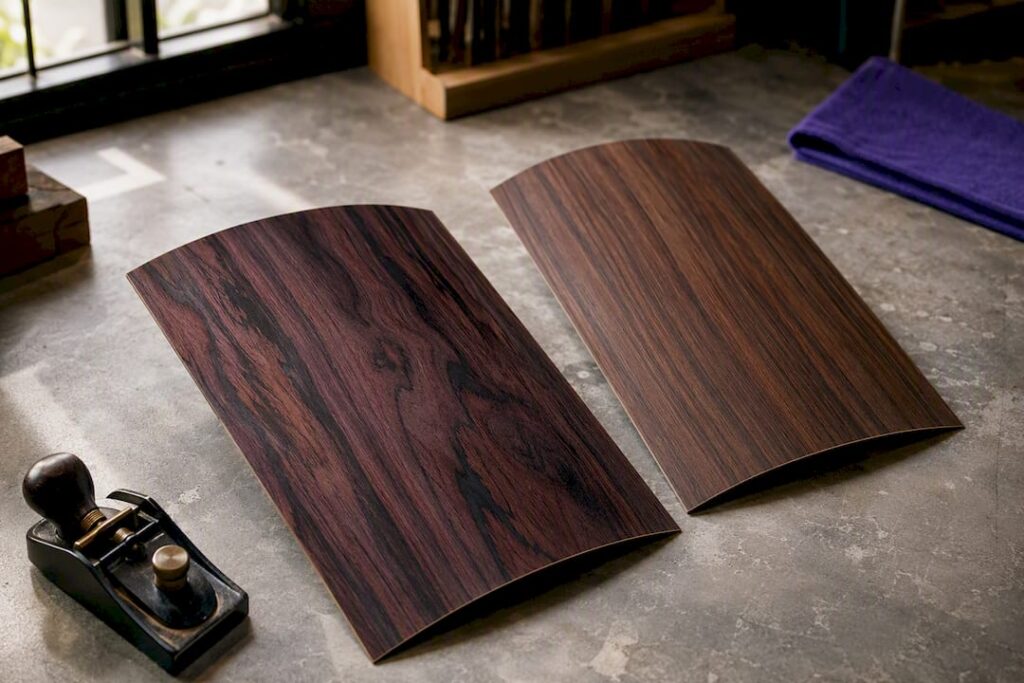
Pore structure is the next clue, and it’s one most players never think to check. Rio Palisander carries unusually large vessels, or macropores, that are often visible to the naked eye on an unfinished edge or endgrain surface. According to research cited in CITES enforcement literature, these vessels occupy a small but distinct portion of the wood’s cross-sectional area, a notably open pore structure compared to East Indian rosewood, which packs pores more densely. Looking at a tangential cut versus a quarter-sawn cut changes what you see, so check more than one surface if you can.
Smell and feel round out the field checks. Sanding dust or a whiff from inside the soundhole sometimes carries a sweet, faintly peppery or almond-like scent associated with older Brazilian stock. The wood also tends to feel slightly oily to the touch. Neither trait is reliable on its own, since decades of polish, sealant, and handling erode both.
- Check color and figure under natural light, not just indoor bulbs
- Inspect an unfinished edge or endgrain for visible large pores
- Smell the soundhole interior for a sweet, spicy note
- Photograph close-ups of grain, endgrain, serial numbers, and purfling
- Watch for lookalikes like Pao Ferro and Santos rosewood, which share color range but not pore density
Pro Tip: Take your photos in daylight near a window, angled across the grain rather than straight on. Raking light exaggerates pore texture and makes the irregular figure much easier for an appraiser to judge from images alone.
Builder guides note that grain irregularity, scent, and pore pattern are helpful indicators but never conclusive on their own, according to specialist guidance from Fritz Guitars. A factory-finished guitar with a thick lacquer coat can mask every one of these cues, and a clever refinish job can even fake the color pattern.
How Do Labs Confirm Rio Palisander Species?
When visual checks aren’t enough, and for anything you plan to sell or export, laboratory analysis is the only route to real certainty.
Wood anatomists use a pore-count method first. Under magnification, they measure vessel density and arrangement across a cross-section. Because Dalbergia nigra’s vessel area represents a distinct proportion of the surface compared to other Dalbergia species, a trained eye with the right equipment can separate Rio Palisander from close substitutes with far more confidence than a naked-eye glance allows.
The second method is chemical. Ethanol extracts from Dalbergia nigra samples show a distinctive greenish-blue fluorescence under UV light, a marker documented in CITES enforcement research on the compound dalnigrin. This is a meaningful detail: simple blacklight testing with water extracts does not reproduce the same pattern, so any online tip suggesting a quick water-and-blacklight test at home is testing the wrong variable entirely.
What does confirmatory testing actually involve?
- A qualified lab or university wood anatomy department extracts a small sample, sometimes a shaving or a tiny core from an inconspicuous edge.
- The sample undergoes microscopic pore analysis and, when needed, an ethanol extraction for fluorescence testing.
- Results typically arrive within a few weeks, depending on the lab’s queue and whether both tests are requested.
- Owners should expect to discuss destructive sampling upfront, since even a small core removes original material permanently.
Sample testing isn’t free, and it isn’t instant. Costs and turnaround vary by lab and by how much material they need, so ask upfront before committing wood from a vintage instrument to a microscope slide.
What Happens Legally If You Own Rio Palisander?
Species identification only answers half the question. The other half is paperwork, and in the EU, paperwork is what actually determines whether you can sell, ship, or even publicly list the instrument.
Dalbergia nigra sits in the strictest CITES protection category, and BfN guidance on musical instruments makes clear that trade inside the EU requires documentation proving the wood either predates the 1992 international listing or carries a valid CITES export and EU market permit. Owners carry the burden of proof, not buyers or authorities. A guitar with textbook Rio Palisander grain but zero paperwork is often functionally unsellable through legitimate channels, no matter how good it sounds.
This isn’t theoretical. Enforcement actions against instrument makers over unverified rosewood sourcing have made headlines, and reporting on tropical wood cases shows how seriously agencies treat undocumented Dalbergia. Municipal guidance, including advisories from the city of Cologne, reiterates that commercial transfer without proper authorization can trigger fines.
- Keep every receipt, import record, or prior appraisal tied to the instrument
- Never list a suspected Rio Palisander guitar for public sale without documentation in hand
- Contact BfN or a local authority before assuming an old guitar is automatically exempt
- Use expert appraisal to strengthen any permit application you eventually file
Pro Tip: If the guitar has been in a family for decades, a dated photo, an old insurance appraisal, or even a decades-old sales receipt can serve as supporting evidence for pre-convention status. Start digging through old paperwork before you contact anyone official.
Reviewing current CITES rosewood regulations before applying for anything is worth the hour it takes.
What Should You Do Next If You Suspect Rio Palisander?
Act methodically, not fast. Rushing to sell before you understand the paperwork situation is the single most common mistake owners make.
- Photograph the guitar thoroughly, close up the grain, endgrain, serial numbers, and any labels, and pull together every receipt or provenance document you have.
- Take the instrument off any public marketplace listing until you’ve confirmed both species and legal status.
- Contact an appraiser experienced with protected woods; bring the photos, documents, and the guitar’s full history, and ask directly whether visual assessment is sufficient or whether lab sampling makes sense for your situation.
- If you intend to sell or export, begin preparing CITES documentation or pre-convention proof now, since permit processing takes time.
Working through a structured authenticity checklist before that first appraisal call tends to save everyone time.
Why Vintage-guitar-world Understands This Better Than Most
Vintage-guitar-world specializes in vintage and handcrafted guitars, which means protected tonewoods aren’t an edge case for us, they’re routine business. Every instrument that passes through expert evaluation gets assessed for wood species alongside condition, originality, and provenance.
Our appraisal workflow starts with document review and visual identification, then brings in lab referrals when the stakes justify it, and includes direct support for CITES application paperwork when an instrument needs to move legally. Self-checks are a reasonable first pass. But once you’re looking at a genuine sale, an export, or a formal certification, professional appraisal isn’t optional, it’s the only route that actually protects your position.
Why Certainty Matters More Than a Good Guess
Most guides on this topic stop at the visual checklist, and that’s where they fail collectors. Knowing the grain pattern and the smell test feels satisfying, but it solves the wrong problem. The real question is never “does this look like Rio Palisander?” It’s “can I prove what this is, and can I prove where it came from?” Those are legal questions, not aesthetic ones.

The conventional advice treats identification as the finish line. It’s the starting line. A confirmed species with no provenance paperwork is often worse off, in market terms, than an unconfirmed guess, because now you know exactly what you can’t sell.
Prioritize documentation before testing. A sample sitting in a lab does you no good if you can’t also produce the import history that makes the wood legally tradeable. Chase paperwork first, chase certainty second, and treat the smell test for what it is: a hint, not evidence.
— Vintage
Get Expert Help Identifying and Documenting Your Guitar
Guesswork on protected tonewoods carries real financial risk, one misjudged sale can leave you facing fines or a blocked transaction. Vintage-guitar-world offers what a solo identification attempt can’t: trained eyes on the wood itself, appraisal experience with protected species, and direct support preparing CITES documentation when you’re ready to sell.

Before reaching out, gather what you have: clear photos of the grain and endgrain, serial numbers, any prior receipts or appraisals, and notes on how long the instrument has been in your possession. That history matters as much as the wood itself.
Run through our guitar appraisal checklist to see exactly what an appraiser will ask for, then book a testing appointment through Vintage-guitar-world to get a professional read on both the species and the paperwork path forward.
Sources
This article is general information, not a substitute for advice from a qualified lawyer. Consult a qualified legal professional about your own circumstances before acting on anything here.