












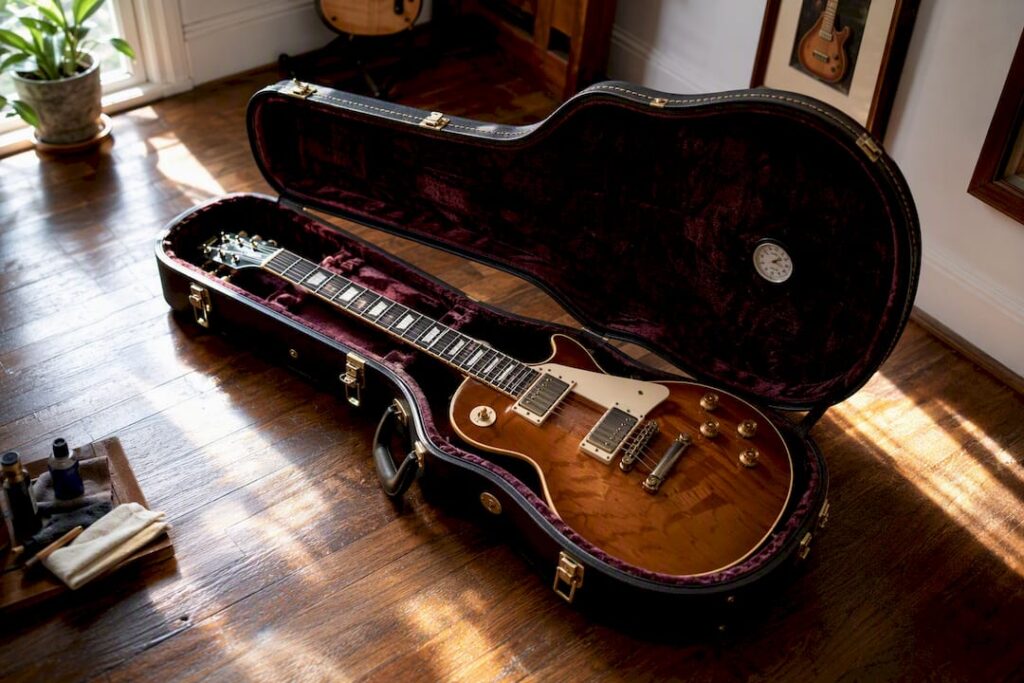

Keep your acoustic or classical guitar at about 50% relative humidity, and check that number today. Grab a hygrometer, read it now, and if the level sits outside 45–55%, put the guitar in its case immediately and correct the imbalance with a case humidifier or a desiccant pack, depending on which direction you’re off. Left unchecked, extremes in either direction can cause cracking, warping, or loose glue joints within a relatively short time.
TL;DR:
- Maintaining a humidity level between 45% and 55% is crucial, with a target of 50% to avoid cracks, warping, or loose joints in guitars.
- Using a reliable digital hygrometer inside the case and adjusting with a two-way humidifier or desiccant pack helps sustain optimal moisture levels.
- Low humidity below 40% causes cracks and shrinkage, while over 60% leads to swelling, loose braces, and corrosion.
- Humidity fluctuations are often due to heating or cooling systems, with temperature swings causing more damage than humidity alone.
- Storing guitars in a sealed case and avoiding rapid temperature changes are the most effective strategies for long-term protection.
Table of Contents
- Why 45–55% Relative Humidity Protects Your Guitar’s Wood
- Signs Your Guitar Is Too Dry or Too Humid
- How to Measure Guitar Humidity Accurately
- Case Humidifiers, 2-Way Systems, and Room Devices
- Storing and Transporting Your Guitar Safely
- What to Do When Your Guitar Shows Humidity Damage
- How Vintage Guitar World Protects High-Value Instruments
- Manufacturer and Care Resources Worth Bookmarking
- The Real Priority Behind All This Humidity Advice
- Sources
Why 45–55% Relative Humidity Protects Your Guitar’s Wood
Wood is hygroscopic. It absorbs and releases moisture until it matches its surroundings, a state called equilibrium moisture content. When the air dries out, the wood shrinks. When humidity climbs, it swells. A guitar top is thin, often 2 to 3 millimeters of spruce or cedar, so it reacts fast to changes most furniture would shrug off.
That’s why manufacturers converge on the same number. Yamaha’s own guidance names 45% to 55% relative humidity as the ideal range, with 50% singled out as the practical target because it gives the wood breathing room in both directions without pushing it toward either failure mode. Martin’s preservation bulletin lands on the same 50% figure for long-term storage.
Temperature matters too, though less directly. At a reference point of about 20°C, relative humidity tends to behave predictably. Turn on a radiator in winter and the same room’s air can lose 15 to 20 percentage points of RH without a window ever opening. That single fact explains most humidity emergencies:
- Winter heating systems dry indoor air aggressively, often faster than owners notice.
- Summer air conditioning can do the reverse in humid climates, pulling moisture out unevenly.
- A guitar left near either system drifts out of range long before visible damage appears.
Signs Your Guitar Is Too Dry or Too Humid
Damage from bad humidity rarely announces itself with a bang. It creeps in, and the symptoms differ sharply depending on which direction things go wrong.
- Cracks along the grain, usually on the top or back, are the clearest sign of prolonged dryness.
- A sunken or concave top, visible when you sight down the bridge, means the wood has shrunk and lost its dome.
- Sharp or protruding fret ends happen because the fretboard wood shrinks faster than the metal frets, leaving edges that catch your hand.
- Buzzing or fretting-out on the high frets often follows a dropped top, since the neck angle shifts.
- A swollen or domed top, opposite of the dry symptom, points to excess humidity.
- Loose or separating braces and bridge, sometimes audible as a rattle, signal glue joints failing under swelling wood.
- Corrosion on tuners, frets, or strings shows up faster than owners expect once humidity climbs.
Yamaha’s guidance is blunt about the thresholds: risk increases sharply below 40% and above 60%. Below 40% or above 60%, you’re in active damage territory, and the clock is running.
How to Measure Guitar Humidity Accurately
Guessing costs money. A cheap analog hygrometer can drift by 10 percentage points or more without you knowing, which means you could be sitting at 35% while your dial reads a comfortable 50%. Digital hygrometers are more reliable, and Bluetooth models add a real advantage: some thermohygrometers built for instrument cases log readings over time and push an alert to your phone the moment you drift past a set threshold.
- Place the hygrometer inside the closed case, not just the room, since case air and room air can differ by 10% or more.
- Keep a second hygrometer in the room if you store multiple instruments or want to track seasonal trends, as local conditions can vary.
- Check min/max readings weekly rather than relying on a single snapshot.
- Recalibrate cheap analog units against a known reference every few months; they wander.
Pro Tip: Mount the hygrometer against a firm, stable surface inside the case rather than sticking it to the plush lining. Adhesive mounts often peel off soft case padding within weeks, and a fallen sensor gives you no data when you need it most.
Case Humidifiers, 2-Way Systems, and Room Devices
Case-centered control beats whole-room humidification for one simple reason: a guitar case is a small, sealed volume, so it’s far easier to stabilize than an entire bedroom. A basic soundhole humidifier or humidifier pack releases moisture into that pocket of air. It needs refilling or replacing roughly every one to two weeks, more often in dry winter conditions.

The catch with these one-way units is that they only add moisture. Thomann’s retailer guidance notes plainly that one-way humidifiers cannot remove excess humidity, so if a humid spell rolls in, you have to remember to pull the unit out or risk pushing your guitar past 55%.

Two-way humidity control packs solve that blind spot. They release moisture when the air is dry and absorb it when the air is humid, holding a target band without you micromanaging it daily. That “set and forget” quality is why they work so well for players in climates with real seasonal swings, cold dry winters followed by humid summers.
Room humidifiers and dehumidifiers have their place, but they’re a supplement, not a substitute. A humidifier running in a large room struggles to raise humidity fast enough during a cold snap, and a case sitting open near a window will still lose that gained moisture quickly. Use room devices to keep the overall environment reasonable; use the case system to hold the actual target.
| Solution | Best for | Maintenance |
|---|---|---|
| One-way case humidifier | Dry winter climates only | Refill every 1 to 2 weeks |
| Two-way humidity pack | Seasonal or unpredictable climates | Replace every 2 to 4 months |
| Room humidifier/dehumidifier | Whole-room baseline support | Clean tank weekly to avoid mold |
Mold is the hidden cost of sloppy humidifier maintenance. A damp sponge left too long, or a case that never gets aired out, breeds mold on the interior lining. Clean the case liner periodically and never store a wet humidifier pack against the guitar’s finish.
Storing and Transporting Your Guitar Safely
A hermetic hardshell case is the single best tool for humidity stability you can own, because it turns “the whole room’s humidity” into “a small, controllable pocket of air.” Vintage Guitar World’s own guitar care and storage guide covers this in more depth, but the short version: keep the guitar in its closed case whenever it’s not being played, especially overnight and during travel.
Temperature swings are where most damage actually happens, not humidity alone. When you bring a guitar in from a cold car into a warm house, resist opening the case right away. Let it sit closed for 30 to 60 minutes so the instrument reaches room temperature gradually; opening too soon risks condensation forming on the finish and inside the electronics cavity, an issue guitar care experts specifically warn against after summer heat exposure.
- Never store a guitar near a window, radiator, fireplace, or heating vent.
- Never leave an instrument in a parked car, even briefly; cabin temperatures swing far faster than a case can buffer.
- Choose an interior room away from exterior walls for long-term storage.
- A well-built case like those detailed in this guide to classical guitar cases holds its internal microclimate for hours even when room conditions shift.
What to Do When Your Guitar Shows Humidity Damage
Move fast, but move carefully. Rushed fixes cause more damage than the original problem.
- If the reading is too low, place a case humidifier inside the closed case and check it every 12 to 24 hours until you’re back in the 45–55% band. Don’t blast the room with a space heater in the meantime; that only accelerates drying.
- If the reading is too high, remove any humidifier immediately, add a desiccant pack, and let the case sit slightly open in a dry, stable room. Avoid direct sun or a hair dryer; rapid drying causes cracking just as reliably as slow drying does.
- If you see a visible crack, an open seam, or a top that looks noticeably sunken or domed, stop playing the guitar and get it to a luthier. This is not a DIY repair, and forcing a warped neck back into position yourself can crack the finish or the wood underneath.
Pro Tip: Never use silica gel meant for shoeboxes as a guitar desiccant substitute in a pinch; it works, but it can overcorrect fast in a small case. A purpose-made two-way pack reacts more gently.
If you’re unsure whether what you’re seeing is cosmetic or structural, a quick guitar evaluation checklist walks through what separates a minor finish issue from a genuine structural concern.
How Vintage Guitar World Protects High-Value Instruments
That discipline matters more for a vintage solid-wood guitar than a modern factory instrument, since decades-old wood has less structural margin for error.
Beyond storage, Vintage Guitar World offers guitar testing appointments for players who want a second opinion before buying or after a suspected humidity scare, along with valuation and certification services for owners who need documented condition history on a rare or restored instrument.
Manufacturer and Care Resources Worth Bookmarking
Yamaha’s humidity FAQ sets the manufacturer baseline. Thomann’s storage guidance compares humidifier types in detail. For preservation workflow specifics, see Vintage Guitar World’s own preservation workflow guide.
The Real Priority Behind All This Humidity Advice
That’s overkill for most owners, and it distracts from the one habit that actually prevents damage: keeping the guitar in a closed case when it’s not being played. A case is a buffer. A guitar sitting on a stand in a living room has none.
The conventional wisdom also underplays temperature shock relative to humidity itself. Plenty of owners chase the perfect RH percentage while ignoring the cold car ride or the sunny windowsill that does the actual damage through rapid temperature swings and condensation. Fix the acclimatization habit first; the humidity numbers matter less if you’ve already stopped exposing the instrument to shock changes.
If there’s one thing worth prioritizing above every gadget mentioned here, it’s this: a hygrometer inside a good case, checked weekly, catches problems before they become cracks. Everything else, two-way packs, Bluetooth alerts, dehumidifiers, is refinement on top of that basic habit. Get the habit right first, and the vintage instruments this industry cares so much about tend to outlive their owners.
— Vintage
Sources
- Akustische Gitarren und Luftfeuchtigkeit — Yamaha FAQ
- Luftfeuchtigkeit und Lagerung — Thomann
- Thermo-Hygrometer schützt Gitarren — Elektroniknet