














If you buy a used guitar from a private person in Germany, you can usually apply the margin scheme under §25a UStG: VAT is then due only on the difference between what you paid and what you sell it for, not the gross sale price. Differenzbesteuerung gitarre questions almost always come down to three quick checks.
Run these before you list the instrument:
- Seller status: Did you buy from a private individual, a small-business owner exempt under §19 UStG, or another dealer already applying the margin scheme? If yes, you likely qualify.
- Purchase location: Was the guitar acquired inside Germany or the EU without recoverable input VAT? Imports that already carried import VAT usually break eligibility.
- VAT on the original purchase: If your invoice from the previous owner shows separate VAT, you cannot apply Differenzbesteuerung to that instrument.
One more thing before you touch the invoice template: never show VAT as a separate line item on a margin-scheme sale. That single mistake creates a tax debt you didn’t actually owe.
Key Takeaways
The margin scheme under §25a UStG lets German guitar dealers tax only the profit spread on used instruments bought from private sellers, provided the purchase, invoice, and recordkeeping all meet strict documentation standards.
| Point | Details |
|---|---|
| Verdict on eligibility | Guitars bought from private sellers or non-VAT businesses usually qualify for §25a UStG margin treatment. |
| Never show VAT on invoice | Displaying VAT separately on a margin-scheme sale triggers a separate tax debt under §14c UStG. |
| Watch the €750 threshold | Purchases above €750 require individual Einzeldifferenz calculation, not pooled Gesamtdifferenz accounting. |
| Rebuilds can disqualify items | Adding new, VAT-deductible components like pickups or electronics can void margin treatment on that guitar. |
| Documentation protects value | Vintage Guitar World’s appraisal and intake process builds the same provenance records that support both audit defense and buyer trust. |
Table of Contents
- What Is Differenzbesteuerung and Why Does It Exist?
- Who Can Apply the Margin Scheme to Guitar Sales?
- Which Guitars and Accessories Actually Qualify?
- How Do You Calculate the Margin and VAT?
- What Has to Appear on a Differenzbesteuerung Invoice?
- What VAT Rate Applies, and When Doesn’t It?
- Do Cross-Border Purchases and Imports Change Anything?
- Your Compliance Checklist Before the Next Sale
- How Does This Play Out on a Real Guitar Sale?
- Does the Margin Scheme Change How You Price Guitars?
- When Doesn’t Differenzbesteuerung Apply to a Guitar Sale?
- A Note on Compliance and Collector Trust
- Get Help Documenting a Margin-Scheme Sale the Right Way
- Where to Verify These Rules Yourself
- Frequently Asked Questions
- Sources
What Is Differenzbesteuerung and Why Does It Exist?
Differenzbesteuerung, the margin scheme codified in §25a UStG, lets a dealer calculate VAT only on the profit margin, the gap between purchase price and selling price, rather than on the full sale amount. The rule applies specifically when the goods came from a source that couldn’t charge or reclaim VAT, typically a private seller.
Here’s the practical translation: buy a 1978 Gibson Les Paul from a retiring guitarist for €2,000, sell it for €2,800, and you owe 19% VAT only on the €800 spread. Tax it on the full €2,800 instead, and you’d be charging VAT twice on value that was already in private hands with no VAT ever recovered. That’s the double taxation problem the scheme was built to prevent.
The legal foundation runs deeper than German domestic law. The rule traces back to the EU VAT directive, which set the framework for margin schemes across member states long before Germany wrote its own implementing text. That matters for cross-border purchases, which we’ll cover later, because the EU-level rules still bound how far German tax offices can stretch or narrow the scheme.
In the German secondhand market, Differenzbesteuerung is the default posture for anyone trading in used goods bought mostly from non-business sellers: antique dealers, used-car lots, pawnshop resellers, and vintage instrument specialists. Guitar dealers fit this pattern almost perfectly. Most of your best inventory, a 1960s Martin D-28 pulled from someone’s attic, a flamenco guitar bought from a retiring luthier, arrives without any VAT attached in the first place. The scheme isn’t an exotic loophole. It’s the standard operating mode for your business model.
Who Can Apply the Margin Scheme to Guitar Sales?
Not every dealer, and not every guitar, qualifies automatically. You need to clear three separate hurdles at once.
First, you must be operating as a Wiederverkäufer, a reseller who regularly buys and resells movable goods as part of a registered business. A one-off private sale of your own guitar collection doesn’t count; this is a scheme for businesses, not individuals clearing out a garage.
Second, the guitar must have been purchased from a seller who could not charge VAT: a private person, a small business under the §19 UStG exemption, or another dealer who themselves applied Differenzbesteuerung on that same instrument. If your supplier invoice shows VAT, the margin scheme is off the table for that unit.
Third, the item has to qualify as a movable good acquired within Germany or the EU under conditions where no input VAT was recoverable. Guitars almost always clear this bar since they’re physical, portable objects, but the acquisition geography still needs checking, especially for instruments imported from outside the EU.
Watch for two disqualifying situations:
- The guitar was bought from a VAT-registered music shop or manufacturer that charged VAT on the sale to you.
- You added significant new components, like a full electronics rebuild or a replacement neck, where you reclaimed input VAT on those parts, which disqualifies margin treatment.
Pro Tip: Keep a short written declaration from every private seller confirming they are not VAT-registered. It takes thirty seconds to collect and can save you an argument with the tax office two years later.
Which Guitars and Accessories Actually Qualify?
Used guitars, whether vintage electrics, steel-string acoustics, or classical and flamenco instruments, are movable goods, so they clear the basic eligibility bar without much debate. Where dealers trip up is in the accessories and refurbishment gray zone.
A used hardshell case sold alongside a guitar, bought from the same private seller, typically travels under the same margin treatment as the instrument. But accessories purchased separately from a VAT-charging supplier, say a brand-new set of tuning pegs bought retail to replace worn originals, follow standard VAT rules on their own, not the margin scheme.
The bigger risk sits in refurbishment work. Case law from the Bundesfinanzhof clarifies that when a used item is substantially altered by adding new components for which input VAT could be reclaimed, the margin scheme cannot apply to the combined item. The BFH’s 2024 ruling (XI R 9/23) is the controlling precedent here: swap in a set of new, VAT-deductible pickups and a refinished top on a vintage guitar, and you may have converted the whole instrument into a taxable-on-full-price item rather than a margin-scheme sale.
Practical takeaway for guitar dealers:
- Minor cosmetic work, a fret dress, a setup, cleaning, generally doesn’t affect eligibility.
- Structural rebuilds using newly purchased, VAT-deductible parts can disqualify the instrument from margin treatment.
- Keep restoration invoices separate from the guitar’s original acquisition paperwork so you can show exactly what was original and what was added.
How Do You Calculate the Margin and VAT?
Two calculation methods exist, and picking the wrong one is one of the easiest ways to misfile a return.
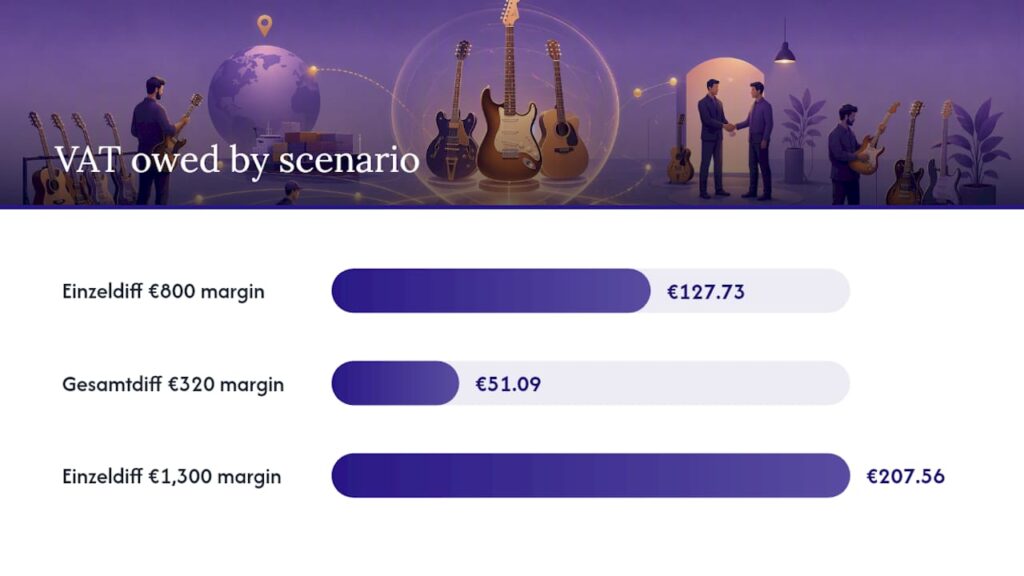
Einzeldifferenz (single-item margin) requires you to calculate VAT separately for each individual guitar: purchase price subtracted from selling price, VAT extracted from that specific margin. This is mandatory for higher-value instruments.
Gesamtdifferenz (aggregate margin) lets you pool multiple low-value purchases within a filing period, netting total purchases against total sales rather than tracking each item individually. Since 1 January 2025, the threshold for including a purchase in the Gesamtdifferenz pool rose to €750, up from the previous €500 limit. Anything you bought for more than €750 has to be tracked and taxed individually under Einzeldifferenz, no exceptions.
The formula for extracting VAT from a margin:
- Calculate the margin: selling price minus purchase price.
- Divide the margin by 1.19 to find the net margin (assuming the standard 19% rate).
- Subtract the net margin from the gross margin to get the VAT owed.
For a margin of €800: €800 ÷ 1.19 = €672.27 net margin. VAT owed is €800 minus €672.27, or €127.73.
Worked example 1, Gesamtdifferenz. You buy three sets of vintage tuning machines and a used gig bag from private sellers over one quarter, each purchase under €750: €180, €220, €90, and €140, totaling €630 in purchases. You resell all four for a combined €950. Margin: €320. VAT owed: €320 minus (€320 ÷ 1.19) = roughly €51.09, filed as one pooled calculation.
Worked example 2, Einzeldifferenz. You buy a 1965 Fender Jazzmaster from a private collector for €3,200 and sell it four months later for €4,500. Because the purchase price exceeds the €750 threshold, this instrument must be tracked individually. Margin: €1,300. VAT owed: €1,300 minus (€1,300 ÷ 1.19) = about €207.56.
The €750 threshold shift has a specific effect on guitar dealers: it makes it easier to fold cheap accessory purchases into your aggregate calculation, but it also means more vintage guitars now cross the line into mandatory single-item accounting, since most collectible instruments sell well above €750 on the buy side. Budget the extra bookkeeping time accordingly.
What Has to Appear on a Differenzbesteuerung Invoice?
The single most important rule here has a hard consequence attached: you must never display VAT as a separate figure on a margin-scheme invoice. Doing so triggers a separate tax debt under §14c UStG, meaning you’d owe the VAT you displayed even though the underlying transaction wasn’t supposed to carry it that way.
Instead, German invoices for margin-scheme sales must carry a prescribed legal reference rather than a VAT breakdown. Acceptable wording includes:
- “Gebrauchtgegenstände/Sonderregelung” for general used goods.
- “Kunstgegenstände/Sonderregelung” if the item is classified as an art object (rarely applicable to guitars, but relevant for museum-grade instruments with documented artistic provenance).
The invoice shows a single gross total, the reference phrase, and standard business details: your name, address, tax ID, the buyer’s details, invoice date, and item description. No net price, no VAT rate, no VAT amount broken out anywhere on the document.
On the bookkeeping side, accountants working with secondhand dealers typically separate margin-scheme revenue using distinct SKR accounts, commonly SKR 03 accounts 8193 (Erlöse Differenzbesteuerung ohne USt) for the gross posting and 8191 (Erlöse aus Differenzbesteuerung 19% USt) for tracking the internal VAT extraction on the margin. This keeps your VAT return calculations traceable without exposing VAT on the customer-facing invoice.
Retain these documents for every margin-scheme guitar sale:
- The original purchase receipt or private seller declaration.
- Any restoration or parts invoices, filed separately from the acquisition proof.
- The final sales invoice with the correct legal wording.
Practitioner guides consistently flag missing acquisition proof and incorrect invoice wording as the two most common reasons tax authorities reject margin treatment and reclassify the sale under standard VAT rules, usually at a cost to the dealer, not the customer.
Our own legal provisions page walks through the invoice wording requirements in more depth if you want a template to adapt.
Pro Tip: Build the legal reference phrase into your invoicing software as a locked default field for used-instrument sales. One accidental override, a bookkeeper typing in a VAT line out of habit, is all it takes to create an avoidable tax liability.
What VAT Rate Applies, and When Doesn’t It?
Margin income under Differenzbesteuerung is taxed at the standard 19% rate in nearly every guitar transaction; there’s no separate reduced rate carved out for musical instruments under the margin scheme itself.
The exception that matters more in 2026 involves the tax rate on your incoming purchase, not your outgoing sale. If you acquired the guitar from a source where the original supply was taxed at a reduced rate, the margin scheme can be blocked entirely for that item, a rule that has gained more relevance as reduced-rate categories shift under ongoing EU VAT harmonization discussions.
A few situational notes worth building into your process:
- Selling to another VAT-registered business (B2B) doesn’t automatically disqualify margin treatment, but many business buyers prefer a standard VAT invoice so they can reclaim input tax, something margin-scheme sales don’t allow.
- If a business customer needs to reclaim VAT, you can opt into regular taxation for that specific sale instead of the margin scheme, but you need to document that opt-in decision clearly and apply it consistently for that transaction.
- Once you opt into regular taxation for an item, you can’t retroactively switch back to margin treatment for the same sale.
Do Cross-Border Purchases and Imports Change Anything?
Buying a guitar from a private seller in France, Spain, or another EU country generally preserves margin-scheme eligibility, provided no recoverable VAT was involved in that original acquisition, the same core test that applies domestically. Chambers of commerce point to movable goods and clean documentation as the two pillars that keep cross-border margin sales defensible.
Imports from outside the EU are trickier. If import VAT was charged when the guitar entered the EU, that generally blocks margin treatment on resale unless narrow exceptions apply, since the import VAT itself represents a recoverable input in most cases. This shows up more often than dealers expect: a rare Japanese-made electric imported from outside the EU customs union will often carry import VAT that disqualifies it from Differenzbesteuerung entirely.
For any cross-border acquisition, keep the original purchase invoice or seller declaration, shipping and customs paperwork, and any import VAT documentation showing whether tax was charged and by whom.
Your Compliance Checklist Before the Next Sale
Build this into your intake process, not your quarterly cleanup:
- Verify seller status at the moment of purchase, before you agree on a price. Get a signed declaration if the seller is private or small-business exempt.
- Record purchase and sale price at the SKU level for every individual instrument, even ones you plan to pool under Gesamtdifferenz.
- Attach documentation to each transaction file: seller declaration, any restoration invoices, and the final sales invoice, stored together, not scattered across systems.
- Review invoice wording before it goes out, confirming the legal reference phrase is present and no VAT figure is displayed.
- Flag any instrument over the €750 threshold for individual Einzeldifferenz treatment rather than pooling it by habit.
- Reconcile SKR account entries quarterly against your actual sales log to catch mismatches early.
The six most common audit triggers, in order of frequency: missing seller declarations, VAT shown on invoices by mistake, restoration costs mixed into acquisition records, purchases above €750 wrongly pooled, inconsistent opt-in documentation for business sales, and incomplete customs paperwork on imports.
Vintage Guitar World’s own intake process reflects this same discipline: every instrument that comes through appraisal gets a documented provenance record and a formal intake form before it ever reaches a sales listing, the same kind of paper trail that keeps a margin-scheme file defensible under audit. Our resale workflow guide breaks down that process step by step.
Pro Tip: Set a calendar reminder to review your Gesamtdifferenz pool every time a single quarter’s purchases push you close to the aggregate threshold. Catching a borderline item early is far easier than reclassifying it after you’ve already invoiced the sale.
How Does This Play Out on a Real Guitar Sale?
Take a 1972 Fender Stratocaster bought from a retiring session player in Hamburg for €4,500, no VAT involved since he wasn’t a registered business. You do a fret dress and a setup, both minor service work that doesn’t add new deductible components, then sell it eight months later for €6,200.
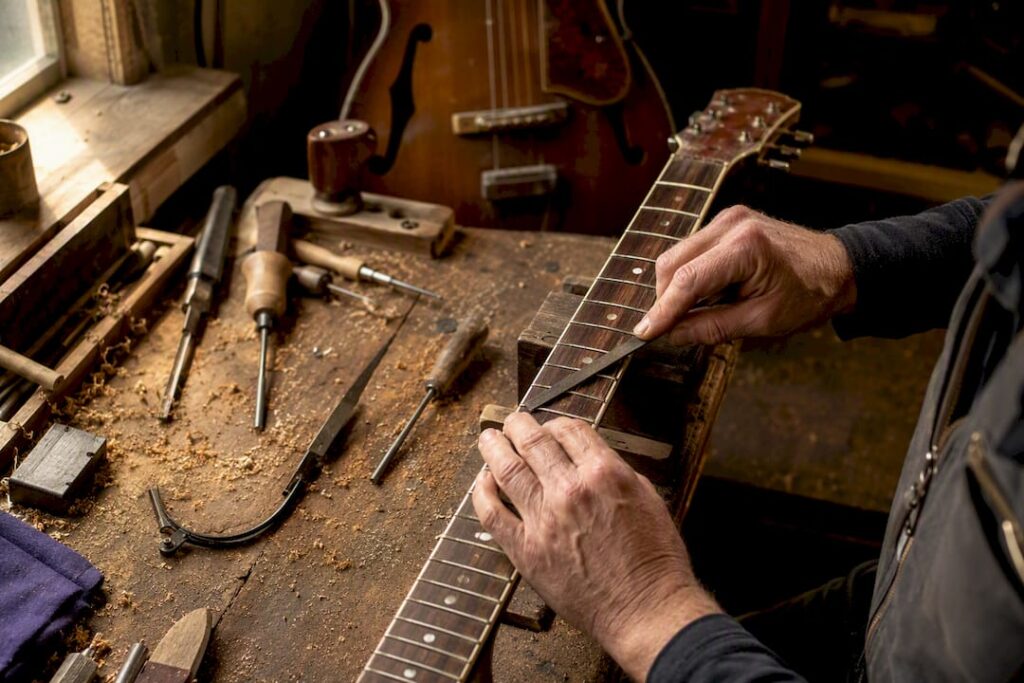
This is a textbook Einzeldifferenz case: purchase over €750, no VAT-deductible parts added, clean private-seller provenance. Margin is €1,700; VAT owed is roughly €271.43. The invoice carries the “Gebrauchtgegenstände/Sonderregelung” wording, no VAT line, and a gross total of €6,200.
Now compare a messier case: a 1968 Gibson ES-335 acquired at an estate sale, where the estate’s executor hired a luthier to replace the entire wiring harness and install new VAT-invoiced pickups before you bought it. Because that refurbishment happened before your acquisition and the seller (the estate) wasn’t VAT-registered, the guitar itself might still qualify for margin treatment on your resale, but you’d want written confirmation of exactly when and by whom that rework was done, since a tax auditor may ask.
The pattern that separates a clean margin-scheme case from a contested one is almost always the same: how well you can document what the instrument was, who owned it, and what changed hands before it reached your shop.
Does the Margin Scheme Change How You Price Guitars?
Differenzbesteuerung directly shapes what a buyer actually pays and, by extension, how competitively you can price against dealers who might be forced into full-price VAT treatment. Because VAT under the margin scheme applies only to your profit spread, not the whole sale price, your effective tax burden on a given transaction is often far lower than the 19% headline rate suggests when measured against the full sticker price.
That gap becomes a real pricing lever on higher-value vintage instruments. A dealer selling a €6,000 guitar under standard VAT rules would need to add nearly €1,140 in tax on top; under the margin scheme, the same guitar might carry a VAT liability in the low hundreds, calculated only on the markup. That difference lets margin-scheme dealers price competitively without eroding margin, which is precisely why so much of the German vintage guitar trade operates this way by default rather than exception.
For resale value specifically, buyers rarely see the tax mechanics directly, since the invoice shows a single gross price either way. But the pricing headroom it creates for dealers tends to keep vintage instrument markets more liquid: lower effective tax costs mean dealers can offer sellers better buy prices while still protecting margin on the eventual resale, which keeps quality inventory moving through legitimate channels rather than private, undocumented sales.
When Doesn’t Differenzbesteuerung Apply to a Guitar Sale?
The scheme has real limits, and misapplying it is just as costly as failing to use it when you should. A handful of scenarios rule it out entirely.
A private sale between two individuals, one collector selling directly to another with no registered business involved, falls outside Differenzbesteuerung altogether because the scheme is a business tax mechanism, not a private transaction rule. Neither party charges or calculates VAT in that case; it simply isn’t a taxable business event.
A guitar purchased from a VAT-registered retailer who charged VAT on your acquisition invoice cannot later be resold under the margin scheme; you’d apply standard VAT rules on the full resale price instead, since you likely reclaimed the input VAT on your original purchase.
An instrument that underwent substantial rebuilding with new, VAT-deductible components, the scenario the BFH addressed directly, loses margin eligibility on the combined item once those new parts are integrated and their input VAT was reclaimed.
And a guitar imported from outside the EU with import VAT charged at the border generally can’t carry margin treatment on resale unless narrow exceptions apply, since that import VAT usually represents recoverable input tax.
Getting this wrong in the other direction, applying margin treatment when it doesn’t qualify, is what actually draws audit attention, not the reverse.
A Note on Compliance and Collector Trust
Correct Differenzbesteuerung practice isn’t just a tax filing exercise. It’s part of what protects an instrument’s provenance and, ultimately, its value to the next owner. A guitar with a clean paper trail, purchase documentation, appraisal notes, and accurate invoicing, carries more credibility in the collector market than one with gaps in its history. At Vintage Guitar World, our appraisal and documented intake process exists partly for this reason: the same records that satisfy a tax auditor also reassure a buyer that what they’re purchasing is exactly what it claims to be.
Get Help Documenting a Margin-Scheme Sale the Right Way
If any of this checklist work sounds like more paperwork than you have time for, that’s the exact gap Vintage Guitar World’s appraisal and documentation services are built to close. Rather than assembling provenance records and invoice wording from scratch on every instrument, dealers can request a professional appraisal that produces the documented intake record, condition notes, and ownership history your margin-scheme file needs to hold up under review.

Our services cover the pieces that matter most for compliance: a formal guitar appraisal that establishes fair market value and documents condition at intake, provenance and ownership records that support your acquisition proof, and certification guidance for instruments where authenticity questions could otherwise complicate a sale. If you’re preparing a vintage instrument for resale and want the paper trail sorted before you write the invoice, start by requesting a valuation through our shop and we’ll walk you through what documentation to gather first.
Where to Verify These Rules Yourself
- §25a UStG margin scheme basics: the statutory foundation explained in plain terms.
- Invoice wording requirements: exact legal phrasing for margin-scheme invoices.
- Handelskammer Hamburg guidance: chamber of commerce rules on eligible goods and documentation.
Frequently Asked Questions
Does Differenzbesteuerung apply automatically, or do I have to elect it?
It applies whenever the legal conditions are met, no formal election is required for most secondhand goods dealers, but you can opt into regular VAT taxation for a specific sale if a business buyer needs to reclaim input VAT.
Can I apply the margin scheme if I bought a guitar at auction?
It depends on who ran the auction and whether VAT was charged. If the auction house sold on behalf of a private consignor without charging VAT, margin treatment usually still applies; if the auction house itself charged VAT, it typically doesn’t.
What happens if I accidentally show VAT on a margin-scheme invoice?
You become liable for that VAT amount under §14c UStG, on top of whatever tax treatment actually applied to the sale, effectively creating a tax you didn’t need to owe.
Do I need a written declaration from every private seller?
It isn’t a strict legal requirement, but practitioner guidance strongly recommends it, since missing acquisition proof is one of the top reasons tax offices reject margin treatment during a review.
Is Differenzbesteuerung better for my customers than standard VAT?
Usually yes on higher-value instruments, since the buyer’s total price reflects VAT only on the dealer’s margin rather than the full sale amount, which tends to keep vintage guitar pricing more competitive.