












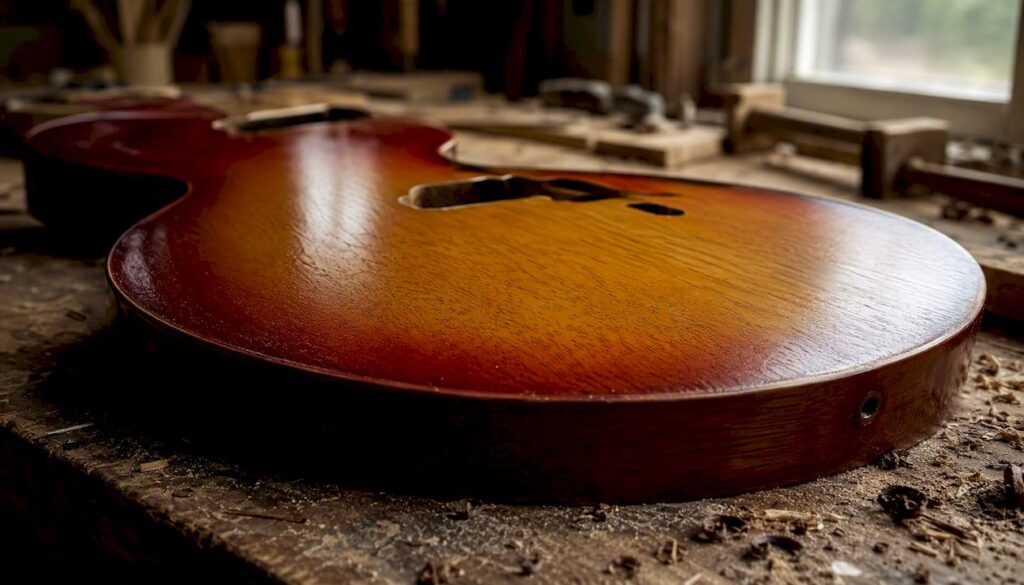

A burst finish is a graduated color treatment: lighter in the center, darker at the edges, applied so the wood grain often shows through the transition. That single technique built one of the most recognizable looks in electric guitar history and turned certain Gibson Les Pauls into six-figure instruments.
A few reasons it matters beyond looks:
- Visual depth: transparent color layers let figured maple tops show through, so the burst frames the wood grain instead of hiding it.
- Collector value: originality of materials, like nitrocellulose lacquer) and period-correct aniline dyes, drives authentication and price.
- Chemistry and patina: how a finish ages, not just how it started, defines its long-term character and market appeal.
At Vintage-guitar-world, we handle enough of these instruments to know the finish tells you almost as much as the serial number.
Key Takeaways
Burst finishes gain both their visual character and collector value from a specific chemical instability: red aniline dye fades under UV light faster than the yellow base beneath it.
| Point | Details |
|---|---|
| Definition | A burst finish shows a lighter center fading into darker edges, often over figured maple. |
| Fading is chemistry | Red dye breaks down under UV faster than yellow, creating honey, iced tea, and lemon stages over decades. |
| Naming varies by maker | Cherry, tobacco, three-color, and honey burst labels shift between brands for similar visual stages. |
| Originality checklist matters | Checking patterns, fade symmetry, and hardware patina together indicate authenticity better than any single clue. |
| Finish affects tone modestly | Thin nitro lacquer flexes more than thick poly, but pickups and construction matter more overall. |
Table of Contents
- Explain Burst Finishes: The Main Types and How to Spot Them
- How Did the Les Paul Burst Become Iconic?
- How Are Burst Finishes Actually Made?
- Why Do Burst Colors Fade or Change Over Decades?
- How Can You Tell an Original Burst From a Reissue?
- Does the Finish Actually Affect Tone?
- Can You DIY a Sunburst Finish at Home?
- Why Bursts Deserve a Closer Look Than Most Buyers Give Them
- Ready to See a Burst Finish in Person?
- Frequently Asked Questions
- Sources
Explain Burst Finishes: The Main Types and How to Spot Them
Every burst runs the same basic idea: light center, dark edge. What changes is the color family and how sharp the contrast is.
- Cherry Sunburst (Cherryburst): red to near-black edges over a lighter center, with the red often the first color to fade with age.
- Tobacco Sunburst: amber to brown, warmer and less red from the start, so it ages more subtly than cherry variants.
- Three-color sunburst: yellow center, red middle band, black or dark brown perimeter, the classic layered look most people picture when they hear “sunburst.”
- Honey or iced tea burst: not a factory color at all, but a faded stage where the original red has dropped out, leaving warm amber tones.
- Lemon drop: an even further-faded stage, where red loss leaves mostly yellow, sometimes with a greenish cast at the edges.
Naming gets messy fast. Modern reissue lines label the same visual stage differently depending on the maker, and guitar forums are full of players comparing photos to figure out what to call their own instrument, a naming inconsistency confirmed repeatedly in community discussions. One more variable: figured maple tops show far more depth and shimmer through a transparent burst than a plain or opaque top ever will, since there is no grain pattern underneath to catch the light.
How Did the Les Paul Burst Become Iconic?
The burst didn’t start on electric guitars. It began in early-1900s instrument shops as a way to mimic the shaded varnish of fine violins, and Gibson carried that technique into the Les Paul line, popularizing the Cherry Sunburst on Les Paul tops starting in 1958.
- Origin: violin-style shading gets adapted to solid-body electric guitars, giving a mass-produced instrument a handmade, artisanal look.
- Variation: hand-spraying, inconsistent dye batches, and natural variation in maple grain meant no two original bursts from that era looked quite the same.
- Reproduction: decades later, the faded “iced tea” and “honey” stages that resulted from aging became so desirable that modern makers now intentionally replicate those specific looks on new instruments, rather than treating them as flaws to avoid.
That’s the strange arc of the burst finish: an accident of chemistry became a design target.
How Are Burst Finishes Actually Made?
Two basic approaches exist, and they produce noticeably different results. The first is a wiped-on stain build, where dye is applied by hand or rag in layers and wiped back before the next coat, common on smaller workshop instruments. The second is sprayed tinted lacquer, the method behind most factory Les Paul bursts.
A typical spray sequence looks like this:
- Apply a light amber base coat across the whole top.
- Mask the center or work freehand to keep it light while building color outward.
- Add red or brown intermediate coats toward the perimeter, feathering the transition so there’s no hard line.
- Darken the very edge, often near-black, then clean up any overspray.
- Seal everything under multiple coats of clear lacquer, typically four to ten coats, then buff to final sheen.
Nitrocellulose lacquer and polyurethane behave differently here. Nitro goes on thin and lets solvents evaporate quickly between coats, which is part of why it remains the material of choice for high-end instruments chasing a vintage look. Poly finishes go on thicker and cure harder, which makes color edges look crisper but can mute the same natural variation collectors prize in nitro finishes.
Pro Tip: If you’re comparing two bursts side by side, tilt the guitar under a single light source and watch how the color transition moves. Nitro-sprayed bursts tend to show soft, slightly uneven gradients; thick poly bursts usually show a sharper, almost printed edge.
Why Do Burst Colors Fade or Change Over Decades?
The short answer is chemistry, not neglect. Late-1950s Gibson finishes relied on red aniline dye, and that particular pigment is chemically unstable under ultraviolet light, breaking down far faster than the yellow base dye beneath it.
- Red fades first, exposing more of the amber and yellow underneath.
- Clear nitro lacquer ambers with age on its own, warming the whole finish even where the dye hasn’t shifted.
- The combination produces a predictable sequence: red loss leads to iced tea or honey tones, and continued fading eventually leads to lemon drop.
That single instability in one dye is why the entire category of “burst tones” exists as we know it today, and why two guitars built a month apart can look decades apart in tone after 50 years under different lighting conditions. Sun exposure, storage, and even the specific dye batch used all shift the outcome, which is why no two vintage bursts age identically.
How Can You Tell an Original Burst From a Reissue?
This is where valuation gets serious, and where guessing gets expensive. A real appraisal checklist looks at several details together, not just one.
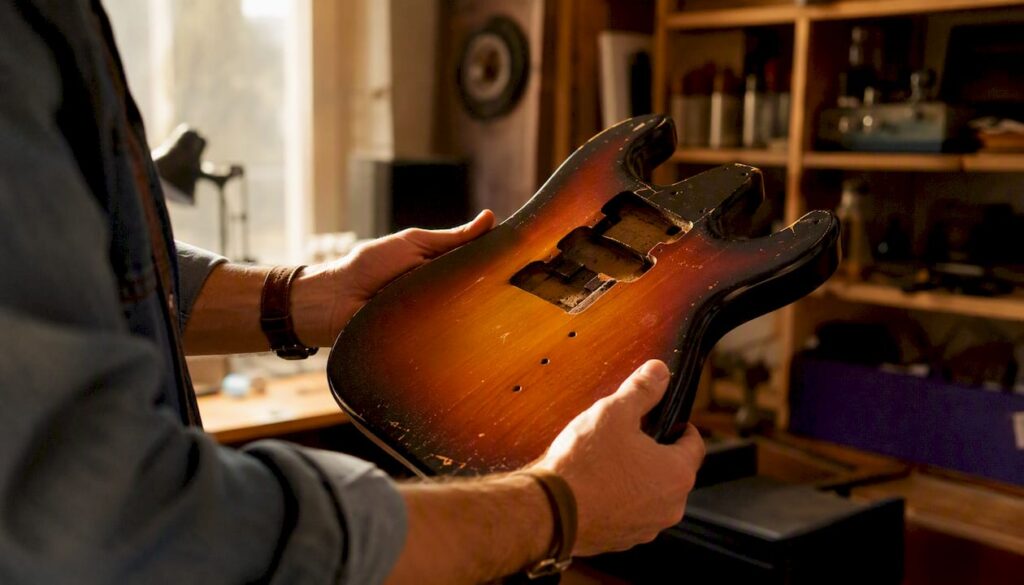
- Lacquer type and checking: nitro develops fine web-like cracks (“checking”) from decades of contraction and expansion; a burst with zero checking on a guitar claimed to be 60+ years old is a red flag.
- Fade symmetry: natural fading is rarely perfectly even, while artificially aged finishes often look too uniform or too deliberately patchy.
- Edge feathering: original sprayed transitions blend gradually; some relic jobs show a harder, more mechanical edge.
- Hardware and screw patina: metal parts should age consistently with the finish; mismatched wear patterns suggest replaced parts or an artificial aging job.
- Provenance: serial numbers, labels, and paperwork trail matter as much as the finish itself.
Pro Tip: Natural checking follows stress lines around the neck joint and control cavities first. If the cracking looks identical and evenly spaced across the whole top, treat that as a warning sign rather than proof of age.
For any instrument where real money is on the line, a professional appraisal beats guesswork from photos every time. Finish condition alone can shift a Les Paul’s value by tens of thousands of dollars depending on originality.
Does the Finish Actually Affect Tone?
Thin nitro lacquer is generally considered less dampening to wood resonance than a thick poly shell, since it flexes more with the top rather than sealing it in a rigid shell. That said, pickups, wood selection, construction, and setup all shape tone far more than finish type does.
- Finish differences are real but subtle, more noticeable to a luthier’s trained ear than a casual listener.
- Don’t expect a burst refinish alone to transform how a guitar sounds.
- Treat finish as one variable among several, not the deciding factor.
Can You DIY a Sunburst Finish at Home?
Yes, with realistic expectations and some prep work. Start with clean sanding, grain filler if the wood needs it, and a proper sealer coat before any color goes on.
- Spray a light, even amber base coat over the entire top.
- Mask the center area or work freehand, then build red or brown tones outward toward the edges.
- Feather each transition by spraying from a slight angle and greater distance, avoiding hard lines.
- Clean up overspray immediately, then let the piece cure before clear coating.
- Apply several coats of clear lacquer, sanding lightly between coats, then buff to finish.
Pro Tip: Warm your aerosol cans in warm water before spraying, and always practice your feathering technique on scrap wood first. Over-applying color is the single most common beginner mistake, and it’s much easier to add more than to remove excess.
One caution worth repeating: DIY relicing on an otherwise original vintage guitar almost always reduces resale value rather than increasing it. Collectors pay for authenticity, not a convincing imitation of age.
Why Bursts Deserve a Closer Look Than Most Buyers Give Them
We’ve handled enough burst-finished guitars at Vintage-guitar-world to know the finish rarely lies, but it takes a trained eye to read it correctly. If you’re weighing a purchase or sale on a high-value burst instrument, a proper testing appointment or valuation settles the question before money changes hands.
Ready to See a Burst Finish in Person?
Photos only tell you so much about a burst finish. Checking, fade patterns, and edge feathering all read differently under real light than they do on a screen, which is exactly why Vintage-guitar-world offers in-person testing and appraisal alongside every listing. If you’re weighing an original Les Paul burst against a modern reissue, our guide to vintage versus reissue buying decisions walks through the tradeoffs in plain terms. And if you’re just getting familiar with what separates a collector-grade instrument from an ordinary one, our overview of vintage guitar types, history, and investment potential is a solid next stop before you commit to a purchase.
Frequently Asked Questions
What does it mean to explain burst finishes in simple terms?
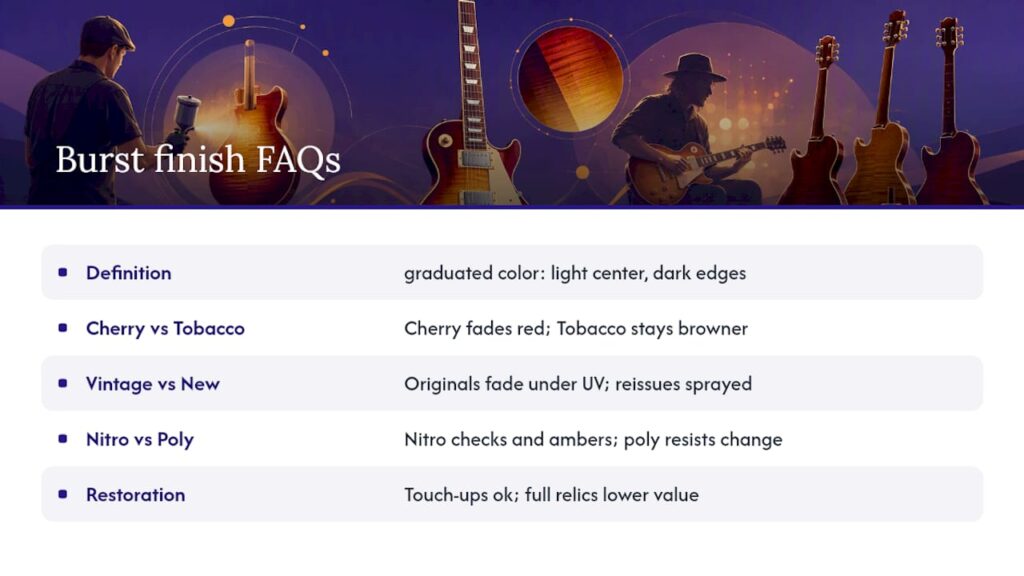
It means describing a graduated color pattern on a guitar body, light in the center and darker at the edges, along with why that pattern fades and varies between instruments over time.
What is the difference between a Cherry Sunburst and a Tobacco Sunburst?
Cherry Sunburst uses red tones that often fade dramatically with age, while Tobacco Sunburst starts warmer and browner, so it shows less dramatic color shift over decades.
Why do vintage Les Paul bursts look different from new ones?
Original red aniline dye degrades under UV light over decades, while modern reissues are sprayed to match a specific look from day one rather than aging into it naturally.
Does nitrocellulose lacquer age differently than polyurethane?
Yes. Nitro develops fine surface checking and ambers with age, while poly finishes resist cracking and tend to hold their original color and clarity much longer.
Can a burst finish be restored without losing value?
Touch-up work on damage is common, but a full artificial relic job on an otherwise original vintage instrument typically lowers value rather than raising it, since collectors pay for genuine age.