













Condition grading for vintage guitars is an expert, forensic-style rating of an instrument’s physical state and originality, used to assign a condition factor for sale, insurance, valuation, or certification. It is not a cosmetic once-over. It is a documented judgment call that blends visible wear with paper trails, and it can swing an instrument’s price by thousands of dollars depending on how it’s read.
Three things follow immediately from that definition:
- It sets the price. A grade translates directly into a condition factor that adjusts an instrument’s baseline value, sometimes by 50% or more.
- It depends on paperwork, not just looks. Originality and provenance (serial numbers, factory specs, sales ledgers) carry as much weight as finish and structural condition.
- It sometimes needs a professional. High-value instruments, insurance claims, and disputed authenticity all call for a certified appraisal rather than a seller’s self-assessment.
You’ll see the same handful of authorities referenced again and again in this space: the Blue Book of Electric Guitars, the Blue Book of Acoustic Guitars, appraiser George Gruhn, and specialty retailers like Vintage-guitar-world that combine sales with certification services. Understanding how these reference points work, and how to apply them yourself, is the difference between guessing at a guitar’s worth and knowing it.
Key Takeaways
Condition grading converts an instrument’s physical state and documentation into a percentage that directly sets its market value, and that percentage only holds up when it’s backed by provenance and, for high-value pieces, a professional appraisal.
| Point | Details |
|---|---|
| Grade by component | Assess finish, structure, neck and frets, electronics, and originality separately before assigning a grade. |
| Read percent scales carefully | Blue Book bands run from Mint or New (New) to Poor (Poor); repairs and refinishes are subtracted separately. |
| Provenance outweighs polish | Serial numbers, factory records, and sales history matter more to collectors than cosmetic wear. |
| Know your red flags | Non-factory refinishes, replaced necks, and mismatched serials cause the steepest grade drops. |
| Get certified when it counts | Vintage-guitar-world offers forensic appraisals with photo appendices and documented certificates for sales, insurance, and estate needs. |
Table of Contents
- What Do Graders Actually Inspect?
- How Do Percent Grades Map to Real Condition?
- Why Does Provenance Change the Grade?
- How Should You Photograph and Judge Condition From Images?
- How Much Does Condition Actually Move the Price?
- What Red Flags Should Make You Walk Away?
- When Do You Need a Professional Appraisal?
- What’s the Step-by-Step Self-Assessment Process?
- How Do You Write a Condition Statement That Holds Up?
- Why Do Two Experts Sometimes Disagree on the Same Guitar?
- How Vintage-Guitar-World Approaches Condition Grading
- Need a Certified Grade? Here’s How to Get One
- Sources
What Do Graders Actually Inspect?
A grader works through an instrument component by component, not as a single glance-and-guess exercise. The order matters less than the coverage.
- Finish and surface: original lacquer versus repaint, checking (the fine cracking in old nitrocellulose finishes), belt-buckle rash, discoloration, and fretboard wear patterns.
- Structural integrity: neck angle and neck-set, headstock cracks, top or back seam separations, and any bridge reglues.
- Neck and frets: fret wear depth, evidence of a refret, neck relief, and overall playability under string tension.
- Electronics and hardware: original pickups, pots with matching date codes, wiring harness condition, tuner function, and plating oxidation.
- Originality of parts: whether tuners, bridge, pickguard, and knobs are factory-original or later replacements, and whether replacements are documented.
- Repairs and refinishes: whether work was done at the factory or by an independent shop, and how cleanly it was executed.
That last point deserves its own emphasis. The Blue Book’s grading guidance treats finish originality, repairs, modifications, and replacement parts as the major swing factors in any assessment, and warns that accurate grading is genuinely difficult without a hands-on inspection. Photos help. They don’t replace touching the instrument.
Once the physical inspection is done, a grader turns to non-physical evidence: serial numbers, factory configuration records, and any sales ledgers tied to the instrument. That’s where provenance work begins, and it’s often the part sellers skip.
How Do Percent Grades Map to Real Condition?
The most widely used reference system in the vintage guitar trade converts condition into a percentage, then attaches a descriptive label to that percentage. It reads almost like a school grading curve, except the stakes are a five-figure price swing instead of a report card.
| Percent | Descriptive Grade | What It Typically Means |
|---|---|---|
| Mint or New | New | Unplayed, factory-fresh, original everything |
| High Excellent | Mint | Essentially unplayed; only the faintest handling marks |
| Low Excellent | Excellent+ | Light play wear, no structural issues, all original |
| Very Good+ | Excellent | Noticeable play wear, still fully original and sound |
| Good | Very Good+ | Visible finish wear, minor repairs possible, still original |
| Fair | Very Good | Moderate wear, may include a non-factory repair |
| Poor | Good | Heavy wear, functional, possibly non-original parts |
| 50% | Fair | Significant issues, may need repair to be fully playable |
| Poor | Poor | Major structural or cosmetic problems |
This scale, drawn from the Blue Book of Electric Guitars’ grading and conversion guidance, is explicitly framed as a guideline rather than an absolute standard. The Blue Book of Acoustic Guitars uses a related but slightly different descriptive framework, splitting “Excellent” into High Excellent and Low Excellent bands, because acoustic tops and braces age differently than solid-body electrics.
Older instruments almost never hit Mint or New. A 1959 Les Paul that’s been played, stored, and moved for six decades will show its age in the finish and hardware even if it’s been meticulously cared for.
Why Does Provenance Change the Grade?
Provenance is the documentary chain that proves an instrument is what it claims to be: matching serial numbers, factory specification sheets, original sales receipts, and the case or paperwork that traveled with it since manufacture. Two guitars can look identical in photos and grade completely differently once one of them has a hole in that chain.
A factory refinish, done in-house before the instrument ever left the manufacturer, is treated far more gently than an independent refinish done decades later. Sotheby’s collector guide makes this distinction explicit: factory work preserves collectability in a way that aftermarket refinishing simply doesn’t, even when the aftermarket job looks better under a showroom light.
Before you trust a seller’s claim or a set of listing photos, run through this:
- Does the serial number match the factory’s known production range for that model and year?
- Do the pickup pole spacing, control layout, and hardware match documented factory specs for that era?
- Is there an original case, warranty card, or receipt tied to the instrument?
- Has the instrument appeared in any published sales ledger, auction record, or prior appraisal?
If you want to go deeper on the mechanics of this, our guide on checking the authenticity of a vintage guitar walks through serial number research step by step.
Pro Tip: A plausible provenance claim usually comes with specifics, an exact date, a named prior owner, a receipt number. A dubious one stays vague (“been in the family for years”) and gets defensive when you ask for documentation.
How Should You Photograph and Judge Condition From Images?
Remote buying and selling now runs almost entirely on photos, which makes photo quality a grading variable in its own right. A poorly lit photo can hide checking that would be obvious in person, and an overexposed one can erase evidence of a touch-up repair entirely.
A complete photo set should include:
- Full front and back shots in even light
- A clean headstock shot with the logo and serial number legible
- Close-ups of any visible wear, cracks, or repairs
- The electronics cavity with pots and wiring visible
- The neck joint or neck heel
- Straight-on shots of the frets and fretboard
Shoot in diffused natural light rather than direct sun or a single overhead bulb, and include a coin or ruler in at least one frame for scale. Avoid filters entirely. They flatten the fine detail that finish checking depends on.
The most common photo trap isn’t intentional deception, it’s technical: reflections off a glossy finish can hide hairline cracks, and low-resolution images lose exactly the texture detail a grader needs. Reference systems like the Blue Book’s Photo Grading System™ exist precisely because visual comparison against known examples improves consistency, but the Blue Book itself is careful to note that photos and condition factors remain guidelines. They don’t substitute for putting the instrument in your hands.
How Much Does Condition Actually Move the Price?
Grading isn’t an academic exercise. It’s the mechanism that converts a subjective impression into a specific dollar adjustment, and the swings can be dramatic on collectible models.
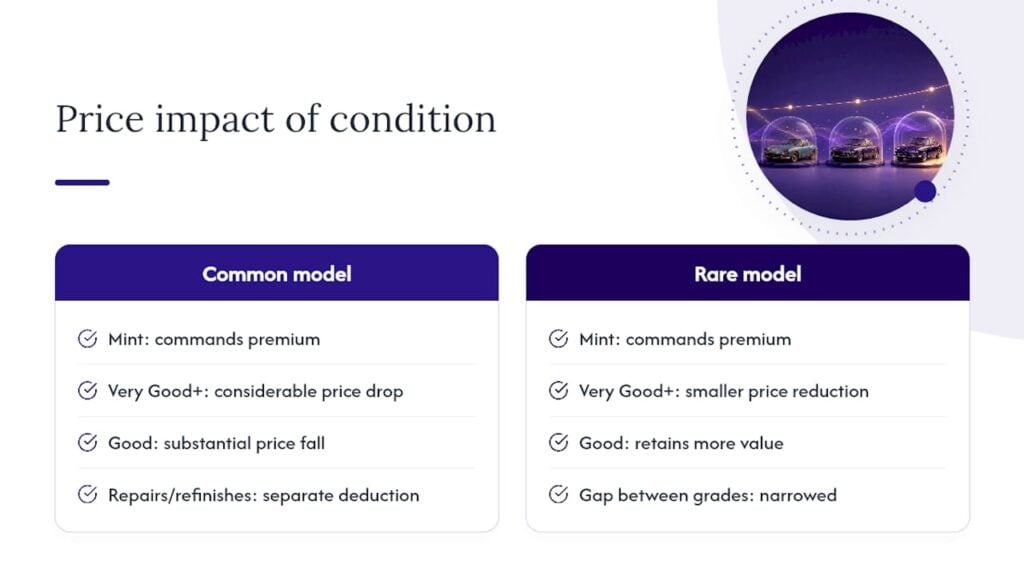
Drop it to a condition commonly termed Very Good+ and the price may reduce considerably. Drop it further to a Good condition, and depending on the model’s demand curve, the price could fall substantially. That’s a marked swing between higher and lower grade conditions on paper, on the exact same guitar body.
Rarity complicates this math. A genuinely scarce model can retain far more of its value at a lower grade than a common one would, because collectors will accept more wear to own something they may never see again. Sotheby’s notes that mint examples of desirable models command real premiums, but that rarity itself narrows the gap between grades on the instruments that matter most to collectors.
One more thing worth stating plainly: repairs and refinishes are not folded quietly into the base condition percentage. They’re listed as separate line items and typically subtracted from the condition-based value, precisely so a buyer can see what they’re paying for and what they’re being warned about. Our piece on why condition impacts vintage guitar value most breaks down several real pricing scenarios if you want to see this in more detail.
What Red Flags Should Make You Walk Away?
Some issues cost a grade a few points. Others gut it. Here’s what belongs in the second category.
- Non-factory refinish with poor overspray, especially where original binding or edges have been sprayed over.
- Replaced necks or shaved neck profiles, which alter both structural originality and playability in ways that can’t be undone.
- Replaced bridges or altered bracing on acoustics, often done to “fix” a problem but permanently changing the instrument’s factory character.
- Mismatched or re-stamped serial numbers, one of the clearest signs of a parts guitar or an outright misrepresentation.
- Altered routing for added electronics, common on older instruments retrofitted for coil-splitting or extra pickups.
- Cosmetic deception, mismatched screws, replated hardware presented as original, or swapped headstock badges.
Most of these show up in photos if you know where to look: check screw finish consistency, look for filler around new routes, and compare serial number fonts against known factory examples. When in doubt, our 7-point checklist for buying vintage guitars is built to catch exactly this kind of issue before money changes hands.
When Do You Need a Professional Appraisal?
Self-assessment gets you most of the way there. It doesn’t get you all the way, and for certain transactions, it shouldn’t be the final word.
Get a professional appraisal when the purchase or sale is high-dollar, when you’re insuring an instrument, during an estate transfer, or whenever authenticity is genuinely in dispute. Appraiser George Gruhn describes the process in forensic terms, closer to a taxonomist identifying a specimen than a shopper checking for scratches. The goal, as Gruhn puts it, is to determine precisely what the instrument is and exactly what has happened to it since it left the factory.
A credible appraisal report should contain:
- Instrument identification (make, model, year, serial number)
- Factory configuration data for that specific era
- A detailed, component-by-component condition statement
- Documented repairs and modifications, clearly separated from original condition
- A photo appendix
- Provenance notes and supporting documentation
- The appraiser’s credentials
- A stated valuation with the methodology behind it
Three qualified appraisers can produce three slightly different grades on the same guitar, and that’s expected rather than alarming. The Blue Book’s own guidance acknowledges that grading depends on individual experience and how criteria get weighted, which is why the written reasoning behind a grade matters as much as the number itself. For insurance purposes, plan on updating an appraisal every few years, especially after any repair work.
Pro Tip: Ask an appraiser upfront how they document disagreement between their grade and a prior appraisal. A good one will explain their reasoning in writing, not just hand you a revised number.
What’s the Step-by-Step Self-Assessment Process?
Whether you’re standing in front of a guitar or reviewing a remote listing, work through the same sequence every time.
- Confirm basic identification. Match the serial number, model, and year against known factory production data.
- Request a complete photo set if buying remotely: front, back, headstock, serial, cavity, neck joint, and close-ups of any flaw.
- Do a hands-on check of neck relief, fret wear, and electronics function if the instrument is in front of you.
- Verify provenance documents, case, paperwork, prior sales records, before trusting a seller’s condition claim.
- Watch for stop-point red flags. A mismatched serial or undisclosed refinish should pause the process entirely.
- Decide your tier: proceed with confidence, proceed with a documented reservation and price adjustment, or require a professional appraisal before moving forward.
For an in-person check, bring a bright flashlight, a small inspection mirror for the neck joint and cavity, a feeler gauge for measuring fret height and neck relief, and a phone camera with macro focus for close detail shots. Our step-by-step condition assessment guide walks through this same sequence with added detail on interpreting borderline cases.
How Do You Write a Condition Statement That Holds Up?
A listing or certificate is only useful if it’s specific enough to prevent disputes later. Vague language is where most disagreements start.
A solid condition statement includes:
- Instrument ID (make, model, year, serial number)
- Grade, both percent and descriptive, with the reasoning stated
- A dated list of photos referenced
- Every non-original part, named specifically
- Repairs and refinishes, itemized separately from the base grade
- Provenance notes and supporting documents
- Appraiser or seller name and relevant credentials
Precision in wording matters more than most sellers realize. “Refinished” and “factory refinished” mean two different things to a buyer’s wallet, and conflating them, intentionally or not, is one of the fastest ways to trigger a return dispute. Say exactly what happened: “non-factory refinish applied circa 1985, original finish not preserved” reads very differently than “excellent finish.”
Why Do Two Experts Sometimes Disagree on the Same Guitar?
Grading involves judgment, and judgment varies by experience. That’s not a flaw in the system, it’s an acknowledged feature of it. The Blue Book itself notes that different graders weigh condition factors differently based on their background, which is exactly why appraisals should update periodically rather than being treated as permanent.
Photos have real limits here. Some issues, a subtle neck twist, a hairline crack under the finish, a repaired headstock with excellent color matching, are difficult or impossible to catch without hands-on inspection or, in rare cases, lab analysis under UV light.
When a dispute arises between a buyer and seller over a stated grade, the practical path forward looks like this: get a second independent appraisal, compare photo appendices and provenance documentation side by side, and if the instrument hasn’t changed hands yet, request an in-person inspection or negotiate an agreed return window before finalizing the sale.
Pro Tip: For high-value transactions, keep timestamped photos of the instrument at handover and, where possible, have the exchange witnessed. Chain-of-custody documentation is often what settles a dispute months later, when memories of “how it looked” have gotten fuzzy.
How Vintage-Guitar-World Approaches Condition Grading
Vintage-guitar-world treats condition grading as forensic work, not a sales pitch dressed up in appraisal language. Every assessment starts with a hands-on, component-by-component inspection: finish, structure, neck and frets, electronics, and hardware, followed by a photo appendix and a provenance check against factory records and sales history.
The result is a documented certificate rather than a verbal opinion. That distinction matters when you’re insuring an instrument, settling an estate, or trying to sell a guitar to a buyer who’s never held it. Our guitar appraisal guide outlines the full process in more depth, including how testing appointments and valuation requests are structured.

Pro Tip: When you book a testing or certification appointment, bring any paperwork you already have, receipts, prior appraisals, case candy, even if it seems minor. Provenance documents that seem irrelevant to you can meaningfully change a grade.
Need a Certified Grade? Here’s How to Get One
If you’ve worked through the checklist above and you’re still unsure what you’re holding, or you need documentation a bank, insurer, or buyer will actually accept, that’s the point where a self-assessment should hand off to a professional one. Vintage-guitar-world’s certification service includes a full forensic exam, a photo appendix, an itemized condition certificate, provenance research, and a supporting valuation statement, the same components outlined in the appraisal checklist above, produced by people who do this daily rather than occasionally.

Booking works two ways: an in-person testing appointment if you’re near enough to bring the instrument in, or a remote evaluation built around your own photo set and documentation if you’re not. Turnaround depends on the complexity of the provenance research involved, straightforward cases move faster than instruments with a gap in their ownership history.
If you’re weighing whether a specific model is worth pursuing certification for in the first place, our guide to guitar certifications for musicians and collectors is a useful starting point. Ready to move forward? Start with the guitar appraisal service page to see appointment options and request your evaluation.
Sources
The grading framework in this guide draws directly from the Blue Book of Electric Guitars’ grading and conversion PDF and the Blue Book of Acoustic Guitars’ explanation PDF, along with the Blue Book’s conditioning factors guidance on subjectivity and repair disclosure.
George Gruhn’s interview with Vintage Guitar® magazine informed the forensic framing used throughout the appraisal sections, and Sotheby’s collector guide shaped the discussion of rarity’s effect on condition-based pricing.
For deeper walkthroughs on authentication and hands-on evaluation, see our guides on checking guitar authenticity and evaluating a used guitar’s quality. If you’re ready for a certified assessment, our appraisal booking page has full details.
- Q&A With George Gruhn: A Strong Case – Vintage Guitar® magazine
- Understand Conditioning Factors — Blue Book of Guitar Values (PDF)
- The Complete Guide to Collecting Specimen Guitars | Sotheby’s