














A neck reset is a luthier procedure that changes the angle between a guitar’s neck and its body by removing a precise wedge of wood from the heel, tilting the neck back so the fingerboard plane re-aligns with the string plane and lowers the action to a playable height. If your acoustic has become genuinely difficult to play and simpler fixes have already been ruled out, a reset is often the right call, but if the guitar is a rare vintage piece, the decision deserves more caution.
Quick verdict:
- Get a reset when action is high, the saddle is already at minimum height, and the neck angle is measurably off.
- Hold off on a vintage instrument until you have multiple professional opinions, because the procedure can alter tone and affects originality.
- Typical U.S. cost: a few hundred dollars for a straightforward reset; higher when a refret or structural work is added.
- Bench time: 30–90 days at most shops, depending on backlog and scope.
Get a written estimate before committing. Costs vary significantly by region, instrument age, and joint type.
Key Takeaways
A neck reset restores playable action on an acoustic guitar by correcting neck angle, but it’s an irreversible procedure that requires careful diagnosis, a qualified luthier, and, for vintage instruments, a serious assessment of tonal and value trade-offs before any work begins.
| Point | Details |
|---|---|
| Diagnose before you reset | Confirm neck angle is the problem; rule out truss rod, saddle, bridge, and brace issues first. |
| Saddle height is the key indicator | A saddle at or below 2.5 mm above the bridge surface on a dreadnought signals a geometry problem, not a setup problem. |
| Tonal change is a real risk | Vintage instruments, especially lightly braced tops, can lose desirable tone after a reset; get multiple opinions. |
| Budget varies widely depending on scope | A basic reset runs a few hundred dollars; add a refret and the total can reach $500–$800 or more. |
| Vintage-guitar-world offers pre-repair appraisals | A professional evaluation documents baseline condition and value before any irreversible work is done. |
Table of Contents
- How to tell if your acoustic actually needs a neck reset
- Why wood moves and what that does to neck angle
- What actually happens during a neck reset, step by step
- Fixes to try before committing to a reset
- Risks, tonal consequences, and what a reset does to vintage value
- What a neck reset costs in the U.S. and how long it takes
- How to choose the right luthier and what to ask before you sign off
- Vintage-guitar-world’s perspective on neck resets
- Vintage-guitar-world can help you evaluate before you commit
- Sources
How to tell if your acoustic actually needs a neck reset
Symptoms can overlap with simpler problems, so measure before you call a shop.
Common symptoms:
- Action at the 12th fret is uncomfortably high, beyond typical comfortable ranges for most acoustics.
- The saddle has been shaved so low it barely clears the bridge plate, leaving little or no room to lower it further.
- The fretboard extension over the body dips noticeably below the bridge top.
- A visible belly or hump has formed behind the bridge, pushing the bridge upward.
- Braces have come loose or compressed, contributing to top deformation.
Measurement checklist:
| What to measure | Tool needed | Target range |
|---|---|---|
| String height at 12th fret (bass side) | Feeler gauge or ruler | within typical playing action range |
| String height at 12th fret (treble side) | Feeler gauge or ruler | within typical playing action range |
| Saddle exposure above bridge surface | Ruler | sufficient for correct geometry on dreadnoughts |
| Straightedge across frets toward bridge | Straightedge (24"+) | Should clear bridge top by ~1/16" |
| Soundboard belly behind bridge | Straightedge across lower bout | Minimal; significant rise = structural issue |
Strange Guitarworks notes that a saddle rise of roughly 2.5–4 mm above the bridge surface is the geometry target for dreadnoughts when the neck angle is correct. Less than that, and you’re out of saddle material to work with.
Before calling a reset: rule out a bowed neck (truss rod adjustment), a saddle that simply needs replacement, a loose bridge, or separated braces. Each of those can mimic reset symptoms and costs far less to fix.
Pro Tip: Lay a straightedge along the frets and extend it toward the bridge. If it lands noticeably below the bridge top, the neck angle is off. If it lands above, check the truss rod first.
Why wood moves and what that does to neck angle
Acoustic guitars are under constant tension. A typical steel-string set pulls considerable string tension on the top, transmitted through the bridge and saddle. Over years and decades, that load causes the spruce or cedar top to rotate forward around the bridge, forming the characteristic belly. The neck, meanwhile, is being pulled forward by string tension at the headstock. Both movements work in the same direction: they tilt the neck toward the strings, raising action.
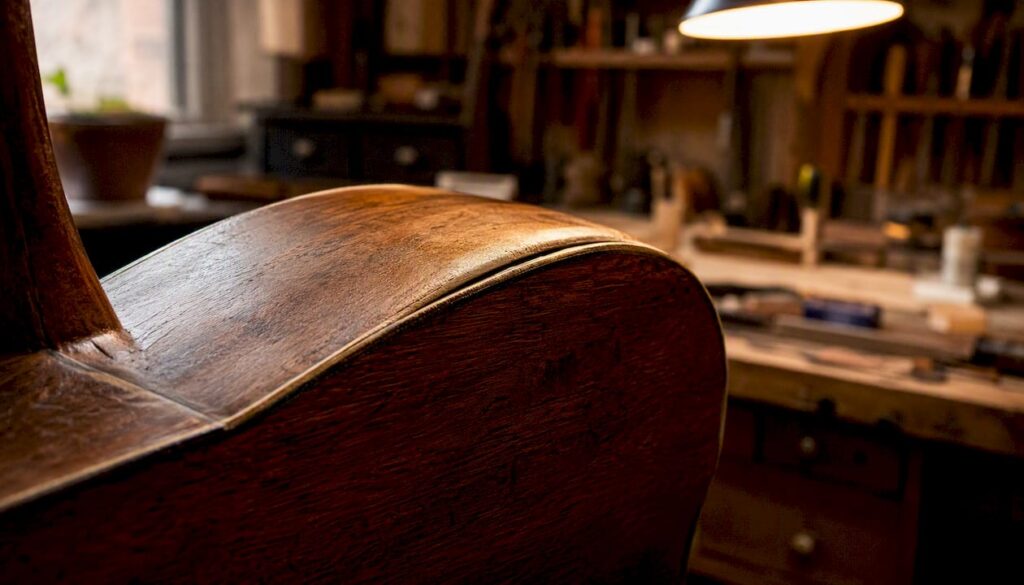
This is wood creep, and it’s not a defect. It’s what wood does under sustained load, especially when humidity cycles cause the fibers to relax and reset repeatedly. On a 30- or 40-year-old guitar, the geometry has often moved far enough that no amount of saddle work can compensate.
The geometry is straightforward. The neck meets the body at a slight back-angle. When that angle decreases, the fingerboard plane rises relative to the bridge, and the strings follow. Removing a wedge from the heel of the neck restores the original angle. The Liutaio Mottola formula quantifies exactly how much material to remove: D = ((Ai – At) × 2 × Lh) / Lb, where Ai is initial action, At is target action, Lh is the distance from the nut to the heel, and Lb is the string length. That formula gives a precise wedge depth at the heel base, and Mottola’s page includes a JavaScript calculator for it.
Joint type matters. A Martin-style dovetail, a bolt-on neck, and a Spanish-heel classical each require different removal techniques. Dovetail joints on older Martins are often steamed free; bolt-on necks simply unbolt. The dovetail is more complex to refit and shim correctly, which is part of why labor costs vary so much between instruments.
A reset is not trivially reversible. Once material is removed from the heel, the geometry is changed permanently. That’s not a reason to avoid it on a player guitar, but it’s a serious consideration for a collector piece.
What actually happens during a neck reset, step by step
A qualified luthier follows a careful sequence. Rushing any stage risks a poor fit, a glue failure, or intonation problems.
- Diagnosis and documentation. Measure action, saddle height, neck relief, and straightedge geometry. Photograph everything. Confirm that simpler fixes have been exhausted.
- Separate the fingerboard extension. The portion of the fretboard that sits over the body must be carefully lifted, usually with heat, to expose the joint area without cracking the finish or the wood.
- Free the neck joint. For a glued dovetail, steam or heat is injected through a small hole drilled into the fret slot above the joint. For bolt-on necks, the bolts come out. Shop documentation on vintage instruments emphasizes that 40-plus-year-old glue joints can behave unpredictably, and patience here prevents broken heel blocks.
- Clean the joint surfaces. Old glue is removed carefully. Any surface irregularities that would prevent a tight fit are addressed.
- Calculate the wedge size. Using the Mottola formula or equivalent measurement, the luthier determines how much material to remove from the heel and precisely where.
- Remove material and fit. A chisel, file, or sanding block removes the wedge. The neck is repeatedly test-fitted until the geometry is correct. Some luthiers set geometry under string tension to account for the deflection the top experiences under load.
- Shim the dovetail if needed. On dovetail joints, shims restore the tight lateral fit after the wedge is removed from the heel face.
- Glue-up and clamp. Hide glue is traditional and preferred for vintage instruments because it’s reversible with heat and moisture. The joint is clamped and left to cure fully.
- Re-setup. The fingerboard extension is reglued. A new saddle is often cut. Fretwork may be needed if the frets have worn unevenly or if the reset changed the fret plane. Nut slots are checked. The guitar is restrung and played in.
Pro Tip: Ask your luthier whether they’ll check and reglue any loose braces before the reset. A belly caused partly by a separated brace will keep moving after the reset if the brace isn’t addressed.
The Mountain Song Guitars procedure illustrates how each stage feeds the next. Skipping the diagnostic step, for instance, can mean removing too little or too much material and needing to repeat the work.
Fixes to try before committing to a reset
A neck reset is the right answer for a geometry problem. It’s the wrong answer for a setup problem. Several less-invasive options should be exhausted first.
- Truss rod adjustment. A neck with too much forward bow raises action at the upper frets. A quarter-turn of the truss rod can drop action noticeably without touching the joint. This is always step one.
- Saddle replacement or reshaping. If the saddle has room to come down, a new saddle cut to the correct height costs $40–$80 and takes an hour. If the saddle is already at the bridge surface, this option is gone.
- Bridge regluing. A lifting bridge rotates forward and raises the saddle. Regluing it flat restores geometry without any neck work.
- Brace repair. A separated X-brace or bridge plate lets the top deform under tension. Regluing it can reduce belly and improve geometry, sometimes enough to avoid a reset.
- Compensated saddle. A compensated or angled saddle can improve intonation but does not fix high action caused by neck angle. Don’t confuse the two.
- Fingerboard extension shimming. On some guitars, shimming the extension over the body can partially correct a mild angle problem. This is a stopgap, not a permanent fix, and it changes the fret plane.
A good shop will document current measurements, restore the saddle to a known reference height, and photograph the geometry before recommending a reset. That documentation protects you and gives the luthier a baseline to work from.
Risks, tonal consequences, and what a reset does to vintage value
This is where the decision gets genuinely complicated, especially for collectors.
Tonal change is real. Changing the neck angle alters the mechanical load the bridge and saddle assembly applies to the top. Acoustic Guitar magazine’s expert Q&A notes that a reset on a vintage instrument can produce minor tonal shifts, and recommends getting multiple opinions before proceeding. The effect varies by instrument, but lightly braced pre-war-style tops are particularly sensitive.
Other risks to weigh:
- Finish cracking or checking around the heel and fingerboard extension during removal.
- Fret sprout or uneven fret plane after the reset, requiring a refret.
- Overloading the top if the new angle increases downward saddle pressure beyond what the bracing was designed for.
- A poor fit at the joint that creates a glue-line gap, weakening the joint long-term.
- Intonation shift if material is removed from the wrong area of the heel, changing the effective scale length.
Value implications. For a collector-grade vintage instrument, a reset is a modification that must be disclosed. A well-executed reset by a known luthier, fully documented, typically has a modest negative effect on value compared to an unplayable guitar. A poorly executed reset, or one with undisclosed finish work or a refret, can significantly reduce value. Before any work, photograph the guitar from every angle, get a written work order specifying materials and methods, and confirm whether the luthier will document the before/after measurements. That paper trail is part of the instrument’s provenance.
For acoustic guitar restoration decisions, the guiding principle is: restore playability only to the degree that the instrument’s originality and tonal character can be preserved. Sometimes that means accepting slightly higher action.
What a neck reset costs in the U.S. and how long it takes
Bench time at most U.S. shops runs 30–90 days, and that range reflects shop backlog as much as the complexity of the work itself. A straightforward reset on a modern guitar might take two weeks of actual labor but sit in queue for two months. Vintage instruments with structural complications take longer.
What drives cost up:
- Dovetail joints on older instruments (more labor than bolt-on).
- Loose or missing braces discovered during the process.
- Finish touch-up around the heel and fingerboard.
- A refret, which adds $200–$400 on its own.
- Certification or appraisal documentation after the work.
- Rare or unusual joint types that require custom tooling or shims.
Get at least two written estimates. Ask each shop to specify what’s included, what materials they’ll use, and what happens if they discover additional problems mid-repair. A vague estimate is a red flag.
How to choose the right luthier and what to ask before you sign off
Not every guitar tech is qualified for a vintage neck reset. The skill gap between a competent setup tech and an experienced luthier is significant, and the wrong hands on a valuable instrument can cause irreversible damage.
Questions to ask before committing:
- How many neck resets have you done on instruments of this age and joint type?
- Can you show examples or references from similar work?
- What glue will you use, and why? (Hide glue is standard for vintage; epoxy is a red flag.)
- Will you document measurements before and after?
- What’s your policy if a refret becomes necessary mid-repair?
- Will you photograph the process?
- What’s your warranty on the glue-up?
Red flags:
- Vague or verbal-only estimates with no written scope.
- Refusal to document the work or share before/after measurements.
- Recommending a reset without first ruling out truss rod, saddle, or brace issues.
- No references for similar vintage instruments.
- Suggesting finish work or a refret without explaining why it’s needed.
- Unusually low quotes that don’t account for the labor a proper reset requires.
What to request in writing: the measurements taken before work begins, the target measurements, a list of all parts to be replaced, the glue type, the expected turnaround, and the shop’s policy on finish touch-up. For a vintage instrument, also ask whether the luthier will provide a written statement of work for provenance documentation. That document has real value at resale.
A guitar appraisal checklist before and after the repair gives you an independent record of the instrument’s condition and value, which protects you regardless of who does the work.
Vintage-guitar-world’s perspective on neck resets
At Vintage-guitar-world, the approach to neck resets starts with a simple question: is this guitar being restored to play, or preserved as a collectible? The answer changes everything.
For instruments that are genuinely meant to be played, a well-executed reset by a qualified luthier is often the right call. A guitar that sits unplayed because the action is painful isn’t serving anyone. But for a rare pre-war flattop or a lightly braced vintage parlor guitar, the calculus shifts. Tonal character built over decades of wood movement and playing is not guaranteed to survive a geometry change, and originality matters to the market.
The position here is preservation-first: exhaust every reversible option before recommending irreversible work. That means a thorough evaluation, documented measurements, and honest conversation about what the instrument is worth in its current state versus what it might be worth after intervention. Sometimes the answer is a reset. Sometimes it’s a careful saddle replacement and a conversation about expectations.
For collectors weighing a purchase that may need a reset, understanding what makes a vintage guitar collectible is the right starting point. A guitar that needs a reset isn’t automatically a bad buy. It’s a negotiating point, and knowing the cost and risk puts you in a much stronger position.
Vintage-guitar-world can help you evaluate before you commit
A neck reset is a significant decision, and the right first step is a professional evaluation, not a repair booking.

Vintage-guitar-world offers expert guitar evaluation and appraisal services designed specifically for collectors and serious players. Before you hand your instrument to a shop, a structured guitar appraisal gives you documented baseline measurements, an honest assessment of what the guitar needs, and a clear picture of how any proposed work would affect its value. For buyers considering a vintage guitar that may need a reset, that evaluation is the difference between a confident purchase and an expensive surprise.
Browse the vintage guitar collection to see instruments that have already been professionally evaluated and are ready to play. Or book a testing appointment to put your hands on a guitar before you decide.
Sources
- Ask the Expert: Should I Reset the Neck on My Vintage Guitar? | Acoustic Guitar
- Neck Reset Formula – Liutaio Mottola
- Neck Reset – The Theory — Haze Guitars
- Vintage Yamaha Neck Reset Procedure v6.1.1.pdf
- Acoustic Guitar Neck Reset – Strange Guitarworks