












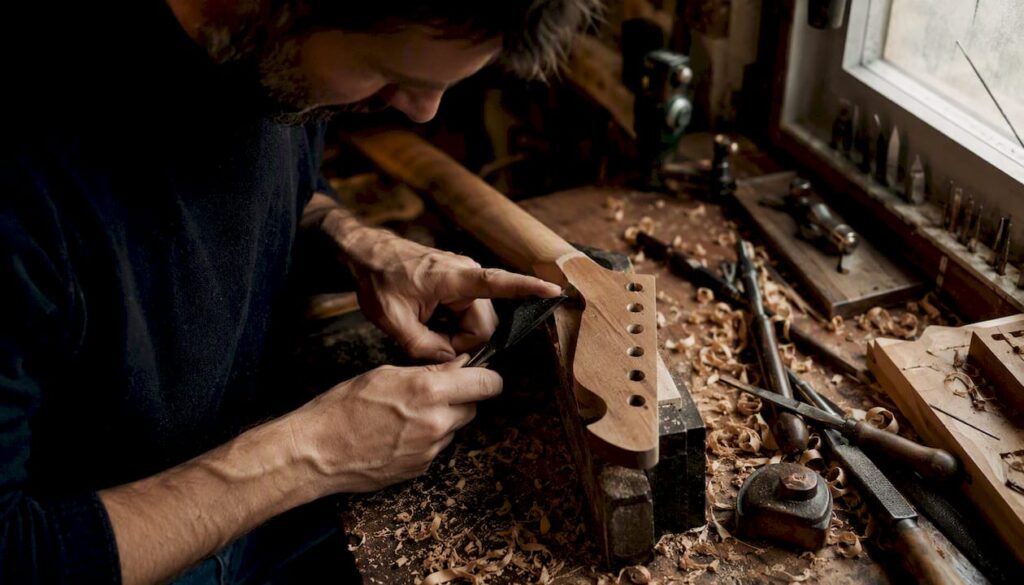

Headstock angle, also called headstock pitch, is the backward tilt of the headstock face relative to the neck plane. It directly sets the string break angle over the nut, which determines how much downward pressure the strings exert on the nut slots. According to Wikipedia’s headstock entry, observed angles across instruments span a wide band, roughly 3°–25°, though most production guitars cluster within a narrower range:
- ~0° (flat/zero-pitch): bolt-on electric archetypes like the Fender Stratocaster and Telecaster
- shallow angles: mild angled designs, some modern set-neck electrics
- medium angles: traditional carved angled headstocks, including the Gibson Les Paul with popular angles around the low to mid teens
- steep angles: classical and some acoustic slotted headstocks, certain vintage archtops
That tilt is the single structural decision that ripples through every setup choice downstream, from whether you need string trees to how your guitar behaves under a tremolo.
Table of Contents
- How builders actually make angled headstocks
- What headstock angle changes for your setup
- How to measure headstock angle accurately
- Repair and modification options after headstock damage
- What collectors should know about headstock angle and vintage value
- Headstock pitch and the β angle: the technical definition
- Key Takeaways
- The angle matters less than most players think
- Useful sources
How builders actually make angled headstocks
The construction method matters as much as the angle itself, especially for repairability and long-term strength. The Electric Luthier’s headstock variations guide covers the main approaches clearly.
Scarf joint
A separate headstock blank is glued to the neck shaft at the desired angle. The glue line runs diagonally, which keeps long grain running parallel to the surface on both pieces. Long grain is strong; short grain snaps. Scarf joints are the preferred method in many modern builds precisely because they preserve that grain orientation and produce a repair-friendly joint.

One-piece carved angled headstock
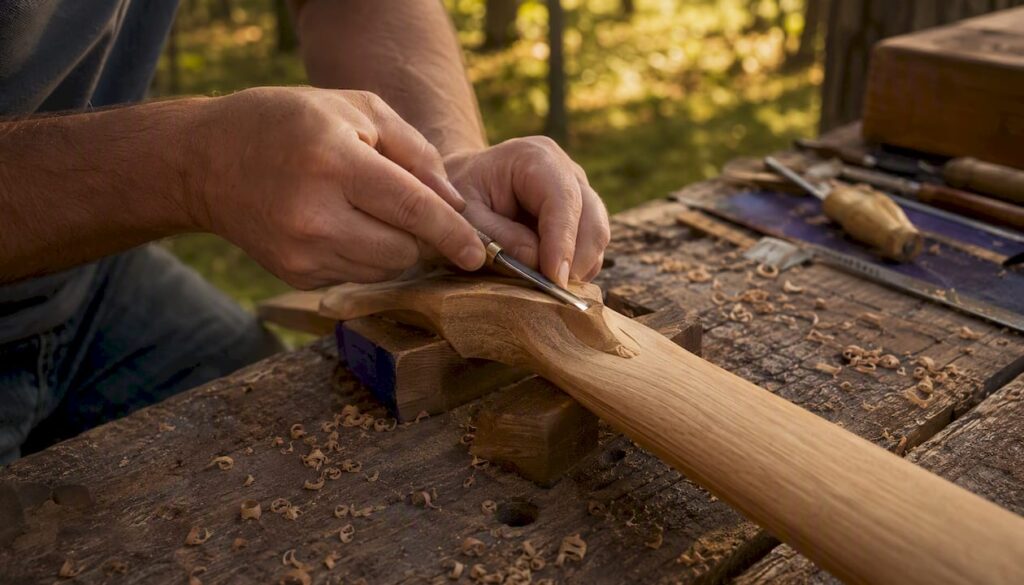
The angle is cut directly from a single neck blank. Gibson’s traditional Les Paul neck is the most recognized example. The problem: carving the angle creates a short-grain section just behind the nut, where the wood fibers run nearly perpendicular to the surface. That is exactly where headstock breaks occur. The wood is not defective; the geometry creates a structural weak point.
Volute
A volute is a small carved ridge on the back of the neck at the headstock transition. It adds material at the weak point without changing the angle. Many builders add a volute to one-piece carved necks as a reinforcement measure. It does not eliminate the short-grain issue but meaningfully reduces break frequency.
Slotted headstock
Used on classical, flamenco, and some acoustic guitars. The headstock is flat or very mildly angled, with slots cut through it. Strings thread through the slots and wrap around rollers. The design distributes string load differently and suits nylon strings well. You will find this construction on Spanish guitar necks built in the traditional Spanish method.
| Method | Strength | Material use | Common failure mode |
|---|---|---|---|
| Scarf joint | High (long grain preserved) | Efficient | Glue line if poorly executed |
| One-piece carved | Moderate | Wasteful | Short-grain break behind nut |
| Volute added | Improved | Adds material | Reduced but not eliminated breaks |
| Slotted headstock | High for nylon strings | Efficient | Roller wear, not structural breaks |
What headstock angle changes for your setup
The practical effects show up in four areas: string seating, string trees, tuning behavior, and tremolo response.
- String seating: A break angle below roughly 6–7° risks strings buzzing or popping out of nut slots. Staggered tuner posts, which vary post height across the headstock, solve this on flat-headstock guitars without adding string trees.
- String trees: Flat headstocks need them on the high strings. String trees add a contact point, which adds friction. A well-lubricated tree causes minimal problems; a dry or rough one is a tuning nightmare.
- Tuning stability under bends: Excessive break angle increases friction in the nut slot. When you bend a string, it moves through the slot; if friction is high, the string does not return to pitch cleanly. Markland Guitar Works’ break angle guide identifies nut-slot friction as the primary mechanical cause of tuning instability.
- Tremolo behavior: On a tremolo-equipped guitar, friction at the nut is amplified by every arm movement. A locking nut eliminates the variable entirely; short of that, lubrication and polished slots are the practical fix.
Pro Tip: Run this sequence before any structural intervention: measure the break angle, check for binding by pulling the string sideways in the slot, then polish and lubricate. Only escalate to hardware changes if the nut is already well-executed.
Ultimate Guitar’s flat vs. angled headstock discussion reinforces that nut shaping and polish often matter more than the angle itself for day-to-day tuning performance.
How to measure headstock angle accurately
You do not need a machine shop. A digital protractor and a straightedge cover most situations.
- Lay a straightedge along the fretboard surface, extending it past the nut onto the headstock face.
- Place a digital protractor or inclinometer on the fretboard plane and zero it. Then move it to the headstock face and read the angle. The difference is the headstock pitch.
- To measure break angle directly, place the straightedge along the string path from the nut to the first tuner post and measure the angle at the nut contact point.
- Verify with a bevel gauge if you want a physical record you can transfer to a template.
Tools that work well:
- Digital protractor (Wixey WR300 or equivalent)
- Bevel gauge for template transfer
- Smartphone inclinometer app (GaugeTool, Clinometer) for quick field readings
- Combination square for checking the headstock face relative to a flat reference
Watch for these pitfalls: a thick finish on the headstock face can add a degree or two of apparent angle; slotted headstocks have a different reference surface than solid headstocks; and tuner bushing flanges can obstruct a straightedge if you are not careful about placement.
Repair and modification options after headstock damage
A broken headstock is not a death sentence for a guitar, but the repair quality matters enormously for structural integrity and resale value. See the full breakdown at Vintage-guitar-world’s headstock repair guide.
- Clean glue and clamp: For a fresh, clean break with intact mating surfaces, a properly executed glue joint using hide glue or Titebond can be stronger than the original wood. This is the preferred first option when surfaces are undamaged.
- Splines: Thin strips of hardwood inserted across the break line add mechanical reinforcement. Used when the break is not clean or when the joint needs extra support.
- Headstock graft: When wood is missing or the break is catastrophic, a luthier can splice in a new headstock section, matching grain and finish. This is skilled work; expect a higher cost and longer timeline.
- When to call a luthier: Any break involving missing wood, multiple fracture lines, or a previous failed repair should be handled by a professional. A poorly re-glued headstock that breaks again is harder to fix than the original break.
For modifications rather than repairs:
- Swap to staggered-post tuners to improve break angle on a flat headstock without adding string trees.
- Add a bone or TUSQ nut with properly cut slots if the existing nut is the friction source.
- A volute can be added by a luthier to reinforce a vulnerable headstock transition on a one-piece carved neck.
Rough cost expectations: a clean glue repair runs $50–$150 at most shops; spline reinforcement adds to that; a full graft can reach $300–$500 or more depending on the instrument’s value and the luthier’s rate. For a vintage instrument, always weigh repair cost against the effect on valuation before proceeding.
What collectors should know about headstock angle and vintage value
Headstock angle is not just a setup variable on a vintage instrument. It is a provenance marker. The construction method, whether scarf joint or one-piece carved, is part of the original specification, and any deviation signals a repair.
Use this checklist when evaluating a vintage guitar:
- Identify the original construction method (scarf joint vs. one-piece carved) from period documentation or known model specs.
- Inspect the headstock transition for mismatched grain, finish overspray, or color variation that suggests a repair or graft.
- Ask for repair documentation: photos of the break, the repair method used, wood species of any grafted material, and the glue type.
- Check the guitar appraisal checklist for a structured approach to evaluating structural integrity before purchase.
- Request certification or a testing appointment for any instrument where the headstock history is unclear.
Angle-related repairs affect provenance in two ways: they change the original wood and finish, and they signal a structural event in the instrument’s history. Buyers deserve full disclosure. Vintage-guitar-world’s valuation and certification services exist precisely to give collectors that clarity before money changes hands.
Headstock pitch and the β angle: the technical definition
In luthiery and acoustic engineering literature, headstock angle is sometimes labeled the β (beta) angle, defined as the angle between the headstock face plane and the neck centerline plane. It is measured at the headstock transition, not at the nut. The break angle at the nut is a derived value: it depends on β plus the geometry of the tuner post height and position relative to the nut.
This distinction matters when you are building or specifying a repair. A 14° headstock pitch does not produce a 14° break angle at the nut. The actual break angle is typically shallower because the string path from nut to tuner post is not perpendicular to the headstock face. Measuring the break angle directly at the nut, as described in the measurement section above, gives you the number that actually governs string behavior.
Key Takeaways
Headstock angle sets the string break angle at the nut, and nut friction, not the angle itself, is the primary driver of tuning stability in most guitars.
| Point | Details |
|---|---|
| Definition | Headstock angle (β) is the backward tilt of the headstock relative to the neck plane, typically observed between 3° and 25° across instruments. |
| Functional threshold | A break angle of roughly 6–7° at the nut is usually sufficient to seat strings without string trees. |
| Construction risk | One-piece carved angled headstocks create short-grain weak points; scarf joints preserve long grain and are stronger. |
| Fix nut first | Polishing and lubricating nut slots resolves most tuning complaints before any structural change is needed. |
| Collector impact | Undisclosed headstock repairs reduce vintage value; documented, professional repairs have a much smaller effect. |
The angle matters less than most players think
The headstock pitch debate generates more heat than it deserves. Players argue about Gibson’s 17° versus Fender’s zero-pitch as if one is objectively correct, but the engineering reality is more boring and more useful: both designs work when the nut is properly cut and the strings have adequate break angle, whether that comes from headstock tilt, staggered tuners, or string trees.
What actually separates a great-playing guitar from a frustrating one at the headstock is almost always the nut. Slot depth, slot width, surface polish, and lubrication account for the overwhelming majority of tuning complaints that players attribute to geometry. A steep-angled headstock with a rough, poorly cut nut will detune on every bend. A flat headstock with a bone nut cut by a skilled luthier will stay in tune through aggressive tremolo use.
The construction method is where the angle decision has real, lasting consequences. One-piece carved angled headstocks on mahogany necks break. Not always, not inevitably, but often enough that any vintage Les Paul-style guitar deserves a careful look at the headstock transition before purchase. A scarf joint, by contrast, is structurally sound and repairable. That is the trade-off worth understanding.
At Vintage-guitar-world, every instrument we handle goes through structural evaluation that includes headstock inspection, construction method identification, and documentation of any prior repairs. For collectors considering a vintage instrument with a complex headstock history, a guitar testing appointment gives you a professional assessment before you commit. Browse our curated vintage guitar collection to see instruments where that work has already been done.

Useful sources
- Pros & Cons of Pitched Vs. Straight Headstocks – Premier Guitar
- Head stock – Wikipedia
- Angled Vs. Flat Headstock, Which to Build? – The Electric Luthier
- Guitar Headstock Variations – What’s the difference? – The Electric Luthier
- Understanding String Break Angle: How Headstock Geometry Affects Playability and Tuning – Markland Guitar Works
- Flat vs. Angled Headstocks – Ultimate Guitar
- Design Philosophy 5 – The Headstock – Edwinson guitar