












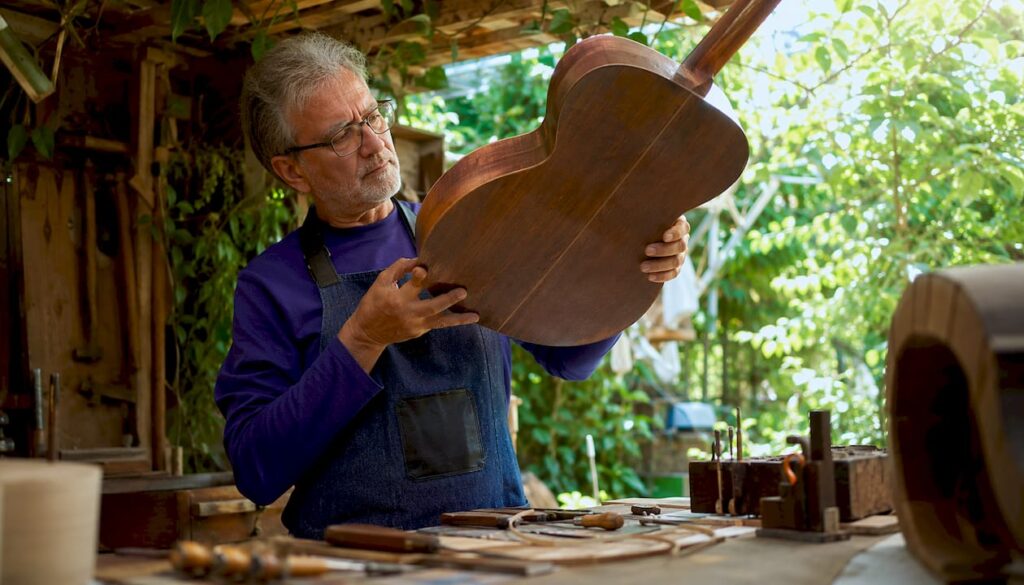

The back and sides of an acoustic guitar act as a reflective resonant chamber that shapes projection, sustain, and harmonic color after the top generates sound. That single sentence is the most useful thing you can carry into any instrument evaluation. Luthier Dana Bourgeois frames it precisely: stiffer backs and sides return energy to the top for cleaner projection and volume, while lighter or more flexible structures absorb some of that energy and trade raw volume for harmonic complexity. Vintage-guitar-world applies this principle across every instrument it evaluates, treating the back and sides not as a secondary afterthought but as a voiceable partner to the soundboard.
Pro Tip: When auditioning a guitar, focus on the first few notes of a sustained phrase. The resonant tail, harmonic richness, and decay you hear in those opening moments reveal the back and sides’ contribution most clearly.
Table of Contents
- How back and sides shape sound in plain acoustic terms
- What tonewood tendencies actually tell you (and what they don’t)
- Construction details that typically matter more than wood species
- How to evaluate back and sides when buying vintage or handcrafted guitars
- How repairs to the back and sides affect tone and collectible value
- Matching back and sides choices to your playing and collecting goals
- Key Takeaways
- A note from Vintage-guitar-world on evaluating backs and sides
- Vintage-guitar-world: curated instruments and expert evaluation
- Select sources and further reading
How back and sides shape sound in plain acoustic terms
Think of the top as a speaker cone and the back and sides as the cabinet around it. The top converts string vibration into sound, but that sound doesn’t simply radiate outward. Strings transfer energy to the top, the top excites the enclosed air column, and that air excites the back. The back then acts as a secondary soundboard, adding its own coloration and sustain to the mix.

The key variables at play are stiffness, mass, internal damping, and cavity volume. A large-body dreadnought creates more air volume than a parlor guitar, which shifts the bass response and sustain profile noticeably. For amplified playing, stiffer sides also reduce feedback sensitivity by limiting how freely the body walls vibrate at high stage volumes.
Practical signs to listen for during evaluation:
- Sustain tail: how long a note rings after the attack fades
- Upper partial prominence: brightness and shimmer in the overtone structure
- Fundamental clarity: how cleanly the root pitch speaks without wash
- Projection vs. coloration: whether the guitar pushes sound outward or wraps it in harmonic texture
What tonewood tendencies actually tell you (and what they don’t)
Species-based generalizations are a starting point, not a verdict. Rosewood delivers deep bass and complex overtones with cathedral-like sustain. Mahogany leans toward strong fundamentals and an immediate, punchy response. Maple is articulate with a fast decay, which is why it dominates archtop and electric guitar bodies. Koa opens bright and sweetens with age, making older koa instruments particularly interesting for collectors.
- Rosewood: rich harmonic complexity, strong upper partials, long sustain; can expose technical imperfections in playing
- Mahogany: warm, mid-forward, forgiving; fundamentals dominate over overtone wash
- Maple: focused, fast, articulate; less sustain, more note separation
- Koa: bright initially, mellows and sweetens over years of play
The caveat matters as much as the profiles. Species effects are real but secondary to soundboard design, bracing pattern, and overall voicing. Two rosewood guitars from different makers can sound nothing alike. Solid backs and sides vibrate more freely than laminates, but a well-executed laminate can behave respectably for stability without catastrophic tonal compromise — an important consideration when evaluating condition and originality in vintage instruments.
Pro Tip: For vintage guitars, prioritize original material and construction over a preferred species. The maker’s voicing decisions and the top/back pairing usually define the instrument’s character more than the wood species alone.
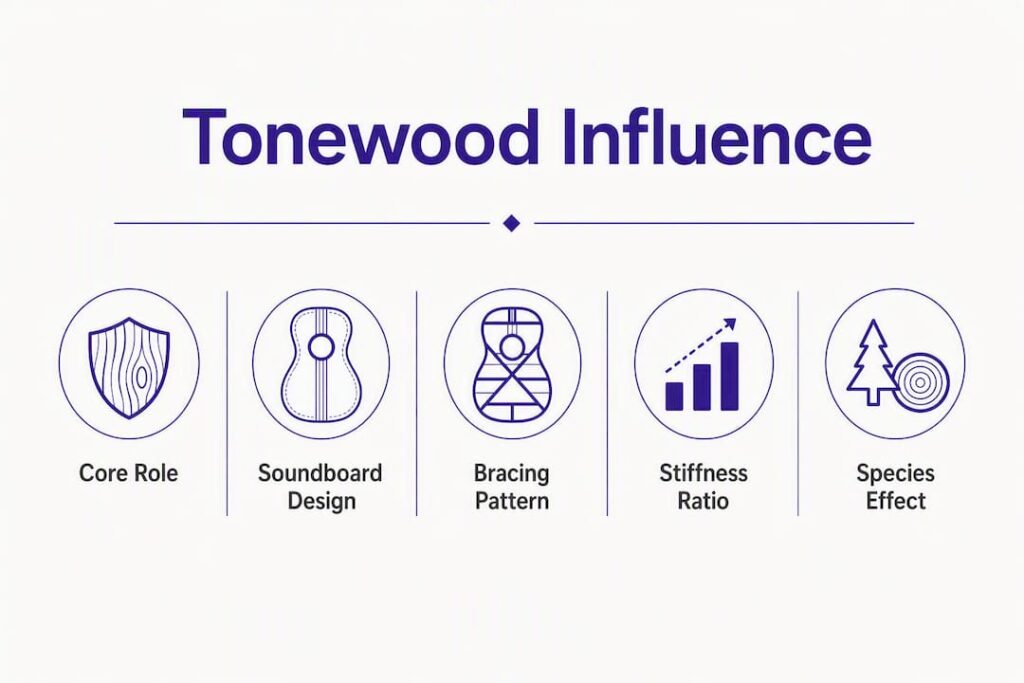
Construction details that typically matter more than wood species
The back and sides set the stage, but these factors usually write the script:
- Top wood and thickness: the soundboard is the primary sound generator; its stiffness-to-weight ratio determines how freely it vibrates
- Bracing pattern and voicing: X-brace, ladder, fan — each shapes frequency response and stiffness distribution across the top; bracing patterns are often the single biggest differentiator between instruments of the same species
- Bridge mass and saddle coupling: a heavy bridge damps the top; saddle material and fit affect how cleanly energy transfers from string to wood
- Body volume and shape: cavity size shifts bass response and air resonance, independent of wood choice
- Neck and bridge set: angle and geometry affect string tension and how the top is loaded
The stiffness-to-weight ratio of the back and sides interacts with all of these. Multi-ply or structured sides can reduce internal damping and create a stiffer enclosure without adding dead weight, which improves projection without flattening tone. Grain orientation and thickness graduations also alter vibrational behavior: quartersawn backs with tight, straight grain tend to be stiffer and more consistent than flatsawn cuts.
For collectors, documented maker practices carry real weight. Original bracing specs and period construction details are decisive for both tone and value — a guitar with replaced bracing is a different instrument, acoustically and historically.
How to evaluate back and sides when buying vintage or handcrafted guitars
A structured approach here saves you from expensive regrets. Use this checklist at any guitar testing appointment or in-store visit:
- Visual inspection: check wood condition, grain orientation, finish integrity, and any signs of cracks or old repairs along the back center seam and side bouts
- Structural check: run a finger along all seams; open seams or lifting bindings signal humidity damage or prior stress
- Rib and brace integrity: look through the soundhole with a mirror or phone light; loose braces or cleats indicate prior cracking
- Provenance check: confirm whether back and sides are original to the instrument; replaced parts must be documented
- Listening test — fundamentals: play single-note lines and listen for clarity, sustain length, and how quickly the note blooms
- Listening test — arpeggios: arpeggiated chords reveal overtone density and whether the back adds warmth or wash
- Listening test — sustained chords: hold a chord and listen to the decay; a lively back extends it, a dead one cuts it short
- Physical contact test: play the guitar held normally, then slightly away from your body. Player contact changes effective vibration — a lightly braced back won’t oscillate freely if clamped to the torso, so this test reveals real-world performance
Pro Tip: Bring a consistent string gauge and use the same pick or finger technique across every instrument you test. Document findings with short audio clips and photos so you can compare objectively after the appointment.
How repairs to the back and sides affect tone and collectible value
Repairs are a fact of life with vintage instruments. The question is always whether a repair stabilizes the instrument without compromising its voice or its market worth.
Common repairs and their implications:
- Back crack with cleats: minimal tonal impact if done correctly; cleats add local stiffness but rarely change overall resonance
- Seam regluing: usually neutral or slightly positive; a tight seam restores the reflective efficiency the loose joint was killing
- Patching: depends on patch size and material; large patches alter local stiffness and can shift the back’s vibrational behavior noticeably
- Full back replacement: the most consequential intervention; it changes the instrument’s inherent voice and can materially reduce collectible value unless performed by a top restoration specialist with full documentation
When assessing repair quality, look for photographic documentation, luthier invoices specifying materials, evidence that solid wood (not laminate) was used for patches, and any notes on sympathetic voicing. An instrument with a clean, documented repair history is often more trustworthy than one with no repair history at all — vintage guitars that have never needed attention are rare.
Matching back and sides choices to your playing and collecting goals
| Goal | Preferred back/sides character | Key trade-off |
|---|---|---|
| Recording / fingerstyle | Rosewood or koa (harmonic complexity) | More overtone wash; can expose technique |
| Singer-songwriter / strumming | Mahogany-style fundamentals | Less harmonic complexity, more punch |
| Live amplified performance | Stiffer woods or laminated sides | Better feedback resistance, slightly less coloration |
| Collector / display | Original materials, documented provenance | Rarity and originality outweigh species preference |
Practical notes by use case:
- Recording and fingerstyle: rosewood’s complex overtones reward clean technique and translate well to microphones; koa adds a distinctive character that ages into the recording
- Stage work: stiffer backs and sides reduce the body’s tendency to feed back at volume; laminates can actually be an asset here
- Collecting for value: originality trumps species every time; a mahogany-backed guitar with all original parts and documentation outperforms a rosewood-backed instrument with replaced components
- Vintage-guitar-world’s testing appointments and appraisal services are designed specifically to help collectors work through these trade-offs with real instruments in hand
Key Takeaways
The back and sides function as a resonant chamber that shapes sustain, projection, and harmonic color — and stiffness-to-weight ratio matters more than species alone when judging their contribution.
| Point | Details |
|---|---|
| Reflective chamber role | Back and sides shape projection, sustain, and harmonic color after the top generates sound. |
| Stiffness-to-weight over species | A stiffer back projects more cleanly; a flexible one adds coloration but reduces volume. |
| Top and bracing dominate | Soundboard design and bracing pattern typically have a larger tonal impact than back/side wood choice. |
| Repairs and originality | Documented, sympathetic repairs preserve value; full back replacement can materially reduce collectible worth. |
| Vintage-guitar-world services | Testing appointments, appraisals, and restoration referrals help collectors evaluate instruments against all these criteria. |
A note from Vintage-guitar-world on evaluating backs and sides
At Vintage-guitar-world, we treat the back and sides as a voiceable partner to the top, not a secondary spec to glance at. When we evaluate an instrument for our curated inventory, we look at original construction, documented provenance, and how the back and sides interact with the specific bracing and top voicing the maker chose. Species is a data point, not a verdict.
Our testing appointments exist precisely because these distinctions are impossible to judge from a photograph or a spec sheet. Bring your reference instrument, a consistent string gauge, and a list of what you’re listening for. Our appraisal and certification services document condition and repair history so you know exactly what you’re buying and what it’s worth. That combination of hands-on evaluation and documented provenance is what separates a confident purchase from an expensive guess.
Vintage-guitar-world: curated instruments and expert evaluation
Every collector deserves to hear an instrument before committing to it. Vintage-guitar-world offers a curated inventory of vintage and handcrafted guitars, each evaluated for tonal character, construction integrity, and provenance — with testing appointments available so you can assess back and sides behavior in person, not just on paper.

Our services include guitar valuation and certification, restoration referrals to trusted specialists, and personalized buying consultation tailored to your playing goals and collecting criteria. Whether you’re sourcing a fingerstyle rosewood dreadnought or a collector-grade mahogany parlor guitar, the process starts with a hands-on test.
Browse our curated vintage guitar inventory or review our handcrafted guitar selection guide to find instruments worth your time and investment.
Select sources and further reading
- Acoustic Guitar — “Guitar Guru: Do the tonewoods and thickness of my guitar’s back have an impact on its sound?” — primary source for the reflective chamber model and Dana Bourgeois’ stiffness commentary (sections 1, 2, 5)
- Guitar World — “How your acoustic’s back and sides affect your guitar tone” — tonewood tendencies, species caveats, and the rosewood/mahogany playing-style heuristic (sections 3, 7)
- Pacific Rim Tonewoods — “Understanding Tonewoods Part 2: Hardwoods for Guitar Backs & Sides” — laminate behavior, luthier voicing practices, and stiffness-to-weight discussion (sections 4, 7)
- Premier Guitar — “Acoustic guitar side” — stiffness-to-weight ratio and multi-ply side construction (sections 4, 5)
- Vintage-guitar-world — Bracing in Acoustic Guitars — bracing patterns and their interaction with back/side stiffness
- Vintage-guitar-world — Guitar Appraisal Checklist — practical appraisal protocol for collectors
- Vintage-guitar-world — Resonance Characteristics of the Guitar — acoustic physics and wood selection for musicians