














TL;DR:
- Guitar body shapes influence tone, projection, and comfort more than visual silhouette alone. Construction, depth, and bracing are critical factors that affect an instrument’s sound and playability. Choosing the right guitar depends on fitting body size and construction to your musical style and physical needs.
Guitar body shapes define the external silhouette and internal construction that determine how an instrument resonates, projects, and feels in your hands. Three categories cover everything you need to know: acoustic size families (parlor through jumbo), electric construction families (solid, chambered/semi-hollow, hollow), and electric silhouette families (Strat-style, Tele-style, Les Paul–style, SG-style, ES-335–style, offset, and extreme shapes).
Here’s the fastest cheat sheet before we go deeper:
- Strumming and bluegrass: Dreadnought or jumbo acoustic; Tele-style or Les Paul–style electric
- Fingerstyle and recording: Parlor, concert/000, or OM acoustic; Strat-style or offset electric
- Jazz and clean tones: ES-335–style semi-hollow or full hollow-body archtop
- High-gain and rock: Solid-body Les Paul–style, SG-style, or Strat-style
- Long gigs and touring: Chambered solid-body or SG-style for weight relief; avoid full hollow-body at high stage volumes
Table of Contents
- What are the main acoustic guitar body shapes?
- How do electric guitar construction and silhouette families differ?
- How does body shape actually affect tone and playability?
- How do you choose the right guitar shape for your playing?
- What luthiers know about body shapes that most buyers miss
- Key Takeaways
- Why construction and playability come before shape names
- Find the right guitar with Vintage-guitar-world’s expert services
What are the main acoustic guitar body shapes?
Acoustic guitar body shapes fall into five well-established size families. Each one has a distinct tonal signature driven by its air volume, soundboard area, and body depth. Larger bodies generally produce more low-end and volume, while smaller bodies offer clearer, more mid-focused tones that cut through a mix.

Parlor and concert (0 and 00)
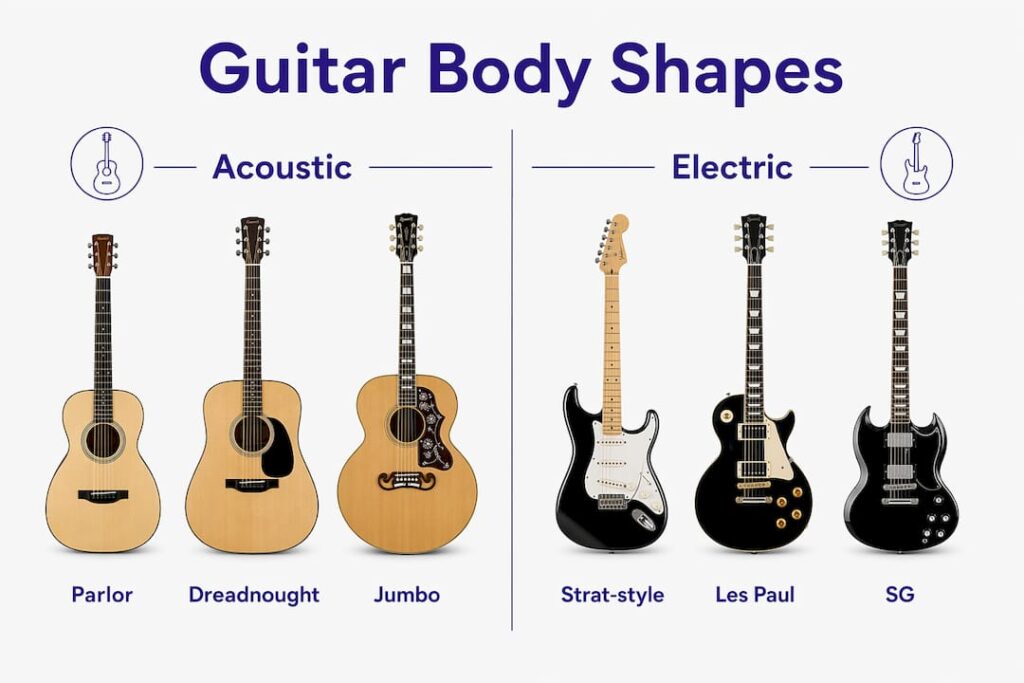
The parlor is the smallest standard acoustic shape. Its narrow waist and shallow body depth produce a focused, punchy midrange with limited bass extension. Notes bloom quickly and decay fast, which is exactly what blues fingerpickers and recording guitarists often want. The concert (00) is a half-step larger with a slightly wider lower bout, adding a touch more warmth without losing that clarity. Both shapes sit comfortably on the leg and are easy to hold for smaller players.
Grand concert and 000/OM
The 000 and OM (Orchestra Model) are where acoustic shapes start to feel genuinely versatile. The OM typically runs a longer scale length than the 000, which tightens string tension and adds definition to single-note lines. Both shapes deliver balanced tone across bass, mid, and treble with enough projection for small-venue performance. Fingerstyle players and singer-songwriters reach for these constantly because note separation is clean without the boomy low end that can muddy a mix.
Dreadnought (round-shoulder and square-shoulder)
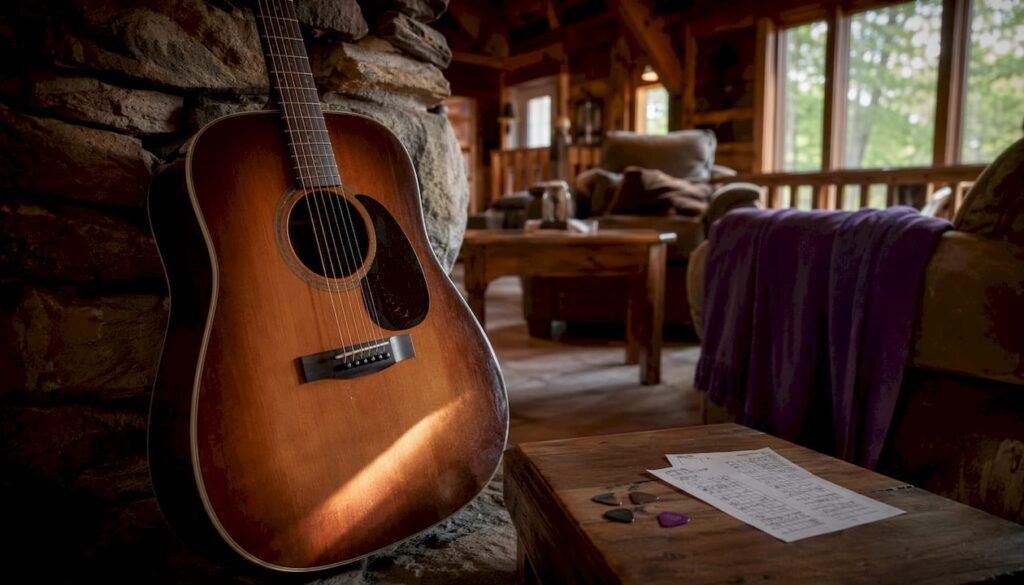
The dreadnought is the shape most people picture when they think “acoustic guitar.” Its wide lower bout, thick waist, and deep body push strong low-end response and loud projection. Body depth correlates directly with bass response, and the dreadnought’s depth is one of the reasons it became the default for bluegrass, country, and strumming-heavy folk. Round-shoulder dreadnoughts sound warm and balanced; square-shoulder versions deliver more punch and directness in the low mids. Both are loud enough to hold their own in a full band setting without amplification.
Jumbo
The jumbo takes everything the dreadnought does and turns up the volume. Its oversized body and wide lower bout produce singing sustain and a pronounced low end that still stays balanced. These guitars were developed in the 1930s as players moved from small parlors to bigger clubs and needed more acoustic power. A jumbo is a stage guitar at heart. Extended standing gigs are where it shines, though its size can feel unwieldy for smaller players or seated practice sessions.
Travel and mini acoustics
Travel guitars sacrifice body depth and lower-bout width for portability. The tonal trade-off is real: less air volume means less bass and lower overall volume. That said, modern travel designs with solid tops can still produce a surprisingly focused, usable tone. They’re practical for practice on the road, not for recording or performance where projection matters.
| Shape | Tonal Character | Volume/Projection | Ergonomics | Best For | Portability |
|---|---|---|---|---|---|
| Parlor/Concert | Mid-forward, punchy | Low–moderate | Compact, easy seated | Blues, fingerstyle, recording | High |
| 000/OM | Balanced, clear | Moderate | Comfortable, versatile | Fingerstyle, singer-songwriter | Moderate–high |
| Dreadnought | Warm bass, full | High | Wide body, deep | Strumming, bluegrass, country | Moderate |
| Jumbo | Big low end, sustained | Very high | Large, best standing | Stage, full-band settings | Low |
| Travel/Mini | Thin, mid-focused | Low | Very compact | Practice, travel | Very high |
Pro Tip: When testing acoustics in a store, sit down and hold the guitar without playing. If the waist digs into your forearm or the lower bout pushes your strumming arm out at an awkward angle, the body depth is working against you. A guitar that fits your body before you play a note will always feel better after an hour.
How do electric guitar construction and silhouette families differ?
Electric guitar body types split first by internal construction, then by silhouette. Construction determines how the instrument behaves when amplified. Silhouette shapes how it feels to play.
The three construction categories
Solid-body guitars maximize sustain and resist feedback, semi-hollow guitars use a center block to reduce feedback while keeping woody resonance, and fully hollow bodies offer the most acoustic-like tone but are more feedback-prone at high stage volumes. Chambered solid bodies sit between solid and semi-hollow: routed cavities reduce weight without dramatically changing the amplified character. For touring players, chambered bodies are a practical compromise for long sets because they retain structural integrity and sustain while cutting fatigue.
Strat-style (double-cutaway contoured)
The Strat-style silhouette is the most copied electric guitar shape in history. Its double cutaway gives easy access to the upper frets, and the contoured body fits against your torso and forearm in a way that feels almost anatomically designed. Relatively lightweight and balanced, it suits long sets without shoulder strain. Tonally, the combination of single-coil pickups and a solid alder or ash body produces bright, glassy tones with a characteristic mid scoop.
Tele-style (single-cutaway slab)
The Tele-style is a flat slab with a single cutaway. It’s simpler and slightly heavier than a Strat-style, with less upper-fret access. What it gives you is a direct, punchy attack and a bright bridge tone that cuts through any mix. Country, rock, and indie players have relied on it for decades precisely because of that unfiltered, no-frills response.
Les Paul–style (thicker single-cutaway)
The Les Paul–style body is thicker and heavier than either Fender-derived shape. A mahogany body with a carved maple top, paired with humbucking pickups, produces warm, thick sustain with a strong low-mid emphasis. It’s heavier than a Strat-style, and some players find the weight tiring over a long set. The trade-off is a density of tone that single-coil-equipped guitars rarely match.
SG-style (thin, double-horned)
The SG-style is the lightweight answer to the Les Paul. A thinner mahogany body with a double-cutaway design gives excellent upper-fret access and reduces overall weight significantly. The neck joint sits further into the body than on a Les Paul, which shifts the balance point and can cause neck dive on cheaper versions. Tonally, the thinner body produces a slightly brighter, more aggressive character than a Les Paul despite sharing similar pickup configurations.
ES-335–style (semi-hollow)
The ES-335–style is the definitive semi-hollow silhouette. A solid center block runs through the body, anchoring the pickups and bridge while the hollow wings on either side add acoustic warmth and resonance. The result is a guitar that can handle clean jazz tones, blues, and even moderate rock gain without the feedback problems of a full hollow-body. Gibson’s Ted McCarty introduced this design in 1958, and it remains the benchmark for versatile amplified tone.
Offset shapes (Jazzmaster, Jaguar, Mustang)
Offset guitars have an asymmetrical waist where the upper and lower halves shift relative to each other. That design makes them comfortable for seated playing and gives them a distinct elongated silhouette. Their unique pickup systems and bridge designs produce tones that range from surf-bright to indie-warm, and they’ve become closely associated with alternative and indie rock.
Flying V, Explorer, and extreme shapes
Extreme shapes like the Flying V and Explorer were designed to make a visual statement as much as a sonic one. Both are solid-body guitars, so their amplified behavior follows solid-body rules: strong sustain, feedback resistance, pickup-driven tone. The ergonomic trade-off is real. Neither shape balances naturally when standing without a strap, and seated playing is genuinely awkward. They’re stage instruments built for attitude.
Pro Tip: When testing an electric at different gain settings, start clean, then move to light breakup, then high gain. A semi-hollow that sounds warm and open clean may feed back at high gain in a live room. A solid-body that sounds thin clean often fills out beautifully with distortion. The construction category tells you what to expect before you even plug in.
How does body shape actually affect tone and playability?
The physics are straightforward once you know what to listen for. A larger air chamber resonates more strongly at lower frequencies, which is why deeper bodies increase bass response while shallower depths deliver better bass-to-treble balance and projection. Shallower bodies also tend to produce a quicker attack because the soundboard has less air mass to move.
Bracing patterns on the top wood control how the soundboard flexes under string vibration. Stiffer bracing produces more focused, articulate tone with a faster decay. Lighter bracing lets the top breathe more freely, which adds warmth and sustain but can reduce note separation at the cost of clarity. When A/B testing two acoustics, listen specifically for how long a note sustains after the pick attack, how clearly individual strings separate in a chord, and whether the bass frequencies bloom or boom.
Body depth is the single most impactful dimensional attribute for bass response in an acoustic guitar. Waist and lower-bout width predict comfort and projection, but depth is what drives the low-end voice of the instrument.
For electrics, unplugged resonance still matters. The way the top and body vibrate changes string response, which subtly shapes what the pickups capture. Two otherwise similar electrics with identical pickups can sound noticeably different unplugged, and that difference carries through to the amplified signal.
| Body Dimension | Tonal Effect | Playability Effect |
|---|---|---|
| Greater body depth | More bass, more volume | Wider reach for strumming arm |
| Wider lower bout | Stronger projection, fuller low end | Larger contact area on lap/body |
| Narrower waist | Better ergonomic fit, less fatigue | Easier seated balance |
| Shallower body | Clearer midrange, faster attack | More comfortable for smaller players |
Pro Tip: For guitar construction details on any instrument you’re considering, ask specifically about top wood species and bracing style. A spruce top with scalloped X-bracing responds differently than a cedar top with fan bracing, even in the same body shape.
How do you choose the right guitar shape for your playing?
The best shape is the one that fits your body, your genre, and your playing context. Here’s a practical checklist to run through in the first five minutes with any guitar.
- Hold it before you play. Sit down, rest the guitar on your leg, and check whether the waist sits naturally or digs into your forearm. Stand up and hang it on a strap. Does it balance, or does the neck dive?
- Play open chords. Strum a G, C, and D. Listen for whether the low strings are clear or muddy, and whether the treble strings cut or disappear.
- Try fingerstyle. Pick individual strings on a simple pattern. Note separation tells you immediately whether the body size suits the playing style.
- Test the upper frets. Play a chord or scale above the 12th fret. A single-cutaway body limits access; a double-cutaway opens it up.
- Check unplugged feel (electrics). Even before plugging in, strum an electric and feel how it resonates in your hands. A guitar that feels alive unplugged usually translates that quality through the amp.
- Weight test. Hold it standing for two full minutes. A guitar that feels fine for thirty seconds can become a problem after a two-hour set.
Questions worth asking the seller or luthier:
- What is the body depth and lower-bout width? (Critical for acoustics.)
- Is the top solid or laminate? (Solid tops open up tonally over time; laminates are more stable but less responsive.)
- Is the electric body solid, chambered, or semi-hollow? (This determines feedback profile and weight.)
- What bracing pattern does the acoustic use? (X-bracing vs fan bracing changes dynamic range.)
Red flags to watch for:
- A jumbo acoustic for extended standing gigs. The size and weight become a physical problem over time.
- A full hollow-body electric at stadium volumes without feedback mitigation. Without a center block, high-gain settings will feed back uncontrollably.
- A very deep-bodied acoustic for a smaller player. Comfort and appropriate size matter more than marketing terms, and a body that doesn’t fit your frame will always fight you.
For online shoppers, testing guitars before buying is worth the effort whenever possible. When you can’t play in person, ask for body depth measurements, lower-bout width, and scale length. Request sound clips played clean and with some gain. Photos of the body from the side reveal depth in a way that front-facing shots never do.
What luthiers know about body shapes that most buyers miss
Build quality and construction category matter more than the marketing name on the headstock. Pro musicians and luthiers advise focusing on construction category first — solid vs hollow vs semi-hollow — because that is the most reliable predictor of feedback profile and amplified voice. The silhouette name is secondary.
When a luthier designs an instrument for a specific brief, the body depth is usually the first dimension they fix. A bluegrass player needs projection and volume, so the luthier pushes toward a deeper body with a wide lower bout and relatively stiff bracing. A studio fingerstyle player needs clarity and note separation, so the luthier pulls back on depth, lightens the bracing, and often chooses a cedar top over spruce for a warmer, faster response.
For vintage instruments, original body depth is one of the first things a restorer checks. Aging can cause top bellying or back distortion that subtly alters the resonance chamber. A guitar that measures differently than its original spec may sound and feel different from a pristine example of the same model.
For vintage electrics, weight is a recurring issue. Many pre-1970s solid-body guitars were built from heavy mahogany or ash without any weight relief. Contoured solid-body shapes are more comfortable seated, and lighter chambered or SG-style guitars reduce shoulder and back fatigue for standing players. If you’re evaluating a heavy vintage electric, ask whether the body has been chambered at any point, and check whether the original finish and binding are intact. Unauthorized routing affects both value and structural integrity.
Collectors examining vintage acoustics should pay close attention to waist and lower-bout measurements, not just the model name. A guitar labeled “000” by one maker may have different dimensions than a “000” from another, and those differences change how it plays and sounds. The historical evolution of guitar body shapes shows that naming conventions were never fully standardized across manufacturers, which is why physical measurements always trump labels when assessing a vintage piece.
Pro Tip: When evaluating a vintage electric for long-set use, bring a strap to the appointment and wear it for at least ten minutes while playing. A guitar that feels manageable on a stand can feel very different after an hour on your shoulder. If the instrument is a candidate for touring use, that ten-minute test is non-negotiable.
Key Takeaways
Body shape and construction category together determine tone, projection, sustain, and playability — and knowing which dimension to prioritize first saves you from buying the wrong instrument.
| Point | Details |
|---|---|
| Construction over silhouette | For electrics, solid/semi-hollow/hollow construction predicts amplified behavior more reliably than the body’s visual shape. |
| Depth drives bass response | Acoustic body depth is the single most impactful dimension for low-end voice; shallower bodies produce clearer, more balanced tone. |
| Size and comfort are linked | Smaller acoustic bodies (parlor, 000) often sit better in a mix and suit fingerstyle; larger bodies (jumbo, dreadnought) project more but require a bigger frame to play comfortably. |
| Test at multiple gain settings | For electrics, always test clean, at light breakup, and at high gain — a semi-hollow that sounds great clean may feed back at stage volumes. |
| Vintage-guitar-world for expert guidance | Vintage-guitar-world offers testing appointments, valuation, and restoration services to help you match the right body shape to your playing needs. |
Why construction and playability come before shape names
The conventional wisdom in most guitar guides is to start with the silhouette: pick a Strat, a Les Paul, a dreadnought. That framing puts the cart before the horse. The shape name is a shorthand that collapses a dozen real variables into a single label, and that compression loses the information that actually matters.
A dreadnought from one maker with light scalloped bracing and a cedar top will sound and play completely differently from a dreadnought with heavy X-bracing and a spruce top, even though both carry the same shape name. The same principle applies to electrics. Two guitars with identical Strat-style silhouettes can feel and sound worlds apart if one is a chambered semi-hollow and the other is a dense solid alder body.
The more useful question isn’t “which shape?” but “what construction, what depth, what bracing, and what weight?” Those four variables predict the instrument’s behavior far more accurately than the silhouette label. Shape names are useful for navigation, not for decision-making.
Vintage-guitar-world’s approach reflects this. Every instrument in the catalog is evaluated for playability, tonal match to intended use, and physical condition, not just categorized by its visual silhouette. For vintage pieces especially, that level of assessment matters because aging, repairs, and modifications can shift an instrument’s behavior away from what the model name implies.
Find the right guitar with Vintage-guitar-world’s expert services
Knowing how to explain guitar body shapes is the first step. Finding the instrument that actually fits your playing is the next one, and that’s where hands-on expertise makes the difference.

Vintage-guitar-world offers a curated selection of rare, restored, and handcrafted guitars across acoustic, electric, classical, and flamenco families, each with detailed construction notes, historical context, and condition assessments. Testing appointments let you play instruments before committing. Valuation and certification services give collectors the documentation they need when buying or selling significant pieces. If you’ve narrowed down a shape family and want to find the right vintage example, the types of vintage guitars catalog is the place to start. For instruments that need work before they’re playable, the restoration team can assess and quote based on the body’s current condition. Book a testing appointment or request a guitar appraisal to get a clear picture of what any instrument is worth before you buy.