












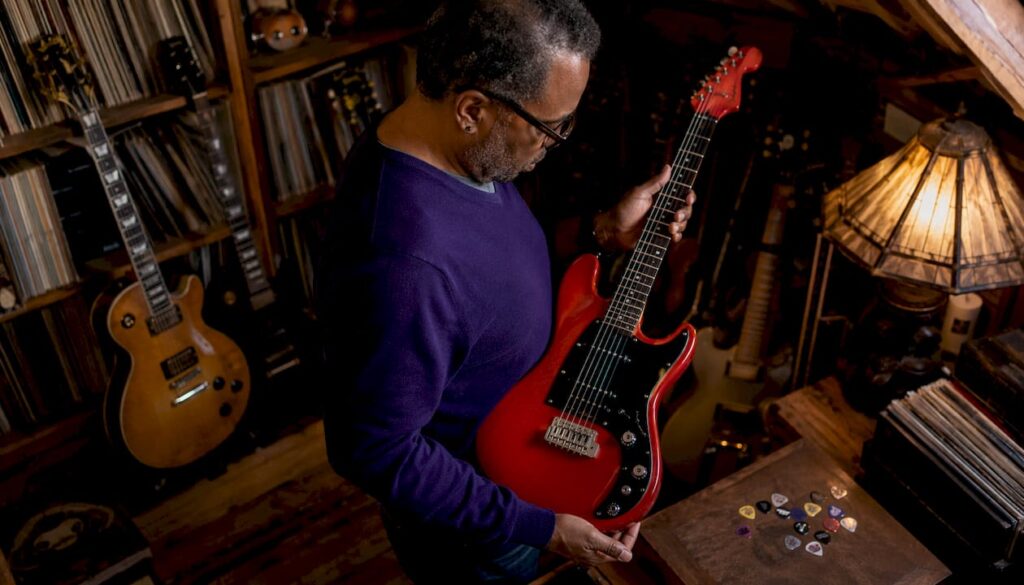

The ten players collectors track most closely, paired with the instruments that matter:
- Jimi Hendrix — redefined electric guitar technique and tone; Fender Stratocaster (1960s sunburst and Olympic White models)
- Eric Clapton — blues-rock architect whose “Blackie” Strat became a named provenance landmark; Fender Stratocaster and Gibson Les Paul Standard
- Jimmy Page — Led Zeppelin’s sonic architect; Gibson Les Paul Standard (1959 “burst” is the holy grail)
- B.B. King — blues royalty whose “Lucille” turned a Gibson ES-style guitar into a cultural icon
- Stevie Ray Vaughan — revived blues for a new generation; Fender Stratocaster (heavy strings, left-handed strung)
- Eddie Van Halen — hard rock pioneer; Frankenstrat (hand-built, striped, one-of-a-kind)
- Les Paul — inventor of the solid-body electric; the Gibson Les Paul Standard carries his design DNA
- David Gilmour — Pink Floyd’s atmospheric voice; Fender Stratocaster (Black Strat, serial 0001)
- Slash — Guns N’ Roses lead guitarist, Rock and Roll Hall of Fame) inductee; Gibson Les Paul Standard
- Chuck Berry — the architect of rock and roll rhythm; Gibson ES-335 and semi-hollow variants
Vintage Guitar magazine’s reader-voted rankings consistently place Hendrix, Clapton, and Page at the top, and those three names also dominate auction results and dealer inquiries. That alignment between critical consensus and market demand is exactly what collectors should watch.
Table of Contents
- Why do legendary guitar players drive collector demand?
- Which guitar models are collectors actually hunting?
- How does player association change what you pay?
- How do you authenticate a vintage guitar before buying?
- What is the smartest buying strategy for collectors?
- Does restoration help or hurt collectible value?
- Key Takeaways
- What collectors underestimate about provenance
- How Vintage-guitar-world supports collectors at every step
- Useful sources for collectors
Why do legendary guitar players drive collector demand?
Artist association raises demand by signaling three things simultaneously: historical significance, tonal legacy, and cultural cachet. A 1959 Gibson Les Paul Standard was already a fine instrument before Jimmy Page played one through a Marshall stack on “Whole Lotta Love.” After that, it became a benchmark. The model’s collectible status is retroactive — values climbed years after the fact, once the cultural transmission was complete.
Les Paul himself illustrates the dual-value principle. His design innovations gave the solid-body electric its commercial viability, so instruments tied to him carry both inventor prestige and performance legacy. B.B. King’s “Lucille” works differently: it is a named instrument with a documented story, which makes it a provenance anchor rather than a production-model collectible. Hendrix’s Stratocasters sit in a third category — production models elevated by documented stage use and photographic evidence.
How legendary status changes collector behavior:
- Provenance premiums: documented artist connection adds measurable value above comparable unassociated examples
- Museum and auction interest: named or associated instruments attract institutional buyers, raising floor prices
- Restoration tolerance: player-grade instruments tied to icons often command prices even in worn condition
- Reissue and signature-model effect: manufacturer reissues validate the original’s status and often increase demand for vintage examples
- Cross-generational demand: Rolling Stone’s 250 Greatest Guitarists list shows that legendary status now spans blues, jazz, and global styles, broadening the collector base beyond classic rock
- Liquidity: guitars tied to household names sell faster and with less price negotiation than obscure models
Which guitar models are collectors actually hunting?
The six instruments every serious collector should know:
- Fender Stratocaster (Hendrix, Clapton, SRV): Three of the most influential players in history used the same platform, which is why Stevie Ray Vaughan’s Strat setup — heavy-gauge strings, specific neck profile, left-hand stringing — is documented and replicated by collectors. Pre-CBS (pre-1965) Strats with original pickups and slab rosewood fretboards are the collector sweet spot.
- Gibson Les Paul Standard (Page, Clapton, Slash): The 1958–1960 “burst” with original PAF humbuckers is among the most valuable production guitars on the market. Originality of the finish (sunburst checking pattern), pickups, and hardware is everything.
- B.B. King’s “Lucille”: A named Gibson ES-335/355-style instrument with documented provenance. Named instruments command premiums because traceability is built into the story.
- Eric Clapton’s “Blackie”: Assembled by Clapton from parts of multiple 1950s Stratocasters, “Blackie” is a unique provenance case — the instrument itself is not for sale, but its history drives demand for the specific Strat components and configurations it represented.
- Stevie Ray Vaughan’s “Number One”: A 1963 Stratocaster with a left-handed neck, heavy strings, and a worn sunburst finish. SRV’s influence on blues-rock keeps collector interest in specific Strat-era features consistently high.
- Eddie Van Halen’s Frankenstrat: A hand-built instrument assembled from a Boogie Bodies body and a Charvel neck, painted in the iconic red-white-black stripe pattern. Custom, one-of-a-kind instruments like this are impossible to replicate authentically, which makes any documented component extraordinarily rare.
| Player | Why Legendary | Iconic Model | Collector Appeal | Rarity Indicators | Provenance Needs |
|---|---|---|---|---|---|
| Jimi Hendrix | Redefined electric guitar technique | Fender Stratocaster (1960s) | Highest cultural cachet | Pre-CBS, original pickups | Stage photos, documented ownership |
| Jimmy Page | Led Zeppelin’s sonic architect | Gibson Les Paul Standard (1959) | “Burst” is a benchmark collectible | PAF humbuckers, original finish | Factory records, photographic evidence |
| B.B. King | Blues royalty, named instrument | Gibson ES-335/355 “Lucille” | Named provenance anchor | Named, documented history | Artist documentation, named provenance |
| Stevie Ray Vaughan | Blues-rock revival | Fender Stratocaster “Number One” | Specific setup drives demand | 1963 body, left-hand neck | Setup records, photographic documentation |
| Eddie Van Halen | Hard rock pioneer | Frankenstrat (custom) | One-of-a-kind, unreplicable | Hand-built, unique components | Component documentation, photos |
| Slash | Rock and Roll Hall of Fame | Gibson Les Paul Standard | Sustained demand, active fanbase | Original hardware, finish | Ownership chain, receipts |
How does player association change what you pay?
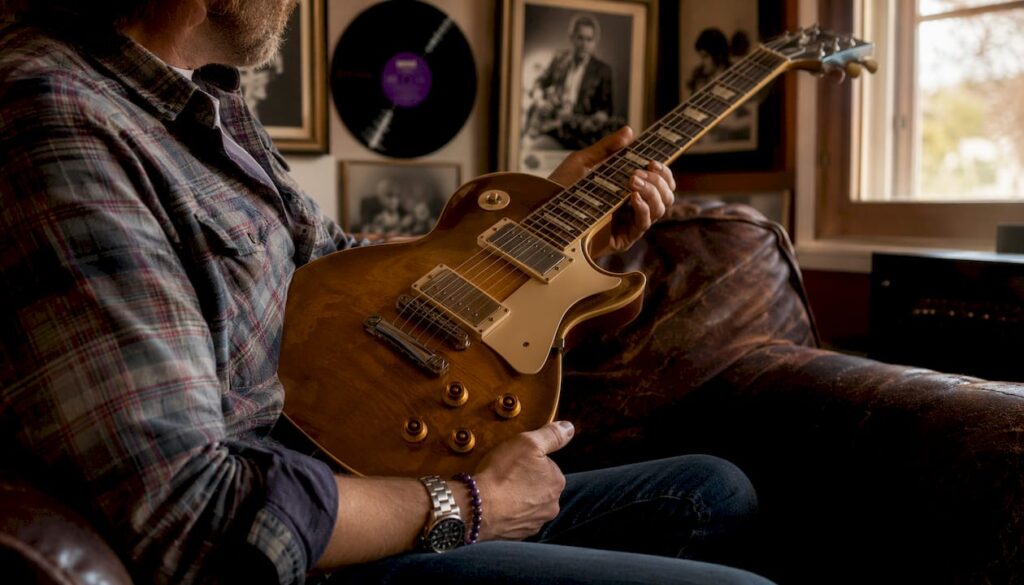
Artist association can multiply market value, but it also introduces volatility and provenance risk that buyers must price in. A standard 1959 Gibson Les Paul Standard in excellent original condition already commands a significant premium in the vintage market. Add documented Page or Clapton association and the price moves into a different category entirely.
Key value drivers:
- Documented provenance: a clear ownership chain from factory to present is the single most powerful value driver
- Stage use: photographic or video evidence of an instrument being played by the associated artist
- Originality: unmodified hardware, original finish, and period-correct electronics
- Condition: wear consistent with age and use; over-restoration can actually reduce value
- Notable modifications: for instruments like the Frankenstrat, the modifications are the provenance
Player-grade instruments (restored, set up to play) versus collector-grade instruments (original condition, minimal intervention) serve different buyers. A player-grade 1960s Strat might be accessible and tonally rewarding; a collector-grade example with original case candy and hang tags is a different asset class. Knowing which you want before you shop saves both money and disappointment.
Investor risk factors worth naming: outright fakes and forgeries are common in the high-value segment; over-restoration destroys provenance certainty; unverifiable claims of artist association are widespread; and market prices for specific models can spike around anniversaries or media events, then correct. The vintage guitar market trends for 2026 reflect continued demand for authenticated, documented examples.
How do you authenticate a vintage guitar before buying?
Use a provenance-first approach: paperwork and photographic evidence come before any physical inspection.
- Verify paperwork and photos — original receipts, case candy, owner’s manuals, and dated photographs of the instrument
- Confirm serial numbers and factory records — cross-reference the serial against published factory production records for the model and year
- Inspect hardware, finish, and electronics — look for period-correct components; mismatched parts are a red flag, not a selling point
- Consult expert opinion or certification — a specialist written opinion before funds transfer is standard practice for high-value purchases; use the guitar valuation workflow as a framework
- Use escrow or third-party verification — for any purchase above a threshold you would not absorb as a loss, escrow protects both parties
Red flags to walk away from:
- Inconsistent paperwork dates or mismatched serial ranges
- Non-original parts described as original
- Evasive seller responses to direct questions about modifications
- Dramatic price drops without explanation
- Claims of artist association supported only by verbal assertion
Pro Tip: Request dated, geotagged photos of every detail — headstock, serial number, neck pocket, pickup cavities, and wiring. If a seller cannot or will not provide them, treat that as a hard stop.
What is the smartest buying strategy for collectors?
Prioritize documented, certified listings and dealers with in-house evaluation or third-party certification. The channel matters as much as the instrument.
Recommended channels:
- Specialist auction houses with established vintage guitar departments
- Reputable vintage-focused dealers offering in-house evaluation and certification
- Curated marketplaces where listings include provenance documentation
- Private sales with escrow and an agreed inspection window
Transaction checklist — insist on all of these:
- Detailed provenance documentation (ownership chain)
- Original receipts or maintenance records where available
- Restoration records with parts documentation
- A return or inspection window before final payment
- Escrow or verified payment method for high-value transactions
On negotiation: request a conditional inspection clause before committing funds. Price anchors tied to independent appraisals give you leverage. A short-term hold agreement while you verify provenance is standard in the serious vintage market and any reputable seller will accept it. The collectible guitar features guide is a useful reference when building your inspection checklist.
Does restoration help or hurt collectible value?
Preservation of originality usually maximizes collector value. That said, careful, documented restoration can increase playability and marketability for player-grade instruments without destroying investment potential — as long as every step is recorded and original parts are retained.
Maintenance checklist for stored instruments:
- Climate control: 65–75°F, 45–55% relative humidity
- Use a quality humidifier in dry climates; monitor with a hygrometer
- Store in a hard case, away from direct sunlight and temperature swings
- Change strings on a schedule; use gauges appropriate to the neck relief
- Transport in a padded, hard-shell case with neck support
Before committing to restoration, decide whether the instrument is player-grade or collector-grade. For collector-grade examples, cosmetic stabilization (cleaning, light fret leveling, nut adjustment) is preferable to a full refinish. For player-grade instruments, a documented restoration workflow that retains original parts is the right approach.
Value-reducing mistakes: over-refinishing (especially stripping original lacquer), installing non-period-correct parts, and performing undocumented work. Any of these can reduce auction performance and make future authentication harder.
Key Takeaways
Provenance documentation is the single most important factor when buying or valuing a guitar tied to a legendary player — without it, even a genuine instrument is difficult to sell at full value.
| Point | Details |
|---|---|
| Provenance first | Always verify paperwork, serial numbers, and photographic evidence before any physical inspection. |
| Know the model traits | Each legendary player is tied to specific model features — PAF humbuckers, pre-CBS Strat specs, named instruments — that define collector value. |
| Player-grade vs. collector-grade | Decide your intent before buying: restored playability and original condition serve different investment goals. |
| Use escrow for high-value buys | Third-party verification and escrow protect against forgeries and unverifiable provenance claims. |
| Vintage-guitar-world | Offers curated vintage listings, professional valuation, certification, and restoration services for collectors navigating this market. |
What collectors underestimate about provenance
The conventional wisdom says condition is king. After years of watching instruments change hands, the more accurate claim is that documentation is king. A heavily played 1959 Les Paul with a clear ownership chain and photographic evidence of stage use will outperform a cleaner example with a murky history at auction, almost every time.
Rolling Stone’s expanded guitarist lists are worth watching not just for cultural interest but as a leading indicator of which players will see collector demand increase. When a blues or jazz guitarist enters mainstream critical consciousness, instruments associated with their style and era tend to follow. The market for guitars tied to Stevie Ray Vaughan, for example, expanded significantly after his posthumous critical rehabilitation in the 1990s — a pattern that repeats with each generation of rediscovery.
The one recommendation worth making plainly: before paying a premium price for any instrument with claimed artist association, request a detailed photo dossier and a dated provenance timeline. If the seller cannot produce both within a reasonable window, the premium is not justified.
How Vintage-guitar-world supports collectors at every step
Collectors who want expert guidance rather than guesswork have a direct route: Vintage-guitar-world offers a curated inventory of authenticated vintage and handcrafted guitars, professional valuation and certification services, and restoration support — all designed for buyers who need more than a listing and a price tag.

The services map directly to the risks this article describes. Provenance risk? Vintage-guitar-world’s in-house evaluation and certification process addresses it before a guitar reaches the listing. Restoration questions? The team provides documented restoration with original parts retention. Valuation uncertainty? A professional guitar valuation gives you an independent, defensible number before you commit funds. Testing appointments are available for collectors who want to play an instrument before purchasing.
Browse the curated inventory and valuation services at Vintage-guitar-world. Independent third-party appraisal is always recommended for high-value purchases — Vintage-guitar-world encourages it as standard practice.
This article is general information for collectors and enthusiasts. For high-value purchases, confirm current market values and provenance standards with a qualified specialist or primary source.
Useful sources for collectors
| Source | Best used for |
|---|---|
| Vintage Guitar magazine — Reader-voted rankings | Reader-voted rankings; tracking which players drive collector demand |
| Rolling Stone — 250 Greatest Guitarists | Broad genre coverage; identifying emerging collector interest beyond classic rock |
| Britannica — B.B. King | Named instrument history; provenance context for “Lucille” and ES-model guitars |
| Britannica — Les Paul | Design history and innovation context for Gibson Les Paul Standard collectibility |
| Wikipedia — Jimi Hendrix | Biographical and technical detail on Hendrix’s Strat use and technique |
| Wikipedia — Stevie Ray Vaughan | Setup documentation and Strat-era collector preferences |
| Vintage-guitar-world — Fascination Guitar | How player status drives collectibility; starting point for due diligence |
For high-value purchases, primary provenance documents — factory records, dated photographs, original receipts — and independent third-party certification remain the most reliable verification tools available.