













TL;DR:
- Handcrafted guitar value is driven by limited production, artisanal voicing, original condition, and proven provenance. Demand for boutique guitars has increased 7.7% in 2026, indicating that craftsmanship and scarcity boost market appreciation. Proper maintenance, original parts, and reversible upgrades help preserve long-term value for collectors.
Handcrafted guitar value boosts are defined by four core factors: limited production, artisanal construction, original condition, and verifiable provenance. These elements drive collector demand and long-term market appreciation far more than any single hardware upgrade. Boutique demand grew 7.7% in a single year as of 2026, confirming that the market rewards instruments built by hand in small numbers. Vintage-guitar-world applies these exact criteria when appraising and certifying handcrafted instruments, giving collectors a reliable standard to measure against.
1. What craftsmanship aspects most drive handcrafted guitar value boosts?
The single greatest value driver in a handcrafted guitar is the luthier’s process of voicing. Voicing involves meticulous attention to wood selection, bracing patterns, top thickness, and body geometry to produce instruments that improve tonal complexity over time. A factory guitar is built to a specification. A voiced guitar is built to a sound.
Collectors and musicians who understand voicing recognize it immediately in the way a guitar opens up after years of regular playing. The resonance deepens, the overtones multiply, and the instrument becomes more responsive. That acoustic evolution is a direct function of the luthier’s choices at the bench, not the price tag on the headstock.
“Handcrafted guitars are not merely instruments. They are long-term musical companions that deepen in tonal character with age and playing, the result of deliberate and patient artisanal work that no production line can replicate.”
Beyond voicing, the following craftsmanship features predict strong value retention over time:
- Hand-carved and fitted neck joints with no visible gaps or filler
- Individually dressed and leveled frets with consistent crown height
- Scalloped or hand-shaped bracing glued under controlled humidity
- Nitrocellulose or French polish finishes applied in thin coats
- Bookmatched tops selected for stiffness-to-weight ratio, not appearance alone
Pro Tip: Run a fingernail lightly across the fret ends. On a well-crafted guitar, every fret end is flush and smooth. Rough or sharp fret ends signal rushed finishing work, which often indicates shortcuts elsewhere in the build.
2. How does originality and condition influence value for handcrafted guitars?
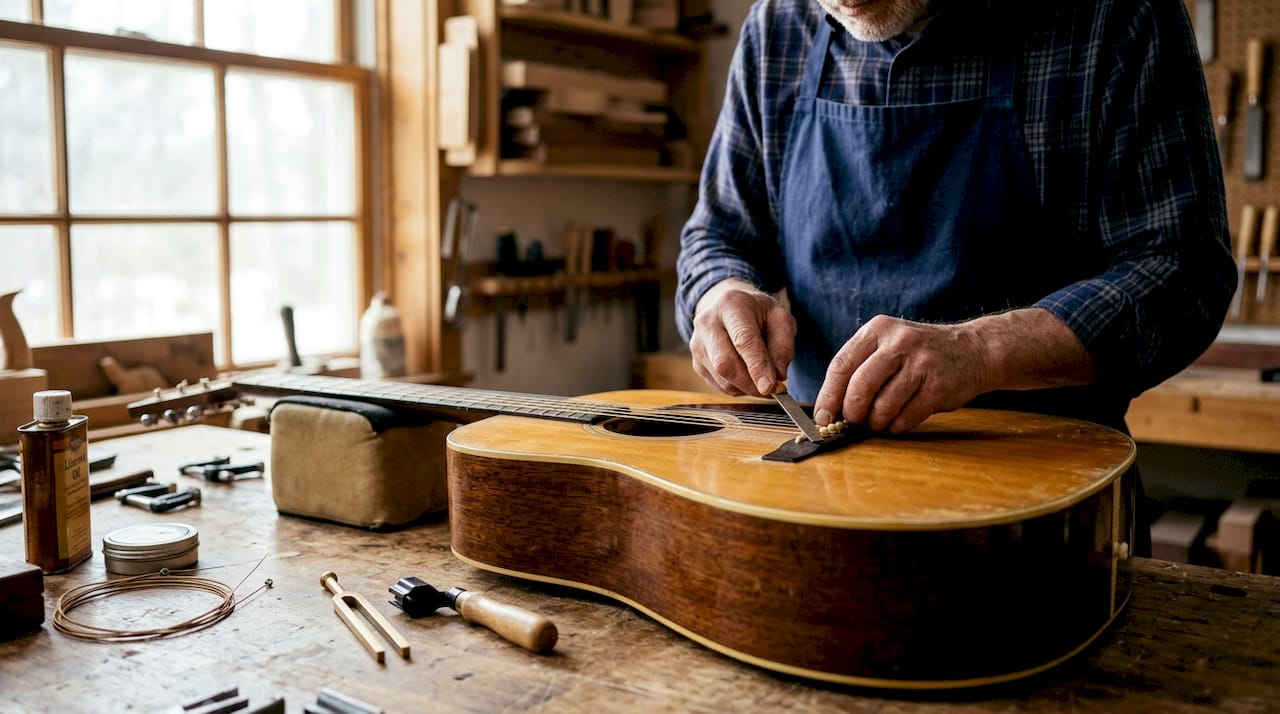
Original parts and finish are the single most scrutinized factors in a handcrafted guitar appraisal. All-original instruments command premium prices because they represent the luthier’s complete vision, unaltered. Even small deviations from original spec reduce that premium significantly.
Replacing a single set of tuners can reduce a guitar’s value by 10–20%. A full refinish averages a 35% value loss. These numbers reflect how seriously collectors treat originality as an authenticity signal.
Honest player wear, such as pick marks, fret wear, and natural checking in the finish, is accepted and sometimes welcomed. It confirms the guitar was played, not stored, and adds character without reducing value. Damage from impact, improper storage, or amateur repairs is a different matter entirely.
The condition factors collectors scrutinize most closely include:
- Finish originality: no touchups, oversprays, or color changes
- Headstock integrity: no cracks, repairs, or replaced tuner holes
- Fret wear: original frets preferred; refrets acceptable if disclosed
- Neck straightness: no twist, excessive relief, or hump at the body joint
- Binding condition: no shrinkage cracks, lifting, or replacement sections
- Electronics originality on electric models: original pots, caps, and pickups
Documented provenance, including original purchase receipts and ownership history, adds a 10–20% price premium. That premium reflects the collector market’s demand for verifiable authenticity, not just physical condition.
| Condition Factor | Value Impact |
|---|---|
| All-original finish | Maximum premium |
| Refinish (full) | Average 35% loss |
| Single tuner replacement | 10–20% loss |
| Honest player wear | Neutral to positive |
| Documented provenance | 10–20% premium |
3. What modifications and upgrades can safely boost guitar value?
The safest and most cost-effective guitar value enhancement is a professional setup. 37% of surveyed guitarists named a professional setup as the most impactful first upgrade, rating it above costly hardware changes. A setup typically costs $50–$80 and directly improves playability, intonation, and buyer confidence.
A well-executed setup signals to any serious buyer that the instrument has been maintained. It also reveals the guitar’s true potential. Many handcrafted guitars underperform simply because they have never been properly adjusted for the player’s string gauge and playing style.
Beyond setups, reversible modifications preserve resale value while improving function. Permanent modifications like refinishing or routing reduce value by 35% or more, while reversible swaps carry far smaller penalties.
| Modification Type | Avg. Value Impact | Reversibility |
|---|---|---|
| Professional setup | Positive | Fully reversible |
| Pickup swap | ~18% loss | High |
| Hardware change | ~12% loss | High |
| Neck reset | ~25% loss | Low |
| Full refinish | ~35% loss | None |
Upgrades that collectors accept without significant value penalty include:
- Nut replacement with bone or TUSQ (keep the original)
- Saddle replacement with bone (keep the original)
- Strap button replacement (keep the originals)
- Period-correct tuner upgrades on working instruments
Pro Tip: Always keep every original part you remove. Store them in a labeled bag inside the case. Buyers and appraisers assign higher value when original components are present, even if not currently installed.
The rule is simple: if you cannot reverse the modification and restore the guitar to factory spec, think carefully before proceeding. Invasive changes like routing new pickup cavities or reshaping the neck profile permanently alter the luthier’s original work and reduce collector desirability.
4. How do market trends and boutique builder reputation affect value?
Boutique builder reputation is now a primary driver of custom guitar investment returns. Demand for handcrafted instruments from boutique luthiers grew 7.7% in a single year as of 2026, with waiting lists at top builders stretching up to two years. That supply constraint is itself a value driver.
Entry-level boutique custom guitars now start around $2,000–$2,500, with mid-tier builds at $3,500–$6,000 and premium instruments reaching $8,000–$15,000 or more. Prices are trending upward due to material and labor costs. Collectors who buy now at current prices are positioned ahead of further appreciation.
Mass-market models face the opposite dynamic. Market saturation causes faster depreciation in production guitars, while limited-run boutique instruments hold or increase in value. The scarcity principle applies directly: fewer units built means fewer available on the secondary market.
Strategies collectors use to leverage these trends include:
- Researching builder waiting lists as a proxy for demand strength
- Prioritizing luthiers with documented build histories and consistent quality
- Buying directly from the builder when possible to establish provenance from day one
- Tracking resale prices for specific builders over 12–24 month periods before committing
Understanding the pentatonic scale and how players actually use a guitar also informs value. Instruments built for specific playing styles, such as fingerstyle classical or blues, attract dedicated communities of buyers who pay premiums for the right tool. A guitar built for a specific musical purpose holds value within that community better than a general-purpose instrument.
Brand recognition still matters, but boutique craftsmanship outperforms brand name alone on the secondary market. A well-documented guitar from a respected independent luthier consistently outperforms a mass-produced instrument from a household name at the same original price point.
Key Takeaways
Handcrafted guitar value is determined by originality, voicing quality, documented provenance, and the reputation of the builder, not by upgrades alone.
| Point | Details |
|---|---|
| Voicing drives long-term value | Hand-voiced guitars improve tonally with age, making craftsmanship the primary value multiplier. |
| Originality commands premiums | All-original instruments earn the highest prices; even one replaced tuner reduces value by 10–20%. |
| Professional setup is the best upgrade | A $50–$80 setup improves playability and buyer confidence more than costly hardware swaps. |
| Reversible mods protect resale value | Keep original parts from any swap; permanent changes like refinishing average a 35% value loss. |
| Boutique demand is rising | A 7.7% demand increase in 2026 and two-year waiting lists confirm boutique guitars appreciate reliably. |
What I’ve learned about value after years with handcrafted instruments
The collectors who get this right share one habit: patience. They do not rush to modify, upgrade, or flip. They acquire instruments from builders with proven track records, store them properly, and document everything from the first day of ownership.
The biggest mistake I see is well-intentioned modification. A collector buys a beautiful handcrafted guitar, decides the tuners could be better, installs a premium set, and discards the originals. The guitar plays slightly better. The value drops. The original tuners were part of the luthier’s complete vision, and their absence is noticed immediately by any serious buyer.
My practical advice is this: get a professional setup on every new acquisition before you do anything else. It costs almost nothing, reveals the guitar’s true character, and signals to future buyers that the instrument was cared for. After that, play it. A guitar that has been played regularly sounds better than one that has been stored, and experienced collectors hear that difference.
Provenance documentation is the other habit worth building from day one. Keep receipts, photographs, and any correspondence with the builder. That paper trail adds a measurable premium at resale and removes doubt from the transaction entirely.
The blues scale and the instruments built to express it remind us that guitars are tools for music first. The best investment strategy is to buy instruments you genuinely want to play. Guitars that get played develop the tonal depth that makes them desirable. Guitars that sit in cases do not.
— Vintage
Handcrafted guitars at Vintage-guitar-world
Vintage-guitar-world curates handcrafted and vintage instruments selected for originality, condition, and documented history. Every guitar in the collection is evaluated against the same criteria discussed here: craftsmanship quality, originality of parts, and verifiable provenance.

Collectors looking to understand what separates a good instrument from a great investment will find the types of vintage guitars guide an authoritative starting point. For deeper assessment skills, the guitar craftsmanship checklist at Vintage-guitar-world walks through every physical feature worth examining before purchase. The shop itself offers classical, flamenco, acoustic, and electric instruments from respected builders, each with full condition notes and appraisal support available on request.
FAQ
What are the top factors that boost handcrafted guitar value?
Limited production, artisanal voicing, all-original condition, and documented provenance are the four primary value drivers. Boutique demand grew 7.7% in 2026, confirming that scarcity and craftsmanship consistently outperform mass production on the secondary market.
Does a professional setup increase guitar resale value?
A professional setup, typically costing $50–$80, is cited by 37% of guitarists as the most impactful first upgrade. It improves playability and buyer confidence without altering the instrument’s originality.
How much value does a guitar lose from a refinish?
A full refinish averages a 35% value loss because it permanently alters the luthier’s original work and removes a key authenticity signal that collectors prize.
Does provenance documentation add real value to a handcrafted guitar?
Documented ownership history and original purchase receipts add a 10–20% price premium. Collectors treat verifiable provenance as a direct authenticity and rarity signal.
Are reversible modifications safe for handcrafted guitar resale value?
Reversible modifications like pickup swaps and hardware changes carry smaller value penalties, averaging 12–18% loss, compared to permanent changes. Keeping all original parts reduces that penalty further and preserves full collector appeal.