














TL;DR:
- A premium-grade guitar is built with superior tonewoods, craftsmanship, and upgraded hardware for reliable playability and durability. Quality indicators include smooth fret ends, tight neck joints, and consistent finish, not just price. Such guitars retain value, perform consistently, and offer better long-term experience for players and collectors.
A premium-grade guitar is defined as an instrument built with superior tonewoods, meticulous craftsmanship, and upgraded hardware that delivers exceptional playability, tonal consistency, and long-term durability. The term “premium-grade” is widely used by players and retailers, but the recognized industry standard is luthier-grade or professional-grade quality. Both phrases describe the same benchmark: a guitar where every build decision serves performance, not cost reduction. Price alone does not determine premium status. A $3,000 guitar with poor fretwork fails the standard. A well-built instrument at $1,200 with AAA tonewoods and precise neck geometry can meet it. Understanding this distinction matters whether you are buying your first serious instrument or adding to a collection.
What is a premium-grade guitar, exactly?
A premium-grade guitar meets a specific set of build criteria across materials, construction, and components. Superior craftsmanship and quality control define the category, not the price tag. The core upgrade areas are neck fit, finishing quality, fretwork precision, and the grade of tuners, bridges, and pickups installed at the factory.
The practical implication is significant. A premium guitar arrives ready to play. You do not need to level frets, adjust the nut, or swap out tuners before your first session. Budget guitars routinely require $100–$200 in setup work to reach the same baseline. That hidden cost narrows the price gap between tiers faster than most buyers expect.
Named builders like Furch, Collings, and Santa Cruz Guitar Company operate at this standard consistently. Their instruments share one trait: every build decision is deliberate, and the quality is repeatable across production runs.
What materials and tonewoods qualify as premium-grade?
Premium guitars use AAA or master-grade tonewoods selected for stiffness, resonance, and visual clarity. The wood grade is not cosmetic. Stiffness-to-weight ratio directly affects how a top vibrates and projects sound. Furch’s 2026 acoustic models use AAA Sitka spruce tops and Indian rosewood backs and sides, with individual voicing applied to each top and back plate before assembly.
The most common premium tonewoods in 2026 production guitars include:
- Sitka spruce: The standard for acoustic tops. Stiff, light, and responsive across a wide dynamic range.
- Engelmann spruce: Softer than Sitka, warmer in tone, favored for fingerstyle players.
- Indian rosewood: Dense, rich in overtones, and the most widely used premium back and side wood since Brazilian rosewood became restricted.
- Mahogany: Warmer and more midrange-focused than rosewood. Common in premium parlor and 00-style guitars.
- Ebony: The top choice for fingerboards at the premium tier. Harder and smoother than rosewood alternatives.
The species alone does not guarantee premium results. Wood voicing and builder skill in adjusting thickness and stiffness determine final tonal properties. Two tops cut from the same Sitka spruce log can perform differently depending on how the luthier thins and braces each one. This is why luxury guitar building requires skilled voicing beyond species selection. It is also why solid wood construction is non-negotiable at the premium tier. Laminate tops are engineered for stability and cost control, not acoustic performance.
Pro Tip: When evaluating a guitar’s top, tap it lightly with your knuckle near the bridge. A premium solid top produces a clear, resonant knock. A laminate sounds dull and flat by comparison.
| Tonewood | Grade used in premium guitars | Primary tonal character |
|---|---|---|
| Sitka spruce | AAA or master grade | Bright, articulate, wide dynamic range |
| Engelmann spruce | AAA | Warm, complex, fingerstyle-friendly |
| Indian rosewood | AAA | Rich overtones, balanced bass and treble |
| Mahogany | Select or premium | Warm midrange, focused and dry |
| Ebony | Premium fingerboard grade | Fast, smooth, precise feel |
How craftsmanship and build quality define premium guitars
Feel and build quality are the most immediate and reliable markers of premium quality in any guitar. You notice them before you play a single note. The neck slides into the pocket without gaps. The frets are level, polished, and end-dressed so the edges do not catch your hand. The finish is even, with no pooling at the binding or rough patches near the heel.
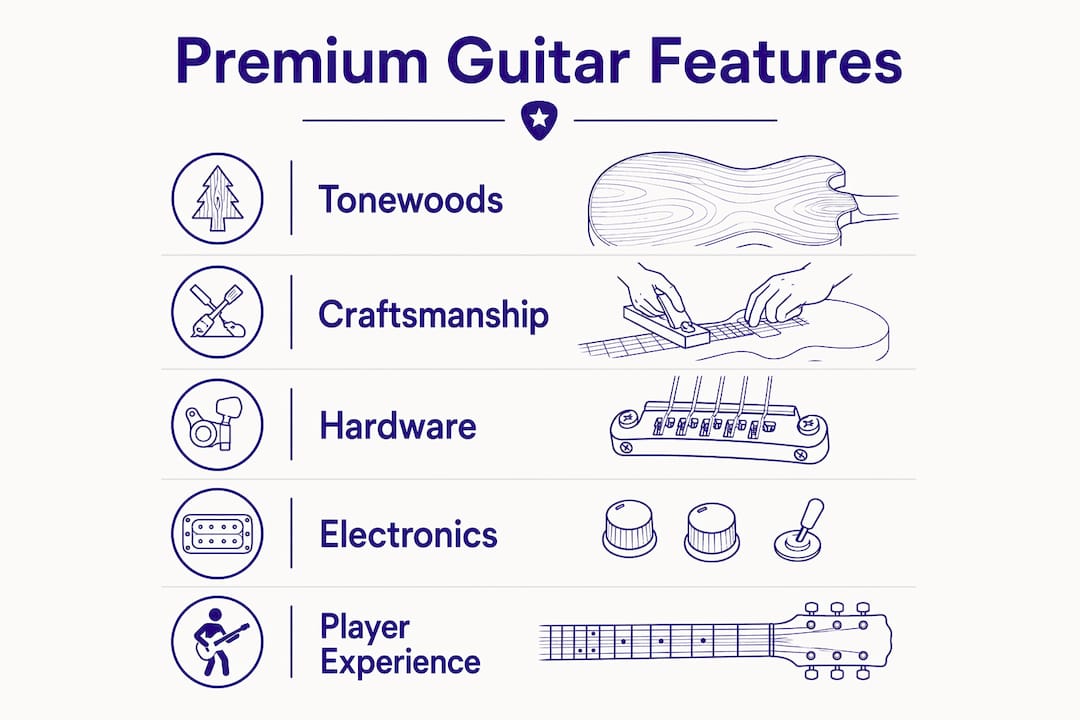
Handcrafted guitars differ from mass-produced instruments in one critical way: tolerance control. A factory producing 500 guitars per day cannot apply the same individual attention that a small shop building 50 per month can. The craftsmanship difference shows up in neck profile accuracy, fret seating consistency, and how the guitar responds to humidity changes over time.
When assessing build quality on any instrument, check these points directly:
- Fret ends: Run your thumb along the fret ends on the treble side. Premium guitars have smooth, rounded ends. Sharp edges indicate incomplete finishing.
- Neck joint: Look for gaps between the neck heel and the body. Any visible gap signals a tolerance problem.
- Nut slots: Press each string behind the first fret. If the open string buzzes, the nut slots are cut too low, a common budget-guitar shortcut.
- Finish consistency: Examine the binding and the area around the soundhole under direct light. Uneven finish thickness is a sign of rushed production.
- Tuner operation: Turn each tuner slowly. Premium tuners move smoothly with no backlash or wobble.
The guitar craftsmanship checklist at Vintage-guitar-world covers these points in detail for collectors who want a structured evaluation process. A premium guitar passes all five checks without exception.
What role do premium hardware and electronics play?
Upgraded hardware at the premium tier includes locking tuners, high-mass bridges, name-brand pickups, and electronics with smooth taper response. Each component serves a specific function that budget hardware cannot match reliably.
Locking tuners reduce string slippage during tuning and after string bends. They are standard on premium electric guitars from builders like PRS and on many high-end acoustics with onboard electronics. High-mass bridges on electrics improve sustain and intonation stability. On acoustics, bone saddles and nuts replace the plastic found on budget instruments. Bone transmits vibration more efficiently, which translates directly into better resonance and note clarity.
Electronics quality separates premium acoustic-electrics from budget models in a way that players notice immediately. Higher-end volume and tone controls use better potentiometers with smooth, linear taper. Budget guitars use cheaper pots that cause abrupt volume jumps at certain positions. That inconsistency is frustrating in a live performance context where small adjustments matter.
Modern premium builders also incorporate carbon fiber for necks and structural reinforcement. Carbon fiber necks resist humidity and temperature changes better than wood alone. Emerald Guitars builds full carbon fiber bodies and necks for players who need maximum stability across climates. This represents the forward edge of premium material innovation in 2026.
How do premium-grade guitars differ in player experience and value?
Blind tests consistently show less tonal difference between price tiers than players expect, but consistency and tactile quality improve noticeably at the premium level. The premium difference is real. It lives in feel, reliability, and predictability rather than in raw sound alone.
Here is what that means in practice for players and collectors:
- Playability from the first session. Premium guitars arrive with a professional setup. Action, intonation, and relief are dialed in. You spend time playing, not adjusting.
- Consistent performance night after night. Tighter build tolerances mean the guitar behaves the same way every time you pick it up. Budget guitars drift more with temperature and humidity changes.
- Long-term durability. Better materials and joinery hold up over decades. A well-built guitar from the 1960s or 1970s still plays beautifully today because the craftsmanship was sound from the start.
- Value retention and appreciation. Premium guitars hold or appreciate in value over time. Durability, brand reputation, and craftsmanship all contribute to long-term worth. Budget guitars depreciate quickly and are difficult to resell.
- Collector desirability. Serious players and collectors prefer premium instruments for predictable performance and tighter tolerances that reduce the need for hardware corrections.
Pro Tip: If you are buying a premium guitar as an investment, review the guitar valuation guide at Vintage-guitar-world before you purchase. Knowing how craftsmanship, provenance, and brand affect resale value protects your investment from day one.
The handcrafted guitar care guide at Vintage-guitar-world explains how proper maintenance preserves both tone and resale value over the long term. Premium guitars reward attentive ownership.
Key Takeaways
A premium-grade guitar is defined by superior craftsmanship, AAA tonewoods, upgraded hardware, and consistent build quality that delivers reliable playability and long-term value.
| Point | Details |
|---|---|
| Premium means craftsmanship, not price | Superior neck fit, fretwork, and components define the tier, not the price tag alone. |
| Tonewoods must be solid and graded | AAA solid tonewoods like Sitka spruce and Indian rosewood are non-negotiable at the premium level. |
| Hardware upgrades are functional | Locking tuners, bone saddles, and quality electronics improve tuning stability and tonal control directly. |
| Feel is the most reliable test | Smooth fret ends, tight neck joints, and consistent setup quality are the fastest indicators of premium build. |
| Premium guitars hold their value | Craftsmanship, durability, and brand reputation make premium instruments viable long-term investments. |
What I have learned after years with premium guitars
Price is a proxy for quality, not a guarantee of it. I have played $4,000 guitars that felt unfinished and $1,500 guitars that were flawless. The difference always came down to cumulative craftsmanship decisions, not a single exotic part or a famous brand name on the headstock.
The most common mistake I see collectors make is fixating on tonewood species. Brazilian rosewood sounds exotic and commands a premium price. But a master-built guitar with Indian rosewood, voiced correctly by a skilled luthier, will outperform a poorly built Brazilian rosewood instrument every time. The cohesive design decisions across the entire build matter more than any single component.
When I assess a guitar in person, I go straight to the fret ends and the neck joint. Those two points tell me more about build quality than anything else. If the frets are sharp and the neck has a visible gap at the heel, I put the guitar down regardless of the price or the label. A premium guitar earns that status through execution, not marketing.
For serious players, the investment in a premium instrument pays off in ways that are hard to quantify until you experience them. You stop fighting the guitar and start playing it. That shift in focus is worth more than any tonal upgrade.
— Vintage
Premium and vintage guitars at Vintage-guitar-world
Vintage-guitar-world curates a selection of rare, restored, and certified instruments that meet the premium-grade criteria this article describes. Every guitar in the collection is evaluated for craftsmanship, tonal quality, and provenance before it is listed.

Whether you are a collector seeking a verified investment-grade instrument or a serious player looking for a guitar that performs without compromise, the vintage guitar catalog covers classical, flamenco, acoustic, and electric models with full historical context and expert documentation. Vintage-guitar-world also offers guitar testing appointments and valuation services so you can assess any instrument against the standards covered here before you commit. If you want to understand what separates a collectible instrument from a commodity, the signs of collectible guitars guide is a strong next step.
FAQ
What is the premium guitar definition in simple terms?
A premium-grade guitar is an instrument built with AAA tonewoods, precise craftsmanship, and upgraded hardware that delivers consistent playability and durability. Price alone does not qualify a guitar as premium.
How do I identify premium guitar quality quickly?
Run your thumb along the fret ends and check the neck joint for gaps. Smooth frets and a tight neck joint are the fastest indicators of premium build quality.
Do high-end guitars sound better than budget guitars?
Blind tests show less tonal difference between price tiers than most players expect. The real advantage of premium guitars is consistency, feel, and build reliability rather than a dramatic difference in raw tone.
What makes a guitar hold its value over time?
Craftsmanship quality, brand reputation, and durable materials all contribute to long-term value retention. Premium guitars built with solid tonewoods and tight tolerances are the most likely to hold or appreciate in value.
Are luxury guitars worth it for hobbyists, not just professionals?
A premium guitar rewards any player who practices regularly. The improved playability and setup quality reduce physical frustration and let you focus on technique rather than fighting the instrument.