













TL;DR:
- Guitar checking refers to fine cracks that develop in nitrocellulose lacquer as the instrument ages, serving as a reliable sign of authenticity and age. Environmental factors like temperature and humidity swings accelerate checking, which can be distinguished from artificial relicing by crack pattern, location, and depth. Proper maintenance including gradual acclimation and stable humidity helps preserve authentic checking without damaging the guitar’s structural integrity.
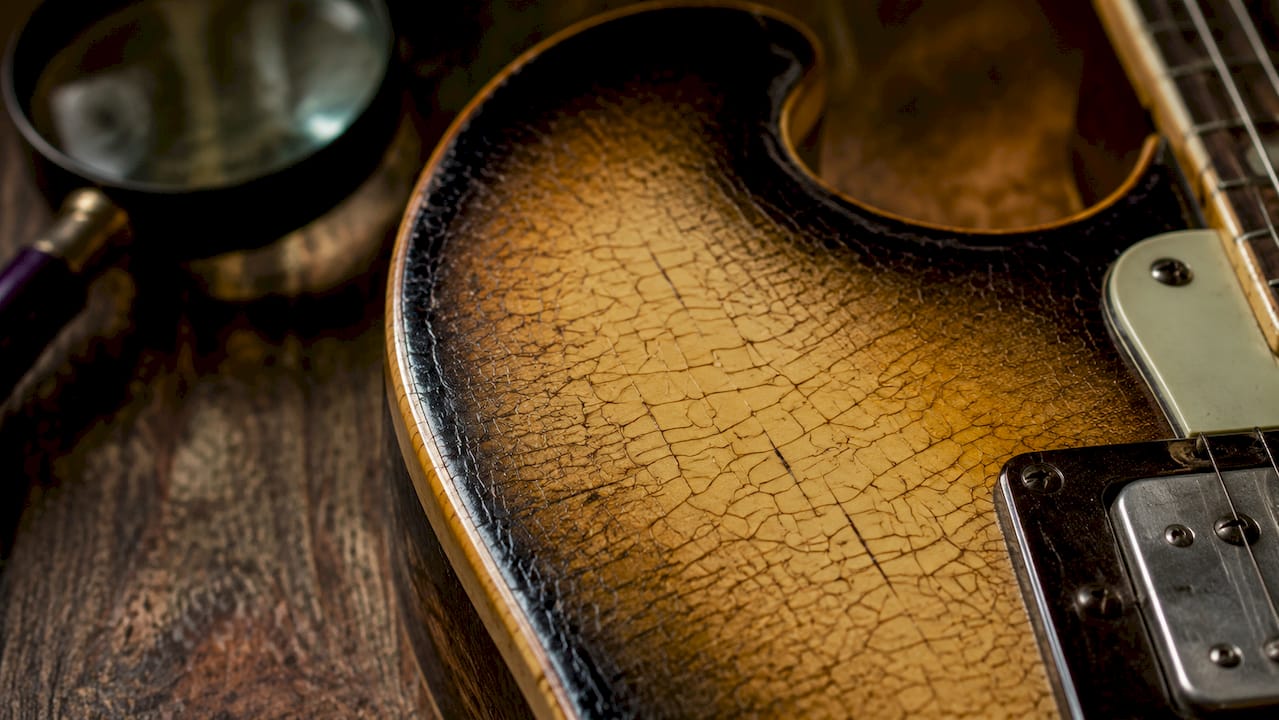
Guitar checking is the network of fine cracks that develop in a nitrocellulose lacquer finish as the instrument ages and responds to shifts in temperature and humidity. The industry term is “finish checking,” and it stands as one of the most reliable indicators of a guitar’s age and authenticity. For collectors and players evaluating vintage instruments, understanding this process is not optional. It separates a genuinely aged 1959 Gibson Les Paul from a factory-reliced reissue, and it directly affects valuation, playability decisions, and long-term care.
What is guitar checking and why does it happen?
Finish checking occurs because wood and lacquer respond to environmental changes at different rates. Wood expands and contracts with humidity shifts, while nitrocellulose lacquer shrinks and hardens as it ages. When the two materials move at different speeds, the finish cracks. Natural checking in nitrocellulose develops over 5–10 years as the lacquer becomes increasingly brittle.
The triggers are almost always environmental. Rapid swings in temperature are the most common cause. Taking a cold guitar from a car trunk into a warm room, or leaving an instrument near a heating vent, creates the kind of thermal shock that accelerates cracking. Humidity changes compound the problem. A guitar stored in a dry climate will see its wood contract while the finish holds its shape, pulling the lacquer apart from within.
Fender’s technical documentation confirms that thermal acclimation is the single most effective way to slow checking progression. Allowing a guitar several hours to adjust to a new environment before opening the case reduces the stress on the finish significantly.
Pro Tip: Never open a guitar case immediately after bringing it in from the cold. Leave it closed for at least two hours so the instrument can acclimate gradually.
Key environmental triggers that accelerate checking:
- Rapid temperature changes of more than 20°F within a short period
- Humidity drops below 40% relative humidity, which dries and contracts wood quickly
- Direct sunlight exposure, which heats the finish surface unevenly
- Storage near air conditioning or heating vents
- Touring conditions where guitars move between climates repeatedly
How do you tell natural checking from artificial relicing?
This question sits at the heart of every serious vintage guitar inspection. Natural checking patterns follow the wood grain on flat surfaces and radiate outward from edges and corners. The cracks are irregular, unpredictable, and vary in depth and spacing. That organic randomness is the fingerprint of real aging.
Artificial relicing uses thermal shock, specifically freeze-thaw cycling, to induce checking on new guitars. The result looks convincing at first glance, but thermal shock creates patterns that are often too uniform and too symmetrical to pass close inspection. A relic job applied to a factory guitar tends to show evenly spaced cracks across the entire body surface, without the variation you see on a guitar that aged through decades of real use.
Location matters just as much as pattern. Authentic checking rarely appears on guitar necks. The neck sees constant handling, which keeps the finish more flexible through friction and body heat. Checking on a vintage guitar concentrates on the body, particularly around the edges, the top near the bridge, and areas exposed to direct light over decades.
Here is a step-by-step approach to assessing checking authenticity during a guitar inspection:
- Examine crack distribution. Real checking clusters around stress points like edges and binding seams. Uniform coverage across the entire body is a red flag.
- Check the neck. Significant checking on the back of the neck suggests artificial aging or a refinish.
- Look at crack depth. Natural cracks vary in depth. Shallow, consistent cracks across a large area suggest mechanical induction.
- Assess the color inside the cracks. Genuine aged checking often shows darkening inside the cracks from years of grime accumulation. Fresh relic cracks look clean.
- Cross-reference with other wear. Real aging produces checking alongside fret wear, hardware oxidation, and finish dulling. Checking without corresponding wear elsewhere is suspicious.
Pro Tip: Use a jeweler’s loupe or a 10x magnifying glass to examine crack edges up close. Natural checking shows micro-chipping and irregular edges. Artificially induced cracks tend to have cleaner, more consistent walls.
For a deeper look at the full authentication process, the vintage guitar authenticity guide at Vintage-guitar-world covers the complete range of markers beyond finish condition.
Nitrocellulose vs. polyurethane vs. polyester finishes
Understanding finish types is non-negotiable for anyone conducting a serious guitar condition assessment. The finish determines whether checking is even possible, and it tells you a great deal about when and where a guitar was made.
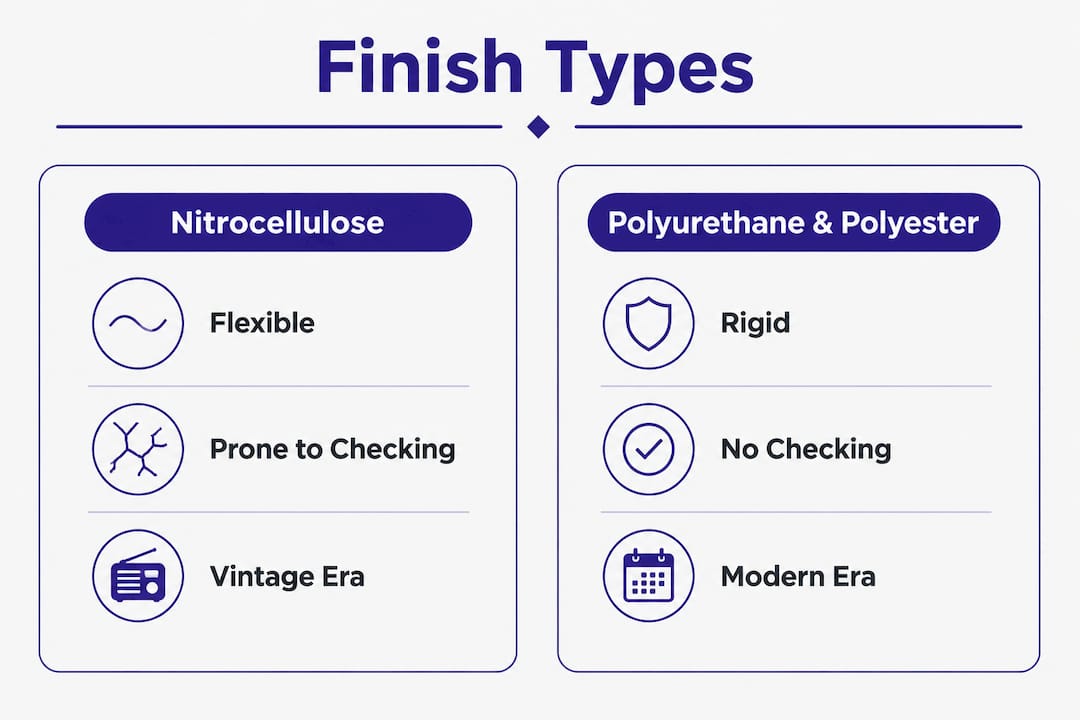
Checking is unique to nitrocellulose lacquer. Polyurethane and polyester finishes do not develop these cracks because they remain flexible and durable over time. Poly finishes resist checking entirely, even after 20 years of regular use. That fact alone makes finish identification a critical first step in any guitar evaluation.
| Finish Type | Flexibility | Checking Risk | Typical Era | Collector Notes |
|---|---|---|---|---|
| Nitrocellulose Lacquer | Low with age | High | Pre-1970s, select modern | Authentic aging marker; valued by collectors |
| Polyurethane | High | None | 1970s onward | Durable but not a vintage authenticity indicator |
| Polyester | Very high | None | 1980s onward | Thick, plastic-like; rarely found on collectible instruments |
| Water-based Lacquer | Moderate | Low | Modern boutique | Eco-friendly; minimal checking potential |
The thickness of a nitrocellulose finish also determines how dramatically it checks. Thicker finishes produce more pronounced checking. A guitar with a heavy lacquer application from the 1950s will show deep, dramatic cracking after decades of aging. A thin nitrocellulose coat may show minimal cracking even under the same environmental stress. This variability matters when you are comparing two guitars of the same era and trying to explain why one shows heavy checking and the other does not.
For collectors, a guitar with a poly finish claiming to be a pre-1970s vintage instrument is an immediate inconsistency. Fender and Gibson both transitioned away from nitrocellulose toward polyester and polyurethane during the late 1960s and early 1970s, largely for production efficiency. A claimed 1964 Stratocaster with a thick poly finish requires serious scrutiny.
How to maintain a guitar with finish checking
Checking does not mean a guitar is damaged beyond use. Many collectors and players accept checking as part of a vintage guitar’s character and charm. The goal of maintenance is not to eliminate checking but to prevent it from progressing into structural finish failure.
Practical maintenance steps for guitars showing checking:
- Acclimate before opening. Always allow a cold or hot guitar to reach room temperature inside its case before exposing it to the air. This single habit reduces thermal stress more than any product.
- Use non-silicone polish. Silicone-based polishes fill cracks temporarily but can cause long-term finish adhesion problems. Non-silicone polish and a soft cloth are the correct tools for cleaning a nitrocellulose finish.
- Avoid vinyl and plastic accessories. Certain guitar straps, pickguard materials, and case linings contain chemicals that react with nitrocellulose lacquer. Smoke, sweat, and grease also accelerate finish aging and discoloration.
- Store at stable humidity. Keep the storage environment between 45% and 55% relative humidity. A D’Addario Two-Way Humidification System or a Boveda pack inside the case maintains this range without active monitoring.
- Use a hardshell case. A quality hardshell case buffers against rapid environmental changes far better than a gig bag. For a vintage instrument with checking, this is not optional.
The classical guitar restoration guide at Vintage-guitar-world covers long-term preservation strategies for instruments where finish integrity directly affects value.
Key takeaways
Finish checking is the definitive aging marker for nitrocellulose lacquer guitars, and reading it correctly separates informed collectors from buyers who overpay for reliced instruments.
| Point | Details |
|---|---|
| Checking is finish-specific | Only nitrocellulose lacquer develops checking; poly finishes never crack this way. |
| Natural patterns are irregular | Authentic checking follows wood grain and concentrates on the body, not the neck. |
| Thickness affects severity | Thicker lacquer produces deeper, more dramatic cracks than thin finish applications. |
| Environment drives progression | Rapid temperature and humidity swings accelerate checking faster than age alone. |
| Maintenance slows the process | Gradual acclimation, non-silicone polish, and stable humidity storage preserve finish condition. |
What checking taught me about reading a guitar
I have handled hundreds of vintage instruments over the years, and finish checking is still the detail that tells me the most in the first thirty seconds. Not because cracks are dramatic, but because they are honest. A guitar cannot fake the way its finish aged.
The misconception I encounter most often is that checking signals damage. Players see the cracks and assume the guitar needs repair. Checking is widely considered a desirable sign of authentic aging, not a flaw. It tells you the instrument lived through real decades in real environments. That history is part of what you are buying.
What I find more interesting is how checking reveals playing history. Heavy checking concentrated around the forearm contour on a Stratocaster body tells me someone played that guitar constantly. Checking only on the back, near the strap button area, suggests a player who stood and performed. The cracks are a map.
The harder lesson is knowing when checking crosses from character into concern. Cracks that run through the finish into the wood, or that show lifting edges where the lacquer is separating from the body, require attention before they worsen. A guitar craftsmanship checklist helps separate cosmetic aging from structural issues worth addressing.
My honest recommendation: learn to read checking before you buy any vintage instrument. It takes practice, but it is the fastest way to develop an eye for authenticity.
— Vintage
Find authentic vintage guitars at Vintage-guitar-world
Understanding finish checking changes how you evaluate every vintage instrument you encounter. Vintage-guitar-world applies exactly this level of scrutiny to every guitar in its collection, from pre-war acoustics to mid-century electric classics.

Each listing includes detailed condition notes, finish assessments, and historical context so you know exactly what you are buying. The vintage guitar types guide covers features, history, and investment potential across every major category. Whether you are building a collection or searching for a player-grade vintage instrument, Vintage-guitar-world offers the expert evaluation and curated selection that serious buyers rely on.
FAQ
What does guitar checking look like?
Guitar checking appears as a network of fine, irregular cracks across the lacquer finish surface. The cracks typically follow wood grain lines and concentrate around edges, binding seams, and high-stress areas of the body.
Does checking affect a guitar’s sound or playability?
Finish checking is purely cosmetic and does not affect tone or playability. The cracks remain in the lacquer layer and do not penetrate the wood structure of the instrument.
Can checking be repaired or reversed?
Checking cannot be reversed without a full refinish, which typically reduces a vintage guitar’s collector value. Most owners and collectors choose to leave checking intact as evidence of authentic aging.
How do i know if my guitar has nitrocellulose lacquer?
Nitrocellulose lacquer feels thinner and less plastic-like than poly finishes. It also reacts to certain solvents and smells faintly of lacquer thinner when rubbed. Guitars made before the early 1970s by Fender and Gibson almost always used nitrocellulose.
Does checking lower a vintage guitar’s value?
Natural checking on a vintage guitar generally does not lower its value and often confirms authenticity. Heavy checking that includes lifting lacquer or finish separation may require disclosure and can affect pricing depending on severity.