













TL;DR:
- Spanish guitars feature a nylon-string, flat-top design with signature soundboard and fan bracing that define their warm tone. Critical elements include carefully graduated soundboards of cedar or spruce, precise internal bracing, and the characteristic 12th fret neck joint. Flamenco models distinguish themselves with cypress wood, lower action, and protective golpeador plates, emphasizing playability and durability.
The Spanish guitar is defined as a nylon-string instrument with a flat top soundboard, a single round sound hole, and a body shape standardized by Antonio de Torres Jurado in the late 19th century. These signature elements of Spanish guitars are not decorative choices. They are engineering decisions that produce the warm, sustained tone this instrument is known for worldwide. Whether you play classical repertoire, collect vintage instruments, or study flamenco, understanding these features changes how you hear and evaluate every guitar you pick up.
1. the signature elements of spanish guitars start with the soundboard
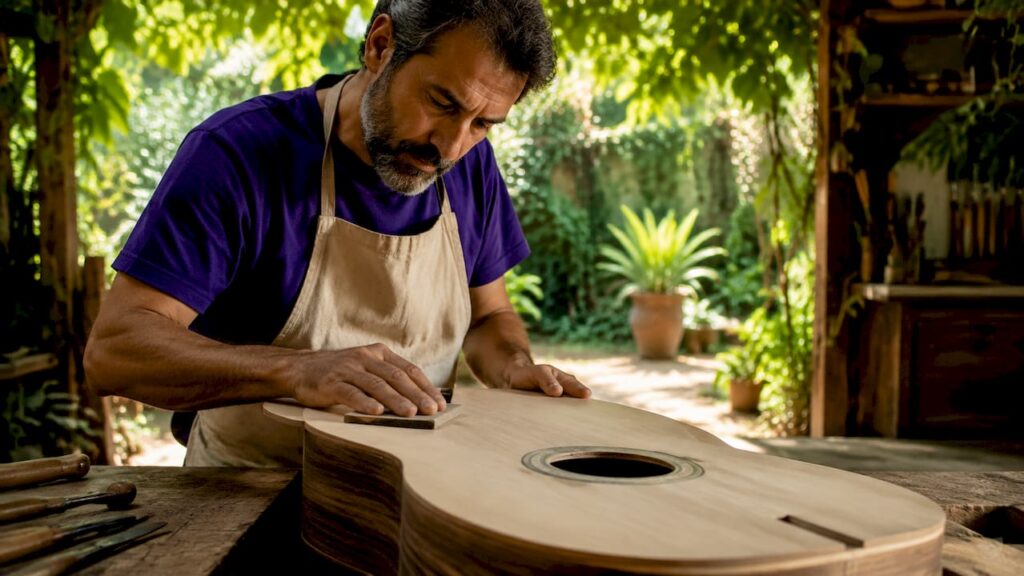
The soundboard is the single most important component of any Spanish guitar. Top thickness and bracing matter more than back and side woods for sound projection. That means the front plate of the guitar does the heavy lifting, and every decision a luthier makes about it shapes the final voice of the instrument.
Spanish guitar tops are typically made from either cedar or spruce. Cedar produces a warmer, darker tone that responds well at lower playing volumes. Spruce delivers more brightness and clarity, with a tone that opens up over decades of playing. Both woods are cut to a thickness of 2–3 mm, thin enough to vibrate freely but strong enough to hold under string tension for generations.
Pro Tip: When evaluating a Spanish guitar, tap the soundboard lightly with one knuckle. A clear, bell-like resonance indicates well-seasoned, properly graduated wood. A dull thud suggests either poor wood quality or excessive finish buildup.
2. back and side woods define the tonal palette
The back and sides of a Spanish guitar shape how sound reflects and projects outward. Rosewood, mahogany, and cypress are the most common choices, and each contributes distinct timbral qualities to the instrument’s overall character.
| Wood | Tonal Character | Common Use |
|---|---|---|
| Brazilian Rosewood | Rich, complex, deep bass | High-end classical guitars |
| Indian Rosewood | Warm, balanced, full midrange | Mid-range classical guitars |
| Mahogany | Clear, focused, punchy | Student and mid-level guitars |
| Cypress | Bright, dry, percussive | Traditional flamenco guitars |
Brazilian rosewood is now protected under international trade agreements, which makes vintage instruments built with it significantly more valuable to collectors. Indian rosewood became the standard replacement and delivers excellent results. Cypress is the defining wood of the flamenco tradition, producing the dry, cutting tone that cuts through the sound of dancers’ footwork.
Visual inlays and purfling along the body edges also signal craftsmanship quality. Fine Spanish guitars feature wood binding and decorative strips that require hours of precise handwork to install correctly.
3. internal fan bracing: the engineering signature
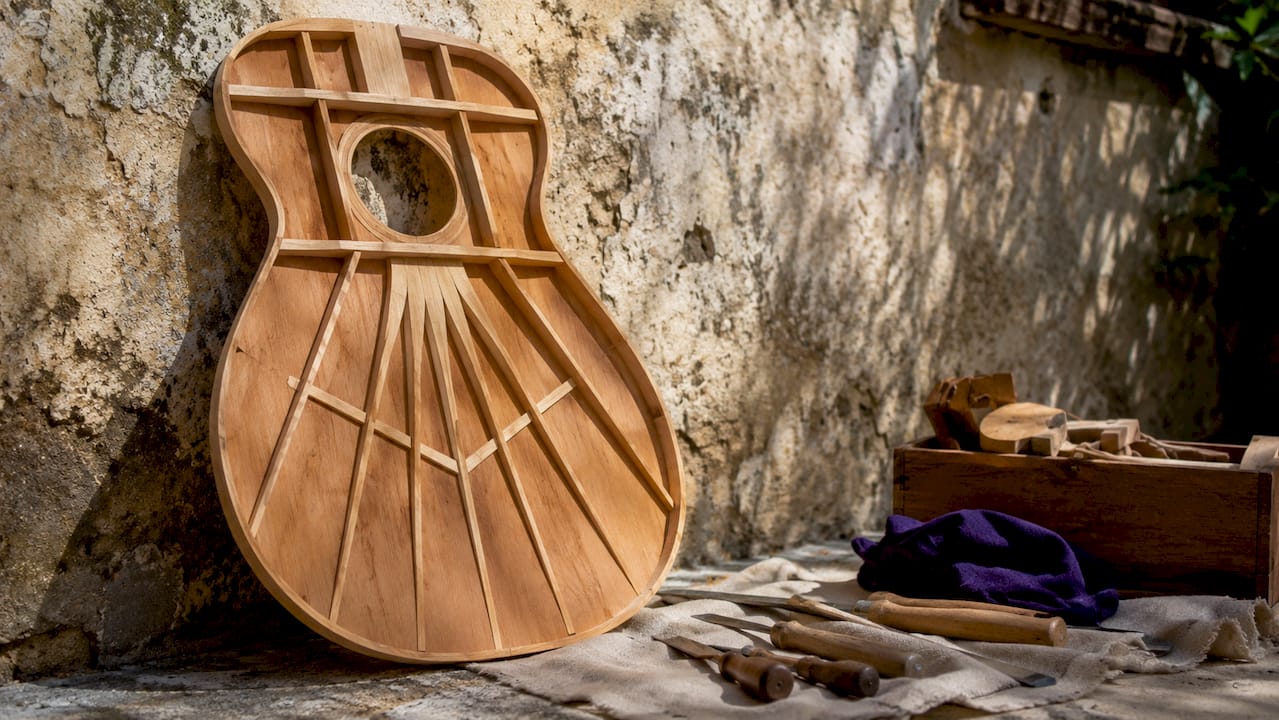
Fan bracing is the structural system that makes the Spanish guitar sound like itself. Antonio de Torres developed the fan bracing system, along with the guitar’s scale length of approximately 640 mm, which together define the modern Spanish guitar sound. His design placed thin wooden struts in a fan pattern beneath the soundboard, allowing the top to vibrate across its full surface while maintaining structural integrity.
The number and placement of fan struts varies between makers and directly affects tone. A seven-fan pattern is the most common classical configuration. Some luthiers use five fans for a warmer, rounder sound. Others experiment with asymmetrical layouts to balance treble and bass response across the strings.
Modern builders have pushed this further. Double-top constructions use two thin wooden plates separated by Nomex honeycomb or carbon fiber lattice, reducing weight while increasing stiffness and projection. These guitars can be significantly louder than traditional builds without losing the warmth that defines the Spanish guitar character.
Bracing patterns and materials continue to be a defining characteristic influencing tonal balance and sustain. Understanding this helps collectors recognize why two guitars built from identical woods can sound completely different.
4. the neck joint at the 12th fret
The placement of the neck-body joint is a structural signature that separates Spanish classical guitars from most other guitar types. The neck joins the body at the 12th fret in classical Spanish guitars, a design choice that optimizes both playing comfort and tonal resonance. This placement keeps the bridge centered on the lower bout, where the soundboard vibrates most freely.
Traditional Spanish guitars use a technique called the “Spanish heel” or “slipper foot” construction. The neck and heel block are carved from a single piece of wood, and the sides slot directly into the heel. This creates a rigid, acoustically efficient joint with no glue line between neck and body at the point of highest stress.
Flamenco guitars adjust this setup for lower string action to support fast playing techniques. The difference is measurable. A classical guitar might have 4 mm of string clearance at the 12th fret on the bass side, while a flamenco guitar often runs closer to 3 mm or less.
5. the rosette: a maker’s visual identity
The rosette surrounding the sound hole is one of the most visually distinctive features of any Spanish guitar. Intricate rosette inlay work using dyed veneers, such as green herringbone patterns, exemplifies traditional craftsmanship and signals maker identity. No two master luthiers use exactly the same rosette design, which makes it a useful authentication tool for collectors.
Traditional Spanish rosettes are built from hundreds of tiny wood tiles arranged in geometric patterns. The tiles are cut, dyed, and assembled into a mosaic ring that is then inlaid flush with the soundboard surface. This process alone can take a skilled maker several days to complete on a single guitar.
Contemporary makers sometimes use printed or laser-cut rosettes on production instruments. The difference is visible under magnification. Handmade tile rosettes show slight irregularities in the pattern that machine-made versions cannot replicate. For collectors, a handmade rosette is a strong indicator of overall build quality.
6. nylon strings and their effect on construction
Spanish guitars are built specifically for nylon strings, and this choice shapes every structural decision the luthier makes. Nylon strings exert far less tension on the top than steel strings, which is why Spanish guitars use lighter bracing and thinner tops than acoustic steel-string instruments.
The lower tension also allows for a wider, flatter neck profile. Classical guitar necks typically measure 52 mm at the nut, compared to 43–44 mm on a standard acoustic. This width gives fingerstyle players room to place each finger cleanly on individual strings without accidentally muting adjacent notes.
Nylon strings also require a tie-block bridge rather than a pin bridge. The strings loop through slots in the bridge and tie onto themselves. This design transfers string vibration directly into the bridge plate and soundboard without the mechanical intermediary of bridge pins.
7. unique aspects of flamenco guitars vs. classical models
Flamenco guitars share the same basic architecture as classical instruments but differ in ways that matter enormously to players and collectors. The most visible difference is the golpeador, a protective plate mounted on the soundboard beside the strings.
Golpeadors are transparent or tinted plates placed on the soundboard to protect thin wood from wear caused by percussive playing. Flamenco technique requires rhythmic tapping on the guitar body, called “golpe,” and without this plate, the soundboard would sustain damage within months of regular playing. The golpeador is both functional and a reliable visual marker that identifies a guitar built for flamenco use.
Other key differences between flamenco and classical Spanish guitars include:
- Wood: Flamenco guitars use cypress or sycamore for back and sides, producing a brighter, drier tone suited to ensemble playing with dancers and singers.
- Top thickness: Flamenco tops are often thinner than classical tops, increasing attack speed and responsiveness.
- Action: Lower string action on flamenco guitars supports fast picado runs and rasgueado strumming.
- Tuners: Traditional flamenco guitars use wooden friction pegs rather than geared tuners, reducing headstock weight and improving balance.
“The golpeador is not an accessory. It is a structural necessity on any guitar built for serious flamenco practice, and its condition tells you exactly how hard the instrument has been played.”
8. tuning machines and headstock design
The tuning machines on a Spanish guitar reveal a great deal about its tradition and intended use. Classical guitars use geared tuners mounted on a slotted headstock, with the tuning rollers running perpendicular to the neck. This design provides precise tuning control and is visually distinct from the solid headstocks found on steel-string guitars.
Traditional flamenco guitars use wooden friction pegs, similar to those found on lutes and early guitars. These pegs are lighter than geared tuners, which shifts the balance point of the guitar slightly toward the body. Many flamenco players prefer this balance because it reduces arm fatigue during long performances.
High-end classical guitars often feature tuners with engraved or carved rollers made from bone or synthetic materials. These details are finishing touches that signal the overall quality of the instrument and the attention a maker paid to every component.
9. historical vs. contemporary spanish guitar construction
The characteristics of Spanish guitars have evolved since Torres established the modern form, but the core elements remain intact. Comparing historical and contemporary makers shows both continuity and deliberate innovation.
| Feature | Torres Era (19th Century) | Contemporary Makers |
|---|---|---|
| Soundboard | Spruce, hand-graduated | Cedar or spruce, sometimes double-top |
| Bracing | Seven-fan wooden struts | Fan bracing, lattice, or carbon fiber |
| Scale Length | ~640 mm | 640–650 mm standard |
| Back and Sides | Brazilian rosewood | Indian rosewood, maple, or synthetic |
| Finish | Shellac or oil | French polish or catalyzed lacquer |
Francisco Tárrega, who composed and performed on Torres guitars, helped establish the tonal ideal that modern luthiers still reference. His playing demonstrated what the Torres design could achieve, and that standard has guided builders for over a century.
Collectors assessing authenticity look at collectible guitar features including neck geometry, bracing patterns visible through the sound hole, and the quality of the rosette inlay. These elements together tell the story of who built the guitar and how seriously they approached the craft.
Key takeaways
The signature elements of Spanish guitars are defined by soundboard engineering, wood selection, and construction techniques that trace directly to Antonio de Torres Jurado’s 19th-century innovations.
| Point | Details |
|---|---|
| Soundboard is primary | Top thickness of 2–3 mm and fan bracing determine tone more than any other factor. |
| Wood choice shapes character | Cedar and spruce tops, combined with rosewood or cypress back and sides, define the tonal range. |
| Flamenco guitars differ structurally | Cypress wood, lower action, and a golpeador distinguish flamenco builds from classical models. |
| Rosette signals craftsmanship | Handmade tile rosettes indicate overall build quality and serve as maker identification. |
| Torres set the standard | His scale length, fan bracing, and body shape remain the reference point for all modern Spanish guitars. |
What i’ve learned from handling hundreds of spanish guitars
After years of evaluating Spanish guitars at Vintage-guitar-world, the detail that consistently separates a great instrument from a merely good one is the soundboard graduation. You can read about 2–3 mm thickness in any textbook, but the real skill is in how a luthier varies that thickness across the plate, thicker near the edges and thinner toward the center, to tune the top like a drum.
Most buyers focus on the wood species and the brand name. I understand why. Those are the visible markers. But I’ve handled Torres-era instruments built from modest woods that sing with extraordinary depth, and I’ve played modern guitars with stunning Brazilian rosewood backs that sound flat and lifeless because the top was graduated carelessly.
The golpeador on a flamenco guitar tells a story that no seller can fake. A worn golpeador with impact marks concentrated near the treble side of the sound hole means the guitar has been played hard by someone who knew what they were doing. A pristine golpeador on a supposedly “professional” flamenco guitar should raise questions.
For collectors, I always recommend looking through the sound hole with a small flashlight before anything else. The bracing pattern, the quality of the glue joints, and the evenness of the internal finish reveal more about a guitar’s true quality than any external feature. That single habit has saved me from more than a few costly mistakes.
— Vintage
Explore vintage and handcrafted spanish guitars
Vintage-guitar-world carries a curated selection of vintage and handcrafted Spanish guitars, including classical and flamenco instruments with documented provenance and expert evaluation. Every guitar in the collection has been assessed for soundboard integrity, bracing condition, and overall playability before listing.

If you are building a collection or searching for a specific playing style, the team at Vintage-guitar-world offers personalized guidance, testing appointments, and valuation services. Browse the full range of vintage guitar types to find instruments that match your taste, budget, and collecting goals. For deeper context on what makes a Spanish guitar worth owning, the craftsmanship guide covers the construction details that separate exceptional instruments from ordinary ones.
FAQ
What makes a spanish guitar different from other classical guitars?
A Spanish guitar is defined by its nylon strings, flat top soundboard, single round sound hole, and fan bracing system developed by Antonio de Torres. These features together produce the warm, resonant tone that distinguishes it from steel-string or archtop instruments.
What wood is used in traditional spanish guitar construction?
Cedar and spruce are the standard soundboard woods, while backs and sides use rosewood, mahogany, or cypress. Cypress is the traditional choice for flamenco guitars because it produces a brighter, drier tone.
What is a golpeador on a flamenco guitar?
A golpeador is a protective plate mounted on the soundboard of a flamenco guitar to absorb impacts from rhythmic finger tapping. Without it, the thin top wood would sustain damage quickly under regular flamenco technique.
How does fan bracing affect spanish guitar tone?
Fan bracing allows the soundboard to vibrate freely across its full surface, which increases resonance and sustain. The number and placement of fan struts directly shape the balance between treble and bass response.
How can collectors identify an authentic spanish guitar?
Look through the sound hole to inspect bracing quality and glue joints, examine the rosette for handmade tile construction, and check the neck joint for a traditional Spanish heel. These internal and structural details confirm authenticity more reliably than external appearance alone.