













TL;DR:
- Maintaining a stable environment with 40% to 55% humidity and 70°F to 78°F is crucial for preserving an acoustic guitar’s wood and finish.
- A repeatable workflow involving measurement, adjustment, and routine monitoring helps prevent damage from humidity fluctuations and temperature shifts.
An acoustic guitar preservation workflow is a structured, repeatable process for controlling humidity, temperature, and physical care to protect your instrument’s wood, finish, and tone over time. The industry term for this practice is preventive conservation, and it applies whether you own a 1960s Martin D-28 or a contemporary handcrafted flamenco guitar. The target environment is 40% to 55% relative humidity and a temperature between 70°F and 78°F. Get those numbers right, and you eliminate the root cause of most acoustic guitar damage. This guide walks you through every stage of the process, from setting up your monitoring tools to troubleshooting seasonal problems before they become expensive repairs.
What is the acoustic guitar preservation workflow?
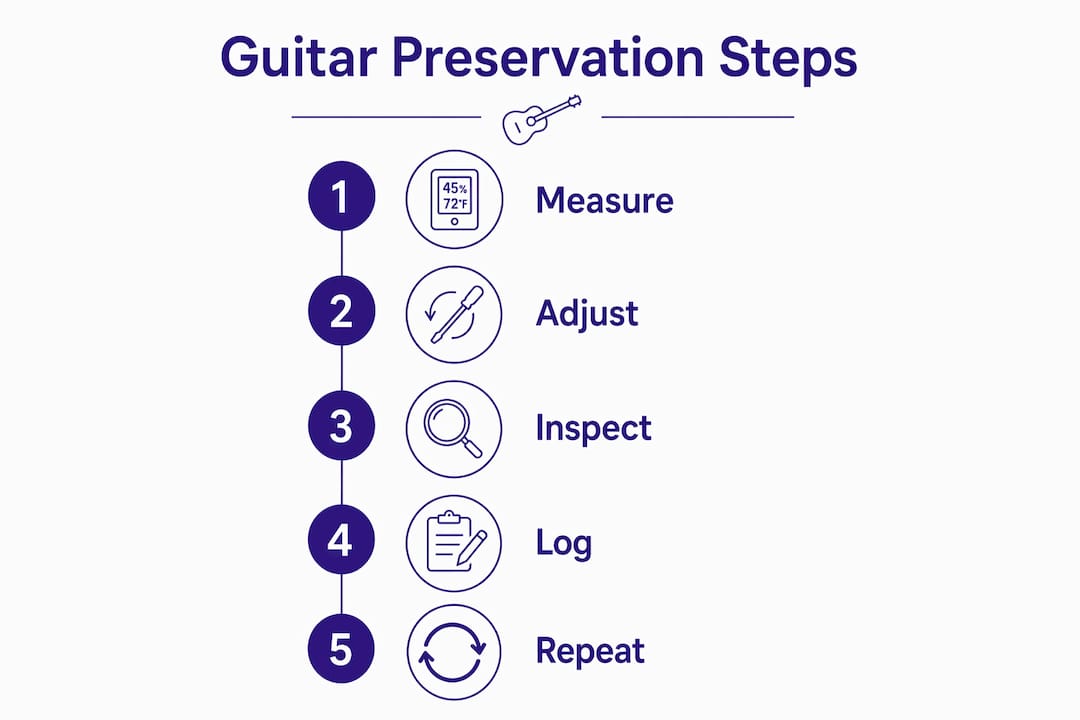
A preservation workflow is not a single task. It is a repeating cycle of measurement, adjustment, and inspection that keeps your guitar inside a stable environmental window. The workflow has four phases: assess your environment, install the right humidity controls, execute an acclimation protocol after any climate change, and schedule routine monitoring. Each phase builds on the last, and skipping one creates gaps that humidity and temperature will exploit.
The reason this matters so much for acoustic guitars specifically is wood. Spruce tops, mahogany backs, rosewood fretboards, and hide glue joints all respond to moisture at different rates. When relative humidity drops below 40%, wood shrinks and cracks appear along the grain. When it climbs above 60%, wood swells and glue joints soften. Humidity fluctuations cause cracking, fret sprout, buzzing, and warped necks. These are not cosmetic problems. They affect playability and, on a vintage instrument, they destroy resale value.
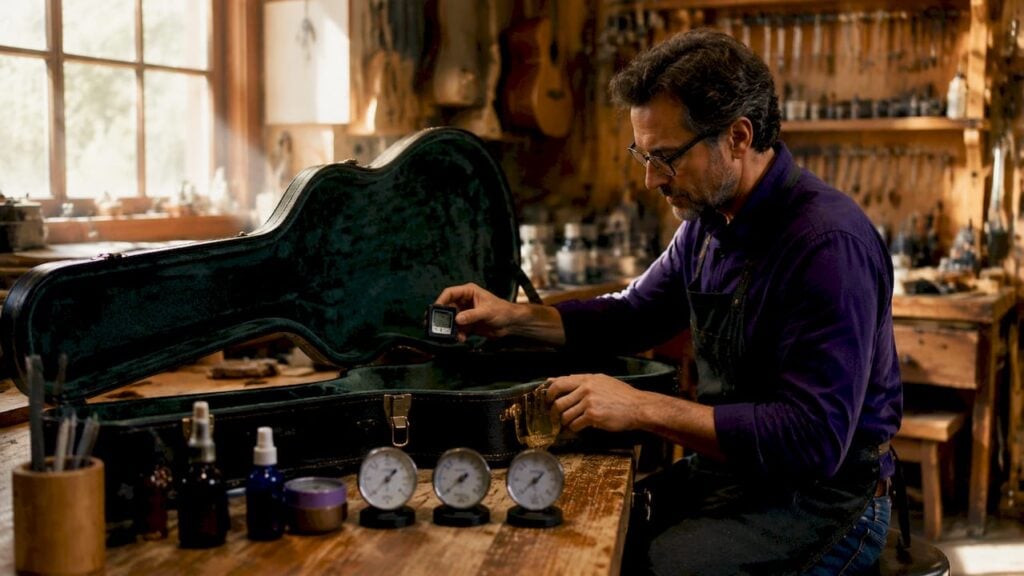
Temperature compounds the effect. Heat accelerates moisture loss from wood, which is why a guitar left in a car on a summer afternoon can crack within hours. The 70°F to 78°F range is not arbitrary. It reflects the moisture retention behavior of tonewoods at typical indoor conditions. A calibrated digital hygrometer is the single most important tool in this workflow because it gives you real data instead of guesswork.
Pro Tip: Place one hygrometer inside your guitar case and a second in the room where you store your instruments. The readings will often differ by 10 to 15 percentage points, which tells you exactly how hard your case is working.
| Condition | Relative humidity | Temperature | Risk |
|---|---|---|---|
| Ideal | 40% to 55% | 70°F to 78°F | None |
| Caution zone | 35% to 39% or 56% to 60% | 65°F to 69°F or 79°F to 85°F | Minor wood movement |
| Danger zone | Below 35% or above 65% | Below 60°F or above 90°F | Cracking, swelling, glue failure |
Which tools do you need for a guitar humidity control process?
The right equipment makes the difference between a workflow that runs itself and one that fails silently. You need tools for measurement, tools for moisture delivery, and protective storage.
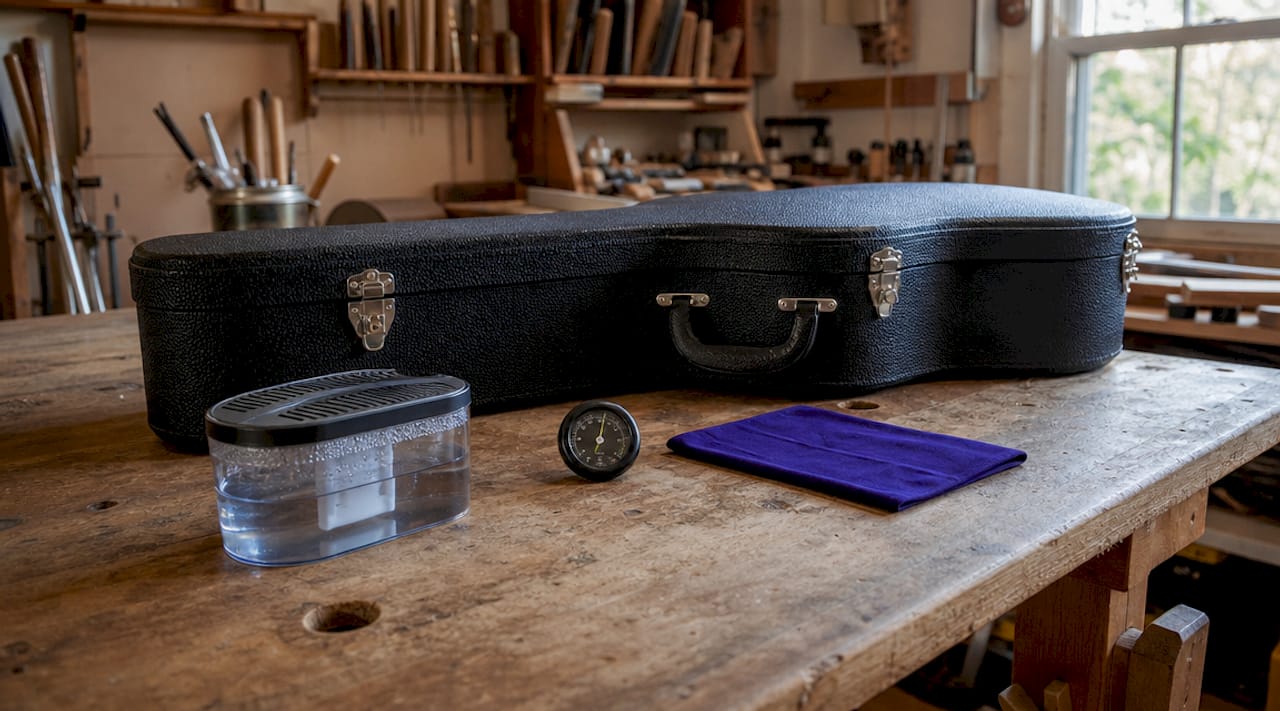
For measurement, a digital hygrometer with at least plus or minus 3% accuracy is the standard. Models from MusicNomad and Boveda are widely used in the guitar care community. Analog dial hygrometers drift over time and should not be trusted for precision work.
For moisture delivery, you have three categories to consider:
- Case humidifiers (gel or sponge style) sit inside the case and release moisture slowly. Gel models like the MusicNomad Humitar or Oasis OH-1 are more consistent than basic sponge types because they release moisture at a controlled rate and do not drip.
- Soundhole humidifiers hang inside the guitar body and humidify from the inside out. They work well as a supplement in very dry climates.
- Room humidifiers maintain ambient humidity for multiple instruments stored in the same space. Combining room and case humidifiers is the recommended approach for consistent care when you own more than two guitars.
Always fill humidifiers with distilled water. Tap water contains minerals that clog the release membrane and leave deposits on your guitar’s finish over time.
For storage, a hardshell case is not optional for vintage or high-value instruments. Keeping a guitar in its hard case creates a microclimate that slows humidity swings far more effectively than a gig bag or wall hanger. Gig bags leak moisture freely, and wall hangers expose the guitar directly to HVAC airflow.
Pro Tip: Keep a small notebook or use a free app like Govee Home to log your hygrometer readings weekly. Patterns in the data will show you which months require the most active humidification before damage occurs.
How to execute a step-by-step guitar humidity control process
This is the operational core of your preservation workflow. Follow these steps in sequence when setting up for the first time or after any significant climate change.
-
Measure your baseline. Place a digital hygrometer inside your closed guitar case for two hours. Record the reading. Then measure the room where the guitar is stored. Note the difference. This gap tells you whether your case is already buffering humidity or whether it is leaking.
-
Install your case humidifier. Fill a gel-style case humidifier with distilled water and place it in the designated slot or hang it from a string inside the case. Do not let it touch the guitar body or strings. Close the case and wait 24 hours before checking the hygrometer again.
-
Add a soundhole humidifier if needed. In climates where winter indoor humidity drops below 30%, a soundhole humidifier used alongside the case humidifier provides the extra moisture output required. Insert it carefully so it rests against the inside of the soundhole without pressing on the top. Check it every three to four days because it depletes faster than case models.
-
Set up a room humidifier for multiple instruments. If you store three or more guitars, a room humidifier targeting 45% to 50% ambient humidity reduces the workload on individual case humidifiers. Position it away from direct airflow from heating or cooling vents, and clean it weekly to prevent mold.
-
Execute the acclimation protocol after any climate change. When a guitar travels from a cold car to a warm room, or arrives by shipping from a different climate zone, keep it in its closed case for 24 to 48 hours. This prevents thermal shock and finish checking, which appears as a network of fine cracks in the lacquer. Opening the case immediately is the most common cause of finish damage during transit.
-
Establish a monitoring schedule. Check your hygrometer daily for the first two weeks after setup. Once readings stabilize within the 40% to 55% range, weekly to monthly checks are sufficient. Refill humidifiers before they run dry rather than after. A dry humidifier provides no protection and can actually draw moisture out of the guitar as it tries to rehydrate.
Pro Tip: Mark your calendar for the first week of each season. Seasonal transitions are when humidity swings are sharpest, and a quick check at those moments catches problems before they escalate.
What are common mistakes in guitar preservation and how do you fix them?
Most humidity-related damage is preventable. The mistakes below account for the majority of cases that reach a repair technician.
Trusting an old wooden case without checking it. Old wooden hardshell cases can absorb moisture, acting as humidity sinks that pull moisture away from the guitar inside. If you use a vintage case, place a hygrometer inside and verify that the internal humidity stays within range. Do not assume the case is protecting the instrument just because it is closed.
Over-humidifying. The signs of excess moisture are just as damaging as dryness. A swollen top that rises above the bridge plane, a high action that develops suddenly, or a neck that feels sluggish to adjust are all indicators of too much humidity. If your hygrometer reads above 60%, remove the humidifier, open the case slightly for a few hours, and recheck. Do not attempt to dry a guitar quickly with a heat source.
Ignoring string tension during storage. Proper string tension during storage prevents neck warping. Do not leave strings fully slack, and do not over-tighten them. Standard pitch tension keeps the neck in its designed alignment. If you are shipping a guitar across a significant climate change, slightly loosening the strings reduces stress on the neck joint during the acclimation period.
Reacting instead of preventing. Proactive humidity monitoring and slow adjustment is more effective than reactive fixes after damage appears. A crack in a spruce top requires a luthier repair that costs far more than a year’s worth of distilled water and a quality hygrometer.
“The best guitar repair is the one you never need. A $30 hygrometer and a $20 case humidifier protect instruments worth thousands. The math is not complicated.”
If you notice fret ends protruding beyond the fretboard edge, a sunken top, or visible cracks along the grain, consult a qualified luthier before attempting any DIY fix. Early intervention on humidity damage is far less costly than structural repair. For deeper guidance on long-term acoustic care, Vintage-guitar-world covers the full spectrum of maintenance practices that complement your humidity workflow.
Key takeaways
A complete acoustic guitar preservation workflow combines precise humidity control, the right tools, a disciplined acclimation protocol, and consistent monitoring to prevent structural damage before it starts.
| Point | Details |
|---|---|
| Target environment | Maintain 40% to 55% RH and 70°F to 78°F to prevent wood movement and glue failure. |
| Essential tools | Use a calibrated digital hygrometer, gel-style case humidifier, and distilled water as your baseline kit. |
| Acclimation protocol | Keep guitars in a closed case for 24 to 48 hours after any climate change to prevent finish checking. |
| Monitoring schedule | Check daily for two weeks after setup, then weekly to monthly once readings stabilize. |
| Avoid common traps | Old wooden cases, over-humidification, and reactive repairs are the leading causes of preventable damage. |
Why I stopped treating humidity as an afterthought
I have handled enough humidity-damaged guitars at Vintage-guitar-world to know that the instruments people regret most are the ones they thought were “safe” in a case. The case was old. The hygrometer was never checked. The winter heating season came and went, and by spring the top had cracked along the bass side of the bridge. A repair like that on a 1970s Gibson J-45 runs several hundred dollars and leaves a visible seam no matter how skilled the luthier.
What I have found over years of working with vintage and restored acoustics is that the players who never have these problems are not doing anything exotic. They own one decent digital hygrometer, one gel humidifier, and they check both once a week from October through March. That is the entire secret. The workflow does not need to be complicated to be effective.
The mistake I see most often is waiting for a symptom before taking action. Fret sprout, buzzing, or a rising action are all late-stage signals. By the time you notice them, the wood has already moved. Starting with measurement and building the habit of weekly checks costs almost nothing and protects instruments that are genuinely irreplaceable.
Start small. Buy the hygrometer first. Once you see your case readings, the rest of the workflow becomes obvious.
— Vintage
Explore vintage guitars built to last at Vintage-guitar-world

At Vintage-guitar-world, every instrument in our catalog has been evaluated for structural integrity, finish condition, and playability before it reaches you. We specialize in rare, restored, and handcrafted acoustics where preservation is not an afterthought. It is built into how we source, inspect, and present each guitar. If you are ready to apply the workflow in this article to an instrument worth protecting, our acoustic guitar restoration guide gives you the next level of detail on repairs, refinishing, and collector-grade care. You can also explore our curated selection of vintage guitar types to find an instrument that rewards the care you are prepared to give it.
FAQ
What humidity level is best for acoustic guitars?
The optimal relative humidity for acoustic guitar storage is 40% to 55%, with 45% to 50% as the ideal center point. Staying within this range prevents both the cracking caused by dry conditions and the swelling caused by excess moisture.
How often should I check my guitar’s humidity?
Check your hygrometer daily for the first two weeks after setting up a humidification system, then weekly to monthly once readings are stable. Increase check frequency during seasonal transitions when indoor humidity shifts most sharply.
Can I use tap water in my guitar humidifier?
Tap water contains minerals that clog humidifier membranes and can leave deposits on your guitar’s finish. Distilled water is the correct choice for all guitar humidifiers.
What is the acclimation process for a guitar after travel?
After any significant climate change, keep the guitar in its closed case for 24 to 48 hours before opening it. This gradual adjustment prevents thermal shock and finish checking caused by rapid temperature or humidity shifts.
Do hardshell cases really make a difference for humidity control?
A hardshell case creates a microclimate that slows humidity swings significantly compared to a gig bag or wall hanger. For vintage or high-value instruments, a hardshell case combined with an active case humidifier is the minimum standard for responsible storage.