














TL;DR:
- Negotiating collectible guitar deals involves thorough market research, condition analysis, and strategic bargaining to secure instruments below their asking prices. Knowing exact market values, condition impacts, and building rapport with sellers enables disciplined offers and better outcomes in various purchase channels. Patience, preparation, and disciplined negotiation techniques are essential for success in acquiring valuable vintage guitars.
Negotiating collectible guitar deals is the practice of securing a vintage or rare instrument below its listed price by combining market research, condition analysis, and deliberate bargaining strategy. List price on a collectible guitar is almost never the final price. Stores and private sellers build profit margins into their asking prices, and disciplined buyers can save 25 to 30% on many purchases. Resources like the Official Vintage Guitar Price Guide 2026, sold listings on Reverb.com, and expert valuation services give you the data to negotiate from a position of knowledge rather than guesswork. Whether you are buying your first vintage Fender Stratocaster or adding a 1960s Gibson ES-335 to a serious collection, the principles of smart negotiation remain the same.
How to negotiate collectible guitar deals: start with accurate valuation
Every successful negotiation starts before you open your mouth. You need to know what the guitar is actually worth before you make any offer.

Check brand, model, year, and provenance
The four pillars of collectible guitar value are brand, model, production year, and provenance. A 1959 Gibson Les Paul Standard carries a completely different market position than a 1985 reissue of the same model. Serial numbers tell you the production year and factory of origin for brands like Fender, Gibson, Martin, and Gretsch. Provenance, meaning documented ownership history or a connection to a notable player, can multiply value significantly. Always verify serial numbers against manufacturer records or authoritative databases before forming a price opinion.
Use price guides and sold comps together
The Official Vintage Guitar Price Guide 2026 is compiled with input from top dealers and provides vetted reference values across thousands of models. It is the industry standard for establishing a baseline. Cross-check that baseline against recent sold listings on Reverb.com, filtering specifically by sold status rather than current asking prices. Sold data reflects what buyers actually paid, which is the number that matters in a negotiation. Asking prices reflect seller optimism.
| Valuation source | What it tells you | Best use |
|---|---|---|
| Official Vintage Guitar Price Guide 2026 | Vetted dealer reference values by model and condition | Establishing a credible baseline |
| Reverb.com sold listings | Real transaction prices from recent sales | Confirming current market demand |
| Professional appraisal ($50 to $150) | Documented value for insurance or legal purposes | High-value instruments above $2,000 |
| Dealer quotes | Current retail pricing with negotiation room built in | Benchmarking against asking prices |
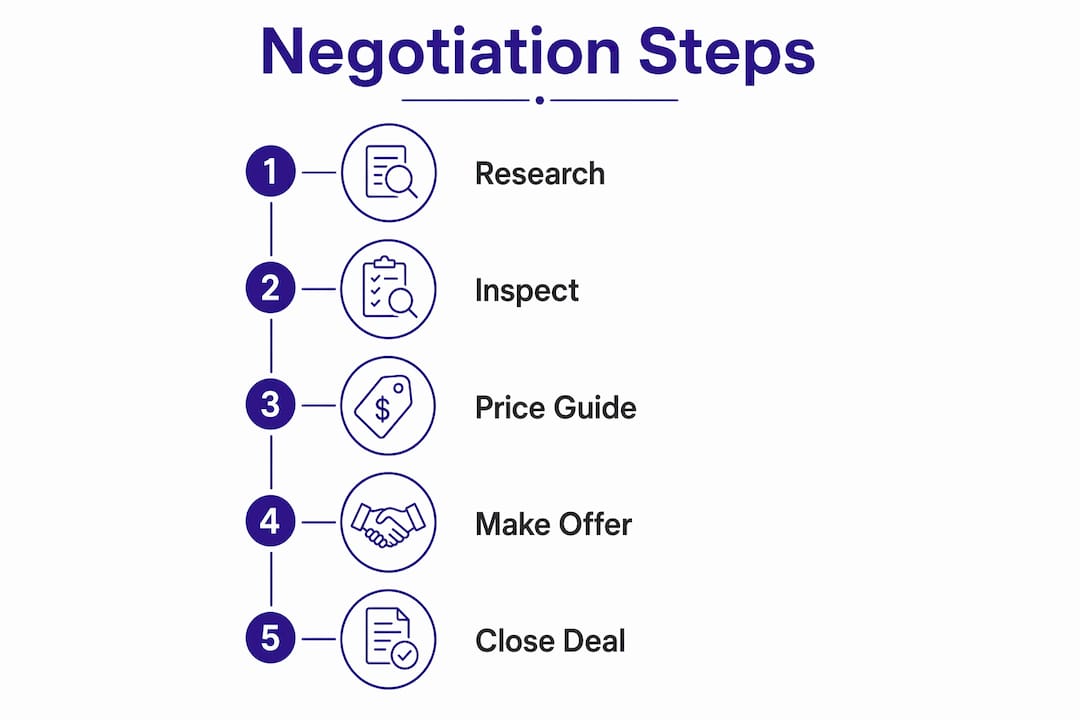
For instruments valued above $2,000, a professional appraisal costing $50 to $150 provides documented value that strengthens your negotiating position and protects you if a dispute arises later. Below that threshold, price guides and sold comps are usually sufficient.
Pro Tip: When reviewing sold listings on Reverb, filter by “sold” and sort by most recent. Prices from 18 months ago may not reflect today’s market, especially for models that have spiked in collector interest.
Condition is the single largest variable in collectible guitar pricing. Original parts, unaltered finish, and correct hardware for the production year all command premiums. A guitar with a replaced tuner set, a refret, or a refinished headstock can be worth 30 to 50% less than an all-original example. Use condition gaps as legitimate negotiation leverage, not as a way to lowball. You can learn more about how condition and features affect pricing in this guitar valuation guide from Vintage-guitar-world.
What negotiation tactics work best when buying collectible guitars
Knowing the value is half the work. Executing the negotiation without undermining yourself is the other half.
The step-by-step approach to making an offer
- Set your ceiling before you arrive. Decide the maximum you will pay based on your research. This prevents emotional decisions when you are holding the guitar.
- Open below your ceiling, not at it. Start your offer at roughly 15 to 20% below your researched fair value. This gives you room to move without going over your limit.
- Cite specific data when you make the offer. Say “I’ve seen comparable examples in similar condition sell for X on Reverb recently” rather than “I think it’s worth less.” Specificity signals that you are informed, not just cheap.
- Point out condition issues factually. A worn fret, a replaced pickup cover, or a missing case are legitimate deductions. Mention them calmly and attach a dollar figure to each.
- Give the seller time to respond. Silence after an offer is not awkward. It is pressure. Resist the urge to fill it by raising your own offer.
- Be prepared to walk away. A seller who knows you will leave has more reason to negotiate. A seller who senses you cannot leave has no reason to move.
Avoid showing over-excitement about any guitar during the inspection. Enthusiasm signals to the seller that you are emotionally committed, which removes their incentive to discount. Examine the guitar methodically, ask technical questions, and keep your tone neutral regardless of how much you want it.
Pro Tip: Never negotiate against yourself. If a seller rejects your offer without making a counter, ask “What’s the best you can do?” rather than immediately raising your number.
Building rapport with knowledgeable dealers over time produces better outcomes than one-off transactions. A dealer who knows you as a serious, repeat buyer is more likely to call you first on a new acquisition, offer you a better price, and stand behind the instrument if a problem surfaces later. Relationships are a long-term negotiation asset.
Where to find collectible guitar deals and bargaining opportunities
The channel you buy through determines how much negotiation room you have and what protections you get.
- Specialty dealers carry authenticated, often restored instruments with expert backing. Prices are higher, but negotiation is accepted practice and the risk of fraud is low. Dealers who specialize in vintage instruments understand that list price is a starting point, not a ceiling.
- Private sellers often price emotionally rather than analytically. You can find genuine bargains, but you carry all the risk. There is no return policy and no authentication guarantee.
- Guitar shows and expos concentrate multiple sellers in one place, which creates natural price competition. Sellers at shows are motivated to move inventory, especially on the last day.
- Online marketplaces like Reverb.com offer strong buyer protections and reasonable fees, making them the preferred channel for specialized collectors who cannot inspect in person. The trade-off is that you cannot play the instrument before buying.
| Buying channel | Negotiation flexibility | Buyer protection | Typical discount potential |
|---|---|---|---|
| Specialty dealer | Moderate | High | 10 to 20% |
| Private seller | High | Low | 15 to 30% |
| Guitar show | High (especially end of day) | Low to moderate | 10 to 25% |
| Reverb.com | Moderate (offer feature) | High | 5 to 15% |
| Pawn shop | High | Very low | Variable, often overpriced |
Pawn shops and unverified online sellers present real risks. Pawn shops frequently misprice instruments at or above retail because staff lack specialized knowledge. You may find a deal, but you are unlikely to get accurate condition disclosure or any recourse if the guitar has hidden issues. Approach these sources only if you can authenticate and assess condition yourself.
Before you commit to any channel, review this 7-point checklist for buying vintage guitars from Vintage-guitar-world to make sure you have covered every inspection point.
Common pitfalls to avoid when negotiating collectible guitar deals
Even well-prepared buyers make mistakes that cost them money or the deal entirely.
- Negotiating without data. An offer based on gut feeling is easy to dismiss. An offer backed by three recent Reverb sold comps and a price guide reference is hard to argue with.
- Revealing your budget. If a seller knows your ceiling, they will price to it. Keep your maximum to yourself.
- Skipping the physical inspection. Cracks in the neck heel, fret wear, and truss rod issues are invisible in photos. Always inspect in person or hire a local tech to inspect on your behalf before finalizing an online purchase.
- Ignoring repair costs. A guitar priced at $1,800 that needs a $400 refret is a $2,200 guitar. Factor all setup and repair costs into your offer.
- Accepting the first counter without pushing back. Most sellers expect at least one round of back-and-forth. Accepting the first counter immediately signals that you had more room.
Pro Tip: If a deal feels wrong, walk away. The vintage guitar market is large and patient. Another example of the same model will appear, often at a better price.
Scam awareness matters especially in online transactions. Requests to pay outside a protected platform, suspiciously low prices on highly sought models like a pre-CBS Fender Telecaster or a 1950s Martin D-28, and sellers who resist providing additional photos or serial number verification are all red flags. Understanding what makes guitars collectible helps you spot when a deal is too good to be true.
Key takeaways
Successful collectible guitar negotiation requires verified market data, condition analysis, and disciplined offer strategy applied before and during every transaction.
| Point | Details |
|---|---|
| Research before you offer | Use the Official Vintage Guitar Price Guide 2026 and Reverb sold comps to establish real market value. |
| Condition drives price | Original parts and unaltered finish command premiums; document every flaw to justify your offer. |
| Control your emotions | Never show excitement or reveal your budget ceiling during negotiation. |
| Choose your channel wisely | Specialty dealers offer safety; private sellers and shows offer more discount potential. |
| Walk away when needed | Leaving a stalled negotiation is a tactic, not a failure. Another deal will come. |
What I’ve learned after years of buying and selling collectible guitars
The single most valuable thing I’ve learned negotiating collectible guitar deals is that preparation embarrasses sellers who are bluffing on price. When you walk in knowing the last five sold comps for a specific model and year, citing the Official Vintage Guitar Price Guide 2026, and noting every condition issue with a dollar figure attached, the conversation changes completely. Sellers who were firm at the opening price suddenly find room to move.
The mistake I see most often from newer collectors is treating the asking price as a fact rather than an opening position. It is not. It is a wish. The seller’s job is to get as much as possible; your job is to pay what the instrument is actually worth in its actual condition.
I’ve also found that the best deals rarely come from aggressive lowballing. They come from being the buyer a seller trusts. When a dealer knows you will close quickly, pay fairly, and not return the instrument over a minor issue, they will call you before they list. That relationship is worth more than any single negotiation win. Patience and consistency beat pressure tactics in this market every time.
— Vintage
Explore vintage guitars and expert buying resources at Vintage-guitar-world
Vintage-guitar-world offers a curated selection of authenticated vintage and collectible guitars, from rare pre-war Martins to iconic electric instruments from the 1950s and 1960s. Every instrument in the inventory comes with expert evaluation and detailed condition documentation, giving you the transparency you need to negotiate and buy with confidence.

Whether you are researching investment potential or looking for your next acquisition, the types of vintage guitars guide covers features, history, and market value across the most sought-after categories. For deeper valuation insight before your next negotiation, the collectible guitar valuation guide walks you through the exact methodology professionals use to price rare instruments accurately.
FAQ
What is a fair opening offer on a collectible guitar?
A fair opening offer is typically 15 to 20% below your researched market value, based on recent sold comps and the instrument’s condition. This gives you room to negotiate while signaling that you are a serious, informed buyer.
How do I value a collectible guitar before negotiating?
Cross-reference the Official Vintage Guitar Price Guide 2026 with recent sold listings on Reverb.com, filtered by sold status. For instruments above $2,000, a professional appraisal costing $50 to $150 provides documented value useful in negotiation.
Is it acceptable to negotiate with guitar dealers?
Negotiation is standard practice with guitar dealers. Stores price instruments with built-in profit margins, and buyers who make informed, respectful offers regularly achieve discounts of 25 to 30% off the listed price.
What condition factors reduce a collectible guitar’s value most?
Replaced or non-original parts, refinished bodies or headstocks, and structural repairs like neck resets or crack repairs reduce value significantly. A non-original finish alone can reduce a collectible guitar’s value by 30 to 50% compared to an all-original example.
When should I walk away from a guitar negotiation?
Walk away when the seller’s final price exceeds your researched fair value after accounting for condition and repair costs, or when the seller cannot provide adequate documentation of provenance and authenticity. Another comparable instrument will become available.