













TL;DR:
- Proper vintage guitar care involves using finish-safe cleaning products, active humidity regulation, and precision tools to preserve instrument integrity. Combining humidity control with real-time monitoring helps prevent warping and cracking, while specialized setup tools protect delicate materials. The right accessories support both playability and preservation, ensuring vintage guitars remain vibrant and functional for generations.
Top vintage guitar accessories are specialized tools, products, and hardware designed to maintain, protect, and enhance classic instruments without compromising their original character. Whether you own a 1959 Gibson Les Paul or a pre-war Martin acoustic, the accessories you choose directly determine how long that instrument stays playable, structurally sound, and valuable. This guide covers the must-have vintage guitar accessories every serious collector and player should own, from finish-safe cleaning kits to precision setup tools and secure hardware upgrades. Choosing the wrong product can damage a nitrocellulose finish or warp a vintage neck in a single season.
1. Top vintage guitar accessories: finish-safe cleaning and polishing products
Cleaning a vintage guitar is not the same as cleaning a modern instrument. The finish type determines everything, and using the wrong product on a soft nitrocellulose finish can cause permanent clouding or surface damage.
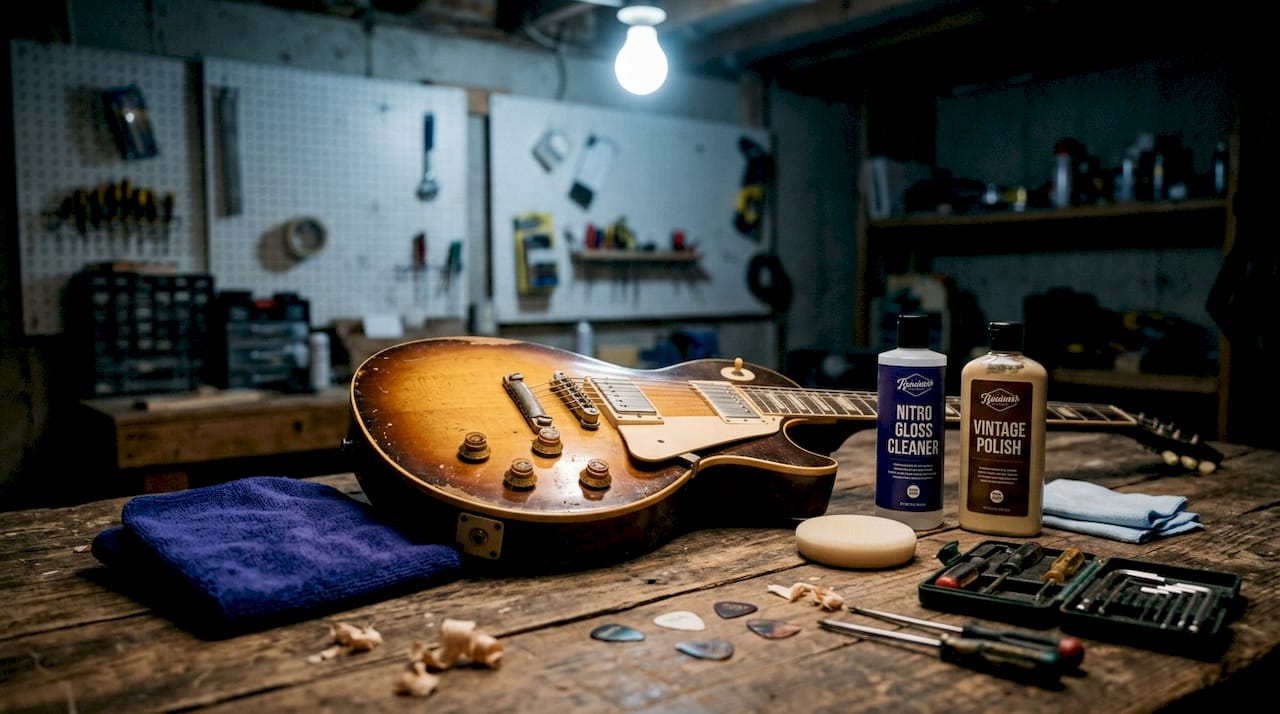
MusicNomad’s Guitar ONE is an all-in-one cleaner, polish, and wax that is safe for gloss finishes including hard nitrocellulose. It uses Brazilian carnauba wax and is voted one of the best music products by US dealers. That endorsement matters because carnauba wax creates a protective barrier without the silicone compounds that can seep into wood grain over time.
One critical rule applies before any polish touches your guitar: clean the surface first. Spray-type products mixed with finish buildup can cause cloudiness or damage on vintage nitro finishes. Removing grime before polishing prevents that buildup from being ground into the surface.
- Use Guitar ONE only on hard, clean nitro or gloss finishes
- Matte and satin finishes require dedicated matte-safe products
- Never apply polish over visible buildup or residue
- Always use a clean, lint-free cloth for application
Pro Tip: Apply polish in small circular sections rather than wiping the entire body at once. This gives you control over pressure and prevents uneven wax distribution on aged finishes.
2. Microfiber cleaning tools that protect vintage surfaces
The cloth you use matters as much as the product. Standard cotton rags and paper towels carry enough surface friction to scratch aged lacquer finishes over repeated use.
MusicNomad’s Nomad Tool uses a 100% lint-free washable microfiber pad that cleans strings and fretboards without solvents. The lint-free design prevents microscopic fiber particles from embedding in open-grain fretboards like rosewood or ebony. For vintage guitars, that level of care is not optional. It is the baseline.
Microfiber tools also reduce the frequency of deep cleaning sessions. When you wipe down strings and the fretboard after every playing session, grime never accumulates to the point where aggressive cleaning becomes necessary. That single habit extends string life and protects fret edges from corrosive sweat buildup.
3. How to protect vintage guitars from humidity damage
Humidity is the single most destructive environmental factor for vintage acoustic and semi-hollow guitars. Wood expands and contracts with moisture changes, and vintage instruments with hide glue joints are especially vulnerable to those shifts.
D’Addario’s Humidipak uses Boveda two-way humidity control technology to automatically maintain 45% to 50% relative humidity inside a guitar case. The system dispenses or absorbs purified water vapor as needed, eliminating the guesswork of manual humidifiers. Builder Boucher Guitars confirms that maintaining 40% to 50% humidity around vintage guitars around the clock is critical to preventing warping and cracking.
- Target range: 45% to 50% relative humidity for most vintage guitars
- Two-way systems both add and remove moisture automatically
- Replace Humidipak sachets every two to three months depending on climate
- Store guitars in hard cases rather than on open wall hangers for better humidity stability
Pro Tip: If you live in a climate with extreme seasonal swings, run two Humidipak sachets in the case simultaneously during winter heating season. One sachet alone may not keep pace with the drying effect of forced-air heating systems.
4. Humidity and temperature monitoring for collectors
Regulation without monitoring is incomplete. A humidity pack may be doing its job, but you have no way to confirm that without a dedicated monitoring device.
MusicNomad’s HONE checks the guitar’s environment every 20 seconds and displays real-time humidity and temperature readings. It triggers alerts when conditions fall outside the safe range of 20% to 99% relative humidity or 32°F to 122°F. That frequency of monitoring catches sudden environmental changes before they cause damage. Pairing an active regulation product like Humidipak with a real-time monitor like HONE is the best practice for collectors who want to protect instrument value and structural integrity.
Passive humidity packs alone cannot tell you whether the case environment is actually stable. A monitor closes that information gap and gives you confidence that your vintage instrument is protected even when stored for weeks between playing sessions.
5. Essential setup tools for vintage guitar maintenance
Precision setup work on a vintage guitar requires tools designed for the task. Standard hardware-store files and improvised tools risk damaging nut slots, fret edges, and fretboard surfaces that cannot be easily replaced on a vintage instrument.
MusicNomad’s diamond-coated nut files feature round string-shaped blades that cut and polish nut slots simultaneously without drifting. Drifting is the primary risk with standard files: the blade slides sideways and widens the slot beyond the correct string gauge, causing tuning instability and string buzz. The ergonomic handles on these files give you the control needed for precise work on materials like bone, TUSQ, and vintage plastic nuts.
- Match file size to the exact string gauge you are using
- Cut slots at a slight downward angle toward the headstock for proper string break
- Clean nut slots with a folded piece of used sandpaper after filing to remove debris
- Never deepen a slot more than one-third of the string diameter below the nut surface
6. Fretboard protection during maintenance and fret work
Fret leveling and polishing are routine maintenance tasks, but they carry real risk for vintage fretboards. The traditional method of masking fretboard wood with blue painter’s tape is slow, imprecise, and leaves adhesive residue on aged wood.
MusicNomad’s Fret Shield replaces tape with a thin, reusable stainless-steel protector that fully shields the fretboard during leveling and polishing. The Fret Shield is designed for hundreds of fret jobs, making it a cost-effective tool for players who do their own maintenance. For vintage guitars where the fretboard wood is often irreplaceable, that level of protection is worth the investment. Accidental scratches from leveling files on a 1960s Brazilian rosewood fretboard cannot be undone.
7. Hardware upgrades that respect vintage authenticity
Strap security is a practical concern that many vintage guitar owners overlook until an accident happens. A guitar dropped from a strap can sustain damage that no accessory can reverse.
Schaller S-Locks use a patented triple-security locking mechanism with felt washers that protect vintage finishes at the strap button contact points. The system supports straps up to 6mm thick and installs without modifying the guitar body beyond the existing strap button screw hole. The felt washer detail is particularly relevant for vintage guitars: bare metal hardware pressing against aged nitro or lacquer finishes causes finish checking and wear over time.
“Vintage guitars are meant to be played and preserved for their feel and sound.” Jared James Nichols, as quoted by Guitar.com, frames this perfectly. Accessories that secure and protect the instrument make it more playable, not less authentic.
Premier Guitar recommends upgrading strap button screws to thicker stainless steel versions for durability while keeping original hardware in place wherever visible. That balance between improved safety and preserved aesthetics is the right framework for all vintage hardware decisions.
8. Comparison of top vintage guitar accessories by category
The table below organizes the best vintage guitar gear by function, so you can identify what your maintenance kit is missing.
| Category | Product | Key benefit | Best for |
|---|---|---|---|
| Cleaning and polish | MusicNomad Guitar ONE | Safe on hard nitro and gloss finishes | Regular surface maintenance |
| Humidity regulation | D’Addario Humidipak | Automatic two-way moisture control | Case storage in variable climates |
| Humidity monitoring | MusicNomad HONE | Real-time alerts every 20 seconds | Collectors storing instruments long-term |
| Setup tools | MusicNomad nut files | Diamond-coated, no-drift slotting | Nut work on bone or TUSQ nuts |
| Fretboard protection | MusicNomad Fret Shield | Reusable stainless-steel fret guard | DIY fret leveling and polishing |
| Strap security | Schaller S-Locks | Patented locking with finish protection | Stage use and regular playing |
Each category addresses a distinct vulnerability in vintage guitar ownership. A complete maintenance kit covers all six.
Key takeaways
The most effective approach to vintage guitar care combines finish-safe cleaning products, active humidity regulation, real-time environmental monitoring, and precision setup tools that respect the instrument’s original materials.
| Point | Details |
|---|---|
| Finish type determines cleaning choice | Use Guitar ONE only on hard, clean nitro or gloss finishes; matte finishes need dedicated products. |
| Pair humidity regulation with monitoring | Humidipak controls moisture; HONE confirms the case environment stays within the safe range. |
| Precision tools prevent irreversible damage | Diamond-coated nut files and the Fret Shield protect vintage materials that cannot be replaced. |
| Hardware upgrades can preserve aesthetics | Schaller S-Locks and thicker strap screws improve safety without altering the guitar’s original look. |
| Playability and preservation are not opposites | As Jared James Nichols notes, vintage guitars are meant to be played. The right accessories make that possible. |
What I’ve learned from years of handling vintage instruments
Working closely with vintage guitars at Vintage-guitar-world has taught me one thing that most accessory guides miss: over-maintenance is as damaging as neglect. I have seen collectors apply polish every week to guitars that needed nothing more than a light wipe-down, and the cumulative wax buildup created a hazy film that required professional buffing to remove.
The vintage guitar care approach I trust most is minimal and targeted. Clean after playing. Monitor humidity constantly. Polish two to four times a year. Do setup work only when the instrument demands it, not on a fixed schedule.
I also want to push back on the collector misconception that accessories are primarily about resale value. Guitar.com’s interview with Jared James Nichols captures the right mindset: vintage guitars exist to be played. The accessories that serve a player best are the ones that keep the instrument in playing condition, not the ones that keep it looking untouched in a case. A guitar that plays beautifully is worth more than one that looks perfect but feels stiff and neglected.
Choose accessories that match how you actually use the instrument. A touring player needs Schaller S-Locks and a reliable humidity system for changing environments. A collector who plays occasionally needs a monitoring device and a quality cleaning kit. There is no single universal kit. There is only the right kit for your guitar and your habits.
— Vintage
Explore vintage guitars and expert care resources at Vintage Guitar World
Vintage Guitar World curates a selection of rare, restored, and certified vintage instruments alongside the knowledge base to care for them properly. If you are building your maintenance kit or looking for your next instrument, the resources available go well beyond a standard retail experience.

Browse the types of vintage guitars available, from pre-war acoustics to vintage electrics, each with detailed provenance and condition notes. For players deciding between an original and a reissue, the vintage vs. reissue guide provides the framework to make a confident decision. Vintage Guitar World also offers valuation and certification services for collectors who want professional documentation of their instrument’s condition and authenticity.
FAQ
What are vintage guitar accessories?
Vintage guitar accessories are products and tools designed to maintain, protect, and set up classic guitars without damaging original finishes or hardware. They include cleaning kits, humidity control systems, precision setup tools, and secure hardware like strap locks.
Are standard guitar cleaners safe for vintage nitro finishes?
Not always. Products safe for modern polyurethane finishes can cloud or damage soft nitrocellulose finishes. MusicNomad Guitar ONE is safe on hard, clean nitro, but soft or buildup-affected nitro requires a different approach before any cleaner is applied.
What humidity level should I maintain for a vintage guitar?
The target range is 45% to 50% relative humidity. D’Addario Humidipak automatically maintains this range inside a guitar case, and pairing it with a monitor like MusicNomad HONE confirms the environment stays stable.
Do strap locks damage vintage guitar finishes?
Standard strap locks with bare metal hardware can cause finish wear at contact points. Schaller S-Locks include felt washers that protect the finish at the strap button, making them the preferred choice for vintage instruments.
How often should I clean and polish a vintage guitar?
Wipe down strings and the body after every playing session using a lint-free microfiber cloth. Apply polish two to four times per year at most. Over-polishing builds up wax residue that dulls the finish over time.