













TL;DR:
- The guitar has ancient origins rooted in Mesopotamian, Egyptian, and Greek stringed instruments, evolving through cultural exchanges. Antonio de Torres revolutionized classical guitar with his design, shaping its modern form, while electric guitars developed through key milestones like the invention of pickups and mass production by Fender and Gibson. The instrument’s tuning and structural innovations have persisted for centuries, reflecting a deep historical continuity despite technological and genre changes.
The guitar is a plucked string instrument whose documented history spans at least five centuries, with roots reaching back thousands of years into ancient Mesopotamia, Egypt, and Greece. Most people think of the guitar as a modern invention, but the guitar’s Spanish origins trace to the early 16th century, evolving from the guitarra latina through a long chain of cultural exchange and technical refinement. This guitar history facts list covers the milestones, inventors, and design breakthroughs that transformed a simple stringed instrument into the most played instrument on earth.
1. What are the earliest ancestors of the guitar?
The guitar’s family tree begins not in Spain or Italy, but in ancient Mesopotamia. Instruments like the tanbur, a long-necked lute played in Sumerian and Babylonian cultures, share the fundamental design logic of the modern guitar: a resonating body, a neck, and strings stretched across both. The ancient Egyptian nefer and the Greek kithara followed a similar structural principle, demonstrating that the idea of a plucked string instrument was universal across early civilizations.
The guitar’s direct lineage runs through several key precursors:
- Tanbur (Mesopotamia, 3000 BCE): A long-necked lute with a small pear-shaped body, considered one of the earliest guitar-like instruments.
- Kithara (Ancient Greece): A large, box-shaped lyre used in formal performance, influencing the concept of a resonating chamber.
- Oud (Middle East and North Africa): A fretless, short-necked lute that Moorish musicians brought to the Iberian Peninsula during the 8th century.
- European lute (Medieval Europe): A direct descendant of the oud, adapted by European craftsmen and widely played from the 13th through 17th centuries.
- Gittern (13th century Europe): Often confused with the early guitar, the gittern was a small, gut-strung instrument. Early guitar references from the 13th century frequently denote the gittern rather than any instrument resembling the modern guitar.
The fusion of the Moorish oud and the European lute tradition on the Iberian Peninsula created the conditions for the guitar to emerge as a distinct instrument. That cultural crossroads is why Spain became the birthplace of the guitar as we recognize it today.
2. How the Renaissance guitar shaped modern tuning
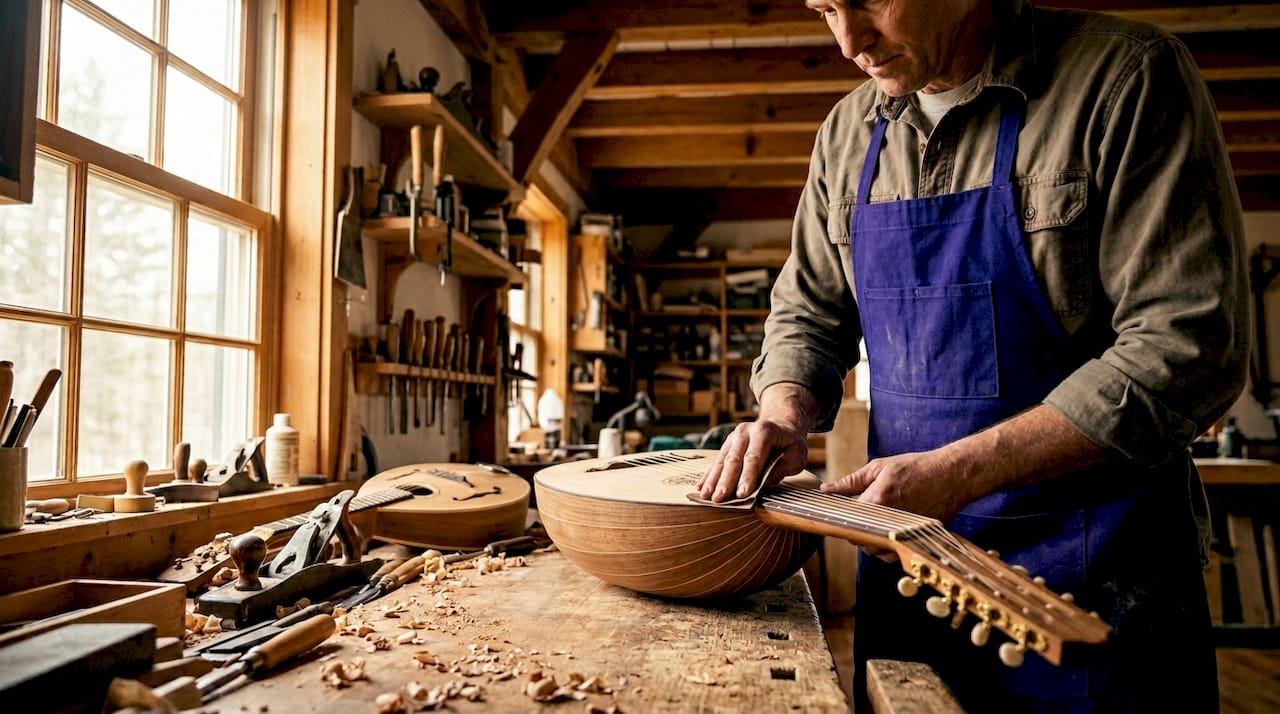
The Renaissance period produced the first instruments historians confidently call guitars. The guitar probably originated in early 16th-century Spain, evolving from the guitarra latina, a four-stringed instrument distinct from the lute in its flat back and incurved sides. That physical distinction matters because it defines the guitar’s acoustic identity.
Here is how the Renaissance guitar evolved into the foundation of the modern instrument:
- Four-course guitar (early 1500s): The earliest Spanish guitars had four pairs of strings called courses, tuned in unison or octaves. Each course functioned as a single voice, giving the instrument a fuller sound than a single string could produce.
- Five-course guitarra (late 1500s): A fifth course was added, expanding the instrument’s range. This five-course guitarra standardized the tuning that would eventually become the A-D-G-B-E standard still used today.
- Spanish vihuela influence: The vihuela, a guitar-shaped instrument tuned like a lute, was the prestige instrument of 16th-century Spanish courts. Its tuning conventions directly influenced how the five-course guitar was played and notated.
- Increase in frets: Early guitars had as few as five or six tied gut frets. By the late Renaissance, instruments carried eight to ten frets, enabling more complex melodic playing.
- Shift from courses to single strings: By the late 18th century, instrument makers began replacing paired courses with single strings. This change improved intonation and made the instrument easier to play in tune.
Pro Tip: If you play a modern guitar, you are using a tuning system that evolved directly from 16th-century Spanish court music. The A-D-G-B-E standard is not arbitrary. It reflects centuries of practical refinement by players and makers.
Understanding the evolution of string courses is the key to grasping why modern guitar tuning and structure formed the way they did. Each step in this progression solved a real problem: range, volume, or playability.
3. Antonio de Torres and the birth of the classical guitar
Antonio de Torres Jurado is the single most important figure in classical guitar construction. Working in Seville and Almería during the mid-to-late 19th century, Torres transformed what was still a relatively small, quiet instrument into the powerful, resonant guitar that Francisco Tárrega and Andrés Segovia would later bring to concert halls worldwide.
Torres is credited with giving the modern classical guitar its definitive form, including an enlarged body, a refined internal bracing system using fan struts, and a longer scale length. These changes were not cosmetic. The fan bracing pattern distributed string tension across the soundboard more efficiently, producing greater volume and a more balanced tonal response across all registers. His body proportions became the template every classical guitar maker has worked from since.
“Torres proved that the guitar’s voice lived inside the wood. His fan bracing design turned the soundboard into an amplifier, not just a lid.” This insight, recognized by luthiers throughout history, explains why his instruments are still studied and copied today.
Torres built over 300 guitars during his lifetime, and surviving examples are held in museums and private collections as irreplaceable artifacts. His influence on the history of classical guitars is so complete that virtually every classical guitar made today traces its geometry back to his workshop.
4. Key milestones in electric guitar development
Electric guitar development is best understood as three separate milestones: invention, commercial availability, and mass production. Conflating them creates a distorted picture of how the instrument actually emerged.
| Milestone | Year | Key Figure | Significance |
|---|---|---|---|
| First commercial pickup | 1931 | George Beauchamp and Paul Barth | Electro-String developed the first viable electromagnetic pickup |
| “Frying pan” guitar | 1932 | Rickenbacker | First commercially sold electric guitar, a lap steel model |
| Fender Broadcaster | 1950 | Leo Fender | First mass-produced solidbody electric guitar |
| Fender Stratocaster | 1954 | Leo Fender | Introduced three pickups and a vibrato system |
| Gibson Les Paul | 1952 | Gibson and Les Paul | Established the humbucking pickup standard |
The first commercial electric pickup was developed in 1931 by George Beauchamp and Paul Barth at Electro-String. This invention solved the fundamental problem facing guitarists in big band settings: the acoustic guitar simply could not compete with brass and percussion in volume. The electromagnetic pickup converted string vibration into an electrical signal, and that signal could be amplified to any volume needed.
The Fender Broadcaster in 1950 was the first solidbody electric guitar produced at scale. Leo Fender’s insight was that a solid wood body eliminated the feedback problems that plagued hollow-body electrics at high volume. The Broadcaster was renamed the Telecaster after a trademark dispute, and it remains in production today, essentially unchanged in concept.
The Fender Stratocaster in 1954 introduced three pickups and a synchronized tremolo system, giving players tonal options and pitch-bending capability that the Telecaster lacked. Jimi Hendrix, Eric Clapton, and David Gilmour all built their signature sounds around the Stratocaster. That is the measure of its design success.
Pro Tip: When researching electric guitar history, always distinguish between who invented the pickup, who built the first electric guitar, and who mass-produced it. These are three different people and three different moments.
5. How guitar design evolved through the 20th century
The 20th century produced more guitar innovation than any previous era, driven by new materials, new music genres, and new manufacturing techniques.
- Steel-string acoustics: C.F. Martin pioneered steel-string guitars and X-bracing in the 19th century to handle the higher tension of steel strings and produce greater volume. This made the acoustic guitar suitable for American folk, blues, and country music.
- Archtop guitars: Orville Gibson and later Lloyd Loar at Gibson developed archtop guitars in the early 20th century, carving the top and back like a violin. These instruments became the standard for jazz players from the 1920s onward.
- Resonator guitars: Invented by John Dopyera in 1927, resonator guitars used a spun aluminum cone inside the body to amplify sound mechanically. They became essential tools for blues slide guitarists before electric amplification was widely available.
- Humbucker pickups: Gibson engineer Seth Lover developed the humbucker pickup in 1955, canceling the electrical hum that plagued single-coil designs. The Gibson Les Paul with humbuckers became the defining instrument for rock and heavy metal.
- Modeling and digital guitars: By the late 1990s, companies like Line 6 introduced modeling technology that allowed a single guitar to simulate dozens of classic instruments and amplifiers. Modern guitars now incorporate onboard electronics that would have been unimaginable to Torres or even Leo Fender.
Key takeaways
The guitar’s evolution from ancient tanbur to modern electric icon is driven by a consistent logic: each generation of makers solved the problems the previous generation left unsolved.
| Point | Details |
|---|---|
| Ancient origins | The guitar descends from instruments like the tanbur and oud, with roots in Mesopotamia and the Moorish Iberian Peninsula. |
| Renaissance tuning standard | The five-course guitarra established the A-D-G-B-E tuning still used on every standard guitar today. |
| Torres defined classical form | Antonio de Torres’ fan bracing and enlarged body became the universal template for classical guitar construction. |
| Electric guitar has three milestones | Invention (1931), first commercial model (1932), and mass production (1950) are distinct events, not one story. |
| 20th-century diversity | Steel strings, archtops, resonators, and humbuckers each solved specific musical problems for specific genres. |
Why guitar history is more layered than most players realize
I have spent years handling instruments that span centuries of guitar making, and the single biggest misconception I encounter is that the guitar has a clean, linear origin story. It does not. The guitar’s origins are genuinely debated, with evidence blending medieval documents, surviving instruments, and iconographic sources that do not always agree with each other.
What strikes me most is how the tuning standard survived intact. The A-D-G-B-E tuning that a teenager learns on a beginner guitar today is the same system that Spanish court musicians used in the 1500s. That continuity across five centuries of cultural upheaval, technological change, and geographic spread is remarkable. It tells you something about how well that particular solution fit the human hand and ear.
The electric guitar story is equally misunderstood. Most people credit Leo Fender or Les Paul with inventing the electric guitar, but the actual invention happened in 1931 with Beauchamp and Barth. Fender’s genius was manufacturing and distribution, not invention. Understanding that distinction changes how you read the entire history of popular music in the 20th century.
For collectors and serious players, this historical depth is not just trivia. It is the context that explains why a pre-war Martin sounds different from a postwar one, why a Torres guitar commands the prices it does, and why certain Fender and Gibson models from specific years are considered collectible guitars worth serious investment. History is baked into the wood.
— Vintage
Explore vintage guitars with Vintage Guitar World
Every fact in this guitar history overview connects to a physical instrument that someone, somewhere, built by hand. At Vintage-guitar-world, we specialize in exactly those instruments: guitars that carry history in their construction, their wood, and their provenance.

Whether you are drawn to a Torres-influenced classical, a pre-CBS Fender, or a mid-century archtop, our curated inventory connects you to the real artifacts of the guitar evolution timeline. Explore our guide to types of vintage guitars to understand what makes each era’s instruments distinct, what to look for when buying, and how historical significance translates into collector value. If you already own a vintage instrument, our guitar appraisal guide explains exactly how professional valuation works.
FAQ
When was the guitar invented?
The guitar as a distinct instrument probably originated in early 16th-century Spain, evolving from the guitarra latina. Earlier references to “guitar-like” instruments often describe the gittern, which is a different instrument.
What is the standard guitar tuning and where did it come from?
Standard guitar tuning is E-A-D-G-B-E (low to high), derived from the five-course guitarra of 16th-century Spain and the vihuela tradition. This tuning system has remained essentially unchanged for over 400 years.
Who invented the electric guitar pickup?
George Beauchamp and Paul Barth developed the first commercial electric pickup in 1931 at Electro-String. The first commercially sold electric guitar, the Rickenbacker “frying pan,” followed in 1932.
What did Antonio de Torres contribute to guitar history?
Antonio de Torres Jurado established the modern classical guitar’s definitive body shape, fan bracing system, and scale length in the 19th century. Every classical guitar made today traces its fundamental design back to his workshop in Spain.
What was the first mass-produced electric guitar?
Leo Fender’s Broadcaster, released in 1950 and later renamed the Telecaster, is recognized as the first mass-produced solidbody electric guitar. It remains in production today with minimal changes to its original concept.