














TL;DR:
- Tuners in vintage guitars primarily ensure string tension and tuning stability, not tonal quality. Locking and gearless tuners improve stability, but nut condition and string path geometry are critical for optimal performance. Proper evaluation and setup, including nut shaping and gear lubrication, are essential before considering hardware replacements.
Tuners in vintage guitars are the mechanical gatekeepers of string tension, controlling how each string holds pitch and how vibrations transfer through the headstock into the instrument’s body. The role of tuners in vintage guitars goes well beyond simple string winding. Tuning machines, the industry’s standard term for these components, determine tuning stability, affect playability under performance conditions, and carry significant aesthetic and collector value. Kluson vintage-style tuners on a 1950s Telecaster and precision verification tools like Peterson strobe tuners represent opposite ends of the spectrum, yet both speak to how seriously this hardware deserves to be evaluated.
How do different types of tuners affect tuning stability in vintage guitars?
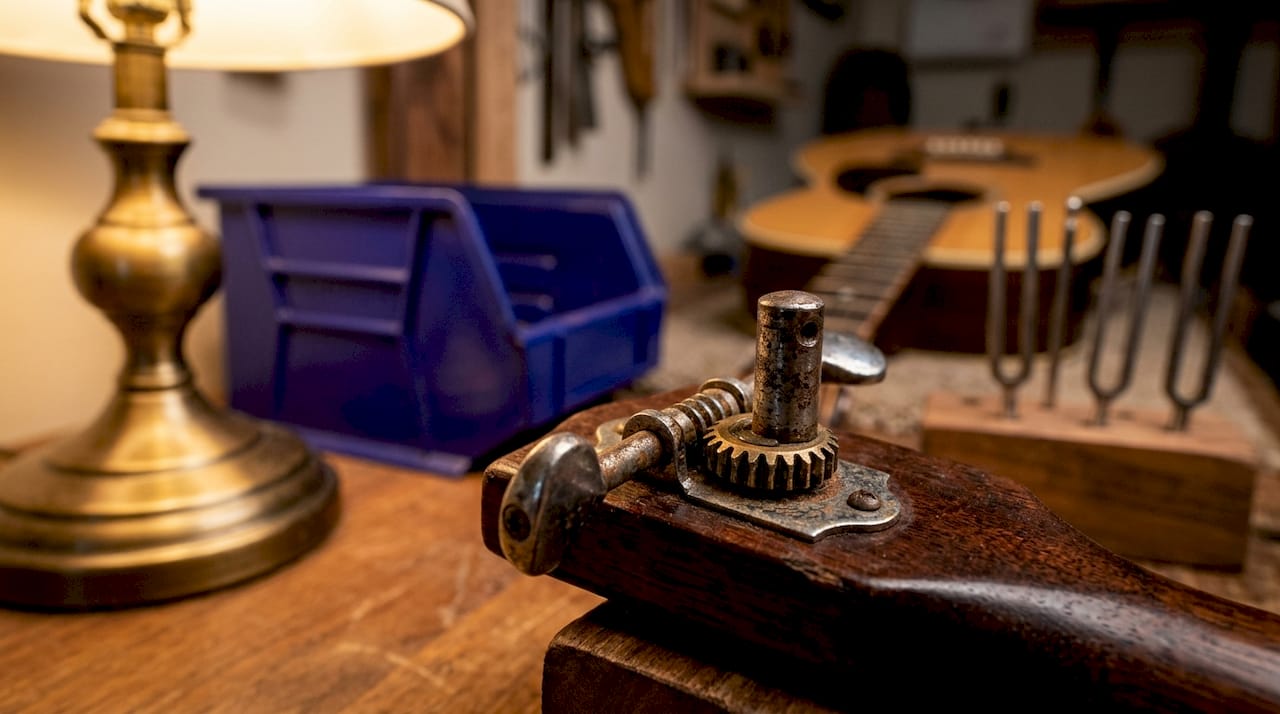
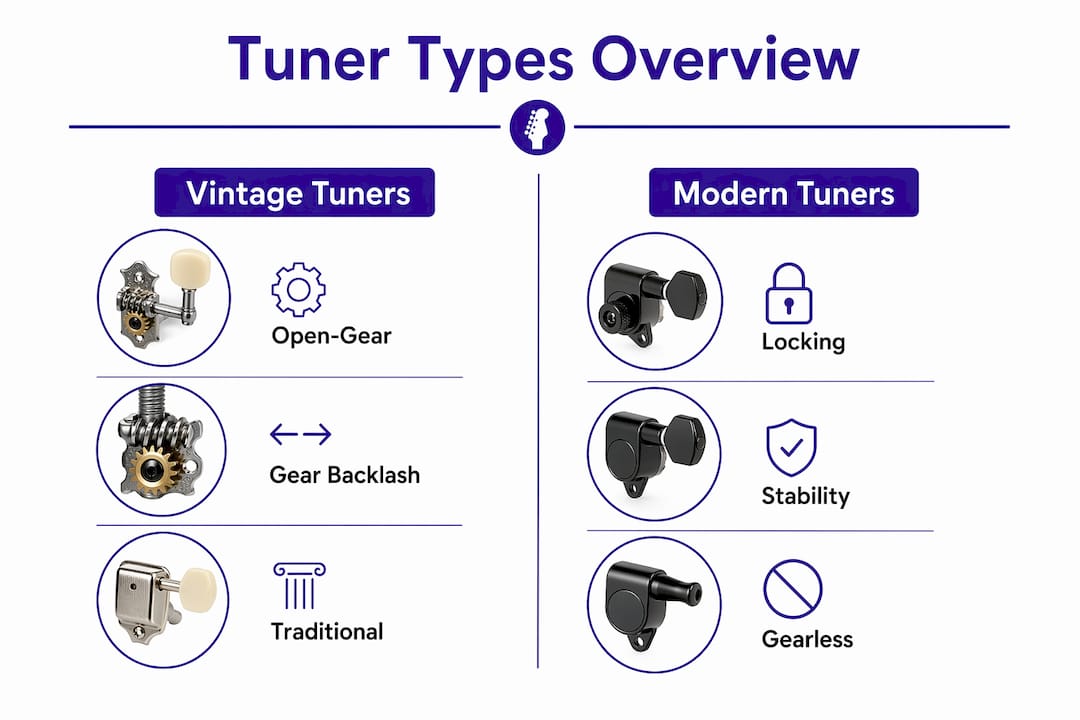
Vintage tuning mechanics rely on open-gear designs where the worm gear and string post are exposed. These machines typically require multiple string wraps around the post to hold tension, which introduces one of the most common sources of instability: string wrap slippage. Every time you bend a note or use a tremolo arm, those wraps shift slightly. Over time, that shift accumulates into noticeable pitch drift.
Modern locking tuners address this directly. Locking tuners clamp strings mechanically, eliminating the need for multiple wraps and removing slippage as a variable entirely. The result is measurably better tuning retention during bends and aggressive tremolo use. For a vintage guitar that sees regular stage use, this is a genuine performance upgrade.
Gearless tuning machines take precision further. Gearless tuners eliminate gear backlash and operate at a 40:1 tuning ratio, meaning each rotation of the tuning button moves the string pitch by a much smaller increment. That ratio makes micro-adjustments far more controlled, which matters most for players who use alternate tunings or retune frequently between songs.
The comparison below shows how the three main tuner categories stack up on the factors that matter most to vintage guitar owners:
| Tuner type | Gear backlash | String slippage | Tuning ratio | Best use case |
|---|---|---|---|---|
| Vintage open-gear | Present | Higher risk | 14:1 to 18:1 | Originality, collector value |
| Locking tuners | Present | Eliminated | 14:1 to 18:1 | Stage performance, tremolo use |
| Gearless tuners | Eliminated | Eliminated | 40:1 | Precision tuning, alternate tunings |
One factor no tuner upgrade can fix is nut binding. Tuner upgrades cannot resolve nut binding, which is the single most common cause of tuning instability on vintage instruments. If the nut slots are too narrow, too rough, or cut at the wrong angle, the string catches and releases unevenly every time you tune or bend. The tuner gets blamed, but the nut is the actual problem.
Pro Tip: Before spending money on new tuning machines, press each string down behind the nut and release it while watching the tuner needle. If the pitch jumps sharply when the string releases, your nut is binding. Fix that first.
Does the choice of tuner impact the tonal quality of vintage guitars?
This is the most persistent myth in vintage guitar circles, and the answer is straightforward. Tuner weight does not significantly affect tone. The primary contributors to a guitar’s sound are the bridge, nut material and fit, pickups, and overall setup quality. Swapping from lightweight Kluson-style tuners to heavier locking machines will not produce a meaningful tonal shift that holds up under controlled listening conditions.
Why does the myth persist? Because players often install new tuners as part of a broader setup refresh. When they also clean the nut slots, adjust the truss rod, and set intonation at the same time, the guitar sounds better. The tuners get the credit for improvements that actually came from the setup work.
The real connection between tuners and tone is indirect:
- A guitar that holds pitch accurately sounds better because every note rings true against the others.
- Tuning instability creates perceived muddiness or dissonance that players often misread as a tonal problem.
- Musicians perceive tonal differences from tuners, but those differences trace back to performance reliability, not tuner mechanics.
- The role of tuners in vintage tone is therefore functional, not acoustic. They keep the instrument in a state where its actual tonal qualities can be heard clearly.
For collectors, this distinction matters. Replacing original tuners on a vintage instrument for tonal reasons is not supported by evidence. Replacing them for stability or playability reasons is a different and more defensible conversation. Understanding how hardware shapes vintage sound helps you make that call with confidence.
What practical steps can vintage guitar collectors take to evaluate tuner performance?
Evaluating tuning machines on a vintage instrument is a structured process. Rushing to replace hardware before diagnosing the actual source of instability is the most common and expensive mistake collectors make.
Follow these steps in order:
-
Inspect the nut first. Check each slot for width, depth, and smoothness. A slot that is too narrow for the string gauge will bind. Rough slot walls create friction that causes pitch to jump when strings are bent or released. Nut slot shape must match string gauge precisely, and rough edges need to be smoothed before any tuner evaluation is meaningful.
-
Test the tuning machines mechanically. Turn each tuner button slowly and feel for roughness, slop, or inconsistency in the gear movement. Vintage open-gear tuners often develop wear in the worm gear over decades. Light roughness can be addressed with proper lubrication. Significant slop in the gear mesh means the machine is worn past the point of reliable service.
-
Clean and lubricate. Use a dry lubricant or a small amount of petroleum jelly on the gear teeth and string post. Avoid oil-based lubricants that attract dust and gum up over time. Corrosion on vintage tuner buttons or posts is cosmetic unless it has reached the gear mechanism itself.
-
Check string winding technique. On vintage-style posts, strings should wind downward from the first wrap, keeping the string angle from the nut as consistent as possible. Sloppy or overlapping wraps create uneven tension distribution and contribute to slippage.
-
Verify pitch accuracy with a precision tool. Peterson strobe tuners resolve pitch to a tenth of a cent or less, which is the standard used in professional vintage guitar restoration. For everyday tuning, a quality clip-on tuner is sufficient. For setup verification after any hardware work, a strobe-level tool reveals intonation issues that standard tuners miss entirely.
-
Decide on originality versus performance. If the guitar is a collector piece where originality drives value, preserving the original tuning machines is almost always the right call. If it is a player-grade vintage instrument, locking tuners provide practical benefits including faster string changes and better retention under performance conditions, with no tonal penalty.
Pro Tip: When evaluating a vintage guitar for purchase, bring a Peterson strobe tuner or a high-resolution clip-on. Tune each string, play a full bend on the B string, and check whether pitch returns exactly. If it does not, you have either a nut binding issue or a worn tuner. Both are negotiating points on price.
How do tuner design and string path geometry interplay to affect tuning stability?
String path geometry is the factor most collectors overlook, and it is where Fender Custom Shop builders focus when diagnosing tuning problems on vintage-spec instruments. The angle at which a string travels from the nut slot to the tuning post determines how much lateral pressure the string exerts against the nut wall. Too steep an angle increases friction. Too shallow an angle reduces downward pressure in the slot, causing the string to pop out or vibrate inconsistently.
Staggered tuning machines, where each post is a slightly different height, address this on headstocks with a straight string pull. On a Fender-style headstock, staggered posts create the correct break angle over the nut without requiring string trees on every string. String trees themselves are a workaround for the same geometry problem. They add downward pressure on the high strings, but a poorly positioned or sharp-edged string tree creates its own binding point.
The nut slot shape compounds all of this. A slot that is correctly shaped for the string gauge will allow the string to move freely during tuning and bending, then return to its seated position without catching. Nut slot filing technique requires matching slot shape to string gauge and smoothing any rough edges that create friction. This is precision work, and it is the single most impactful setup task for tuning stability on any vintage guitar.
The practical takeaway is direct: even the finest gearless tuning machines cannot compensate for a poorly cut nut or a mismatched string angle. Precision tuning equipment is essential for restorers who need to verify that geometry corrections have actually solved the problem. Getting the string path right before evaluating tuner performance is not optional. It is the only sequence that produces reliable results.
Key takeaways
The role of tuners in vintage guitars is primarily mechanical: they control string tension and tuning stability, not tone, and their performance depends as much on nut condition and string path geometry as on the tuner design itself.
| Point | Details |
|---|---|
| Tuners control stability, not tone | Tonal improvements after tuner swaps come from setup work, not the hardware itself. |
| Nut binding is the real bottleneck | Fix nut slot shape and smoothness before evaluating or replacing tuning machines. |
| Locking tuners eliminate slippage | They are the right upgrade for stage use but not necessary for collector-grade instruments. |
| String path geometry matters | Staggered posts and correct nut angles are as important as tuner quality for pitch retention. |
| Precision tools verify the work | Peterson strobe tuners confirm that setup corrections have actually solved the instability. |
What I’ve learned from years of handling vintage tuning hardware
After working with hundreds of vintage instruments, the pattern I see most often is this: a player or collector replaces the original tuning machines, the guitar still drifts in pitch, and the conclusion is that vintage guitars are just inherently unstable. That conclusion is almost always wrong.
The original Kluson-style tuners on a well-maintained 1960s instrument are not the problem. The nut that has never been properly cut, the string tree that was installed at the wrong angle, the string wraps that were never done correctly. Those are the problems. I have seen guitars with worn, decades-old open-gear tuners hold pitch beautifully after a proper nut job and a string path correction.
That said, I am not a purist who insists on original hardware at all costs. If you play your vintage guitar hard, use a tremolo regularly, and need it to stay in tune through a two-hour set, locking tuners are a sensible choice. The key is making that decision with clear eyes. Understand why vintage instruments sound the way they do before you start modifying them. And always, always fix the nut first.
— Vintage
Explore vintage guitars and hardware at Vintage Guitar World
At Vintage-guitar-world, every instrument in the catalog has been evaluated for hardware integrity, including tuning machine condition and string path geometry. Whether you are building a collection or looking for a player-grade vintage guitar that holds pitch reliably, the selection reflects that level of scrutiny.

If you are researching your next acquisition, the vintage guitar types guide covers the hardware characteristics, historical context, and collector considerations across every major category. For buyers weighing originality against performance, the vintage vs. reissue comparison addresses exactly that trade-off with the specificity collectors need.
FAQ
What is the primary role of tuners in vintage guitars?
Tuning machines in vintage guitars hold string tension and control how consistently each string returns to pitch after bending or playing. Their primary function is mechanical stability, not tonal contribution.
Do locking tuners improve the sound of a vintage guitar?
Locking tuners do not directly improve tone. They eliminate string slippage, which improves tuning stability, and a guitar that stays in tune sounds better. The tonal improvement is indirect.
How do I know if my vintage tuners need replacing?
Turn each tuner button slowly and feel for roughness or excessive play in the gear. If the guitar drifts in pitch after bends, first check the nut for binding before concluding the tuners are at fault.
What is the best way to maintain vintage open-gear tuners?
Clean the gear mechanism with a soft brush, apply a dry lubricant to the gear teeth, and check for corrosion on the posts. Proper string winding technique also reduces wear on the post and gear over time.
Can a precision tuner like a Peterson strobe help with vintage guitar setup?
Peterson strobe tuners resolve pitch to a tenth of a cent, making them the standard tool for vintage guitar restoration and intonation verification. They reveal setup problems that standard clip-on tuners cannot detect.