













TL;DR:
- Handcrafted guitars offer superior tonewoods, detailed construction, and personalized features that enhance resonance and playability. They develop a deep emotional connection, respond uniquely to each player’s style, and often gain value over time due to quality craftsmanship. These instruments provide durability, customization, and a meaningful relationship with music that mass-produced guitars cannot replicate.
Picking the right guitar is never simple. Walk into any store or browse any catalog, and you are instantly confronted with hundreds of options spanning every price point and style. But once you understand the real benefits of handcrafted guitars, the noise quiets down fast. A handcrafted instrument is not just a purchase. It is a decision about the kind of relationship you want with music. This article breaks down exactly what sets handmade guitars apart, from the woods and winding to the feel under your fingers and the value they hold for decades.
Table of Contents
- Key takeaways
- 1. The real benefits of handcrafted guitars start with wood selection
- 2. Luthier expertise shapes more than the wood
- 3. Sound quality that responds to how you play
- 4. Neck profiles and action: the feel you cannot fake
- 5. Customization as a creative act
- 6. Durability and long-term value
- 7. Handcrafted versus mass-produced: the honest comparison
- My honest take after years with handcrafted instruments
- Explore handcrafted guitars at Vintage-guitar-world
- FAQ
Key takeaways
| Point | Details |
|---|---|
| Superior tonewoods matter | Luthiers hand-select aged woods that produce richer resonance than factory-standard materials. |
| Sound responds to you | Handcrafted setups and hand-wound pickups react to subtle playing nuances no machine replicates. |
| Built to last and appreciate | Better construction and quality control mean handcrafted guitars resist wear and often gain value over time. |
| Personalization goes deep | Custom specs, woods, and finishes make every handcrafted guitar a true one-of-a-kind instrument. |
| Connection drives performance | The emotional bond with a unique instrument consistently inspires different and deeper playing. |
1. The real benefits of handcrafted guitars start with wood selection
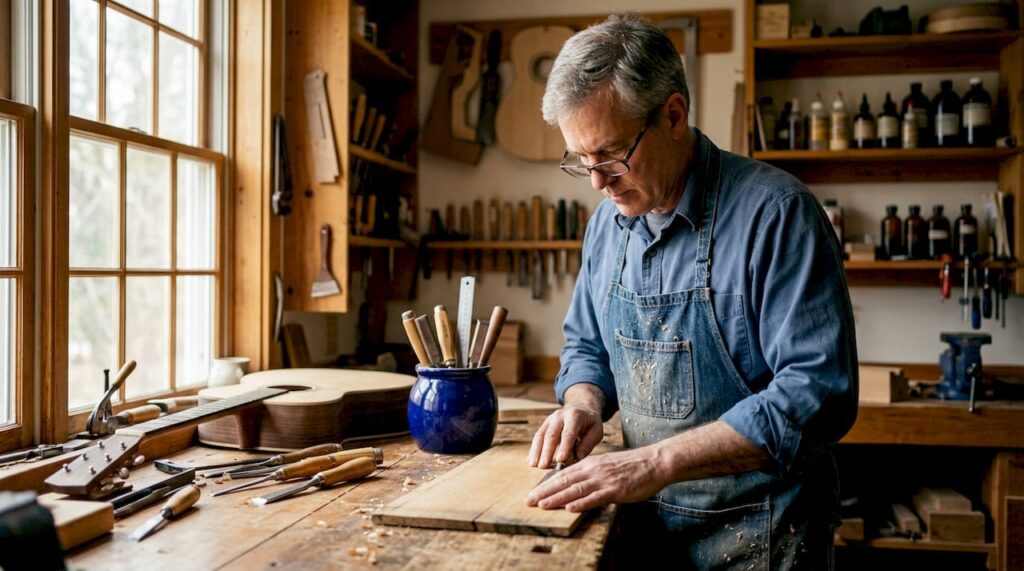
Mass-produced guitars are built for consistency at scale. That means tonewoods are often selected by grade in bulk, not chosen one by one for how they look, feel, or sound. A luthier works differently. Before a single joint is cut, they tap, flex, and listen to each piece of wood.
Boutique manufacturers’ careful selection of tonewoods and individual attention improves resonance and tonal richness compared to mass production. Aged and treated premium woods produce warm, complex sounds that uniform factory processes simply cannot recreate.
This matters practically. A spruce top selected for stiffness-to-weight ratio will vibrate differently than one pulled from a generic batch. That difference is what makes one guitar bloom under a fingerpicked arpeggio while another just sounds adequate.
- Hand-tapped tops allow luthiers to find the resonant sweet spot in each piece of wood before shaping begins.
- Aged wood has had time to release internal moisture and stress, stabilizing its acoustic behavior.
- Matching back and sides for grain and stiffness creates instruments where all tonal elements work together rather than against each other.
Pro Tip: When evaluating any handcrafted instrument, ask the maker or seller about the wood’s origin and age. A luthier who knows these details has paid attention to the entire build, not just the finishing stages.
2. Luthier expertise shapes more than the wood
Wood selection is only half the story. What a skilled luthier does to that wood during construction has just as much impact on the final instrument. Bracing patterns, neck angles, nut slots, and saddle height are not guesses. They are calculated, adjusted by hand, and verified by ear.
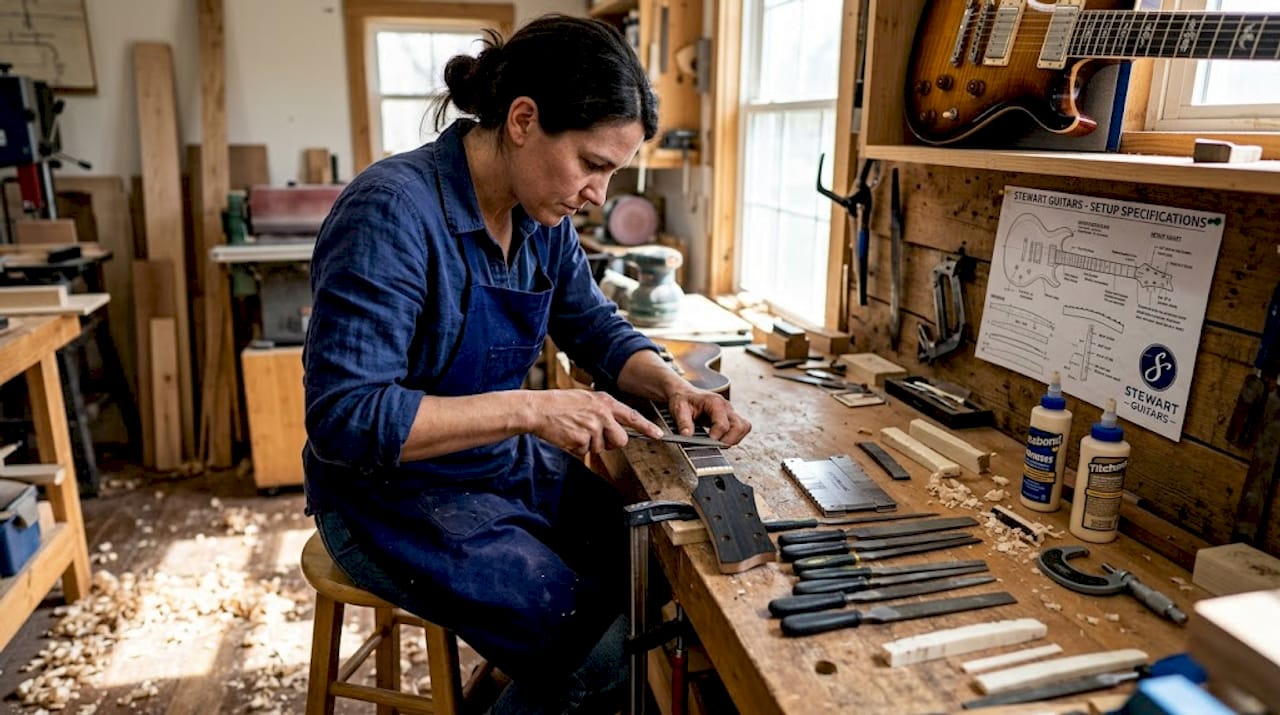
Fender Master Builders confirm that manual nut filing and human intervention in setup deliver tuning stability and playability superior to mass production. This is not marketing language. It reflects a real limitation of automated systems, which set tolerances based on averages rather than the specific behavior of each individual guitar.
Factory guitars often leave the production line with nut slots that are slightly too high or fret ends that are mildly sharp. Players notice these issues as discomfort or tuning problems, often without knowing why. A master luthier addresses every one of these details before the instrument leaves the bench.
Expert setup and finishing work, like nut filing and component fitting done by master builders, elevates tuning stability and playability beyond factory standards. That level of care is a defining advantage of handmade guitars.
3. Sound quality that responds to how you play
Here is something most spec sheets cannot tell you: a well-built handcrafted guitar responds differently to different players. It reads your attack. Pull back on the pick pressure and the sound softens. Dig in and it opens up with more harmonic complexity. Factory guitars often compress this dynamic range into a narrower, more predictable output.
Handmade instruments with hand-wound pickups significantly improve dynamic response and note separation, enhancing player control over subtle sound variations. Professional players in 2026 report these instruments feel more immediate and articulate for nuanced expression.
For acoustic players, this translates to cleaner note separation in chord voicings and more expressive solo lines. For electric players, it means the volume knob and pick attack actually control the tone rather than just changing the volume level.
“Handmade pickups provide clearer note definition, stronger dynamic range, and feel more alive under the fingers, enabling the guitar to respond authentically to pick attack and volume knob adjustments.” — BTone Company
This responsiveness has direct implications for recording. Studio engineers consistently notice that handmade pickups and components contribute to touch sensitivity impossible to replicate by specs or machinery. That matters when you need a guitar track to have life on a recording rather than just sitting flat in the mix.
4. Neck profiles and action: the feel you cannot fake
Playability is not just about fret height. The neck profile, the width at the nut, the radius of the fretboard, and the overall weight distribution of the instrument all determine how long you can play without fatigue and how naturally your technique develops.
Mass-produced guitars default to a small number of standard profiles because tooling changes cost money. Handcrafted guitars can be shaped around the player’s hand. A luthier building a custom instrument will often take measurements of the player’s hand span and preferred grip, then carve the neck accordingly. The result is a guitar that feels like it was made for you because it literally was.
For players dealing with hand fatigue or injury recovery, this is more than comfort. It is a functional improvement that changes practice consistency and performance endurance.
5. Customization as a creative act
One of the clearest custom guitar benefits is the ability to make decisions that a factory never allows. Choice of body wood, top wood, binding material, finish type, inlay design, pickup configuration, and hardware finish are all open variables when working with a luthier.
- Choose your tonewoods based on your preferred sound profile: mahogany for warmth, maple for brightness, rosewood for depth.
- Select your hardware to match your playing needs, from tuning machines rated for stability to bridges optimized for your string gauge.
- Specify your neck dimensions including profile shape, width, and radius to fit your playing style.
- Design the aesthetic from headstock shape to body binding, creating an instrument that reflects your identity as a musician.
- Configure electronics with pickup types and positions that suit your genre and recording requirements.
Custom guitars support emotional connection and personalized aesthetics, fostering deeper musical expression and identity through unique design choices. When an instrument reflects who you are, you pick it up more. You practice longer. You write more music.
Pro Tip: Before commissioning or buying a custom handcrafted guitar, spend time playing as many acoustic and electric instruments as you can. Note which neck profiles feel natural and which body shapes sit comfortably. Those physical preferences are the most important specs to communicate to a luthier.
There is also a cultural dimension worth acknowledging. Choosing a handcrafted instrument often means supporting an individual maker or small workshop rather than a large manufacturer. That relationship comes with real benefits, including direct access to the person who built your guitar for questions, adjustments, and future work.
6. Durability and long-term value
A handcrafted guitar built with proper joinery, quality finish, and selected tonewoods will outlast most factory instruments by a significant margin. The difference is not always visible in the first few years, but it becomes obvious over decades.
Handcrafted guitars generally undergo stringent quality control and use superior materials leading to greater durability and lasting value as collector’s items. Better construction resists warping, and local maker support facilitates long-term maintenance.
This is where the advantages of handmade guitars become a financial argument as well as a sonic one. Factory instruments depreciate quickly. A well-made handcrafted guitar often holds its value or appreciates, particularly if the maker develops a strong reputation. Instruments from recognized luthiers regularly sell on the secondary market for more than their original price.
| Factor | Handcrafted guitar | Mass-produced guitar |
|---|---|---|
| Material selection | Hand-picked tonewoods, aged and tested | Grade-sorted bulk materials |
| Setup quality | Individual adjustment by skilled luthier | Factory average tolerances |
| Tuning stability | Manually fitted nut and saddle | Machined to spec, variable quality |
| Durability | Superior joinery and finish | Consistent but average build quality |
| Resale value | Often appreciates or holds strong | Depreciates quickly |
| Customization | Fully tailored to the player | Limited to available models |
The long-term maintenance relationship with a maker is another advantage most players overlook. When your factory guitar needs a setup adjustment years from now, you call a generic repair shop. When your handcrafted instrument needs attention, you may be able to go directly back to the person who built it.
7. Handcrafted versus mass-produced: the honest comparison
This is not an argument that mass-produced guitars have no value. For beginners, the affordability and consistency of factory instruments make them the right starting point. But while CNC machining improves consistency in mass production, individual craftsmanship imparts unique character that energizes the musician’s connection with the instrument.
The honest comparison looks like this. Factory guitars give you predictability and lower upfront cost. Handcrafted guitars give you character, responsiveness, longevity, and a playing experience that rewards growth over time. The more you develop as a player, the more you will notice the ceiling of a factory instrument and the open space a handcrafted one provides.
There is also the matter of inspiration. Modern mass production often lacks the character and life perceived in handcrafted or vintage guitars. That difference impacts player inspiration and instrument feel more than measurable tone aspects. If a guitar makes you want to play, it has already done something a spec sheet cannot measure.
My honest take after years with handcrafted instruments
I have spent years handling handcrafted guitars, and the thing that surprises most players is not the sound. It is how the instrument changes their playing without them realizing it. You sit down with a luthier-built guitar and within twenty minutes you are playing things you did not know you had in you, not because the guitar is magic but because it is responding to everything you do instead of limiting it.
The second thing I keep coming back to is maintenance. I have seen players neglect their factory guitars for years without consequence, then struggle when something goes wrong because they never built a real relationship with the instrument. Players who own handcrafted guitars tend to be more attentive. They learn the wood’s response to humidity, they notice when the action shifts, and they address it before it becomes a problem. The guitar teaches them to be better caretakers.
My strongest piece of advice: do not buy a handcrafted guitar based on specs alone. Play it, or at the very least understand the role of craftsmanship behind it. The story of how an instrument was built is part of what you are paying for and part of what you will feel every time you play it.
— Vintage
Explore handcrafted guitars at Vintage-guitar-world

At Vintage-guitar-world, every instrument in our catalog has been individually evaluated for craftsmanship, tonal quality, and structural integrity. We specialize in guitars where the hands of a skilled maker are present in every detail, from the neck joint to the tuning machines. If the benefits covered in this article resonate with you, our collection of handcrafted and vintage guitars is the natural next step.
We also provide detailed information on vintage guitar investment value for players who want to understand how their purchase holds up over time. Whether you are looking for a classical instrument with a luthier’s legacy behind it or a handcrafted electric built to perform at the highest level, our team is ready to guide your decision with real expertise.
FAQ
What makes a handcrafted guitar better than a factory guitar?
Handcrafted guitars benefit from individually selected tonewoods, luthier-adjusted setups, and hand-fitted components that improve resonance, tuning stability, and dynamic response in ways factory tolerances cannot match.
Are handcrafted guitars worth the higher price?
For serious players, yes. Better materials, superior playability, and longer durability often result in a lower total cost over time, especially since handcrafted guitars tend to hold or increase their resale value.
How do hand-wound pickups affect guitar tone?
Hand-wound pickups produce clearer note definition and stronger dynamic range than machine-wound versions, responding more accurately to pick attack and volume adjustments for a more expressive playing experience.
Can you customize a handcrafted guitar to fit your playing style?
Fully. Luthiers can tailor neck profiles, body dimensions, tonewoods, hardware, and electronics to match a specific player’s hand size, genre, and aesthetic preferences.
Do handcrafted guitars improve with age?
Well-constructed handcrafted guitars built with quality tonewoods often open up tonally as the wood matures, and their value on the collector market frequently increases alongside the maker’s growing reputation.