













TL;DR:
- A genuine limited edition guitar features a fixed production cap and at least one exclusive design element, confirmed by documentation. Rarity alone does not qualify a guitar as limited; craftsmanship, authenticity, and a clear unit limit are essential. Verifying a true limited edition requires checking manufacturer announcements, serial numbers, certificates, and provenance to avoid marketing misconceptions.
The term “limited edition” gets thrown around constantly in the guitar world, but what defines a limited edition guitar in any meaningful sense? Walk through enough gear forums or manufacturer catalogs and you will quickly notice that “limited edition” can mean anything from 50 hand-signed instruments to a seasonal colorway with no production cap in sight. For serious collectors and players, that ambiguity is not just frustrating. It costs real money. Understanding exactly which criteria separate a genuine limited edition from clever marketing is the first skill every collector needs to develop.
Table of Contents
- Key takeaways
- What defines a limited edition guitar
- Rarity, craftsmanship, and exclusivity
- Limited edition vs. special edition vs. signature models
- How to verify a guitar’s limited edition status
- Why limited edition guitars appeal to collectors and players
- My take on what really separates genuine limited editions from the noise
- Explore rare and limited guitars at Vintage-guitar-world
- FAQ
Key takeaways
| Point | Details |
|---|---|
| Fixed production cap is non-negotiable | A true limited edition guitar requires an explicit, documented unit ceiling set by the manufacturer. |
| Unique features must distinguish the run | Exclusive finishes, hardware, or materials must separate a limited edition from the standard catalog model. |
| Verification requires documentation | Serial number ranges, certificates of authenticity, and manufacturer announcements confirm real limited status. |
| “Limited” and “special” are not synonyms | Special editions emphasize unique features; limited editions require a strict quantity cap on top of those features. |
| Craftsmanship and provenance drive value | Hand-built quality, signed components, and documented provenance directly affect resale and collector desirability. |
What defines a limited edition guitar
At its core, a limited edition guitar is defined by two things working together: a finite production cap and at least one feature exclusive to that run. Neither element alone is enough. A guitar with a beautiful one-off finish but no production limit is just a special variant. A guitar made in limited numbers but otherwise identical to a standard model is closer to a short-run production item.
The clearest industry examples help make this concrete. PRS set a 1,000-unit ceiling on the SE Ed Sheeran “Cosmic Splash,” combining the unit cap with a finish you cannot get anywhere else in the catalog. The PRS Robben Ford McCarty went further, capping at 200 units and positioning the run’s exclusivity as a core part of the instrument’s identity. Gibson has taken this to the extreme: their L-1 Anniversary Limited Edition stopped at just 100 units.
Here is what to look for when identifying the characteristics of limited edition guitars:
- Explicit production cap: The manufacturer states a specific number of units, not just a vague “limited availability.”
- Exclusive design elements: Unique finish, hardware, wood selection, or inlay work not found on standard models.
- Sequential serial numbering: Each guitar carries a number within the declared run (e.g., “047 of 200”).
- Certificate of authenticity: Especially common on artist collaboration models or ultra-low production runs.
- Manufacturer announcement: Official documentation, press release, or catalog entry confirming the limited run.
Pro Tip: Before purchasing any guitar marketed as limited edition, search for the manufacturer’s original press release or product announcement. If the original announcement does not state a specific unit count, the “limited” label may not mean what you think it means.
Rarity, craftsmanship, and exclusivity
Rarity alone does not make a guitar worth collecting. What separates a genuinely desirable limited edition from a forgotten oddity is the quality of craftsmanship behind it. When a manufacturer constrains production, the best ones use that constraint as a reason to raise every standard on the build. That is where the unique traits of limited edition guitars really show up.
Here is how rarity and craftsmanship typically combine to define a true limited edition:
- Rare materials drive small batch sizes. Some limited runs exist specifically because the tonewoods, finishes, or hardware components are only available in restricted quantities. A figured maple top with exceptional grain consistency cannot be sourced in unlimited supply.
- Custom shop production elevates build standards. Many genuine limited editions come from a manufacturer’s custom shop or a dedicated artisan team rather than the standard production line. The Seymour Duncan 50th Anniversary set, limited to 500 units, was hand-built and individually signed, with each set featuring exact reproduction specs and exclusive packaging.
- Artist collaboration deepens authenticity. Signature limited editions developed with direct artist input carry specifications tailored to the artist’s actual sound and preferences. This is not just a name on the headstock. It is a guitar built to replicate how a specific player actually works.
- Strict documentation preserves integrity. The Gibson and Keith Richards collaboration produced only 50 signed Collector’s Edition guitars, each with certificates of authenticity and components replicating Richards’ original gear. That level of documentation is not incidental. It is what keeps limited edition guitar value intact for decades.
Pro Tip: Check whether a limited edition comes from the manufacturer’s standard production facility or their custom shop. Custom shop builds typically hold their value better and attract more serious collectors.
Limited edition vs. special edition vs. signature models
This is where most buyers get confused, and where marketing departments do their most creative work. These three categories overlap but are not the same thing, and knowing the differences will protect you from overpaying for something that does not meet your expectations.
| Category | Production cap | Exclusive features | Artist involvement | Typical purpose |
|---|---|---|---|---|
| Limited edition | Yes, fixed number | Yes, unique to run | Sometimes | Collector scarcity and exclusivity |
| Special edition | No hard cap | Yes, unique finishes or specs | Rarely | Seasonal or event-based differentiation |
| Signature model | No (usually ongoing) | Yes, artist-spec features | Yes, direct | Recreate artist’s preferred setup |
Taylor Guitars defines this clearly: a limited edition implies a fixed production quantity, while a special edition focuses on unique features without necessarily setting a ceiling on how many get made. That distinction matters enormously in practice.
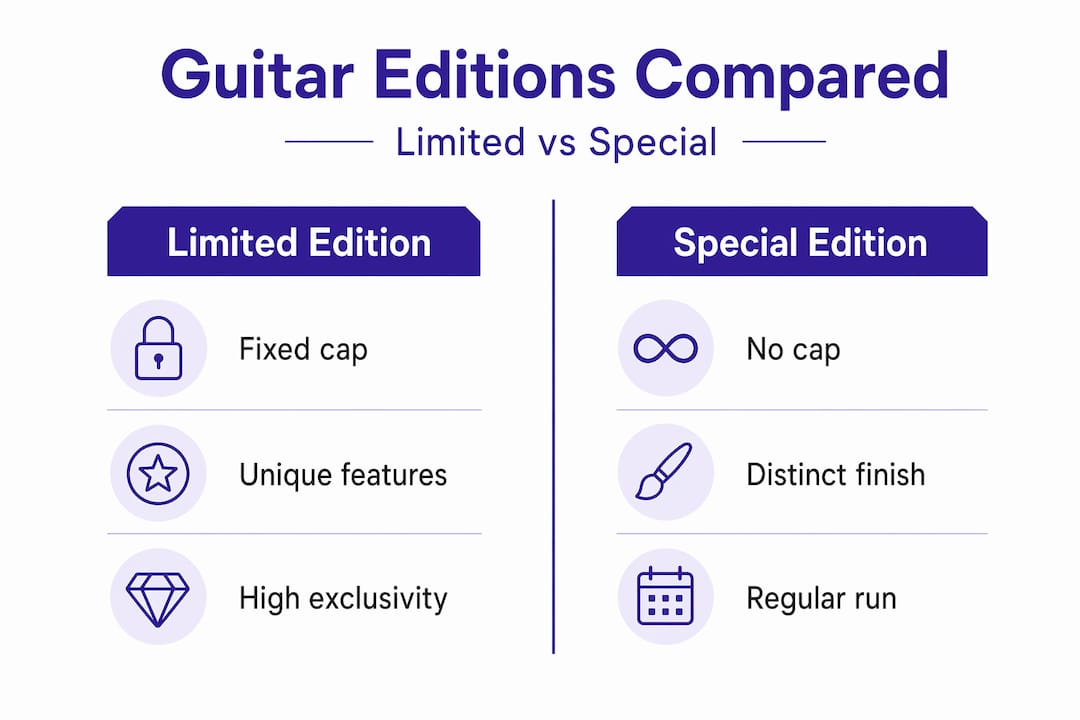
A signature model can run for years or even decades on a standard production line. Eric Clapton signature Stratocasters have been available for so long that calling them “exclusive” would be a stretch. A genuine limited edition, by contrast, disappears permanently once the production cap is reached.
The common marketing abuse is calling something “limited edition” when the actual limitation is a time window for orders rather than a unit cap. Some manufacturer offerings depend on orders placed within a set timeframe rather than a fixed total quantity. That is a meaningful difference. A run where 50,000 people place orders is not scarce in any real sense, even if the ordering period ended.
How to verify a guitar’s limited edition status
Buying a guitar based on a label alone is one of the most expensive mistakes a collector can make. Here is a practical approach to confirming whether a limited edition claim holds up:
- Find the manufacturer’s original announcement. Press releases and official product pages from the release date are the most reliable sources. They will state whether a specific unit count was set.
- Check the serial number against documented ranges. A genuine limited edition will have serial numbers that correspond to the declared production run. If the serial number system cannot be verified against known documentation, be cautious.
- Look for sequentially numbered certificates. High-integrity limited editions, especially those from artist collaborations, include certificates that tie the instrument to its position in the run.
- Request provenance documentation from the seller. Original purchase receipts, hang tags, packaging, and any case candy that came with the guitar all support authenticity. Condition and provenance documentation drastically affect market value.
- Consult expert evaluation services. When the stakes are high, professional appraisal from someone who specializes in rare guitar models is worth every dollar.
- Be skeptical of vague language. Phrases like “limited availability” or “while supplies last” do not confirm a production cap. Look for explicit language: “Only 500 units produced worldwide.”
The collectors who differentiate between order-window limitations versus absolute quantity caps are the ones who avoid mislabeling their acquisitions and protect their investment portfolios over time.
Why limited edition guitars appeal to collectors and players
Understanding why limited edition guitars appeal goes deeper than simple scarcity. Yes, the finite supply creates urgency. But the full picture involves psychology, community, investment potential, and the way a compelling story changes how an instrument feels to own and play.
“Scarcity combined with a compelling narrative drives collector demand more than production limits alone.” This insight from research into collectible psychology explains why some limited editions command enormous premiums while others with identical production caps fail to excite the market.
The story matters. A guitar tied to a specific moment in music history, built in collaboration with an artist whose catalog you love, carries emotional weight that a standard production model cannot replicate. That emotional weight is not irrational. It is part of what you are paying for, and it is part of what holds value over time.
From an investment angle, true limited editions add real value potential but only when transparency and strict production control back them up. The Jackson X Series Diablo Kelly, a themed limited run with distinctive artwork and metal-oriented specs, demonstrates how targeted design and production limits create a specific collector niche. The guitar speaks directly to a community, and that community sustains its desirability.
There is also the identity dimension. Owning a guitar that fewer than 1,000 people in the world possess connects you to a specific moment in a manufacturer’s history. That is a relationship with an instrument that extends beyond how it plays. It shapes how it is discussed, displayed, and passed on.

My take on what really separates genuine limited editions from the noise
I’ve handled a lot of guitars over the years, and the honest truth is that the “limited edition” label has been stretched so far that it has nearly lost meaning in some corners of the market. I’ve seen instruments marketed as limited editions with no publicly verifiable production caps, no unique structural features, and no documentation beyond a sticker on the case. That is not a limited edition. That is a marketing decision.
What I’ve learned is that the manufacturers who take limited editions seriously use them to honor something. A milestone anniversary, a legendary player’s legacy, a material so exceptional it can only be sourced in small quantities. The Seymour Duncan 50th Anniversary set was built that way. The Gibson-Richards collaboration was built that way. Those instruments exist because the producer had genuine respect for the collector who would eventually own one.
My advice: trust documentation over marketing language, every time. A guitar that arrives with a numbered certificate, verifiable serial range, and a manufacturer press release that states a specific unit count is the real thing. Everything else deserves scrutiny. The importance of limited edition guitars in any serious collection depends on that foundation of honesty.
— Vintage
Explore rare and limited guitars at Vintage-guitar-world

At Vintage-guitar-world, every instrument in the catalog has been evaluated for the qualities that actually matter to collectors: documented provenance, verified rarity, and build quality that stands up to scrutiny. If you are building a collection around instruments with genuine exclusivity, the features that define collectible guitars are exactly what we look for before anything reaches the store.
For collectors who want to go deeper, the guide to vintage guitar types, features, and investment history covers how rarity, production history, and craftsmanship interact across different guitar categories. Whether you are hunting for a verified limited edition or a historic instrument with its own story, Vintage-guitar-world offers expert valuation, certification services, and a curated selection built specifically for buyers who know the difference.
FAQ
What makes a guitar officially limited edition?
A guitar qualifies as limited edition when the manufacturer sets an explicit, finite production cap and produces the instrument with at least one feature exclusive to that run. Serial numbering within the declared run and a certificate of authenticity typically confirm the status.
How do I spot a real limited edition guitar?
Look for a manufacturer-confirmed unit count in the original press release, sequential serial numbers within the stated production range, and accompanying documentation such as numbered certificates. Vague language like “while supplies last” does not confirm a true limited run.
Are limited edition and special edition guitars the same thing?
No. A limited edition has a fixed production ceiling. A special edition focuses on unique features or finishes without necessarily capping the number of units produced. Taylor Guitars defines the distinction clearly: limited implies quantity, special implies differentiation.
Do limited edition guitars hold their value better?
Genuine limited editions with strict production caps, strong provenance documentation, and compelling artist or historical connections tend to hold and increase in value over time. Limited editions with vague production histories or no documentation are far less reliable as investments.
Can a signature model also be a limited edition?
Yes, when the manufacturer pairs artist involvement with a hard production cap and exclusive features. The Gibson-Keith Richards collaboration, for example, was both a signature collaboration and a strictly limited run of 50 signed instruments, complete with certificates of authenticity.