














TL;DR:
- Knowing how to identify counterfeit guitars beyond visual cues is essential for serious collectors, as modern fakes now utilize advanced methods like laser-etched logos and forged certificates. Proper preparation with precise measuring tools, reference materials, and internal verification methods enables confident authentication of both structural and electronic components. Relying solely on surface appearances or certificates is risky; instead, systematically cross-check serial numbers, pot codes, and physical details to prevent costly fraud.
If you’ve spent real money on a guitar only to discover it was a fake, you already know the damage goes beyond the wallet. Knowing how to spot counterfeit guitars before you buy is one of the most valuable skills any serious collector or enthusiast can develop. Today’s counterfeits are no longer crude knockoffs. Counterfeiters now use CNC-milled headstocks, laser-etched logos, and forged COAs, making visual authentication dangerously unreliable. This guide gives you a systematic, hands-on process to verify any guitar with confidence.
Table of Contents
- Key Takeaways
- How to spot counterfeit guitars before you start
- Physical inspection: what fakes get wrong
- Serial number verification: the right way to do it
- Common mistakes and expert shortcuts
- My perspective on guitar authentication
- Find authentic vintage guitars at Vintage-guitar-world
- FAQ
Key Takeaways
| Point | Details |
|---|---|
| Preparation before inspection | Gather calipers, a magnifying glass, and brand-specific spec guides before examining any guitar. |
| Physical inspection matters most | Weight, binding seams, truss rod cover spacing, and neck joints reveal fakes that logos never will. |
| Serial numbers require cross-checking | Match serial numbers against official databases and internal pot codes to confirm authenticity. |
| COAs alone are insufficient | Certificates of Authenticity only hold value when backed by credentialed experts and full documentation. |
| Professional appraisal protects you | For any guitar priced above $5,000, an independent professional appraisal is non-negotiable. |
How to spot counterfeit guitars before you start
Before you touch the guitar, you need to arrive prepared. Walking into an inspection without the right tools is like trying to diagnose an engine problem without a wrench. The difference between a confident buyer and a victim of fraud often comes down to preparation.
Here is what you need before any guitar examination:
- Calipers for measuring headstock dimensions, truss rod cover screw spacing, and nut width to the millimeter
- A digital protractor app to verify headstock angle, which varies precisely by brand and model year
- A magnifying glass and flashlight to examine finish layers, binding seams, and electronics cavities
- High-resolution camera or phone to document every detail for comparison and expert review later
- Access to official manufacturer serial number databases and year-by-year specification guides, not third-party decoder sites
- Brand-specific construction references, including books, authenticated photos from museum collections, or dealer documentation
One often-overlooked preparation step is studying mid-year manufacturing changes by brand. For example, Fender changed dot spacing and logo styles within a single calendar year, meaning a guitar that looks “wrong” compared to one reference photo might still be completely authentic. Relying on a single image for comparison is one of the most common and costly mistakes collectors make.
Pro Tip: Build a brand-specific reference folder on your phone with authenticated photos from museum sources or certified dealer catalogs. Having your reference material offline means you can check on the spot, even without cell signal.
Physical inspection: what fakes get wrong
This is where guitar counterfeit signs reveal themselves most clearly. Sophisticated fakes can fool a casual eye, but they almost never survive a structured hands-on inspection.
Follow this process in order:
-
Check the weight. Standard Gibson Les Paul guitars weigh between 8.2 and 9.8 lbs. A guitar that comes in over 10.5 lbs or under 7.5 lbs is a strong counterfeit indicator, often caused by incorrect chambering or substitute materials.
-
Examine the binding seams. Run your fingernail along every binding edge. Authentic guitars have tight, flush binding with no visible glue residue or color bleeding. Fakes routinely show gaps, uneven heights, or binding that lifts at the corners.
-
Measure the truss rod cover screw spacing. On authentic Gibson guitars, truss rod screws sit exactly 19.5 mm apart center to center. Counterfeit instruments frequently land at 21.2 mm or 18.7 mm, and many use flat-head or Torx screws instead of the correct type.
-
Evaluate the headstock angle and logo placement. Use your protractor app. Gibson headstocks break back at 17 degrees. Any deviation beyond a fraction of a degree, combined with a logo that sits too high, too low, or slightly rotated, signals a fake.
-
Inspect the neck joint depth and fit. On a bolt-on guitar, slide a thin piece of paper along the neck heel joint. There should be virtually no gap. Set-neck guitars should show perfectly matched wood grain flow across the joint area with no filler visible under a flashlight.
-
Open the electronics cavity. This is where most fakes completely give themselves away.
Here is a direct comparison of what you will find:
| Feature | Authentic guitar | Counterfeit guitar |
|---|---|---|
| Wiring neatness | Clean runs, no crossovers | Tangled, crossed wires |
| Solder quality | Smooth joints, no burns | Burn marks, rough blobs |
| Cavity finish | Natural wood or correct color | Spray-painted black |
| Pot codes | Match manufacturing year | Inconsistent or absent |
| Capacitor type | Brand-correct spec | Generic or wrong value |
Electronics cavities in authentic guitars exhibit clean wiring, no solder burns, and pot codes that match manufacturing dates. Counterfeits routinely fail this test. You don’t need to be an electronics expert. You just need a flashlight and a few minutes.
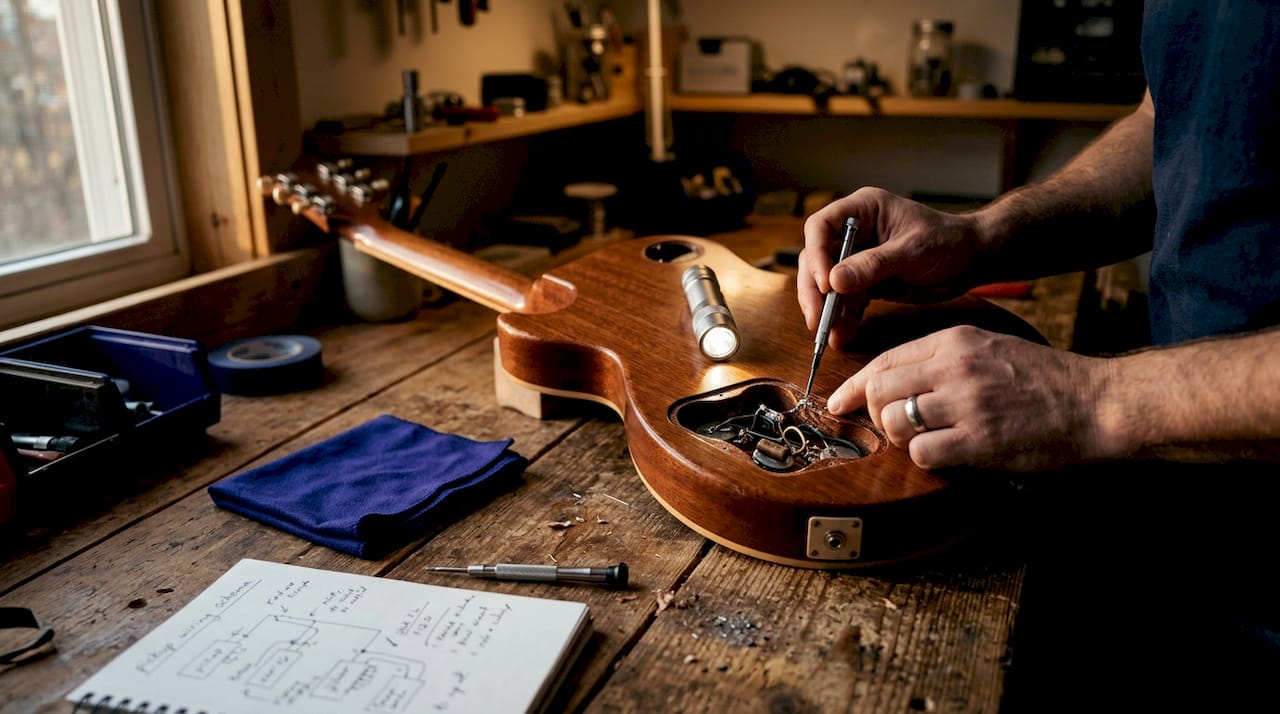
Pro Tip: Photograph the electronics cavity with your flash on. The image will pick up solder quality and wiring patterns far more clearly than direct visual inspection in low light.
Serial number verification: the right way to do it
Serial numbers are the most commonly faked and most commonly misread form of guitar authentication. Knowing how to use them correctly separates serious collectors from easy targets.
Start with location. Serial number placement varies by brand, model, and era:
- Gibson: Back of headstock for most models; inside the body on some hollow-body models from specific years
- Fender: Neck plate on older models; headstock front on most post-1976 instruments; neckplate, body, or headstock on various vintage models depending on year
- Gretsch: Interior label on hollow-body models, with a separate numerical system pre and post 1967
- Martin: Inside the body on a paper label; format shifts significantly across decades
Once you locate it, watch for these red flags in counterfeit serial number patterns:
- Numbers that belong to an entirely different model or production run
- Repeated number sequences (counterfeits recycle popular serial codes)
- Font inconsistencies: spacing, character weight, or depth of stamping that differs from known authentic examples
- Serial numbers with valid-looking prefixes that fail deeper scrutiny against official manufacturer databases
Gibson’s official database only confirms authorized shipments after 2006. For earlier guitars, official Gibson verification requires physical documentation and costs $125. Third-party decoder sites have no access to manufacturer records. Do not trust them.
The most reliable internal cross-check is the potentiometer date code. Pot codes and serial numbers must align with the same manufacturing year. A mismatch between a pot code and the serial number is conclusive evidence of modification or counterfeiting. No other single data point gives you a more definitive answer.
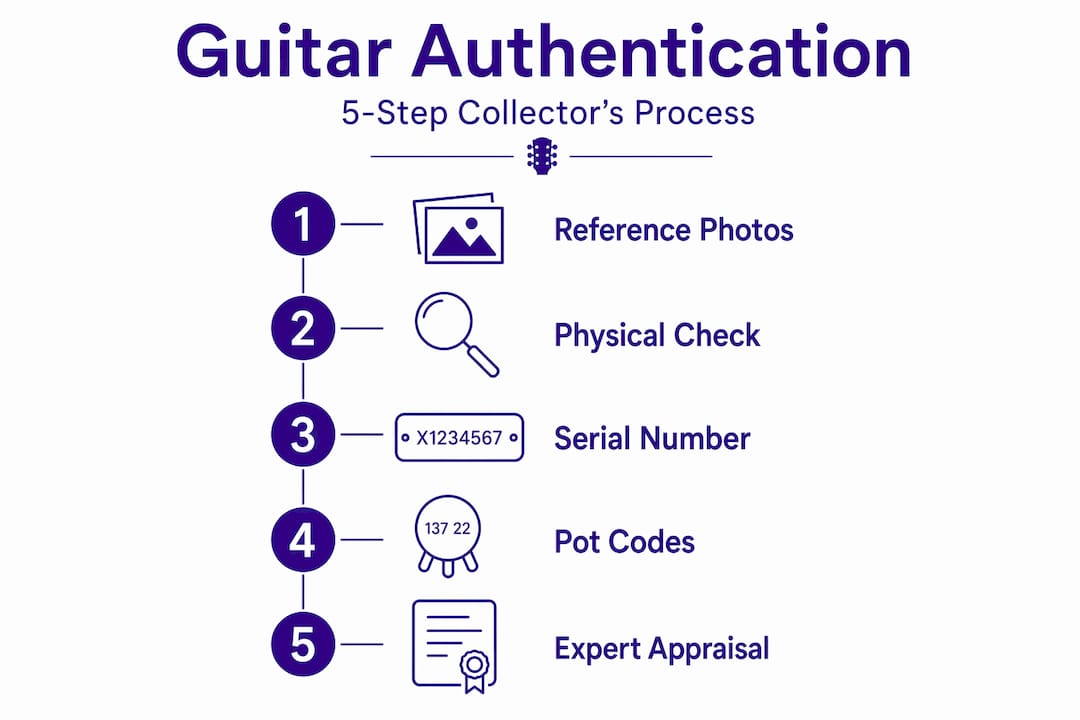
On the documentation side, treat Certificates of Authenticity with healthy skepticism. Authenticity certificates only hold value when they include the specific model, year, condition grade, serial number, professional signature, and supporting documentation. A certificate from a seller with no verifiable credentials is worth nothing.
| Verification method | Reliability | Notes |
|---|---|---|
| Official manufacturer database | High (post-2006) | Limited for pre-2006 instruments |
| Pot code cross-check | Very high | Conclusive on mismatch |
| Third-party decoder sites | Low | No manufacturer database access |
| Seller-provided COA | Varies | Only reliable with credentialed expert |
| Photo matching | Moderate | Useful but requires spec knowledge |
For your guide to authenticating vintage guitars, this cross-referencing approach is the backbone of every credible inspection process.
Common mistakes and expert shortcuts
Even experienced collectors make authentication errors. Most of them come down to the same patterns: moving too fast, trusting surface appearances, and underestimating how sophisticated today’s fakes have become.
Here are the most frequent mistakes and how to avoid them:
- Trusting logos and headstock shape alone. Confidence should only come after structural, electronic, and hardware verification, never from logo presence alone.
- Accepting seller photos as proof. Counterfeiters recycle authenticated product photos from legitimate listings. Always request photos of specific areas: truss rod cover, electronics cavity, neck heel, and serial number location, taken during your conversation.
- Ignoring weight as an indicator. Many collectors skip weighing a guitar entirely. It takes thirty seconds and eliminates a large percentage of counterfeits immediately.
- Assuming a clean exterior means an authentic interior. High-end counterfeit production now invests heavily in exterior finish quality. The inside is where they cut costs.
- Trusting holograms and packaging. Fake holograms have been in circulation for years. Packaging tells you nothing about the instrument inside it.
For any guitar priced above $5,000, a professional appraisal is non-negotiable. The cost of an appraisal is always a fraction of the risk you carry without one. An expert authentication process requires cross-checking multiple features and documentation together, not in isolation.
Pro Tip: Maintain a personal spreadsheet of serial numbers and pot codes for every guitar you inspect or purchase. When a questionable instrument surfaces later, you’ll have a comparison database that no online tool can replicate.
My perspective on guitar authentication
I’ve watched collectors with genuine passion hand over serious money for instruments that, under a flashlight and a set of calipers, would have failed within the first five minutes. The frustration isn’t that fakes exist. It’s that most of them were avoidable.
What I’ve found, after years of working with vintage and collectible guitars, is that the biggest vulnerability isn’t knowledge. It’s impatience. When collectors get excited about a potential find, they compress their inspection process. They tell themselves the logo looks right, the finish is clean, and the seller seems honest. That’s exactly the moment to slow down.
The signs of counterfeit guitars are almost always there. The wiring looks rushed. The screw spacing is off by a millimeter and a half. The pot code predates the serial number by three years. None of those things jump out at you emotionally. They require deliberate, systematic attention.
My honest advice: treat every inspection like you expect to find a fake. Not because most guitars are fakes, but because that mindset keeps your process sharp. The authentic instruments hold up to scrutiny. That’s actually what makes them worth owning.
— Vintage
Find authentic vintage guitars at Vintage-guitar-world

At Vintage-guitar-world, every instrument in the collection goes through the kind of rigorous evaluation this article describes before it ever reaches a listing. The team has assessed structural integrity, serial number provenance, internal component dating, and hardware accuracy across every guitar offered. For collectors who want to learn more before buying, the site includes detailed product histories, vintage guitar types and investment context, and access to appraisal and testing appointments. Whether you’re adding to an established collection or buying your first serious instrument, Vintage-guitar-world gives you the documentation and expert backing that makes authentication a starting point, not a question mark. Browse the curated selection and explore what genuine craftsmanship looks like up close.
FAQ
How do you tell if a guitar is counterfeit?
Check physical details that counterfeiters consistently miss: weight, binding seam quality, truss rod cover screw spacing, and electronics cavity wiring. Then cross-reference the serial number against the internal pot codes for a definitive answer.
Can serial numbers alone confirm a guitar is authentic?
No. Counterfeiters recycle valid-looking serial codes, and online decoders have no access to official manufacturer records. Serial numbers must be cross-checked with internal pot codes and, for high-value instruments, official manufacturer verification.
What tools do I need to inspect a guitar for authenticity?
You need calipers, a digital protractor app, a magnifying glass, a flashlight, and access to official brand specification guides. These tools allow you to measure, compare, and document details that distinguish authentic instruments from fakes.
Are Certificates of Authenticity reliable proof?
Only when issued by a credentialed expert and supported by full documentation including model, year, condition, serial number, and professional signature. A COA from a private seller without verifiable credentials carries no authentication weight.
When should I get a professional appraisal?
Any guitar priced above $5,000 warrants an independent professional appraisal before purchase. The appraisal cost is always a fraction of the financial risk involved in buying an unverified high-value instrument.