













TL;DR:
- Guitar craftsmanship details such as joint tolerances, wood selection, and bracing patterns significantly influence sound, playability, and value. Gibson’s set-neck design with hide glue offers superior sustain, while Fender’s bolt-on necks enable mass production with distinctive tonal traits; neck-through construction provides maximum sustain but is less repairable. Understanding these construction nuances helps collectors evaluate authenticity, long-term value, and the true quality of vintage guitars beyond brand reputation.
Walk into any serious guitar collection and you’ll notice something immediately: two instruments from the same era and the same manufacturer can feel, sound, and behave completely differently. The difference usually isn’t visible at a glance. It lives in the joint tolerances, the glue, the bracing geometry, and the decision made by a craftsman decades ago. For collectors who want to make smart acquisitions and genuinely appreciate what they own, understanding the foundational craftsmanship styles of iconic guitars isn’t optional. It’s the entire game.
Table of Contents
- Essential criteria for assessing craftsmanship styles
- Gibson set-neck tradition: Dovetail and tenon mastery
- The Fender revolution: Bolt-on necks and mass appeal
- Neck-through-body: Ultimate sustain and elite builds
- Bracing brilliance: Martin X vs. Gibson ladder patterns
- Summary comparison: Which style suits your collection?
- Why craftsmanship debate matters more than ever for collectors
- Ready to expand your vintage guitar collection?
- Frequently asked questions
Key Takeaways
| Point | Details |
|---|---|
| Set-neck craftsmanship | Set-necks using dovetails and hide glue deliver sustain and value for collectors who appreciate handcrafted tradition. |
| Bolt-on innovation | Fender’s bolt-on necks offer bright tone and repair ease, proving that innovation shapes collectibility as much as tradition. |
| Neck-through prestige | Neck-through-body guitars provide unmatched sustain favored in elite and collectible models. |
| Brace pattern impact | Martin X-bracing and Gibson ladder bracing each create signature acoustic flavors sought after by different players and collectors. |
| Collector’s edge | Recognizing craftsmanship details lets collectors invest with confidence and appreciate what truly makes a guitar iconic. |
Essential criteria for assessing craftsmanship styles
To identify what sets a classic apart, you need to know which benchmarks matter most when examining guitar builds. Craftsmanship isn’t a single quality. It’s a combination of decisions made at every stage of construction, and each one affects sound, playability, and long-term value.
The primary attributes every serious collector should evaluate include:
- Wood selection: Tone woods like Sitka spruce, mahogany, rosewood, and maple each contribute distinct acoustic properties. Original, aged tonewoods in vintage instruments are increasingly scarce and add measurable value.
- Adhesives: Vintage guitar builds use hide glue for reversible joints that allow vibration transfer and facilitate clean repairs. Modern epoxy or synthetic glues are far less forgiving and harder to reverse without damage.
- Joint construction and tolerances: A dovetail neck joint with tolerances under 0.1mm sustains vibration across the wood-to-wood connection rather than losing energy at a loose interface.
- Bracing patterns: Internal bracing shapes an acoustic guitar’s voice entirely. X-bracing, ladder bracing, and scalloped variants each define tonal character.
- Repairability: A well-built vintage guitar should be restorable. Check our guitar craftsmanship checklist for a hands-on assessment guide when examining a potential acquisition.
- Sound and playability: Ultimately, craftsmanship must produce results. Tight fret work, even action, and resonant response confirm quality build standards.
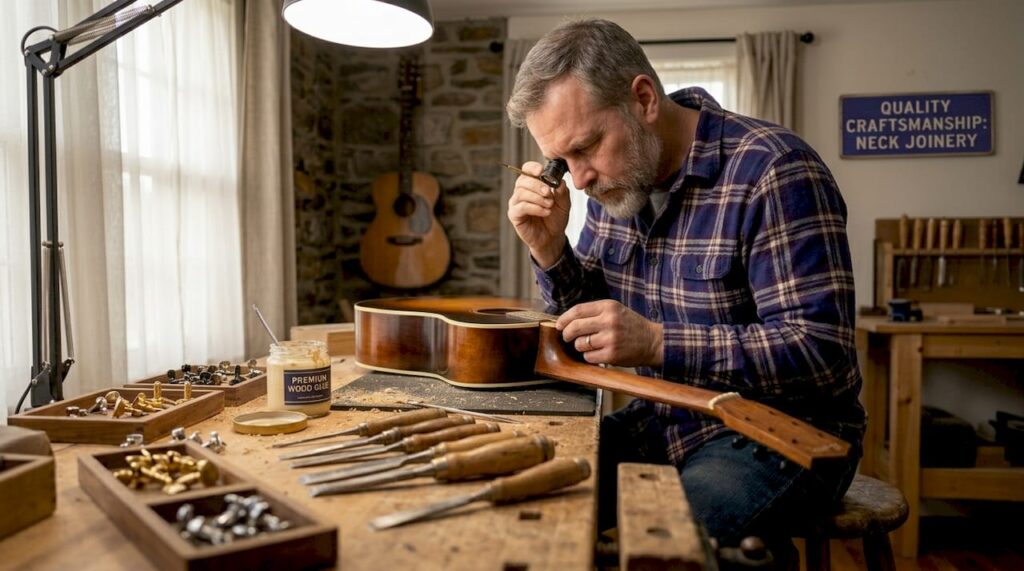
Pro Tip: When evaluating an unfamiliar vintage guitar, look closely at the heel of the neck where it meets the body. A tight, gap-free joint with no visible filler is one of the fastest signals of serious original craftsmanship.
Gibson set-neck tradition: Dovetail and tenon mastery
Now that you know which details to look for, let’s examine how Gibson set the bar for neck joints and vintage guitar resonance. The set-neck approach is arguably the most discussed construction choice in all of guitar collecting, and Gibson’s execution of it remains a benchmark that builders still reference today.
Gibson electric guitars like the Les Paul use set-neck construction with dovetail or long tenon joints glued using hide glue for maximum sustain and vibration transfer. The dovetail joint, shaped like a bird’s tail in cross-section, locks mechanically as well as chemically, creating a connection that transfers string energy directly through the neck and into the body without interruption.
The key collector advantages of Gibson’s set-neck approach:
- Long tenon joints on golden-era Les Pauls extend the glue surface deeper into the body, dramatically increasing neck-to-body contact and resonance.
- Hide glue stiffens and ages into the surrounding wood over decades, which many luthiers believe actually improves vibration transmission in older instruments.
- Sub-0.1mm tolerances in the dovetail channel mean virtually no slop in the joint, which translates directly to consistent sustain and tonal character.
- Original hide glue joints can be steamed open for neck resets without damaging the surrounding wood, making authentic restoration possible.
“Set-neck guitars are theoretically superior for sustain through their permanent glue bond, but empirical testing shows well-made bolt-ons match performance; the real edge case is poor fit in either style compromising tone.”
This is actually an important nuance for collectors. The Gibson mystique around set-necks is real, but it’s specifically about execution quality, not the concept alone. A poorly fitted set-neck performs worse than a precision bolt-on. Explore the Fascination Guitar section and our collection of handcrafted masterpieces to see how this philosophy plays out across iconic models.
The Fender revolution: Bolt-on necks and mass appeal
While Gibson represented handcrafted tradition, Fender’s next move redefined what craftsmanship could mean for the modern era. Leo Fender wasn’t trying to build traditional instruments. He was solving an engineering problem: how do you produce consistent, reliable electric guitars at a scale that working musicians can afford?
Fender pioneered bolt-on necks secured with four wood screws and a metal plate, enabling mass production, easier repairs, and a brighter, snappier tonal profile. The design was initially dismissed by traditionalists, but the results spoke clearly. The Telecaster and Stratocaster became the backbone of rock, country, and blues because the bolt-on build delivered its own sonic signature rather than compromising one.
When evaluating a vintage Fender bolt-on, collectors should focus on these four factors in order:
- Neck pocket fit: The tighter the fit between neck heel and body pocket, the better the energy transfer. Original Fenders with undisturbed neck pockets retain their tonal character more reliably than those that have been refretted and re-shimmed.
- Original hardware and date codes: Fender stamped production dates on neck heels. Matching dates between neck and body are a primary authentication point and a significant value driver.
- Finish condition inside the pocket: Raw, unfinished wood inside the neck pocket was standard for many early Fenders. Overspray or mismatched finish inside suggests a replacement neck or body.
- Screw hole condition: Stripped or enlarged screw holes indicate repeated neck removal. While bolt-on repair is a feature, excessive disassembly can affect long-term joint integrity.
The tonal reality of bolt-on construction is worth understanding fully. The slightly more rigid, definite attack of a bolt-on produces what players describe as “snap” on the front of notes. This is particularly prized in country picking and funk, where note articulation matters more than endless sustain. Browse our guide to handcrafted guitars to understand how builders today are refining this same philosophy.
Pro Tip: A common misconception is that any neck replacement kills a vintage Fender’s value. That’s not quite accurate. An original replacement neck from the correct era with matching date codes can retain significant collector value. Document everything and verify dates independently.
Neck-through-body: Ultimate sustain and elite builds
For collectors chasing ultimate detail, some builds go one step further—merging neck and body for a seamless expression of tone. Neck-through-body construction is the most structurally ambitious approach in mainstream guitar making, and original examples represent some of the most technically impressive instruments ever produced.
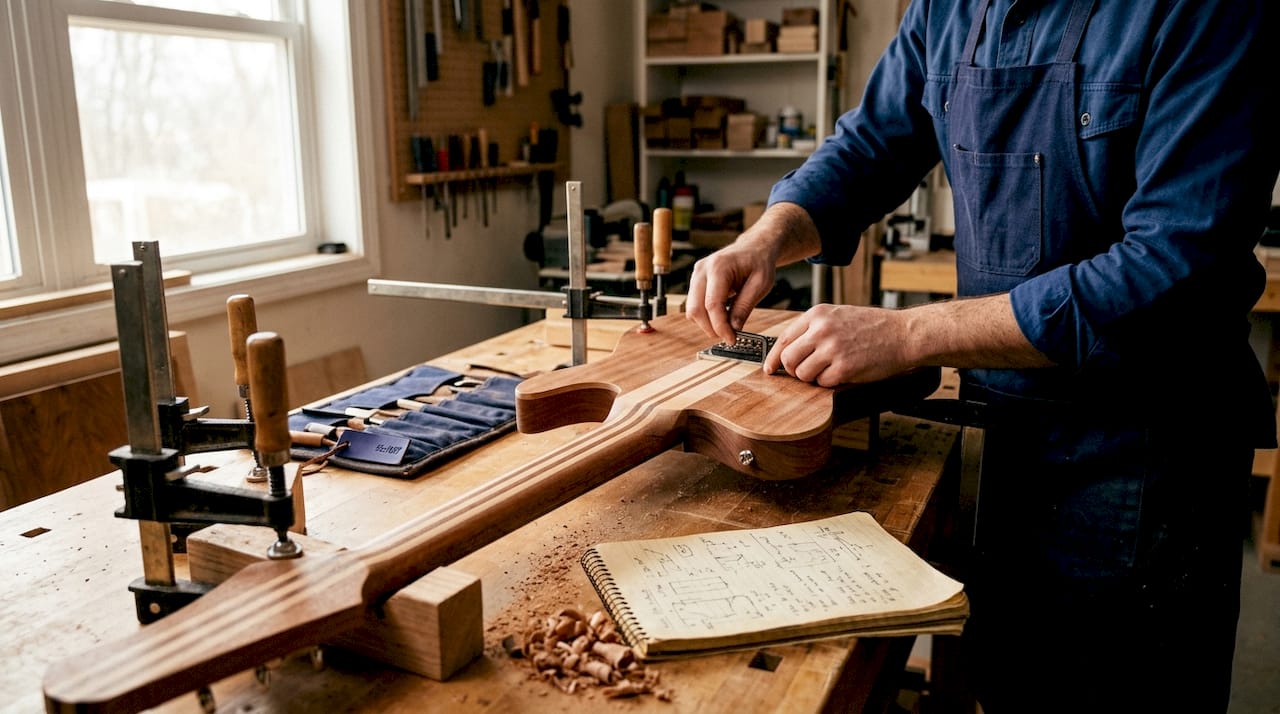
Neck-through-body construction runs wood continuously from the headstock to the body end for ultimate sustain, and it’s found in high-end models like the Gibson Firebird and boutique instruments from independent makers. The structural core is a single plank or laminated blank that extends the full length of the instrument, with body wings glued to the sides. The result is complete wood continuity and zero joint energy loss.
| Feature | Set-neck | Bolt-on | Neck-through |
|---|---|---|---|
| Sustain | High | Moderate to high | Maximum |
| Repairability | Moderate (steam joint) | Easy (unscrew) | Very difficult |
| Production cost | High | Low to moderate | Very high |
| Tonal character | Warm, full | Bright, articulate | Rich, complex |
| Collector rarity | Common in premiums | Very common | Rare, boutique |
The key tradeoff with neck-through instruments is repairability. If the neck breaks or warps significantly, repair options are limited and expensive. Original, unrepaired examples command the strongest collector premiums because they demonstrate structural integrity across decades. Understand the role of craftsmanship in determining these value differentials before you invest at this level.
Bracing brilliance: Martin X vs. Gibson ladder patterns
Electric guitar necks aren’t the only arena for iconic craftsmanship. The inside of an acoustic guitar is just as revealing, and for collectors of vintage flat-tops, understanding bracing is non-negotiable.
Martin acoustics use forward-shifted scalloped X-bracing on Sitka spruce tops with hide glue, enabling steel strings, greater volume, bass response, and projection. The X-brace, introduced by Martin in the 1850s, crosses at a point just below the soundhole and distributes string tension across the entire top rather than concentrating stress in one area. Forward-shifted scalloping removes material from the braces’ non-structural zones, allowing the top to flex more freely and produce greater acoustic bloom.
Gibson acoustics traditionally use ladder bracing for a brighter, more focused treble response, which contrasts with Martin’s X-bracing that provides balanced midrange and sustain. Ladder bracing runs horizontal bars perpendicular to the strings across the lower bout, creating a stiffer top that delivers sharp note separation and clear treble frequencies. For blues players and early country pickers, this definition was exactly what the music needed.
The bracing implications for collectors and players:
- Fingerstyle preference: Forward-shifted scalloped X-bracing boosts bass and treble bloom for fingerstyle playing, though it trades some flatpicking tautness for that opening response.
- Flatpicking preference: Rear-shifted X-bracing or ladder configurations offer more top resistance, translating pick attack into immediate, punchy projection.
- Value signals: Original, undisturbed bracing in a vintage acoustic dramatically affects value. Reglued, replaced, or modified braces reduce collector appeal even when tonally successful.
- Dating verification: Bracing style and glue type help authenticate production era. Pre-war Martins used specific scallop geometries that later production changed, and these details matter enormously to serious buyers.
Our curated section of examples of craftsmanship features acoustic instruments where these internal details have been verified and documented.
Summary comparison: Which style suits your collection?
With all the legendary options explored, a direct comparison helps clarify which guitar craftsmanship style fits your goals as a collector.
| Construction style | Signature models | Tonal profile | Collector strength |
|---|---|---|---|
| Gibson set-neck | Les Paul, ES-335 | Warm, sustained, full | High restoration value |
| Fender bolt-on | Telecaster, Stratocaster | Bright, snappy, articulate | Authentication-driven value |
| Neck-through | Gibson Firebird, boutique | Rich, complex, maximum sustain | Rarity and originality premium |
| Martin X-bracing | D-28, OM-28 | Balanced, projecting, full | Strong investment history |
| Gibson ladder bracing | J-45, early flat-tops | Bright treble, focused | Era-specific collector appeal |
Matching your collection goals to a craftsmanship style matters more than brand loyalty. Consider these collector priorities:
- Restoration enthusiasts will find set-neck, hide-glue instruments most rewarding because reversible joints allow authentic work without permanent alteration.
- Investment-focused collectors should study authentication markers for bolt-on Fenders, where matching date codes and original parts create the biggest value gaps between similar-looking instruments.
- Tone-first buyers who also want structural integrity should seriously consider neck-through examples, accepting the reduced repairability in exchange for unmatched acoustic performance.
- Acoustic collectors need to decide between the balanced projection of X-braced Martins and the focused articulation of Gibson ladder-braced models before entering the market.
Use our craftsmanship quality guide to map these priorities against specific instruments you’re evaluating.
Why craftsmanship debate matters more than ever for collectors
Here’s the contrarian take that most collecting guides avoid: chasing a famous name without understanding the build underneath it is one of the most expensive habits in this hobby. The vintage guitar market has experienced dramatic price increases over the past decade, and a significant portion of those gains have concentrated specifically in instruments with difficult-to-replicate craftsmanship details.
Most buyers respond to logos. True collectors respond to joinery, glue, and geometry. This isn’t elitism. It’s practical protection. When you understand why a 1959 Les Paul commands its premium, you can identify whether a specific example actually delivers the construction details that justify the price, or whether you’re paying for the decal on the headstock. These are very different transactions.
The current market reality is that CNC-routed reproductions have narrowed the visual gap between authentic vintage instruments and high-quality reissues. What they cannot replicate is the aging of original materials, the specific tool marks of hand-scalloped braces, or the particular stiffness curve of a 60-year-old hide glue joint. Collectors who can read these details are not just more satisfied in their acquisitions. They’re protected against buying well-marketed imitations at original prices.
Understanding the discover craftsmanship role in long-term instrument value is the discipline that separates a collector from a buyer. The debate between set-neck and bolt-on, between X-bracing and ladder bracing, matters because these choices have concrete, measurable effects on what an instrument is worth and how it performs across time.
Ready to expand your vintage guitar collection?
Understanding legendary build techniques readies you for the next step: finding and evaluating your own classic instrument with confidence.

At Vintage Guitar World, every listed instrument comes with detailed construction documentation, so you’re never buying blind. Explore our breakdown of vintage guitar types to match craftsmanship styles with specific eras and models. Before you commit to any acquisition, use our handmade guitar valuation framework to assess what you’re actually paying for. And when you’re ready to verify authenticity and condition, our guitar appraisal guide walks you through the exact process our experts use. Your next great instrument deserves that level of scrutiny.
Frequently asked questions
What is the main difference between set-neck and bolt-on guitar construction?
Set-necks are glued into the body for seamless vibration transfer, while bolt-ons use screws for easier repairs and a characteristically brighter, more articulate tonal attack.
Why is hide glue favored in vintage guitar craftsmanship?
Hide glue creates reversible joints that transfer vibration exceptionally well and can be steamed open without damaging surrounding wood, making authentic restoration possible decades later.
How does Martin X-bracing affect acoustic guitar tone?
Martin’s forward-shifted scalloped X-bracing opens the top for greater acoustic bloom, boosting bass response, volume, and projection for a well-balanced sound across playing styles.
Are neck-through guitars better for sustain than other construction styles?
Neck-through construction maximizes sustain through continuous wood from headstock to body end, making it the preferred choice for high-end and boutique instruments where tonal complexity is the priority.
Which bracing pattern is preferred by flatpickers vs. fingerstyle players?
Flatpickers typically favor rear-shifted X-bracing for its taut response and projection, while fingerstyle players often prefer forward-shifted scalloped X-bracing for its bloom and dynamic sensitivity at lower volumes.