














TL;DR:
- Guitar value is driven more by its history, provenance, and materials than by age alone. Understanding landmark eras and specific model details enables collectors to identify truly valuable instruments. Proper research and documentation significantly enhance a guitar’s worth, regardless of its price level.
Not every old guitar is a treasure. Two instruments made a decade apart, both bearing famous brand names, can differ in value by tens of thousands of dollars simply because of their backstory. The guitar market proves this point repeatedly: record-breaking guitar sales show that David Gilmour’s Stratocaster sold for $14.5 million and Jerry Garcia’s guitar for $11.5 million, prices that no amount of polish or originality alone could explain. For serious collectors, understanding why history drives value is not optional — it is the foundation of every smart acquisition decision.
Table of Contents
- Why history matters: The collector’s advantage
- Landmark eras and models: What collectors should know
- Materials and craftsmanship: Hidden historical drivers
- Provenance: When history meets the individual guitar
- Applying historical insight: Building a smarter collection
- A collector’s perspective: Don’t let history overshadow discovery
- Explore more and elevate your collection
- Frequently asked questions
Key Takeaways
| Point | Details |
|---|---|
| History boosts value | A guitar’s historical context—era, events, and associations—can multiply its collectible worth. |
| Provenance matters | Well-documented ownership and artist associations greatly increase desirability and price. |
| Craftsmanship and materials | Pre-war materials and meticulous craftsmanship are key drivers behind premium valuations. |
| Informed collecting | Expert research into a guitar’s story, rarity, and construction helps avoid costly mistakes. |
Why history matters: The collector’s advantage
Building off those record-breaking sales, let’s break down why a guitar’s backstory turns it from average to legendary in the hands of a knowledgeable collector.
The core truth is simple but often misunderstood: age is not value. Context is value. A 1957 student-grade guitar sitting in someone’s attic for 60 years is not automatically a collectible. A 1959 instrument played on a landmark album, with photographs and ownership records to prove it, is a completely different story. Understanding this distinction is what separates informed collectors from buyers who overpay for the wrong things.
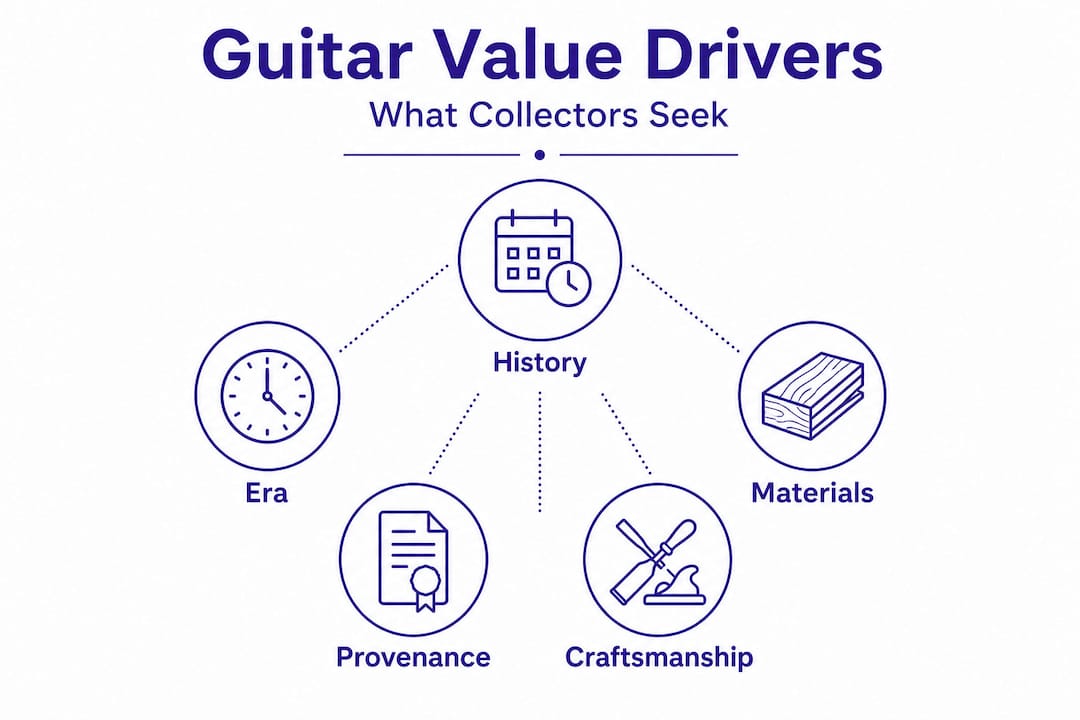
The factors that consistently boost a guitar’s value include:
- Provenance: Documented ownership history, especially artist connection
- Design year: Specific production years tied to historic model changes
- Rarity: Limited production runs or low survival rates
- Materials: Premium woods and hardware used only in certain eras
- Artist ownership: Personal instruments of major musicians
The historical context and value of a specific guitar feeds directly into every one of these factors. What makes guitar provenance and value so powerful is that it stacks: a rare model, from a prized year, owned by a famous player, can reach astronomical prices because all those variables multiply each other rather than simply adding together.
“Provenance and artist association dramatically increase value” — as proven by the $14.5 million sale of David Gilmour’s Stratocaster, a guitar that would have fetched a fraction of that price without its documented musical heritage.
What most new collectors overlook is that this same principle applies at every price level. You do not need a million-dollar instrument for history to matter. A regional blues musician’s verified guitar from the 1960s, a factory prototype with paperwork, or a transitional-year model with documented specifications all carry historical weight that makes them worth more than generic examples of the same model.
Landmark eras and models: What collectors should know
With an understanding of why history matters, let’s zero in on exactly which eras and models command collector attention and why.
Certain years are not just famous — they represent turning points in guitar design, manufacturing, and cultural impact. Knowing these years lets you walk into any sale with clarity that other buyers lack.
| Model | Landmark year | What makes it special |
|---|---|---|
| Fender Telecaster | 1959 | Bridge change: top-loader vs. string-through variants create price gap |
| Gibson ES-335 | 1959 | “No-wire” bridge, original PAF pickups, low production |
| Martin D-28 | Pre-war (1934-1941) | Brazilian rosewood, Adirondack spruce, golden age craftsmanship |
| Martin D-18 | 1931 | Only 13 made that year, extreme rarity |
| Gibson Les Paul | 1958-1960 | Sunburst finish period, most sought-after solid body era |
These distinctions are not arbitrary. Pre-war Martin guitars from the golden age of 1934 to 1941 represent a period when materials, craftsmanship standards, and production volume aligned in ways that have never been fully replicated. When only 13 D-18 guitars were made in 1931, survival of even one example in good condition is a significant event in the collecting world.
To research a guitar’s history effectively using landmark models as your guide, follow these steps:
- Identify the model and approximate year using the serial number, headstock design, and body specifications before looking at any other features.
- Check production records from manufacturer archives, published guitar encyclopedias, or specialist databases to confirm what changed in that model year.
- Examine design-specific details such as bridge type, pickup style, tuner brand, and finish material that vary by production period.
- Cross-reference with auction records from major houses to see what comparable examples have sold for in recent years.
- Consult specialist resources including vintage guitar publications, forums with documented expertise, and platforms tracking vintage guitar trends.
Pro Tip: Transitional-year guitars are often undervalued because they fall between two well-known periods. A 1959 Telecaster with the top-loader bridge was produced for only a short window, and many buyers miss the significance of that detail. Sellers sometimes price these in line with standard examples, giving informed buyers a real edge.
Understanding why collectors love vintage models often comes down to exactly these kinds of subtle, model-specific details that only show up when you dig into the historical record.
Materials and craftsmanship: Hidden historical drivers
Having explored which years and models stand out, let’s zoom in on the less visible but vital influence of materials and builder expertise on collectibility.
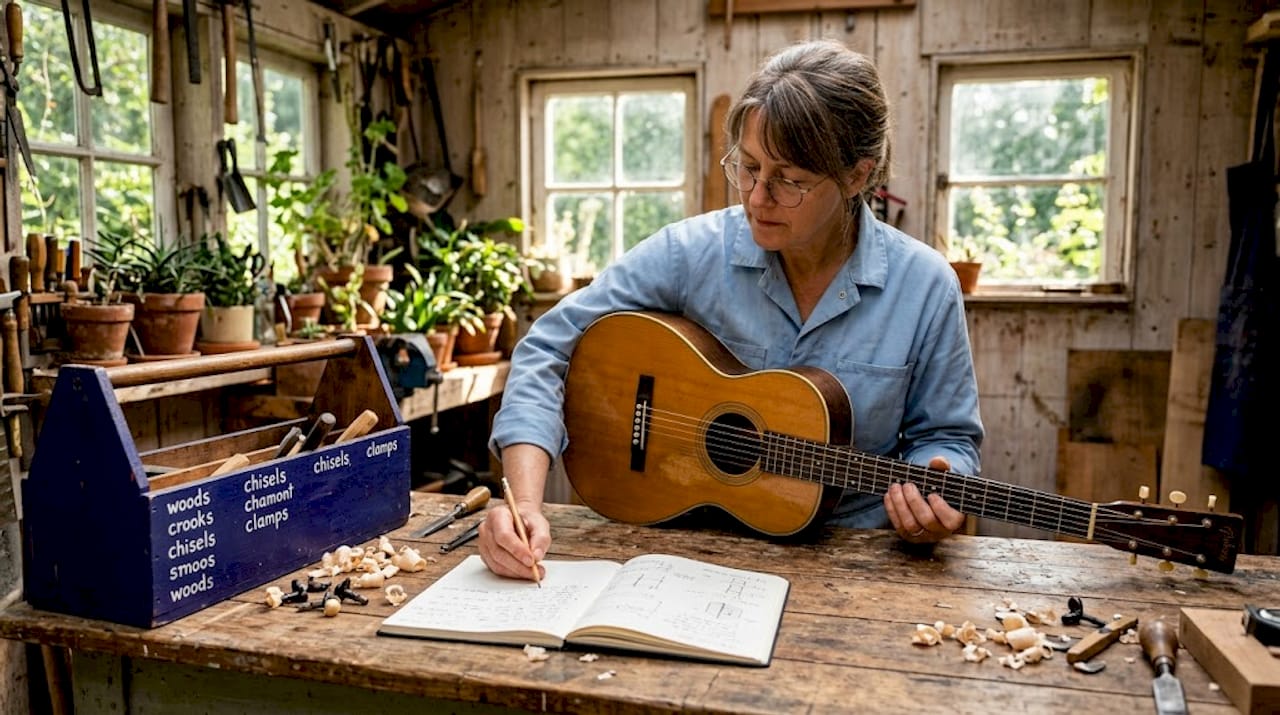
The materials used in a vintage guitar’s construction are not just about sound — they are about supply chain history, ecological shifts, and the decisions makers took during specific decades. Once you understand why certain woods are no longer available in the same form, you realize that original pre-war examples are genuinely irreplaceable.
Pre-war guitars are prized specifically for superior materials like Adirondack spruce and Brazilian rosewood that became unavailable or heavily restricted after World War II. Brazilian rosewood (Dalbergia nigra) was listed under CITES (the Convention on International Trade in Endangered Species) in 1992, effectively ending its use in new commercial guitar production. Instruments made before that restriction carry genuine scarcity value, not just vintage appeal.
| Material | Era of primary use | Why it matters for collectors |
|---|---|---|
| Brazilian rosewood | Pre-1970s (commercially), pre-WWII for finest examples | Restricted, unmatched tonal density, visual grain |
| Adirondack spruce | Pre-WWII tops | Stiffer than Sitka spruce, associated with pre-war projection |
| Sitka spruce | Post-WWII to present | Still quality, but less prized than Adirondack for top-tier collecting |
| Honduran mahogany | Pre-1960s primarily | Denser early stock vs. lighter later cuts |
| Celluloid nitrocellulose lacquer | Pre-1970s | Thin finish, ages distinctively, affects resonance differently than poly |
The appeal of handcrafted guitars goes hand in hand with these material considerations. Pre-war instruments were often built by small teams or individual craftsmen using techniques that required years of skill to master, with no CNC machinery and far less standardization than modern production.
When examining a vintage guitar for materials and build quality, look for:
- Top wood grain consistency: Tight, even grain lines on a spruce top indicate slow-growth timber prized for its resonance.
- Back and side figure: Brazilian rosewood has a characteristic rich, dark figure distinct from Indian rosewood used later.
- Finish aging patterns: Genuine nitrocellulose lacquer checks and crazes in a specific pattern over decades, unlike polyester finishes.
- Binding materials: Early ivoroid and celluloid binding yellows authentically; newer plastics behave differently under UV light.
- Bracing style: X-bracing scalloped by hand versus factory-cut braces tells you as much about era as the serial number does.
Provenance: When history meets the individual guitar
Now that you appreciate the role of materials and make, it’s time to discover how a guitar’s story — its provenance — can be an even bigger differentiator than all the material quality in the world.
Provenance means the documented history of who owned a guitar, where it was used, and what we can verify about its journey from the factory bench to the present day. It is the difference between believing a guitar was played on a famous recording and actually knowing it, with evidence that holds up to scrutiny.
The $14.5 million paid for David Gilmour’s Stratocaster was not for the guitar — it was for the guitar’s life. Every scratch, every photograph, every recording tied that instrument to a body of music that shaped a generation.
Artist-connected guitars command prices that seem irrational until you accept that buyers are purchasing documented cultural history in physical form. The guitar becomes an artifact, not just an instrument.
Pro Tip: Never accept provenance claims without supporting documentation. Photographs showing the exact guitar (matching hardware, wear patterns, and finish) with the claimed owner are a strong start. Performance footage, studio session logs, and repair shop records add further verification. A verbal claim from a seller — even a well-meaning one — is not provenance. It is a story.
Understanding provenance in collecting requires knowing that documentation quality falls on a spectrum. Rookie collectors often underestimate how much a fully documented guitar outperforms an undocumented one at resale, even when the instruments appear identical in every measurable specification. If you want to dig deeper into the fundamentals, learning what guitar provenance means before any major purchase will protect both your investment and your confidence in the collection you build.
Applying historical insight: Building a smarter collection
With the big-picture impact of history now clear, you’re ready to put this knowledge to work when acquiring your next guitar.
Follow these steps every time you evaluate a potential acquisition:
- Start with the serial number. Cross-reference it against factory records and known databases to establish the production year and plant location with confidence.
- Identify the model’s landmark status. Determine whether the production year falls within a historically prized window or near a known transitional change in design.
- Inspect materials firsthand. If possible, examine the guitar in person or have a trusted expert confirm the wood species, finish type, and hardware originality.
- Request all available documentation. Ask the seller for receipts, prior appraisals, old photographs, repair records, and any correspondence related to the instrument.
- Research comparable sales. Use auction archives and specialist platforms to understand what similar examples have fetched in the last two to five years.
- Factor in playability and condition honestly. A guitar with spectacular history but severe structural damage may carry emotional appeal while posing financial risk.
When reviewing a guitar’s documented background, keep these signals in mind:
Green lights:
- Factory shipping records matching the serial number
- Continuous ownership chain with dated receipts
- Period photographs showing the specific instrument
- Original case and accessories with matching wear
Red flags:
- Provenance based entirely on the seller’s verbal account
- Replaced or refinished components presented as original
- Serial number inconsistencies with known production records
- Unusually low pricing for a guitar claimed to have significant history
The signs of a collectible guitar and the ability to identify collectible features both depend on exactly this kind of systematic approach. It applies equally whether you are looking at a transitional Fender Telecaster from 1959 or a pre-war Martin with a production run that numbered in the single digits for a given year. The framework is the same; only the specific details change.
A collector’s perspective: Don’t let history overshadow discovery
Here is the perspective that most collecting guides skip: the romance of history can become a trap.
We have seen collectors spend years chasing a specific serial number range or a famous player’s verified instrument, only to pass over guitars that would have given them years of genuine joy and solid investment returns. The market for instruments with a famous name attached is also the most crowded and most susceptible to inflated pricing, because emotional demand outpaces rational valuation.
There is real value in the overlooked instrument. A regional session player’s verified 1960s workhorse, a small-batch factory guitar from a forgotten production run, or a luthier-built instrument with exceptional documentation but no celebrity pedigree can offer remarkable collector passion and meaningful appreciation over time.
The best collections we encounter are built by people who understood history deeply enough to know when to ignore it. They bought instruments that spoke to them — in sound, in feel, in the story they personally found compelling — and they did the documentation work to support their choices. History gave them a framework. Their own taste gave them a collection worth owning.
Do not let the pursuit of the objectively historic crowd out the personally meaningful. Your collecting knowledge should empower your judgment, not replace it.
Explore more and elevate your collection
Ready to take your collecting journey further? Here’s where you can deepen your expertise and discover one-of-a-kind instruments.
Whether you’re just starting to map out your focus area or actively searching for your next acquisition, grounding your decisions in verified knowledge pays dividends every time.

At Vintage Guitar World, we specialize in exactly the kind of instruments this guide covers: historically significant, expertly evaluated, and honestly documented. Explore our resources on types of vintage guitars to understand which categories fit your collecting goals, then sharpen your financial thinking with our guide to guitar valuation explained. When you’re ready to understand why scarcity matters as much as fame, our deep dive on guitar rarity and value will give you a framework you’ll use for every purchase from here forward.
Frequently asked questions
Does the year a guitar was made always determine its value?
No; while certain years and eras are historically prized, factors like provenance, materials, and condition all play crucial roles — a transitional 1959 Telecaster with the wrong bridge type can be worth far less than a generic example of the same year if key specifications differ.
Can a lesser-known vintage guitar ever be more valuable than a famous model?
Yes; rare specifications, unique production details, or strong provenance can make an obscure instrument extremely collectible, as seen with pre-war Martins where production ran to as few as 13 examples in a single year.
How do I research a guitar’s provenance?
Start with serial numbers, factory shipping records, and period catalogs, then seek photographs, performance footage, or repair shop receipts that verify artist association and ownership continuity.
Why are pre-war guitars considered holy grails by collectors?
Pre-war guitars used premium Adirondack spruce and Brazilian rosewood, materials that are now restricted or commercially unavailable, creating a combination of tonal quality and genuine scarcity that modern production cannot replicate.
Is collectible guitar value guaranteed to rise?
No; the vintage guitar market fluctuates based on cultural trends, economic conditions, and changing collector tastes, though historically significant models with strong documentation tend to hold their value better over long periods.