













TL;DR:
- Early electric guitars from the 1930s and 1940s are highly valued as rare, historically significant artifacts that shaped music technology. Their low production numbers, expert craftsmanship, and provenance make them prized among collectors, often surpassing postwar models in importance. Proper evaluation relies on authenticity, detailed provenance, and understanding their unique construction, which adds to their investment appeal.
Most collectors assume that 1950s Gibsons and Fenders represent the pinnacle of vintage electric guitar value. That assumption leaves serious money and history on the table. The instruments built in the 1930s and 1940s, from the Rickenbacker Frying Pan to the Gibson EH-185, occupy a different tier entirely: museum-grade artifacts that shaped how electricity and music merged for the first time. Understanding what makes these earlier electrics extraordinary requires looking at their origins, their construction, and the stories attached to them.
Table of Contents
- The origins of electric guitar collectability
- Craftsmanship and innovation: Why build quality matters
- Historical significance and provenance: The story behind the sound
- Rarity and investment appeal: Supply, demand, and legacy
- Our perspective: What most collectors overlook about early electrics
- Ready to explore or invest in early electric guitars?
- Frequently asked questions
Key Takeaways
| Point | Details |
|---|---|
| Historical foundation | Early electrics like the Gibson EH-185 laid the groundwork for modern guitars and are valued as artifacts. |
| Craftsmanship matters | Premium materials and unique construction set early electric guitars apart for collectors. |
| Provenance impacts value | The story, previous owners, and era for each guitar can dramatically boost desirability and price. |
| Rarity increases worth | Limited production and survival rates mean early electrics remain elite investments. |
| True collector insight | Going beyond appearance or trends reveals the real long-term value in early electric guitars. |
The origins of electric guitar collectability
The electric guitar history does not begin in the late 1940s with Leo Fender. It begins in 1931, when Adolph Rickenbacker and George Beauchamp introduced the “Frying Pan,” a lap steel guitar with an electromagnetic pickup built into its aluminum body. That single instrument rewrote what was possible in popular music. It proved that a guitar could project its sound through an amplifier without the acoustic chamber that had defined stringed instruments for centuries.
Within a decade, Gibson entered the electric market with instruments like the EH-150 and the EH-185. These were not experiments. They were fully realized products built with the same attention to detail Gibson applied to its acoustic archtops. The EH-185, produced between 1939 and the early 1940s, featured figured maple construction, double binding, and a Hyblum metal core inside the body that improved sustain in a way no purely wooden instrument could replicate. Its under-string pickup design was an engineering solution that would influence pickup development for decades.
What makes these models especially compelling for collectors today is their survival rate. Production numbers for 1930s and 1940s electrics were extremely small compared to postwar instruments. Wartime material restrictions cut into manufacturing capacity. Many instruments from this era were lost, damaged, or cannibalized for parts. A genuine, intact EH-185 in playable condition is genuinely rare in a way that even a 1959 Les Paul Standard is not.

| Model | Production era | Approximate units produced | Current known survivors |
|---|---|---|---|
| Rickenbacker Frying Pan | 1931 to 1939 | Under 1,000 | Fewer than 100 confirmed |
| Gibson EH-150 | 1936 to 1942 | Several hundred per year | Low hundreds |
| Gibson EH-185 | 1939 to 1943 | Limited run | Extremely rare |
| Epiphone Electar | 1935 to 1940s | Small batches | Very few |
These numbers tell a critical story. When you encounter a working, original 1930s electric guitar, you are holding one of the last surviving examples of an entire chapter in music technology. That scarcity alone drives collector demand and pricing well beyond what condition or playability alone could justify.
Key reasons early electrics attract serious collector attention:
- Extremely low production numbers relative to postwar guitars
- High attrition rate due to wartime material shortages and abandonment
- Foundational role in establishing electric guitar technology
- Unique construction materials and methods unavailable in later instruments
- Museum and institutional interest that competes with private collectors for surviving examples
Craftsmanship and innovation: Why build quality matters
Understanding the origins leads us to what truly sets these instruments apart in the eyes of discerning collectors: the unparalleled craftsmanship and technical ingenuity embedded in every detail.
Early electric guitars were not built on modern production lines. They were hand-assembled by luthiers who were solving problems in real time. The makers had no established playbook for how an electric guitar should feel, balance, or respond under a player’s hands. Every decision, from the choice of tonewoods to the routing of internal wiring, was a judgment call made by skilled craftspeople working at the edge of what was technically possible.
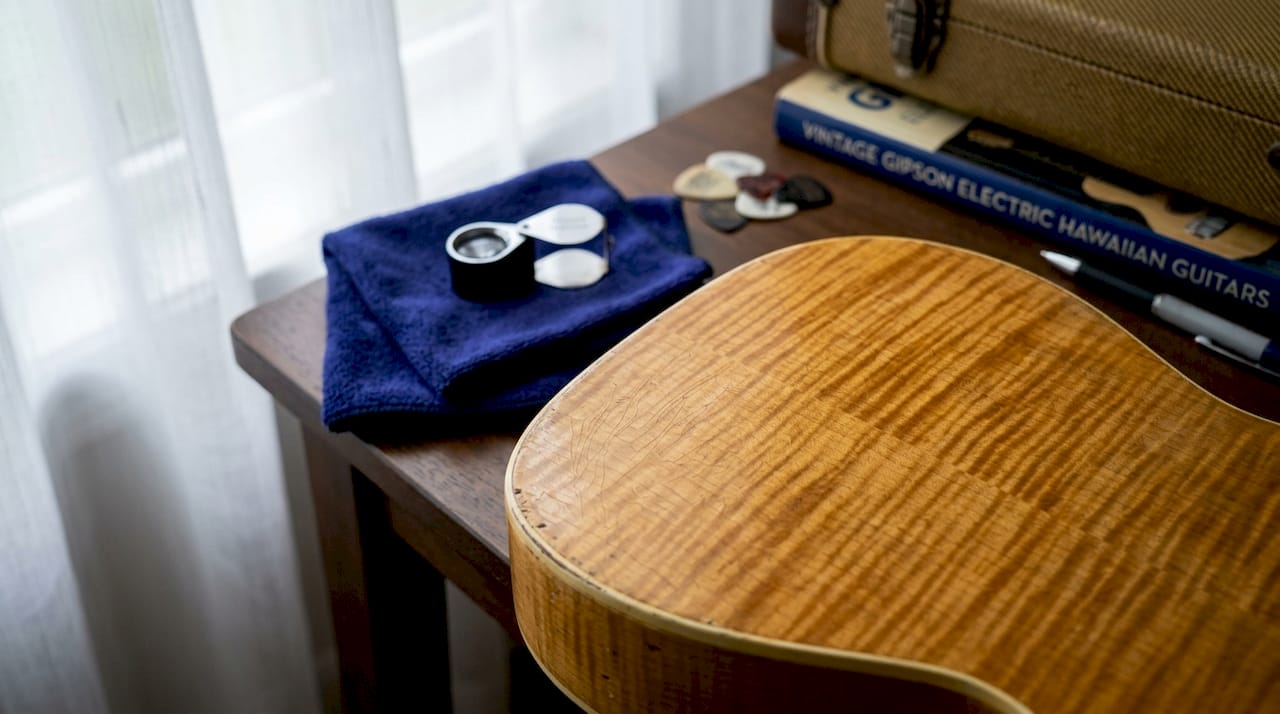
Take the Gibson EH-185 again. Its premium craftsmanship includes a figured maple top selected for both visual appeal and tonal properties. The double binding around the body edges reflects the same finishing standards Gibson applied to its best acoustic instruments, which cost far more to produce than basic models. The Hyblum metal core, an internal aluminum alloy insert, was a genuine engineering innovation designed to add mass and sustain to what would otherwise be a relatively thin-bodied instrument. These are not cosmetic details. They are structural decisions that affect how the instrument behaves under amplification.
| Feature | 1930s to 1940s electrics | Post-1950s production electrics |
|---|---|---|
| Body construction | Hand-fitted, individual selection | Increasingly standardized |
| Tonewoods | Premium figured maple, selected cuts | Mix of grades depending on model |
| Pickup design | Custom wound, experimental | More standardized specifications |
| Binding and finishing | Thick, multi-layer, hand-applied | Thinner, more uniform |
| Internal components | Experimental metal cores, custom hardware | Established materials and specs |
Modern replicas simply cannot reproduce the material conditions of the 1930s and 1940s. Old-growth figured maple of the quality Gibson used in that era is no longer commercially available at scale. The manufacturing knowledge embedded in the handwork of those instruments took decades to develop and was never fully documented. When a craftsman retired or a factory changed ownership, that knowledge often disappeared with them. This is part of why originals command such strong interest: they cannot be truly replicated, only approximated.
Pro Tip: When evaluating an early electric for purchase, look closely at the binding edges and the finish around any hardware cutouts. Hand-applied binding often shows slight irregularities in width or depth that machine-applied binding does not. These “imperfections” are actually evidence of authenticity.
The electronics in these instruments also carry significant weight in the collector conversation. Early pickups were wound by hand, which introduced natural variation in output, tone, and frequency response from one instrument to the next. Two EH-185 guitars built in the same month at the same factory would sound noticeably different from each other. That sonic individuality is something modern manufacturing specifically tries to eliminate. For collectors who also play, this variation is part of the appeal. No two instruments from this era are truly identical, which connects to the broader question of why old guitars are valuable beyond their historical status alone.
Historical significance and provenance: The story behind the sound
Beyond how these guitars are built, who owned them and the cultural moment they emerged from can define their market appeal entirely.
Provenance refers to the documented history of an object: where it has been, who owned it, and how it connects to significant events or people. In the world of postwar vintage guitars, provenance matters. In the world of pre-1950s electrics, it can be the single most important factor in determining value. A 1939 EH-185 with no documented history is a rare artifact. The same guitar with documentation linking it to a recording session, a named player, or a specific venue from the era becomes something else entirely.
“While 1950s Gibsons and Fenders dominate the player-collector market for tone and playability, 1930s pioneers like the Frying Pan and EH-185 are museum-grade historical artifacts; some collectors prioritize ‘mojo’ or provenance over perfect condition.”
This perspective from experienced collectors reflects a fundamental truth about the pre-1950s market. Condition still matters, but it is not the whole story. A guitar with original finish wear consistent with regular use, original tuning machines, and a cracked headstock that has been professionally repaired may be worth significantly more than a “mint” example if the worn one carries documented provenance from a key player or historical moment.
Here is a practical guide to researching and verifying an early electric’s story:
- Start with the serial number. Many 1930s and 1940s Gibson instruments carry serial numbers that Gibson’s factory ledgers partially document. Cross-reference with published databases from reputable vintage guitar research sources.
- Examine original case contents. Old case candy, including original fingerpicks, instruction sheets, or even receipts tucked into the case lining, can provide powerful supporting evidence of unbroken ownership history.
- Research the manufacturing features. Each year of production for key models had specific hardware variations. Knowing which tuner style, which pickup winding specifications, or which binding profile Gibson used in 1939 versus 1941 helps confirm whether the instrument is genuine and matches its claimed date.
- Seek expert appraisal from specialists in pre-war instruments. General vintage guitar dealers may not have deep familiarity with 1930s production details. Specialists in this specific era are essential for high-stakes purchases.
- Trace ownership through estate sales, auction records, and collector networks. The vintage guitar community is smaller and more connected than outsiders assume. Instruments often have traceable histories through auction house records going back decades.
Pro Tip: Always ask the seller for photos of the guitar’s interior through the sound hole or any existing openings. Original labels, date stamps, and inspector’s marks inside the body are difficult to fake and can confirm manufacturing authenticity in a way that exterior features alone cannot.
Learning about guitar provenance value before you buy is not just due diligence. It is the difference between acquiring an investment and acquiring an expensive mistake.
Rarity and investment appeal: Supply, demand, and legacy
While provenance defines the story, a guitar’s rarity often cements its reputation as a blue-chip collectible.
The supply side of the equation for 1930s and 1940s electrics is essentially fixed. No new examples are being made. No warehouse of unplayed EH-185 guitars will surface in a storage unit. Every surviving instrument from this era is one of a finite pool, and that pool shrinks as examples are damaged, destroyed, or absorbed into institutional collections. Meanwhile, collector interest in pre-war American manufacturing across categories from watches to cameras to musical instruments has grown steadily over the past two decades. That growing demand pressing against a fixed and shrinking supply creates a structural pressure on prices that has historically favored patient, knowledgeable collectors.
Some collectors prioritize the intangible quality of “mojo” over measurable condition metrics, and in the pre-war electric market this instinct often proves financially sound. Instruments with honest wear and full original hardware frequently appreciate faster than over-restored examples, because serious collectors understand that a sympathetic re-fret is acceptable while a refinished body destroys much of the historical record.
Key factors that drive investment value in early electrics:
- Fixed and shrinking supply with no new production possible
- Growing collector interest in pre-war American craftsmanship
- Institutional competition from museums and university collections
- Cross-category appeal to both guitar collectors and broader music history enthusiasts
- Strong auction performance at major houses including Christie’s and Julien’s
Consulting a vintage guitar value guide before entering the market gives you a realistic baseline. Without that context, it is easy to overpay for a common later model while undervaluing a genuinely rare pre-war instrument you encounter.
The pitfalls in this market are real. Reproductions of early electrics exist, though they are generally less convincing than fakes of more valuable postwar models. The greater danger is misidentification: paying pre-war prices for a late-1940s or early-1950s model that shares visual characteristics but lacks the manufacturing details of the true pre-war era.
Our perspective: What most collectors overlook about early electrics
We have spent considerable time with collectors who know their 1959 burst from their 1960 burst, who can identify a correct-spec late-1950s PAF pickup by weight and pull. These are skilled, knowledgeable people. And many of them have almost no familiarity with the instruments that made the 1959 Les Paul possible in the first place.
The market for pre-war electrics is still genuinely undervalued relative to what these instruments represent historically. A museum-quality 1939 Gibson EH-185 in original condition routinely sells for a fraction of what a comparable postwar Gibson archtop commands, despite being rarer, older, and more historically significant. Part of this is the player-collector dynamic: postwar guitars can be used on stage, which creates a much larger potential buyer pool. Pre-war electrics attract a more specialized audience, and that has kept prices lower than their historical importance justifies.
This is changing. As the pool of affordable 1950s and 1960s collectibles continues to shrink and prices for “entry-level” vintage Gibsons and Fenders climb beyond what casual collectors can access, serious money is moving earlier. Collectors who recognize the influence of early electrics on everything that followed are positioning themselves in a market that the broader collecting world has not yet fully priced.
Our honest advice: do not collect early electrics purely as a financial strategy. These instruments reward genuine curiosity about music history and craftsmanship. The collectors who do best over time are the ones who develop deep knowledge of the specific models they pursue, not the ones chasing generic “vintage value.” Learn the manufacturing details, study the production history, and build relationships with the small community of specialists who truly understand this era. That knowledge is worth more than any valuation guide.
Ready to explore or invest in early electric guitars?
If reading this has shifted how you think about pre-war instruments, you are already ahead of most of the market. At Vintage Guitar World, we specialize in exactly the kind of curated, expertly evaluated instruments that this level of collecting demands.

Our team evaluates every instrument for historical accuracy, originality, and condition before it reaches our platform. Whether you are building a serious collection or simply want to own a piece of the moment electricity first met the guitar, we can guide you. Explore our resources on vintage guitar types and history to deepen your understanding, or visit our collection and see why we love vintage guitars as much as you do. The right instrument is out there, and knowing what you are looking for makes all the difference.
Frequently asked questions
What makes an early electric guitar more valuable than a newer vintage model?
Early electric guitars are valued for their historical innovation, unique craftsmanship, and extreme rarity, with instruments like the EH-185 featuring figured maple, double binding, and pioneering pickup designs that postwar production guitars simply did not replicate.
How do collectors verify the authenticity of early electric guitars?
Collectors rely on provenance documents, period-correct manufacturing details, interior date stamps, and specialist appraisals, since provenance over condition is often the deciding factor in authentication decisions for pre-war instruments.
Is condition more important than history and ownership when valuing early electrics?
No. Many serious collectors place original hardware, honest wear, and documented history above pristine cosmetic condition, because mojo and provenance signal authenticity and unbroken ownership in ways a refinished or over-restored guitar cannot.
Are 1930s and 1940s electrics good investments for new collectors?
They can be strong long-term investments because their historical status and rarity create structural upward price pressure, but museum-grade artifacts from this era require expert guidance to evaluate and authenticate correctly before purchase.